
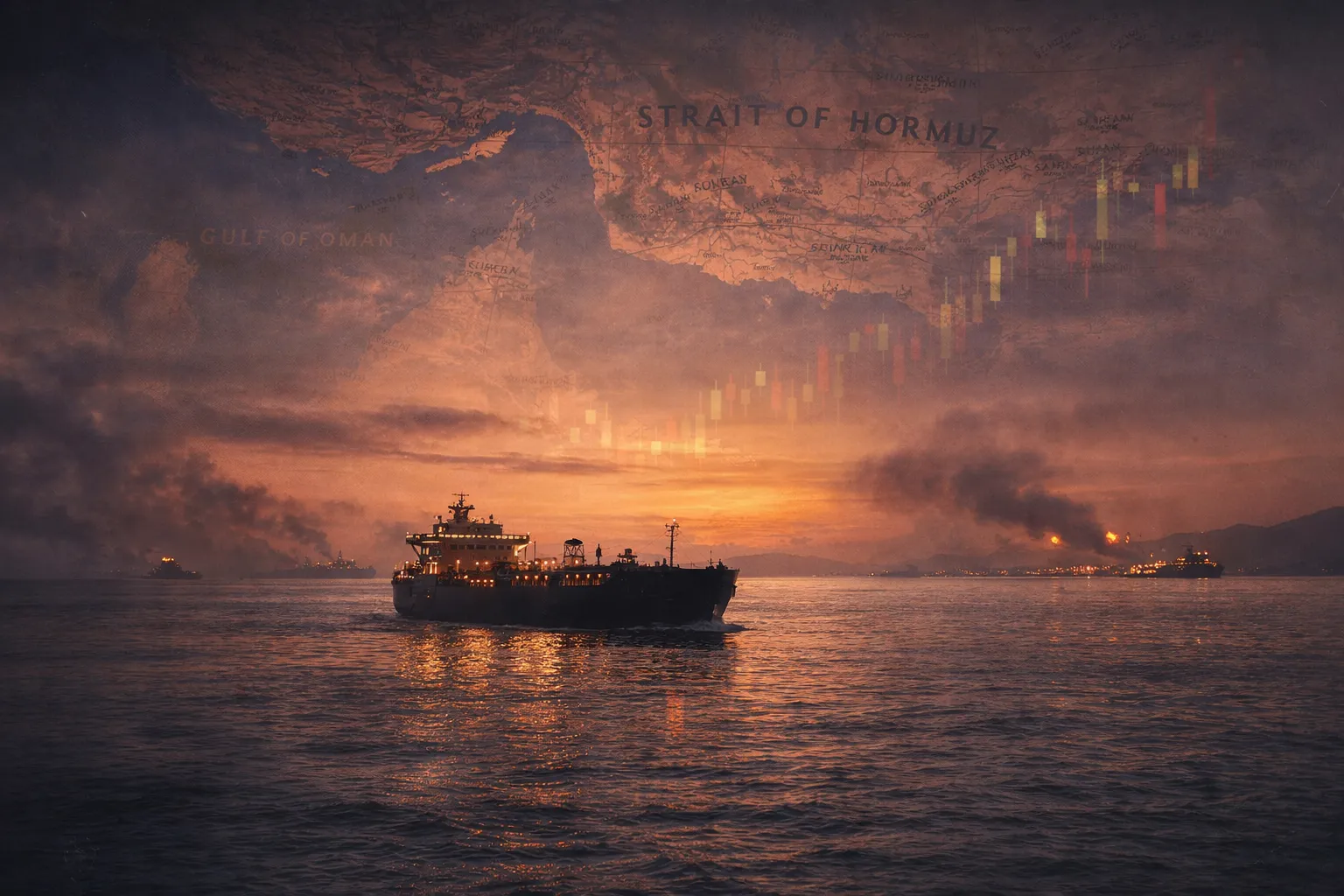
The world is running out of time at Hormuz. From oil prices to Dalal Street, the fallout has already begun — and the next phase could be worse.
Time is running out at Hormuz, and the war is entering a phase far more dangerous than the missile exchanges that defined its first three weeks. As Donald Trump’s deadline for reopening the strait nears expiry, Iran is threatening escalation across Gulf infrastructure, Israel is pressing ahead with major strikes, and markets from oil to Dalal Street are already reacting to fears that the conflict could spill beyond the battlefield and into the arteries of the global economy.
That shift matters because the war is no longer just about military pressure. It is now about leverage over one of the most important energy chokepoints on earth. The Strait of Hormuz is not an abstract map label or a strategic cliché. It is the narrow corridor through which a huge share of the world’s oil and gas moves every day. When tensions there rise, the impact is felt far beyond the Gulf — in freight costs, fuel prices, currencies, consumer confidence, and the mood of financial markets.
Trump’s message raised the stakes
Trump’s message was not one of restraint. He issued a 48-hour ultimatum for Iran to fully reopen the Strait of Hormuz, warning that otherwise the United States would “obliterate” the country’s power plants. In doing so, he turned a military confrontation into an energy ultimatum — one that now threatens to drag oil markets, shipping lanes, and regional infrastructure deeper into the conflict.
There is a difference between battlefield escalation and economic escalation. Missiles and airstrikes can still be seen as part of a war already underway. But once leaders begin threatening the systems that keep electricity flowing, ports functioning, and tanker traffic moving, the risk profile changes completely. At that point, the conflict is no longer contained by geography. It starts reaching into homes, fuel bills, import costs, airline prices, and the political calculations of governments far from the front line.
Iran’s response was just as stark
Tehran answered Trump’s ultimatum with a threat designed to alarm far beyond Iran’s borders. Iranian officials and Revolutionary Guards figures warned that if the United States strikes Iran’s power infrastructure, the Strait of Hormuz will remain shut and retaliation could expand across the Gulf. They also signalled that desalination plants, refineries, and other sensitive infrastructure in countries hosting US forces could come under attack.
That is what makes this moment so unstable. Neither side is merely threatening the other’s military assets. Both are now talking openly about infrastructure that sustains daily life and economic continuity. In a region already living under the strain of war, that is a chilling signal. It suggests that the next phase may not be defined only by visible explosions, but by the deliberate targeting of systems ordinary people depend on.
Why Hormuz matters so much
Every crisis produces one place where the pressure becomes unbearable. Right now, that place is Hormuz. Roughly a fifth of the world’s oil passes through the strait, making it one of the few locations on the map where military tension can very quickly become a global economic emergency. Even the fear of prolonged disruption is enough to shake markets. A real and sustained closure would be worse: it would hit shipping flows, push up insurance costs, tighten supplies, and revive inflation at a moment when many economies are already fragile.
That is why the language around Hormuz matters so much. This is not just rhetoric for domestic audiences. Traders hear it. Importers hear it. Central banks hear it. Governments hear it. And once enough people start pricing in the possibility of disruption, the economic damage begins before the full military one does.
India is already feeling the pressure
For India, this is not a distant geopolitical spectacle. It is rapidly becoming an economic stress test. The country remains deeply exposed to Gulf energy flows, and that exposure is now showing up across the market. The rupee has hit a record low. Equities have come under pressure. Investors are again worrying about imported inflation, a wider current account strain, and the possibility that higher oil prices could wash into everything from transport costs to household spending.
That is why Dalal Street reacted so sharply. The selloff was not just about headlines from the Middle East. It was about what those headlines mean for India’s balance sheet. Expensive oil has a way of travelling quickly through the system. It hits the currency, corporate margins, aviation, logistics, and sentiment all at once. For ordinary Indians, the anxiety is simpler: when oil becomes unstable, life becomes more expensive.
Readers who want the broader market context can also see how earlier regional shocks fed into the defence and risk trade in our analysis of the US-Iran war’s market impact on defence stocks and our deeper look at how Middle East war tensions affect Indian defence stocks.
Oil, gold and fear are moving together
The anxiety is not confined to India. Oil has surged as traders weigh the possibility of a prolonged disruption in the Gulf. Gold has climbed as investors look for safety. Risk assets remain under pressure because the fear is no longer theoretical. If Hormuz stays shut — or even partially disrupted for a meaningful period — the result could be a fresh inflation shock at a time when major economies are already dealing with weak demand, heavy debt, and volatile capital flows.
There is also a psychological element here that markets rarely ignore. Energy shocks revive memories of past crises very quickly. They remind investors how fast confidence can break when supply chains, fuel costs, and geopolitical risk start colliding at the same time. Once that mood takes hold, volatility feeds on itself.
The battlefield is still getting hotter
On the military front, there is still no convincing sign of de-escalation. Iranian missile strikes near Dimona exposed renewed pressure on Israel’s air-defence shield, while Israel has continued major strikes on Iranian military and research-linked targets. The war is not cooling as the diplomatic and economic stakes rise. It is intensifying.
That matters because markets can absorb bad news more easily than strategic uncertainty. What they struggle with is a war that keeps widening while the red lines keep shifting. A single strike can be explained. A pattern of escalation around energy infrastructure, shipping lanes, and sensitive military sites is far harder to digest calmly.
What the world is watching now
The immediate question is whether either side still has room for restraint. If Iran refuses to back down and Washington follows through on its threat to hit power infrastructure, the conflict could move from missile warfare into a direct assault on the systems that keep the Gulf’s energy economy functioning. That would not just deepen the war. It would multiply its consequences for oil importers, shipping firms, financial markets, and governments already struggling to contain inflation and public anxiety.
The next question is whether the damage can still be ring-fenced. History offers little comfort on that front. Once energy insecurity becomes part of a live war, spillover is hard to control. Prices move first. Then political pressure builds. Then every leader starts asking the same question: how much worse can this get?
At this point, the danger is no longer confined to the battlefield. It is moving through tankers, currencies, stock markets, and the nerves of every economy that depends on Gulf energy. What happens at Hormuz in the coming hours will not stay at Hormuz.
Further reading:
- Indian Defence Stocks: Ultimate Guide
- Indian Defence Stocks: Sector Outlook
- How Middle East Tensions Affect Indian Defence Stocks
- US-Iran War: Market Impact and Defence Stocks
External sources: