
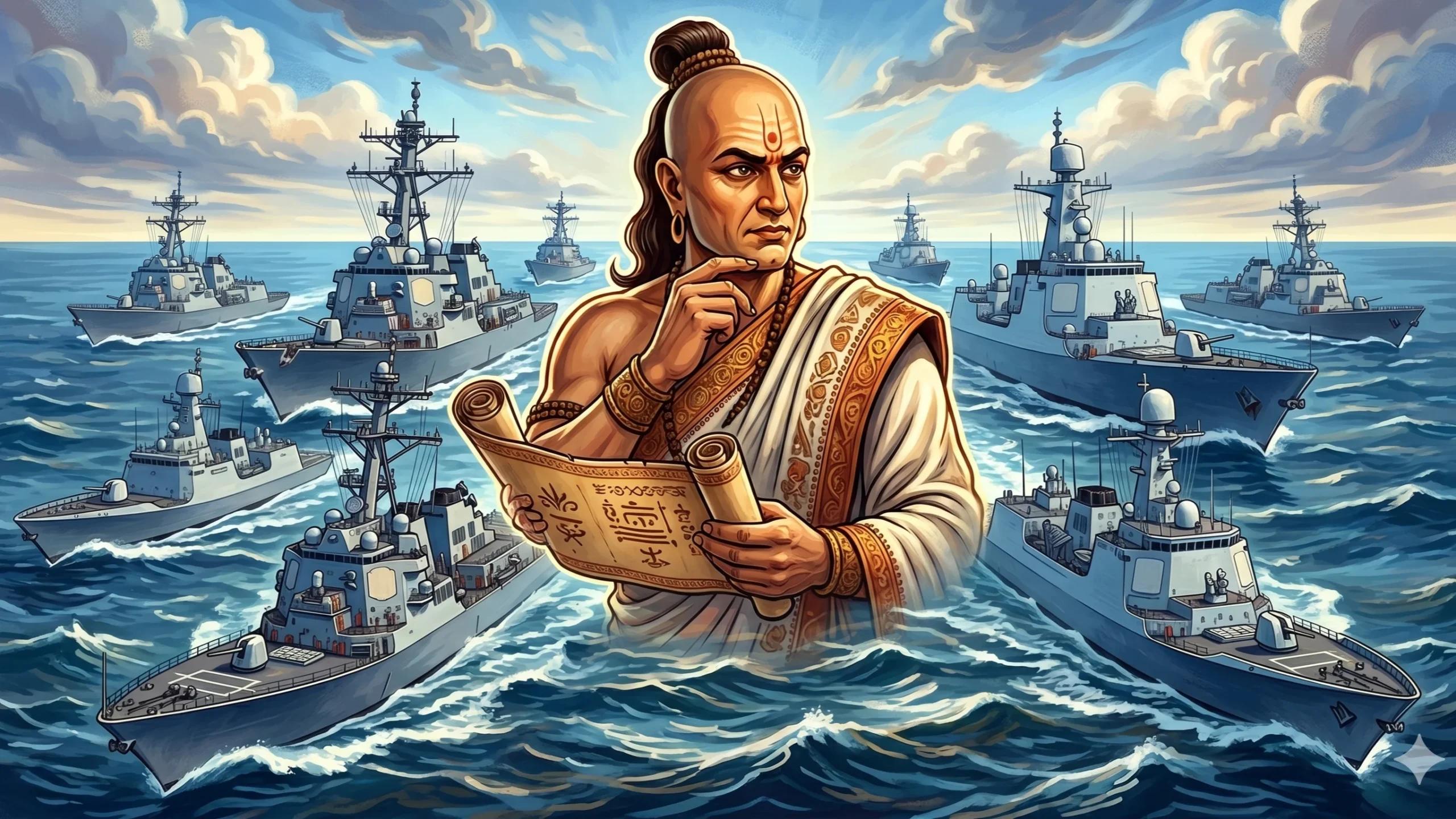
The Ancient Secret to Ending Modern Wars: Why the World Must Listen to Chanakya Today
Introduction
In 1993, I sat in a room in Cambodia with commanders of the Khmer Rouge. These were men who had ordered the deaths of thousands. The air in that room carried the weight of everything that had happened before I arrived. My task, as part of India’s UN peacekeeping mission, was to find a way to secure their surrender. What finally worked was not force, not threats, and not ultimatums. It was a principle written by an Indian scholar 2300 years earlier in a text that most of the world has forgotten and India has not yet fully reclaimed.
That text is the Arthashastra. Its author is Chanakya, also known as Kautilya or Vishnugupta, the fourth-century BCE strategist who built the Maurya Empire from nothing and documented every lesson he learned in a framework so precise and complete that nothing written since has genuinely surpassed it. Today, as the world watches the US-Iran war enter its 56th day, oil prices breach $106 a barrel, and President Trump orders the US Navy to “shoot and kill” any Iranian boats laying mines in the Strait of Hormuz (NPR, April 5, 2026), the Arthashastra is not silent. It is speaking with the calm authority of a man who saw all of this coming long before any of us were born. India would do well to listen.
A Civilisation That Has Outlasted Every Conqueror
Before examining what Chanakya prescribes, it is worth understanding why Iran matters in this equation beyond the immediate crisis. Iran is not a modern state with a short memory. It is one of the world’s oldest continuous civilisations, heir to the Achaemenid, Parthian, and Sassanid empires, each of which survived conquest and rebuilt itself every time. This civilisational resilience is not incidental. It is structural. Iran has faced the armies of Alexander the Great, the Arab conquest, the Mongol invasion, and the brutal eight-year war with Iraq from 1980 to 1988, and it has endured every one of them.
The United States has a history of underestimating this resilience. In 1988, the US Navy established a naval blockade of Iranian waters during Operation Praying Mantis, destroying Iranian oil platforms and sinking several of its vessels. The confrontation did not break Iran. In June 2025, the United States carried out direct military strikes on Iranian nuclear and military infrastructure in coordination with Israel. Iran responded by closing the Strait of Hormuz, triggering the global energy crisis the world is managing today. The pattern of escalation without resolution is not new. Chanakya, who studied this pattern across hundreds of kingdoms over a lifetime, left very clear instructions about what it produces.
The idea of Greater Israel, the expansionist vision held by certain segments of Israeli political leadership that envisions Israeli sovereignty stretching from the Nile to the Euphrates, adds another dimension to this conflict that Chanakya would have recognised immediately. A state pursuing territorial maximalism while simultaneously fighting on multiple fronts, in Gaza, Lebanon, and now Iran, is a state that has ignored the most fundamental warning in the Arthashastra. No kingdom can sustain simultaneous wars on all its borders. The treasury depletes, the army exhausts, and the alliances fracture. This is not commentary. This is the documented Chanakyan principle, observed across centuries of statecraft.
Rajamandala — The Circle That Explains Everything
Chanakya’s foreign policy rests on one foundational insight: that the relationships between nations follow predictable, recurring patterns driven not by ideology but by geography, resources, and human nature. He called this framework Rajamandala, the Circle of Kings, and wrote in the Arthashastra, Book 6, Chapter 2:
अरिमित्रामित्रमध्यमोदासीनाः पञ्च प्रकृतयः
Hindi: “शत्रु, मित्र, शत्रु का मित्र, मध्यम राजा और तटस्थ — ये राज्यों के बीच पाँच स्वाभाविक संबंध हैं।”
English: “The enemy, the friend, the enemy’s friend, the middle king, and the neutral — these are the five natural relationships between states.”
— Kautilya, Arthashastra, Book 6, Ch. 2; Olivelle, P., 2013, King, Governance, and Law in Ancient India
The United States and Iran are not natural enemies by geography or civilisational history. They have been drawn into sustained conflict by the strategic calculations of third parties whose interests are served by maintaining that enmity. Israeli Prime Minister Benjamin Netanyahu stated publicly that the war with Iran is “not over” even as ceasefire talks were being proposed, a signal widely interpreted as a message to Washington to maintain military pressure (CounterPunch, April 24, 2026). Chanakya mapped this dynamic with mathematical precision 2300 years ago. Your neighbour is your natural rival. Your neighbour’s neighbour is your natural ally. When nations forget this circle, they create conflicts that serve no one but themselves.
In my years on the Line of Control, this principle operated every single day. The real contest was never only between the two parties facing each other across the fence. There was always a larger circle turning quietly around them, and the soldier who forgot that circle was the one who made the fatal miscalculation.
Kosha Mula Danda — Geography as the Ultimate Weapon
From the Line of Control to the Strait of Hormuz, geography has always been the most powerful weapon available to a strategist. Chanakya understood this before anyone else articulated it systematically, and he wrote in the Arthashastra, Book 2, Chapter 1:
कोशमूलो दण्डः
Hindi: “राज्य की सैन्य शक्ति का मूल उसका कोष अर्थात् आर्थिक सम्पदा है।”
English: “The treasury is the root of all sovereign power.”
— Kautilya, Arthashastra, Book 2, Ch. 1; Rangarajan, L.N., Ed. and Trans., 1992
Iran closed the Strait of Hormuz, one waterway, twenty one miles wide at its narrowest point, and the entire global economy shook. Brent crude breached $106 a barrel (Al Jazeera, April 24, 2026). Supply chains fractured across continents. The Strait of Hormuz became a battleground destabilising global energy supply chains and threatening roughly one fifth of the world’s energy infrastructure (CounterPunch, April 24, 2026).
We held Siachen not because it was beautiful but because whoever commands the high ground commands everything below. Iran’s closure of the Strait of Hormuz is the same principle applied to water. One piece of geography, total strategic leverage, and a global economy held hostage by a single decision. Chanakya documented this principle not as theory but as observed fact across kingdoms whose names the world has long forgotten.
Shatru Nasha — The Unresolved Enemy Always Returns
Bestselling author Ashwin Sanghi, writing in his Times of India column Chanakya’s Chant on April 14, 2026, cited directly from the Arthashastra to illuminate the current crisis: “I shall create troubles in his fort… cause him to sustain heavy loss of men and money… sow the seeds of dissension among his friends… cut off supplies and stores going to him… and compel him to make peace with me on my own terms.” (Sanghi, 2026) This is not a description of ancient warfare. It is a precise description of economic sanctions, cyber operations, and strategic supply disruption being deployed in the Middle East today.
Chanakya prescribed the correct sequence of instruments in the Arthashastra, Book 9:
तस्माद् अशस्त्रः पश्येद् दण्डम्
Hindi: “इसलिए बुद्धिमान राजा शत्रु पर साम, दाम, भेद और दण्ड का प्रयोग इसी क्रम में करे, और दण्ड को सदा अंतिम उपाय माने।”
English: “Therefore, the wise king applies Sama (conciliation), Dama (incentive), Bheda (division), and Danda (force), always in that order, with force being the last resort.”
— Kautilya, Arthashastra, Book 9; Shamasastry, R., Trans., 1915
Trump declined to give any timeline on ending the war, saying simply “Don’t rush me” (CNN, April 23, 2026). The administration simultaneously demanded the surrender of enriched uranium that would not exist had it not abandoned the Joint Comprehensive Plan of Action in its first term (CounterPunch, April 24, 2026). Danda was deployed before Sama was genuinely attempted. The result, exactly as Chanakya predicted, is a conflict that grows harder and more expensive to resolve with every passing week.
In Cambodia in 1993, the breakthrough came not from pressure but from finding the one thing that even men hardened by decades of atrocity still cared about, which was their people, their legacy, and their place in history. That is Sama. It is the instrument being ignored in the Middle East today, and its absence is costing the world more than anyone is willing to calculate publicly.
Chanakya’s Vision and Its Relevance to Ending This War
Chanakya writes in the Arthashastra, Book 6:
अरिजयः कृतप्रतीकारः
Hindi: “राजा को सदा अपने शत्रु के प्रति सतर्क रहना चाहिए और समय पर उचित सुरक्षात्मक उपाय करने चाहिए।”
English: “A king should remain watchful of his enemy and take timely, measured steps to safeguard himself.”
— Kautilya, Arthashastra, Book 6; Olivelle, P., 2013, p. 244
This counsel does not mean aggression. It means strategic clarity combined with disciplined restraint. For the world today, Chanakya’s vision points toward four clear prescriptions:
- An immediate return to Sama: Trump made a “moral request” asking Iranian officials not to execute women protesters as part of ongoing negotiations (CNN, April 23, 2026), a small signal of Sama buried beneath weeks of Danda. That instinct must become the primary strategy rather than an occasional footnote. Every party must find the shared ground that makes sustainable peace possible.
- Protection of the Kosha on all sides: Every nation involved in this conflict is depleting its treasury—financial, human, and moral. Former US Ambassador to Bahrain Adam Ereli warned that the pressure campaign could outlast both Trump’s patience and American public support (Al Jazeera, April 24, 2026). A depleted Kosha on either side does not produce peace; it produces desperation, and desperate kingdoms make catastrophic decisions.
- An honest reading of the Rajamandala: Every nation currently involved must ask who actually benefits from continued conflict. The answer will reveal the third-party interests that have shaped this war from its inception and that continue to resist every genuine off-ramp.
- The maintenance of strategic patience (especially for India): India’s studied neutrality in this conflict is not absence or indifference. It is the most Chanakyan position any nation could hold at this moment. While the world exhausts itself in escalation, Bharat is accumulating the strategic credibility and moral authority that will matter most in the world order that emerges after this war ends. Chanakya called this the wisdom of the Udasina, the neutral power that watches, waits, and shapes the peace.
Conclusion
Chanakya did not write the Arthashastra for kings alone. He wrote it for every human being who has ever faced an enemy, protected something precious, or tried to build something that would outlast them. Three principles from the Arthashastra that every leader, whether in a boardroom, a classroom, or a country, can apply today: Know your real Shatru. Guard your Kosha. Practice Sama before anything else.
The world is watching a war that an Indian genius predicted 2300 years ago with the calm certainty of a man who had studied human nature long enough to know that it never truly changes. The ancient secret to ending this war was never hidden. It was always written. We simply need the wisdom to read it and the courage to act on it before the cost of ignoring it becomes irreversible.