
38 Days Over Iran: What Operation Epic Fury Won — and Left Unsettled
The U.S.-Israeli air campaign killed a Supreme Leader, sank a navy, and cost $25 billion. It did not produce a peace deal.
WASHINGTON / DUBAI — At 1:15 a.m. EST on February 28, 2026, U.S. Central Command launched Operation Epic Fury under direct presidential orders. Within the first twelve hours, roughly 900 joint U.S.-Israeli strikes had killed Supreme Leader Ali Khamenei and dozens of senior commanders. Iran’s central government went into immediate paralysis. The war had started. No one had an agreed plan for how it would end. (Follow all TES coverage of the Iran conflict →)
By April 8 — 38 days later — Tehran accepted a ceasefire and agreed to reopen the Strait of Hormuz. The White House declared victory. Iran’s navy was gone. Its missile factories were rubble. Its ballistic missile launch rate had fallen by over 86 percent from peak. Secretary of War Pete Hegseth said Iran had “begged for this ceasefire.” What Hegseth did not say was what comes next.
As of May 1, 2026, ceasefire negotiations continue in Islamabad. The U.S. naval blockade remains in place. Iranian mines and fast-attack boats still harass Gulf shipping. The Iranian regime, badly degraded, has not collapsed — and no successor political order has been put forward by Washington or anyone else.
How It Started
The conflict did not materialize overnight. According to the U.S. State Department’s legal justification published in April, Washington made multiple attempts at negotiation — in early 2025 and again in late 2025 — before concluding diplomacy had run its course. Iran’s accelerating nuclear program, its drone and missile buildup, and the continued proxy network across Lebanon, Yemen, and Iraq formed the stated predicate for war.
Operation Epic Fury was also not America’s first strike on Iran in this cycle. It followed Operation Midnight Hammer in June 2025, after which a ceasefire briefly held before breaking down. That history matters legally and politically: Washington has argued the 2026 campaign is a continuation of an existing armed conflict, not a fresh war requiring new justification. Critics in international law circles dispute that reading.
The campaign is also known in some quarters as the Ramadan War. Iran calls its response Operation True Promise IV. Whatever the name, Britannica describes it as the largest combat operation in the Middle East since 2003.
The Opening Salvo and Iran’s Response
The decision to kill Khamenei in the first hours was consequential in ways U.S. planners understood going in. Decapitating the regime was intended to cause maximum paralysis. It did. It also triggered a doctrinal response the Iranians had prepared for years.
Iran’s “Mosaic Defense” — a decentralized command structure designed to survive leadership collapse — meant that provincial and IRGC commanders were authorized to retaliate independently. What followed was a mass barrage of drones and ballistic missiles targeting U.S. bases and Gulf partners. Soft civilian targets were hit, including the Crowne Plaza Hotel in Bahrain and residential zones in Dubai. The strikes killed civilians and caused a brief breakdown in confidence among Gulf states about their own air defense coverage.
The defense held, but the economics were grim. U.S. forces were repeatedly firing multi-million dollar interceptors to knock down Iranian Shahed drones that cost roughly $20,000 apiece. Commanders flagged this cost asymmetry publicly. It remains an unresolved structural problem in U.S. air defense doctrine.
The Military Results
On purely military terms, the results were sweeping. According to the White House fact sheet released April 8, more than 85 percent of Iran’s defense industrial base was destroyed — including the majority of its ballistic missiles and long-range attack drones. Iran’s air force, which previously flew up to 100 sorties per day, was flying zero. Every submarine in the Iranian fleet was sunk. Ninety-seven percent of its naval mine inventory was eliminated.
Ground-based systems contributed more than the air campaign’s headline numbers suggest. The Army’s HIMARS and the first combat use of the Precision Strike Missile (PrSM) struck targets previously requiring airpower. The Air Force dispersed aircraft across civilian airports under its Agile Combat Employment doctrine — a direct response to Iranian missile salvoes targeting major air bases.
The Pentagon confirmed to Congress that the operation cost approximately $25 billion, with most allocated to munitions and equipment replacement. Iran’s own war losses have been estimated at up to $145 billion.
The U.S. military also deployed AI tools at scale. Generative models, including Anthropic’s Claude, were used to analyze communication intercepts and identify fractures in Iran’s command structure. LUCAS one-way attack drones — reverse-engineered from captured Iranian technology — were deployed in volume for the first time. Both represent a meaningful shift in how the U.S. military integrates commercial AI into active combat operations.
The Blockade and the Oil Shock
As the air campaign wound down, the conflict pivoted to the Strait of Hormuz — and to the economics of attrition. According to maritime intelligence firm Windward, as reported by TES, commercial traffic through the strait collapsed by more than 95 percent since late February. Daily transits fell from hundreds of vessels before the war to just 13 by April 28. Roughly 2,000 ships and 20,000 mariners are currently stranded across the wider Persian Gulf. International insurers pulled coverage from the region entirely.
The IRGC sealed the 21-mile waterway using anti-ship missile batteries along the Hormozgan coast and mines in the shipping lanes. The enforcement has been lethal. An Iranian projectile struck the oil tanker Skylight north of Khasab, Oman, killing two Indian crew members. Helicopter-borne IRGC commandos boarded and seized container vessels including the EPAMINONDAS and MSC FRANCESCA. In mid-April, during a brief ceasefire window, Tehran demanded transit tolls of $1 million per vessel — a demand Western capitals and the shipping industry flatly rejected.
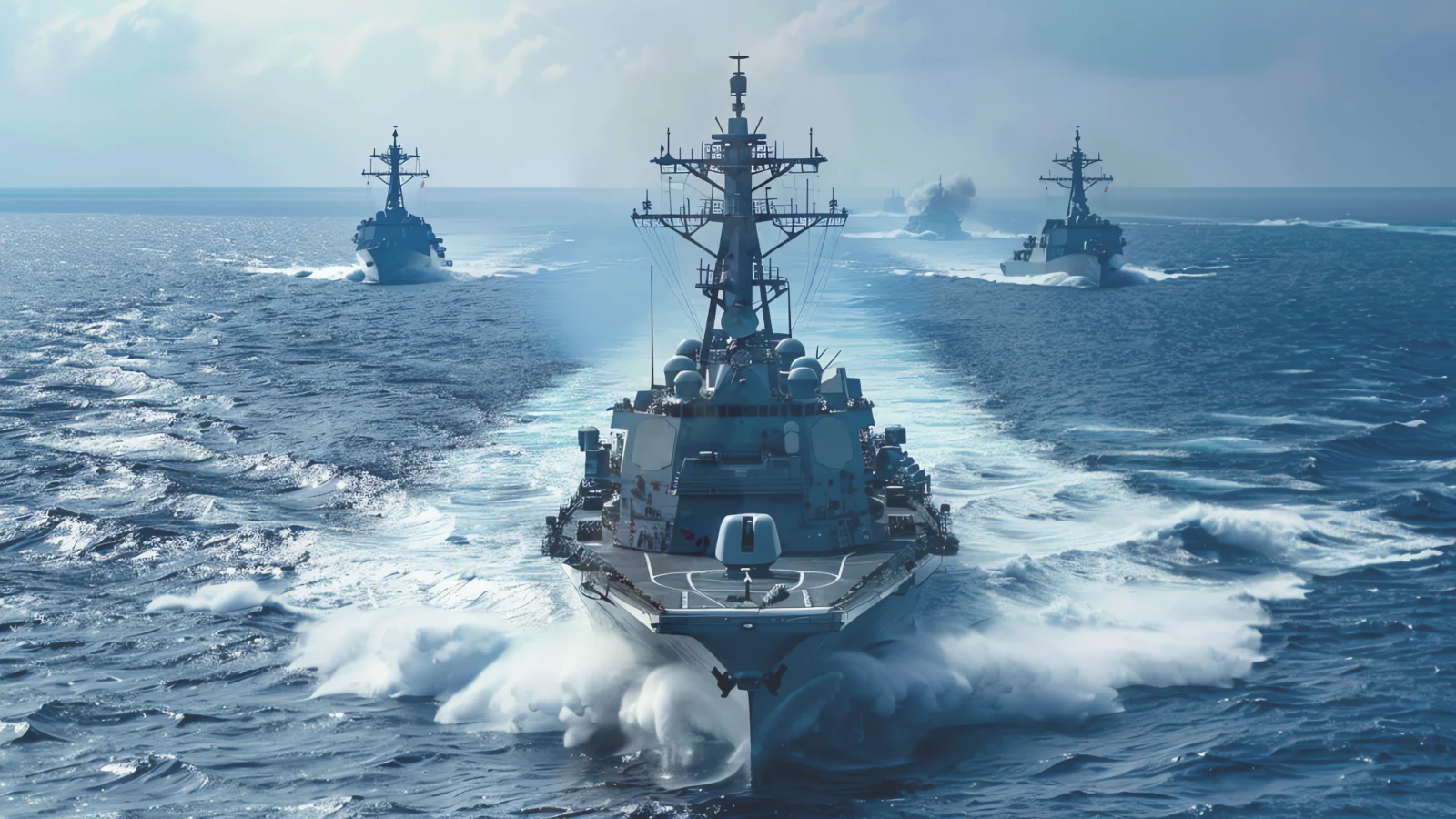
The U.S. responded with a formal counter-blockade launched April 13, targeting Iranian ports and coastal infrastructure. Defense Secretary Hegseth authorized commanders to use lethal force against vessels attempting to lay mines. The USS Rafael Peralta and other guided-missile destroyers intercepted 39 ships by April 28. Iran’s remaining oil exports now move via a “dark fleet” — captains disabling AIS transponders to mask their cargo’s origin, navigating a mined, militarized strait with no radar signature. The margin for miscalculation is thin.
Brent crude peaked at $124.67 a barrel. U.S. intelligence assessments suggest Iran has between 12 and 22 days of usable oil storage remaining. If the blockade holds, Tehran faces a stark choice: halt domestic extraction — risking permanent damage to its reservoirs — or negotiate on American terms. Washington is betting the former will fracture the IRGC’s internal coalition. Tehran is betting that $120 oil and global supply disruption break Western political will first. Neither side has moved.
What the White House Is Not Saying
Washington has framed this as a military victory. On the objectives it publicly set, that is defensible. Iran cannot project conventional force. Its missile factories are gone. Its proxies are disrupted. These are real outcomes.
What the administration has not addressed is the political endgame. There is no stated framework for what a post-war Iran should look like — who governs, what security guarantees follow, or what Washington offers in exchange for lifting the blockade. The regime is weakened but functional enough to negotiate, and that gives Tehran leverage it should not, on paper, possess.
The military situation is also less settled than the April 8 ceasefire announcement implied. Bloomberg reported this week that U.S. Central Command has formally requested deployment of the Army’s experimental Dark Eagle hypersonic missile system — because Iran has relocated surviving mobile ballistic missile launchers into the mountainous interior, beyond the 300-mile reach of the PrSM. The Dark Eagle, if deployed, would mark the first combat use of hypersonic weaponry. It would also signal to Beijing and Moscow that Washington is drawing down Pacific-focused munitions on a regional conflict it has not yet closed.
The talks in Islamabad are also not what Washington’s framing suggests. According to TES reporting on the backchannel, confirmed by Reuters, U.S. envoys Steve Witkoff and Jared Kushner have been dispatched to Pakistan for indirect contact with Iranian officials. Tehran has categorically denied any direct meetings. Iranian Foreign Ministry spokesman Esmaeil Baqaei described Foreign Minister Abbas Araqchi’s presence in Islamabad strictly as coordination with an allied neighbor — not as engagement with the Americans. The two descriptions are irreconcilable. That gap is deliberate. Both governments need an exit from a conflict draining their economies, but neither can absorb the domestic political cost of being seen to blink first. Pakistan is providing the room — and the ambiguity — that lets each side claim the other came to them.
Hegseth has stated Washington’s public condition clearly: Iran must abandon its nuclear program “in meaningful and verifiable ways” before the blockade lifts. Tehran has not accepted that framing. Hezbollah, meanwhile, has rejected the U.S.-brokered ceasefire extension between Israel and Lebanon, leaving the proxy dimension of the war still active and unresolved. Any deal reached through Pakistani intermediaries will have to quietly account for all of that — without any of it appearing in the text.
The 2003 invasion of Iraq achieved its stated military objectives within weeks. The political disorder lasted decades. Libya in 2011 moved faster in the wrong direction. Neither maps cleanly onto Iran — a larger, more institutionalized state with a government that is damaged but functional. The pattern of military success preceding political vacancy has precedent. Washington has not yet demonstrated it has a plan to break it.
Where Things Stand
Iran’s conventional military capacity has been gutted. The White House declared victory on April 8 and, on its own stated metrics, had grounds to do so. The Strait of Hormuz is formally open under ceasefire terms. Iran’s missile factories are gone.
What has not been settled is everything that comes after: who governs a degraded Iranian state, what the strait looks like once the guns are finally quiet, whether an indirect backchannel in Islamabad can produce anything durable, and whether CENTCOM’s next weapons request gets approved before the diplomacy has a chance to work.
The blockade runs. The mines remain. Witkoff and Araqchi are in the same city, talking to the same Pakistani intermediaries, and calling it something different. The war after the war has already begun — it just doesn’t have a name yet.
Sources & further reading: U.S. Department of War (war.gov); U.S. Central Command (centcom.mil); White House releases (April 8, 2026); State Department Legal Adviser (April 2026); Pentagon Comptroller via Washington Times; Britannica; Wikipedia 2026 Iran War entry; CENTCOM fact sheets (March 3 & March 16, 2026); maritime data via Windward, cited in TES Hormuz blockade analysis; Dark Eagle reporting via TES / Bloomberg; Islamabad backchannel via TES and Reuters. Full Iran conflict coverage: The Iran Conflict Hub →

1 thought on “38 Days Over Iran: What Operation Epic Fury Won — and Left Unsettled”