
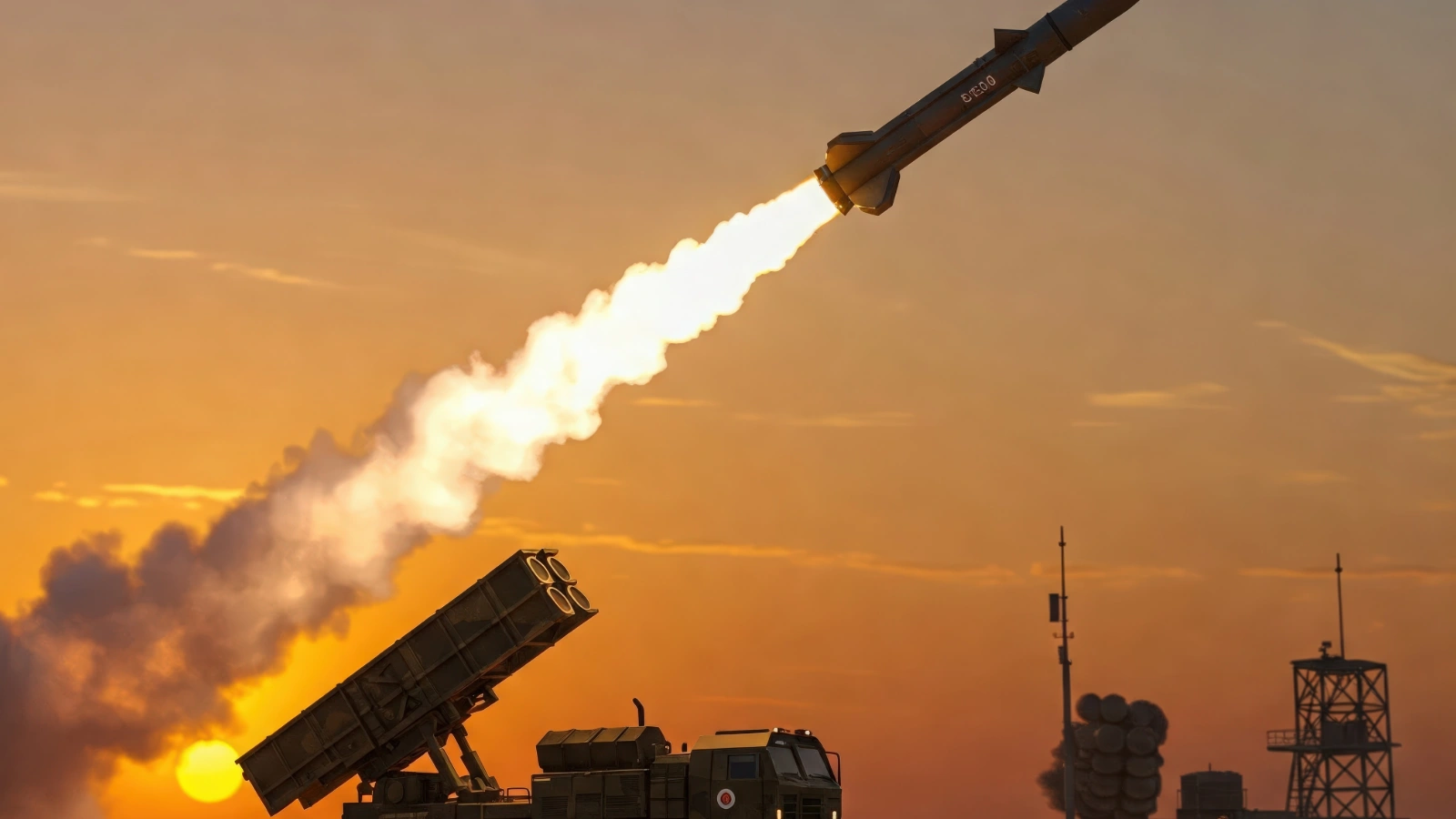
India’s defence sector has moved beyond patriotic stock-market excitement. It is now sitting at the intersection of global rearmament, domestic industrial policy and hard geopolitical risk. From Ukraine to the Middle East, from the Red Sea to the Indo-Pacific, governments are rebuilding military capacity after years of underinvestment. India is no exception.
New Delhi’s direction is clear: more domestic procurement, higher capital acquisition, rising exports and a deliberate push to reduce dependence on foreign suppliers. But investors need to separate the strategic story from the stock-market story. A powerful national-security theme does not automatically make every defence stock a good buy at any price.
The opportunity is real. The easy-money phase may not be.
Global Rearmament Has Changed The Defence Market
The biggest tailwind for Indian defence companies is not just India’s neighbourhood. It is the global security cycle. The International Institute for Strategic Studies reported that global defence spending reached $2.63 trillion in 2025, up from $2.48 trillion in 2024. That is not a routine increase. It reflects a world where governments are no longer comfortable with thin inventories and slow production lines.
Ukraine exposed the West’s ammunition shortage. The Middle East has pushed air defence, missiles, drones and naval security back to the centre of military planning. The Red Sea and Strait of Hormuz have reminded import-dependent economies that sea lanes cannot be taken for granted. China’s rise has forced countries across the Indo-Pacific to rethink deterrence, surveillance and maritime security.
For India, this creates a long demand runway. The country needs more aircraft, radars, missiles, drones, naval platforms, electronic warfare systems, space assets and battlefield communication networks. It also has an opportunity to become a serious supplier to friendly countries looking beyond traditional Western and Russian vendors.
India’s Policy Push Is Now Backed By Money
India’s defence indigenisation push is no longer only a slogan. In the Union Budget 2026–27, the government reserved around 75% of the capital acquisition budget for domestic defence industries, according to the Press Information Bureau. That matters because defence manufacturing is shaped by state priorities, long procurement cycles and strategic necessity.
The production numbers also show momentum. India’s defence production touched a record level in FY 2024–25, while exports reached a new high, according to another PIB release on defence production and exports. A decade ago, India’s defence exports were below ₹1,000 crore. The direction of travel is unmistakable.
This is why the India defence sector deserves serious attention. The country is trying to move from being one of the world’s largest arms importers to a nation that can design, manufacture and export more of its own military hardware.
That ambition also links directly with India’s larger strategic-industrial push. From the GE-HAL F414 engine deal to the rise of hidden Indian defence companies, the next phase of India’s defence story will depend on whether domestic firms can move from assembly and licensed production to deeper technology control.
The Market Has Already Priced In A Lot Of Hope
The problem is not the defence story. The problem is the price investors are willing to pay for it.
Brokerage caution has increased. HSBC cut India to underweight and warned about earnings risks linked to crude prices, inflation and expensive valuations, as reported by Financial Express. Its reluctance to chase fresh defence stock buy calls does not kill the defence thesis. It simply signals that the market is moving from narrative to numbers.
That shift is important. Defence companies can no longer rise only because the geopolitical backdrop is tense. They will now have to show revenue conversion, margin discipline, delivery execution and credible order-book monetisation.
Investors often make one mistake in defence cycles: they confuse strategic inevitability with near-term earnings certainty. A country may need fighter jets, missiles, radars and drones. But that does not mean every listed defence company will grow profits smoothly every quarter. Orders can be delayed. Deliveries can slip. Imported components can become bottlenecks. Margins can fluctuate. Valuations can compress even when the long-term story remains intact.
BEL Looks Like The Cleanest Risk-Adjusted Play
Among India’s listed defence names, Bharat Electronics Ltd remains one of the cleanest risk-adjusted plays. BEL is not merely a platform company. It sits in the electronics layer of modern warfare: radars, communication systems, electronic warfare, satellite communication, drones, fuzes, command systems and surveillance equipment.
This matters because modern militaries are becoming more networked, sensor-heavy and software-driven. Even when governments buy aircraft, ships, tanks or missile systems, the value of electronics, sensors and communication architecture keeps rising.
BEL reported record turnover of about ₹26,750 crore in FY26. Its order book stood at around ₹74,000 crore as of April 1, 2026, including an export order book of about $495 million, according to the company’s FY26 turnover update.
That gives BEL strong revenue visibility. But even a high-quality company is not immune to valuation risk. A good business can still become a difficult investment if the stock price assumes perfect execution.
HAL Has The Biggest Strategic Weight — And The Biggest Execution Test
Hindustan Aeronautics Ltd is the most strategically important listed defence company in India. Aircraft, helicopters, engines, repair, overhaul and future fighter ecosystems sit at the heart of military power. HAL’s order book gives it long-term visibility, especially as India pushes ahead with indigenous aircraft and aerospace capability.
But HAL’s challenge is not demand. It is throughput.
The company must show that it can convert a large order pipeline into timely deliveries, steady revenue growth and stronger cash flow. Supply-chain pressure, engine availability, vendor depth and production ramp-up will decide how much of the strategic opportunity becomes financial performance.
For India, HAL’s success is bigger than one company’s profit and loss statement. It is tied to whether the country can build a credible aerospace-industrial base. For investors, however, the question is narrower: how fast can HAL turn national priority into reported earnings?
BDL, Solar And Smallcaps: Strong Stories, Sharper Risks
Bharat Dynamics Ltd sits in one of the most important categories of modern warfare: missiles and guided weapons. Recent conflicts have shown that precision munitions, air defence systems and standoff weapons are central to deterrence. BDL’s opportunity is strong, but its earnings can be lumpy because missile programmes depend on milestones, clearances, production cycles and delivery schedules.
Solar Industries represents another powerful angle: ammunition depth. Ukraine has proved that wars are not sustained by shiny platforms alone. They are sustained by rockets, explosives, propellants, artillery shells and munitions supply chains. Solar’s defence opportunity is serious. The risk is not business quality. The risk is paying too much for quality.
Small and midcap defence names may still create large returns, especially in electronics, drones, simulation, components and niche systems. But this part of the market carries higher risk: order concentration, thin liquidity, delayed revenue conversion and valuation compression. In smallcap defence, narrative often travels faster than earnings.
The Hidden Constraint: Budget Quality
The headline defence budget is large, but the quality of spending matters. Salaries and pensions continue to take a large share of total defence expenditure, while capital spending must compete with personnel costs, maintenance and operational needs. This spending mix has been highlighted by PRS Legislative Research.
This means India’s modernisation push is real, but fiscal space is not unlimited. Every approval does not become an order immediately. Every order does not become revenue quickly. Every revenue line does not guarantee stable margins.
That is where stock selection becomes critical. Companies with deep manufacturing capability, proven delivery records, strong balance sheets and repeat order potential will command a premium. Companies surviving only on announcements may struggle once the market demands numbers.
Geopolitics Makes The Opportunity Durable
The defence theme is not going away because the geopolitical triggers are not going away.
China remains the long-term strategic driver. Even if the border is quiet on a given day, India’s military planning must assume a more assertive China across land, sea, cyber and space. That supports demand for surveillance, air defence, missiles, drones, electronic warfare, satellite systems and naval capability.
Pakistan remains the tactical trigger. Any escalation on the western front strengthens the case for precision strike, air defence, artillery, drones and intelligence-surveillance-reconnaissance systems.
The Middle East adds another layer. If the Strait of Hormuz or Red Sea becomes unstable, India will need stronger maritime surveillance, naval readiness, anti-drone systems and logistics resilience. Energy security and military preparedness will increasingly overlap. Our continuing coverage of the Iran conflict and Hormuz risk shows how quickly regional crises can become strategic and economic shocks for India.
In other words, India’s defence sector is not riding one conflict. It is riding a world where conflict risk has become distributed, persistent and technologically complex.
The Real Test: From Order Book To Earnings
The next phase of India’s defence boom will separate companies into two groups. The first group will convert policy support into orders, orders into revenue, revenue into margins and margins into cash flow. The second group will remain dependent on announcements, excitement and retail momentum.
This is why the sector is becoming bifurcated. BEL and HAL deserve serious long-term attention because they sit at the centre of India’s defence architecture. Solar Industries has a strong private-sector munitions angle. BDL has a powerful missile story but needs execution consistency. Smaller defence stocks may produce large gains, but they require stricter risk control.
The larger conclusion is clear. India’s defence sector remains one of the country’s strongest long-term industrial stories. But investors must stop treating every defence stock as a strategic asset. A strategic sector can still contain overvalued companies, weak execution and crowded trades.
Conclusion: Constructive, Not Euphoric
India’s defence boom is real. The world is rearming, India is localising procurement, exports are rising and the domestic industrial base is expanding. These are structural forces, not temporary triggers.
But the market has already rewarded the theme heavily. From here, the winners will not be the companies with the loudest geopolitical narrative. They will be the companies that deliver manufacturing scale, technology depth, export credibility and earnings discipline.
The easy phase of the defence rally may be over. The serious phase has just begun.
For India, this is an industrial opportunity. For investors, it is now an execution test.

1 thought on “India’s Defence Boom Faces Its Biggest Test: Why BEL, HAL And Other Defence Stocks Can’t Run On Hype Alone”