
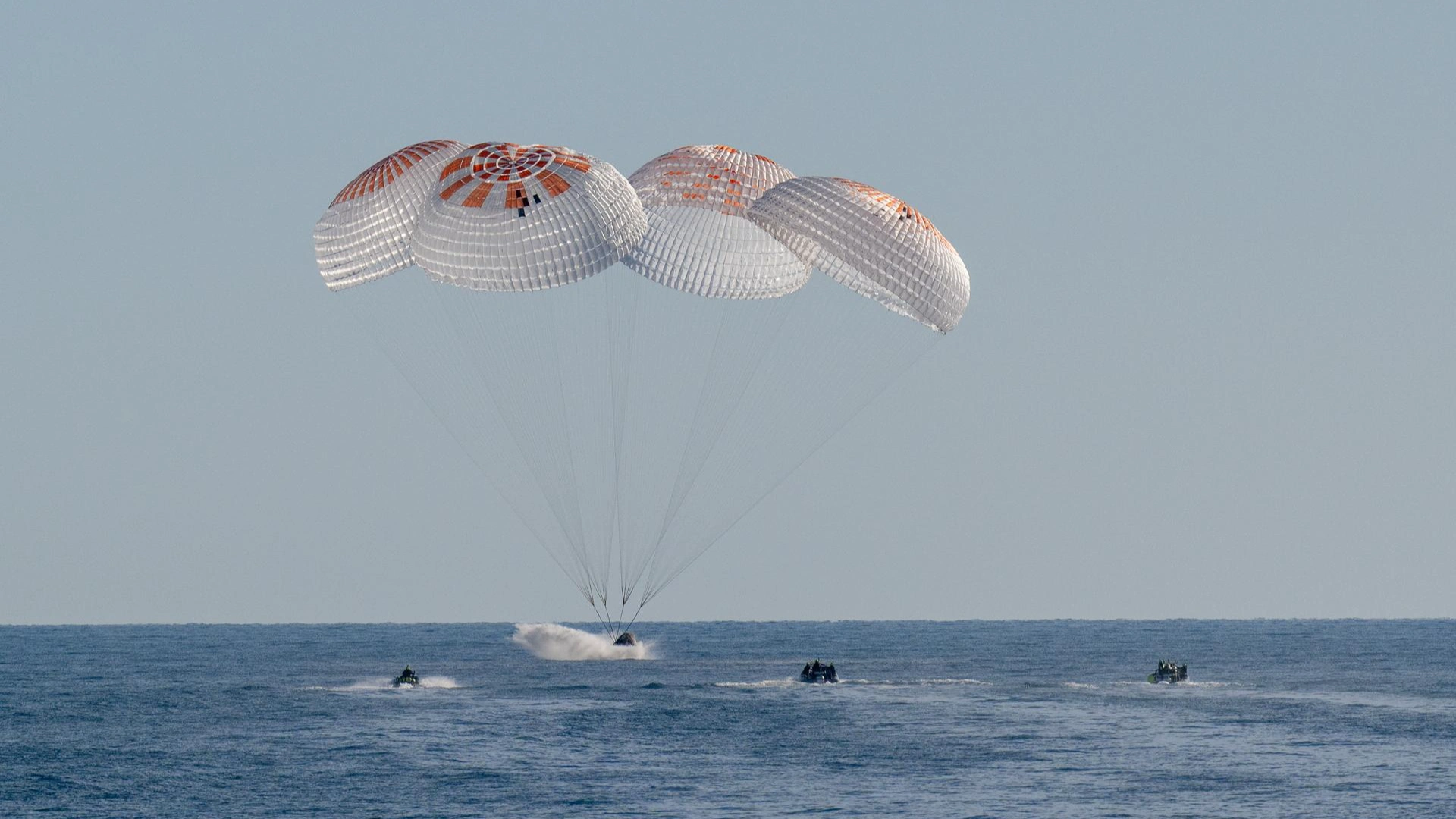
On April 10, 2026, NASA’s Orion spacecraft, named Integrity, splashed down in the Pacific Ocean off the coast of California, closing the first crewed lunar mission of the Artemis era. The nearly ten-day flight did more than test a spacecraft. It brought human beings back into deep-space operations for the first time since Apollo.
Commanded by Reid Wiseman, with Victor Glover, Christina Koch, and Canadian Space Agency astronaut Jeremy Hansen onboard, Artemis II carried a crew around the Moon and back without attempting a landing. NASA said the mission took the crew roughly 252,756 miles from Earth at its farthest point, surpassing the Apollo 13 distance record set in 1970.
For Washington, Artemis II was also a political signal. The US-led lunar program is no longer stuck in planning documents. It has now returned astronauts safely from the Moon’s neighborhood.
Technology, Alliances, and the New Space Race
The mission validated several critical systems at once: the Space Launch System, the Orion crew spacecraft, life-support systems, navigation procedures, recovery operations, and deep-space communications. Orion’s return through Earth’s atmosphere was especially important because the spacecraft’s heat shield had faced scrutiny after the uncrewed Artemis I mission.
During re-entry, Orion faced temperatures of roughly 5,000 degrees Fahrenheit, or about 2,760 degrees Celsius, before parachuting into the Pacific. That test mattered because a spacecraft returning from the Moon enters Earth’s atmosphere at far higher speeds than vehicles coming back from low Earth orbit.
The flight also tested the Orion Artemis II Optical Communications System, known as O2O. The system is designed to send high-resolution imagery, video, mission data, flight procedures, and communications between Orion and Earth at rates of up to 260 megabits per second.
Future lunar missions will need fast and reliable links for images, crew instructions, system checks, navigation support, and surface operations. The next phase of Moon activity will not depend only on rockets and landers. It will also depend on communications, power systems, surface mobility, robotic support, and the ability to coordinate complex activity far from Earth.
The presence of Jeremy Hansen also carried diplomatic weight. Canada’s role underlined the alliance model behind Artemis: the United States is not returning to the Moon alone. It is building a coalition through the Artemis Accords, a framework meant to shape norms around peaceful exploration, transparency, interoperability, emergency assistance, data sharing, and space activity before rival systems define the rules.
Why the Lunar South Pole Matters
Artemis II did not land on the Moon, but it has direct implications for the coming race toward the lunar south pole. That region matters because permanently shadowed areas may contain water ice. If accessible, that ice could support life-support systems, fuel production, and longer-duration missions.
In plain terms, the south pole could become the logistics hub of a future lunar economy.
This is why Artemis is no longer just a space program. It is part of a wider contest over technology standards, industrial capacity, alliance networks, and access to strategic locations beyond Earth. China is advancing its own crewed lunar ambitions and has set a target of landing astronauts on the Moon before 2030, while its broader International Lunar Research Station plan points toward a long-term presence on or around the Moon.
India should read the mission closely. The next space race will reward countries that build infrastructure, not just launch prestige missions. Lunar power systems, communications networks, robotics, materials science, space medicine, and resource mapping will matter as much as the launch itself.
From Flags and Footprints to Lunar Infrastructure
The old Apollo-era model was built around national prestige and short-duration missions. The new lunar race is different. Artemis II points toward an era in which the Moon becomes a testbed for industrial coordination, scientific access, alliance-building, and long-range competition.
That does not mean the Moon is about to become a battlefield. But it does mean lunar geography is becoming politically meaningful. Water ice, landing zones, communications corridors, navigation systems, power generation, robotics, and surface habitats are now part of the basic infrastructure of power beyond Earth orbit.
The success of Artemis II gives the United States and its partners a stronger platform for later Artemis missions. But the hard part begins now. Landing humans, building surface infrastructure, coordinating commercial partners, and keeping timelines intact will be far more difficult than a flyby.
The Strategic Takeaway
Artemis II has brought human deep-space flight back into active geopolitics. The mission proved that the United States can again send astronauts around the Moon and bring them home safely. But it also showed something larger: the new space race will not be won by symbolism alone.
The real contest will be over infrastructure. Communications, landing systems, surface power, water ice access, commercial supply chains, robotic support and international rules will decide who shapes the lunar order.
For The Eastern Strategist, that is the real meaning of Artemis II. The mission gave the US-led coalition credibility. The harder test begins now: whether Washington and its partners can turn a successful lunar flyby into a lasting presence on the Moon.