
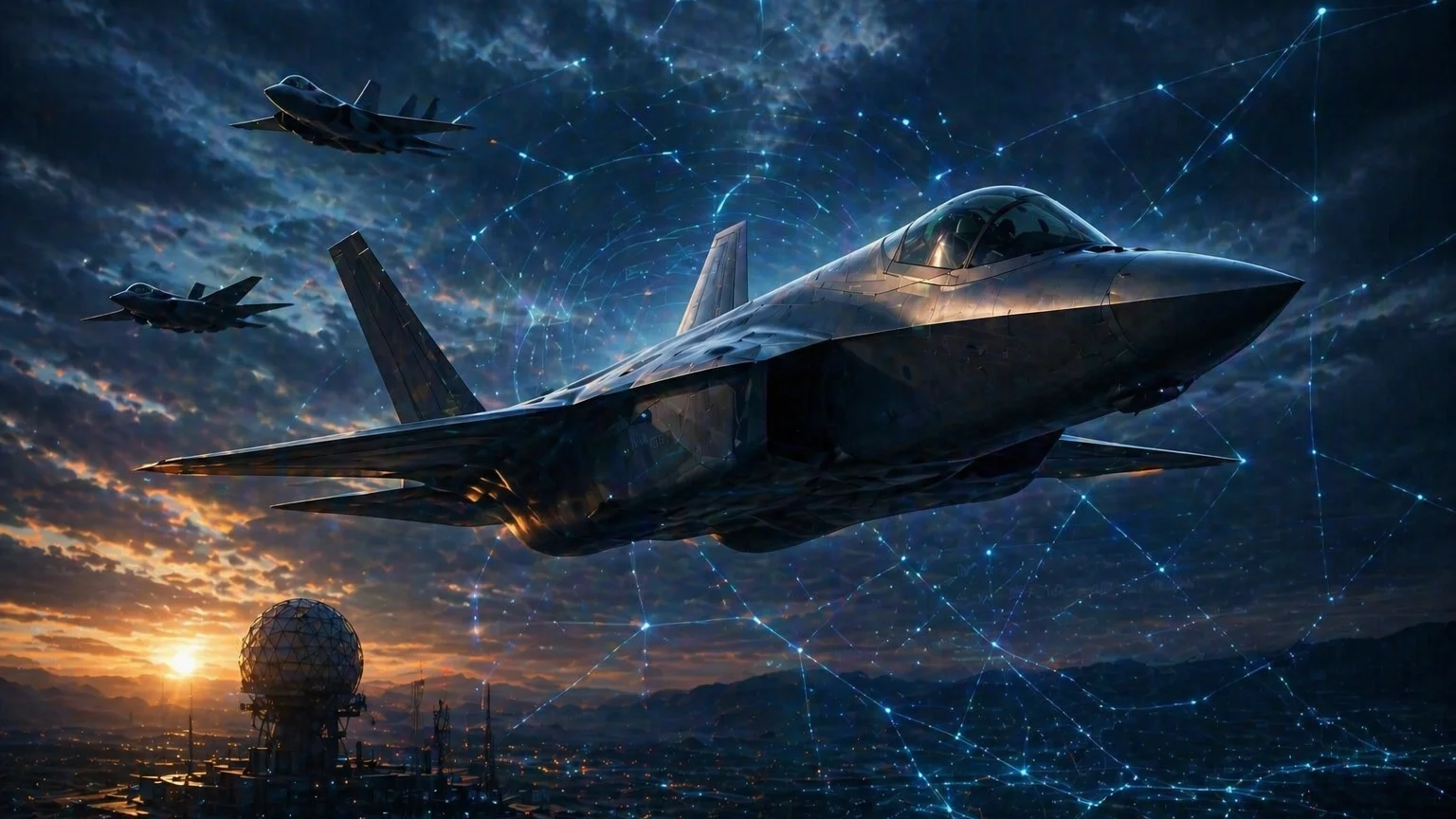
For decades the metric of aerial supremacy was forged in titanium and measured by the thrust to weight ratio of a jet engine. In the hangars of the 20th century a fighter jet was a kinetic platform that carried electronics. In 2026 that paradigm has inverted. A fifth generation platform like India’s Advanced Medium Combat Aircraft (AMCA), currently under development, is increasingly being designed as a high-performance computing system as much as an aerial platform.
We have entered the era of the software defined battlefield. In this new theater the decisive edge is no longer just the airframe stealth or engine supercruise capability. It is the algorithmic brain that fuses a high volume of data points into a single actionable moment of clarity for the pilot. For India achieving Atmanirbharta in this domain is not just a secondary goal. It is becoming central to long-term strategic autonomy.
The Decentralization of Innovation
The most significant shift in India’s aerospace landscape in 2026 is the evolving structure of the AMCA program. For decades, development was largely driven by the public sector. Today, however, the increasing participation of private players such as Tata Advanced Systems and Larsen & Toubro signals a broader transformation in India’s military-industrial ecosystem.
While the vision is ambitious, as of 2026, India remains in the early stages of integrating AI-native architectures into next-generation combat platforms, with several capabilities still under development. The program continues to be anchored by institutions such as Defence Research and Development Organisation (DRDO) and Aeronautical Development Agency (ADA), with Hindustan Aeronautics Limited (HAL) playing a central role in manufacturing and integration.
By transitioning from a centralized model to a decentralized competitive ecosystem India is finally mirroring the Silicon Valley approach to defense. The move to involve private players in the final evaluation phase of the AMCA prototype reflects a hard truth. The pace of software innovation moves too fast for traditional bureaucracy. Private firms can complement traditional defense institutions by bringing agile development practices and faster prototyping cycles.
Smartising the Kill Chain
Recent military discussions and strategic forums have increasingly focused on smartising the kill chain. This is where AI driven Atmanirbharta becomes tangible. In a modern conflict the kill chain is often bottlenecked by human bandwidth.
A software defined AMCA addresses this through sensor fusion. By utilizing AI-assisted systems to filter noise from signals across radar and electronic sensors the aircraft provides the pilot with a superior view of the battlespace. Self reliance here is critical. If the algorithms governing these sensors are black boxes developed by foreign entities India loses sovereign control over its most critical assets. Strategic dependence on externally controlled systems introduces potential risks related to supply chain dependencies and limited sovereign control.
Furthermore the integration of digital twins allows for predictive maintenance that can anticipate a failure before it happens. For a nation managing a complex military ecosystem, this AI efficiency is the only way to sustain high operational readiness without exploding the defense budget.
The Silicon Shield
You cannot have sovereign AI without sovereign infrastructure. The software defined battlefield requires massive computational power both in the cockpit and at the command center. This brings us to the critical role of sovereign clouds and indigenous GPU infrastructure.
In 2026, access to advanced compute infrastructure, particularly GPUs, is emerging as a critical strategic capability. India’s strategic push into this sector is the backbone of our aerospace future. For the AMCA brain to be truly indigenous the models it uses must be trained on domestic soil.
Using global public clouds for sensitive and mission-critical military data presents strategic risks that must be carefully evaluated. As warfare becomes increasingly software-defined, control over underlying data infrastructure is emerging as a critical pillar of national security.
While domestic cloud and AI ecosystems are evolving rapidly, their current deployments are largely focused on enterprise, private sector, and civilian government use cases. Defence applications, however, require purpose-built, highly secure and tightly controlled environments designed specifically for military-grade operations. In this context, the idea of a “Silicon Shield” reflects the need for sovereign, mission-specific digital infrastructure that safeguards critical systems from external dependencies and potential vulnerabilities.
The Engine and the Algorithm
There is a recurring debate in defense circles about whether India can be truly self reliant if we still rely on American GE-F414 engines. While the metallurgical challenge of high thrust engines is a real hurdle we must recognize that in 2026 software is an increasingly important force multiplier.
A software defined platform can be upgraded overnight with a new code push whereas a hardware centric platform requires years of physical refitting. Our ability to code indigenous electronic counter measures and autonomous wingman drone protocols provides a layer of strategic depth that no engine can offer. The AMCA Mk-2 project aiming for a 120kN engine jointly developed with France is essential but the real victory will be the day an Indian designed AI system out-thinks a foreign adversary in a contested environment.
The Geopolitical Stakes
Recent tensions around the Strait of Hormuz have shown how a single chokepoint can trigger cascading disruptions across energy, trade and economic stability, exposing the fragility of interconnected systems. In such an environment, the nature of advantage is shifting toward those who can anticipate, process and respond to disruption in real time.
The software-defined battlefield is no longer theoretical. It is fast becoming operational reality, where AI, data and decision-making speed define outcomes. For India, this is a defining moment. In the 21st century, Atmanirbharta will not be measured by what we build, but by how effectively we design, control and secure the AI-driven digital systems that underpin national security.
View LinkedIn profile
For a deeper understanding of the strategic and technological shifts shaping India’s defence ecosystem, readers can explore our analysis on the IRGC and modern military doctrine, our breakdown of rising tensions around the Strait of Hormuz, and our detailed report on India’s fighter engine roadmap and strategic dependencies. Together, these developments underline how geopolitics, technology and airpower are converging to define the next phase of India’s strategic trajectory.