
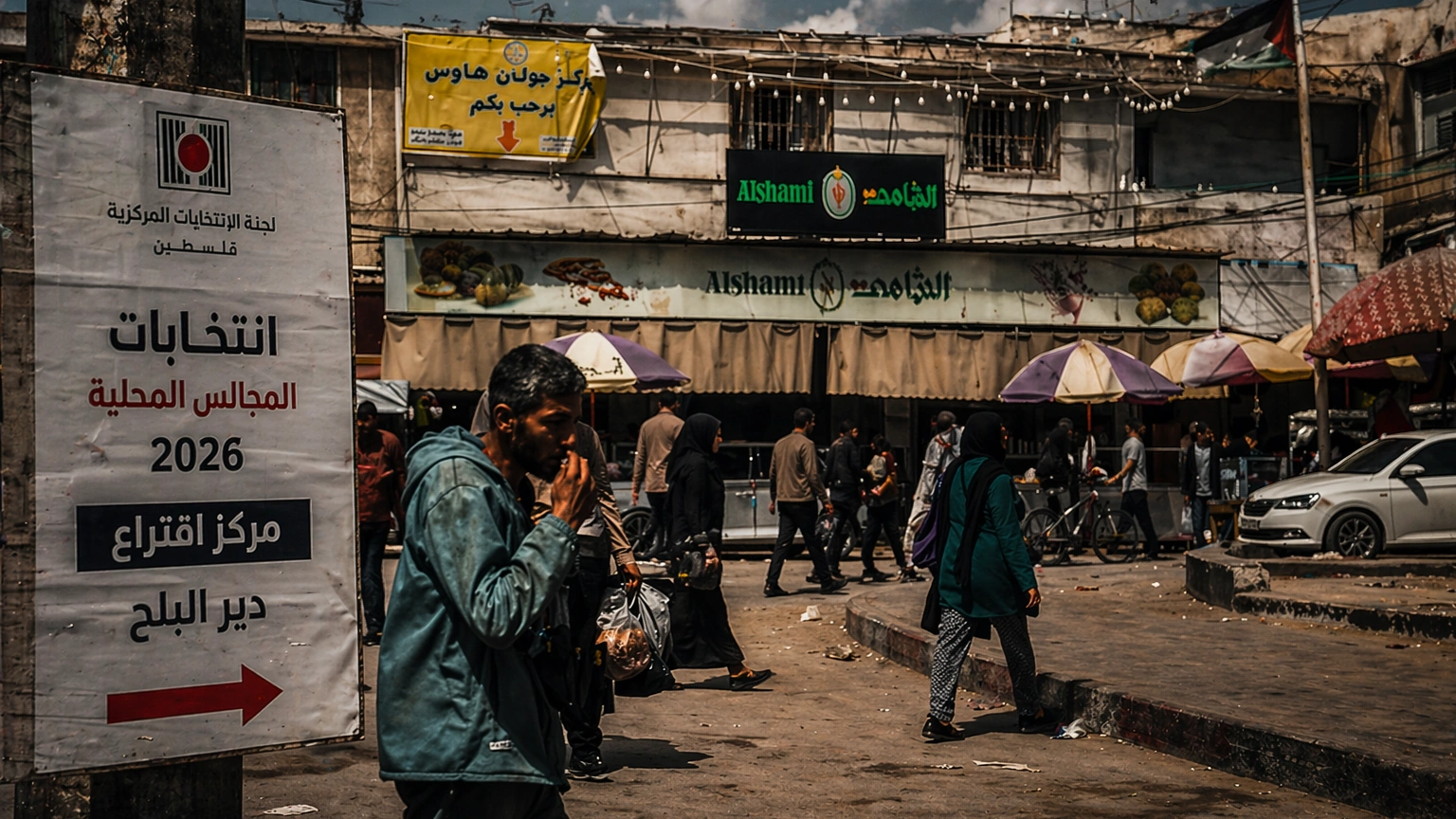
A local election in Gaza this weekend is drawing attention far beyond the town where it is being held. The vote is taking place in Deir al-Balah, part of the Palestinian Authority’s municipal election cycle, and about 70,000 people are eligible to cast ballots. It is not a national election, and it cannot by itself settle the question of who speaks for Gaza. But because Hamas is officially sitting the contest out while a list with candidates seen by residents and analysts as pro-Hamas is still running, the ballot is being watched as a limited political test of the group’s standing after two years of war.
That is what gives this small municipal contest unusual weight. Reuters reported that Palestinians backing the vote see it as part of a broader effort to show Gaza remains tied to the Palestinian political system at a time when outside plans for the territory’s future are under debate. Analysts quoted by Reuters described the election as a symbolic move as Washington pushes a post-war framework for Gaza built around reconstruction and a technocratic administration rather than Hamas rule.
Why a Local Gaza Vote Is Being Watched So Closely
The historical backdrop matters here. The last Palestinian legislative election was held in January 2006, and Hamas won it, taking 74 seats while Fatah won 45. Reuters says this Deir al-Balah vote will be Gaza’s first vote of any kind since that 2006 contest and the Hamas takeover that followed the split with Fatah. Palestinian election history also shows how irregular and fragmented the process has become over time, with later local elections held in different phases and often shaped by the Fatah-Hamas divide.
That long freeze is the reason even a local ballot now attracts national and regional scrutiny. In Deir al-Balah, voting is due to take place in 12 polling centres, including open fields and tents, which is a reminder of how damaged Gaza remains after the war. Reuters reported that the city was chosen in part because it suffered less destruction than other parts of the enclave. Four lists are contesting the election, including one that residents and analysts describe as pro-Hamas, even though Hamas itself has not formally endorsed a slate.
What the Vote Can — and Cannot — Tell Us
This is where the story needs to be handled carefully. The vote is a signal, not a verdict. It is too small and too constrained to be read as a clean referendum on Hamas. War, displacement, fear, and the absence of a wider national electoral process all limit how much one municipal contest can prove. Still, Reuters quoted political analyst Hani Al-Masri as saying Hamas may use the performance of pro-Hamas candidates to gauge its popularity. That makes the election politically significant even if it is institutionally narrow.
There is also a simple human reason this election matters. Reuters spoke to residents in Deir al-Balah who described the vote as their first real chance in years to express themselves politically. One voter said he had heard about elections his whole life without seeing one actually happen. Another framed the ballot as part of rebuilding life after two years of destruction. Those comments do not turn the election into a democratic breakthrough, but they do show why even a local vote can carry emotional force in a place where public life has been broken by conflict.
Any attempt to read Gaza’s political future in isolation also misses the wider regional struggle that shapes the conflict. For more on that longer arc, read our analysis of Iran and Israel relations history.
Why Hamas’s Standing Still Shapes the Story
The broader political question is what this says about Hamas now. Reuters pointed to polling from the Palestinian Center for Policy and Survey Research that found in October 2025 that 41% of Palestinians in Gaza supported Hamas, compared with 29% for Fatah. That does not automatically predict the outcome in Deir al-Balah, and polling in conflict zones should always be treated with caution. But it helps explain why this vote is being watched so closely by Palestinian factions, regional actors, and outside governments trying to imagine a post-war order for Gaza.
The election also lands in the middle of a larger debate over who governs Gaza after the war. Reuters reported that the U.S. “Board of Peace” proposal envisions the territory being rebuilt under an apolitical committee of Palestinian technocrats, with Hamas expected to hand over governance and disarm. Hamas has rejected disarmament. Palestinian analysts quoted by Reuters argue that the municipal vote sends a different message: that Gaza cannot be treated as politically separate from the wider Palestinian question or reduced to a purely administrative problem.
The Gaza vote is local, but the politics around it are not. They sit inside a wider regional ecosystem shaped by Iran-backed power structures and militant networks. For that internal Iranian power map, read our explainer on what the IRGC is.
A Small Ballot, But Not a Small Signal
That is the deeper meaning of the Deir al-Balah ballot. It is not proof that Gaza’s political future has been decided. It is not a full test of public will. But it is one of the few real political measurements available inside Gaza after years of fracture and war. In a system where national legitimacy has been frozen for nearly two decades, even a local vote can reveal something valuable: not final answers, but a clearer sense of where political sentiment may still be moving.