
News Analysis · 25 October 2026 · Contract signed 21 October
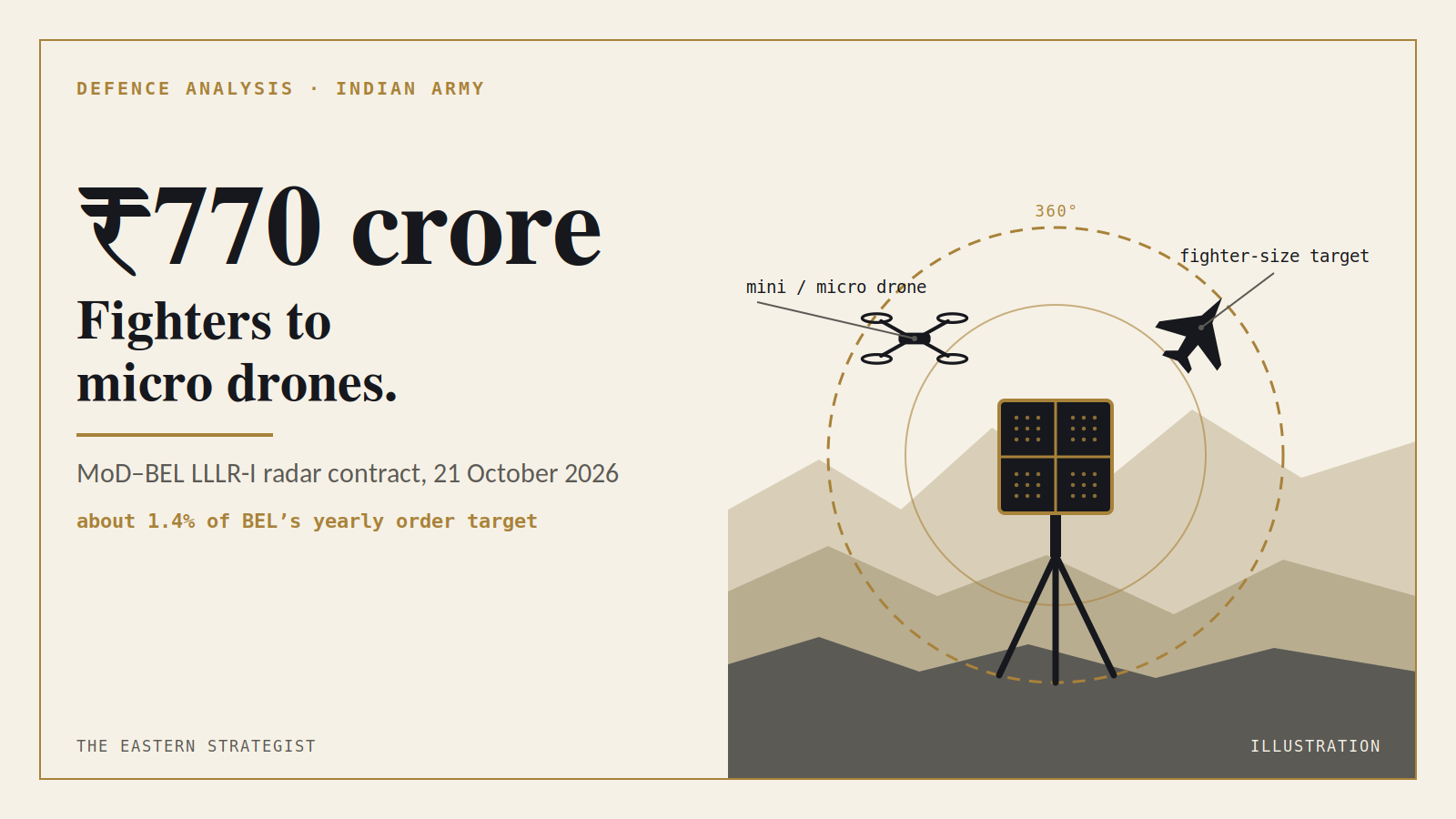
The Ministry of Defence (MoD) signed a contract worth about ₹770 crore (about $81 million) with Bharat Electronics Limited (BEL) on 21 October for radars that, the ministry says, can detect and track fighter-sized targets and mini or micro drones. The LLLR-I radar contract is about 1.4 per cent of BEL’s order-inflow target for 2026-27. It buys the Army a sensor for low airspace, a capability area the Army flagged for urgent attention after Operation Sindoor.
- The MoD signed with BEL on 21 October for the Improved Low Level Light Weight Radar (LLLR-I), at about ₹770 crore.
- The ministry says the radar tracks fighter-sized targets and mini or micro drones, and can rank aerial targets by priority.
- The number of radars, the delivery dates and the detection range have not been disclosed.
- BEL’s management targets more than ₹55,000 crore of new orders this year. The LLLR-I radar contract is about 1.4 per cent of that.
The LLLR-I Radar Contract Gives the Army a Low-Altitude Eye for Fighters and Micro Drones
Defence Secretary Rajesh Kumar Singh was present when the MoD and BEL signed the deal in New Delhi on 21 October. The ministry said the Improved Low Level Light Weight Radar detects and tracks fighter-sized targets and mini or micro drones, and can prioritise aerial targets, which will help the Army counter the threat from unmanned aerial systems. It called the purchase a step towards indigenisation of air defence platforms, with a boost to micro, small and medium enterprises (MSMEs).
The announcement leaves several things out. It gives no count of radars, no delivery schedule, no detection range and no figure for indigenous content. Those details will decide how quickly the Army can field the radars and how many formations they reach.
BEL’s own brochure for the radar adds detail the ministry’s statement does not carry. It describes a pulse-Doppler, software-defined set with an active electronically scanned array (AESA) antenna, gallium nitride (GaN) amplifiers and digital beamforming, built for low radar cross-section targets such as drones. Four fixed phased-array panels on a tripod give 360-degree coverage, passively cooled with no moving parts or liquids. BEL also lists monopulse tracking, track-while-scan, a built-in self-test, electronic counter-countermeasures, remote control from a control and display unit, and man-portable operation. The brochure, as TES has seen it, gives no detection range.
Why Low-Altitude Detection Became an Army Priority After Operation Sindoor
The MoD’s Annual Report 2025-26 records that a special Defence Acquisition Council (DAC) meeting on 9 May 2025 approved urgent emergency procurement. Based on lessons from the first phase of Operation Sindoor, the Army set out to close critical capability voids in unmanned systems, counter-drone systems, loitering munitions, air defence and electronic warfare. A radar that can see small drones at low level belongs on that list.
The same report states the shortfall directly. It says the operation brought out the inability of indigenous industry to offer niche products in the unmanned, counter-unmanned and loitering-munition domains, and it records a proposal for nine fast-track development projects under the ADITI and DISC schemes, endorsed by the Defence Secretary and to be run as Innovation for Defence Excellence (iDEX) projects. It also lists a Core Committee on unmanned and counter-unmanned systems, a proposed special purpose vehicle with special financial powers for faster research and procurement, and a drone platoon, named ASHNI, in every infantry battalion.
Britain met a version of this problem in 1938. RAF exercises that year showed that low-flying aircraft could slip past the Chain Home radar line unseen, and in August 1939 the Air Ministry ordered 24 coastal-defence radars from Pye Radio to fill the gap. They became the Chain Home Low stations. The sequence is the useful part: a review exposed the hole, sensors were bought in quantity, and they were tied into the existing reporting system. India’s review followed Operation Sindoor, and the LLLR-I radar contract is the sensor-buying step.
Where the LLLR-I Radar Contract Fits Among the Army’s Counter-Drone Layers
A radar finds a target and does not stop one. BEL’s brochure lists target indication to weapon systems as a feature of the LLLR-I, so its value depends on what sits behind it. In early July the DAC gave Acceptance of Necessity (AoN) to about ₹52,000 crore of proposals, including the Akash Tarang anti-drone electronic warfare system, medium-range surface-to-air missiles and very short range air defence systems. This order is a contract, which is a later stage.
Most large figures this year have been AoN approvals: that ₹52,000 crore in early July, then about ₹1.10 lakh crore on 7 September, of which the ministry said around 98 per cent would come from Indian industry. An AoN is the in-principle first step, before tendering, trials and contract negotiation. A signed contract, even a modest one, is where a delivery schedule and a payment first appear on paper. The ₹2,563 crore GSAT-7C contract, signed on 15 October after a 2021 DAC nod, followed the same path.
BEL’s ₹770 Crore Order Is 1.4% of Its Target, and QRSAM Is the Larger Swing
BEL’s management has guided to order inflows of more than ₹55,000 crore in 2026-27, including a Quick Reaction Surface-to-Air Missile (QRSAM) order of about ₹30,000 crore that was awaiting Cabinet Committee on Security (CCS) clearance at its last update. The LLLR-I radar contract is about 1.4 per cent of the target. Orders booked by mid-October stood at ₹7,400 crore, below last year’s pace.
BEL’s order backlog was ₹72,300 crore on 1 July, and its revenue grew about 25 per cent in the June quarter. Macquarie, which rates the stock Outperform, puts the slow start to the timing of bookings, not weaker demand.
TES’s reading is that orders of this size matter less to BEL’s reported numbers than to what they signal. The Army is buying detection capacity now, in a tranche that does not wait for the large programmes to clear. For investors the numbers to track are BEL’s September-quarter order inflow and any CCS decision on QRSAM. TES has looked at how BEL’s valuation and order book sit together, and at why defence stocks fell with the wider market on 23 October. In defence electronics, Tonbo Imaging’s IPO showed Indian sales doubling while exports fell 93 per cent.
What to Watch After the LLLR-I Radar Contract
How many radars will the Army get, and by when?
The ministry has not said. BEL’s exchange disclosures and the Army’s induction plans are the places to look. A delivery schedule would show whether the radars arrive in time to serve the drone units now being raised in infantry battalions.
Will the QRSAM order clear the CCS?
At its June-quarter update, BEL’s management said QRSAM was awaiting CCS approval. No signing had been announced in the sources TES reviewed. A clearance would change BEL’s order picture far more than the LLLR-I radar contract does.
Will counter-drone buying move to a dedicated vehicle?
The Annual Report mentions a proposed special purpose vehicle for unmanned and counter-unmanned systems. Its approval would show whether the Army wants these purchases to move faster than the standard procurement cycle.
What will BEL say when it reports September-quarter results?
Look for management comments on the timing of QRSAM, the guidance of more than ₹55,000 crore, and execution against the ₹72,300 crore backlog.
The Takeaway: A Modest Contract for the Part of the Sky Drones Use
The LLLR-I radar contract is small in rupees and specific in purpose. It puts signed paper behind the detection layer of the Army’s counter-drone effort, at a time when most of the headline numbers are approvals still waiting to become orders.
Chain Home Low closed Britain’s blind spot because the sets were ordered in quantity and tied into the same reporting system as the rest. The test for the LLLR-I radar contract will be the same three questions: how many sets, how soon, and how well they feed the weapons behind them. The ministry has answered the first in rupees only. The other two will be answered in delivery.
Source note: Ministry of Defence press release of 21 October 2026 and Annual Report 2025-26; Defence Acquisition Council announcements; BEL management commentary as reported in brokerage notes; BEL product literature for the radar’s design; published RAF radar histories for the Chain Home Low background.

2 thoughts on “MoD Signs ₹770 Crore LLLR-I Radar Contract With BEL for the Army”