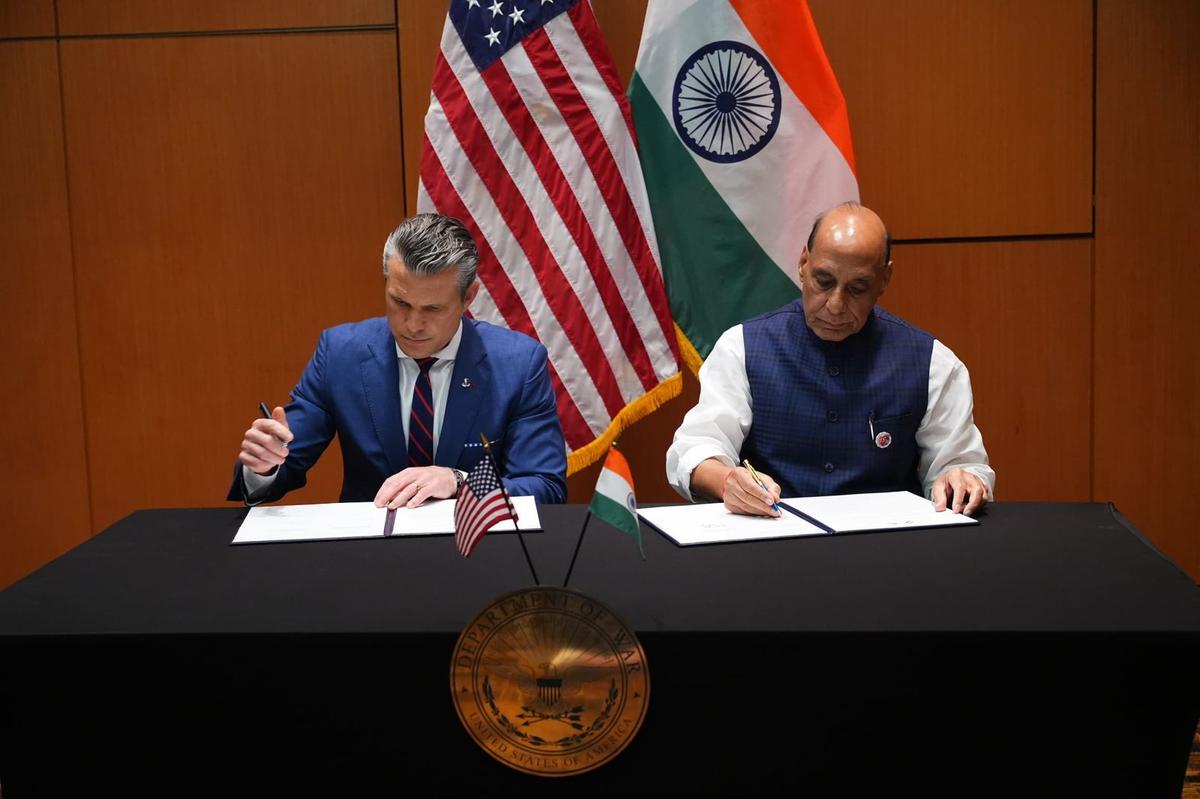
Defence Minister Rajnath Singh met US Secretary of War Pete Hegseth in Cebu on 28 October 2026, a year after the two signed the India US defence framework. The Ministry of Defence (MoD) readout covers terrorism, co-production and maritime security. It does not mention the $686 million F-16 package for Pakistan, which Indian media report Singh raised, citing officials. The US notified that package to Congress 34 days after the framework was signed.
India has made this objection before and kept the relationship moving. In September 2022, days after Washington approved a $450 million F-16 sustainment package, the MoD itself announced that Singh had conveyed India’s concern to then US Secretary of Defense Lloyd Austin. The 2026 readout carries no such line.
What the India US Defence Framework Is, and What It Is Not
The framework is a 10-year policy document that Singh and Hegseth signed in Kuala Lumpur on 31 October 2025, the third of its kind after 2005 and 2015. The MoD release said it is meant to give a unified vision and policy direction. As the ministers describe it, the framework sets direction; purchases and co-production run through separate contracts. Its full text is not public.
The 2025 release added that the two ministers reviewed ongoing defence issues and the challenges that persist. The 2026 readout has no equivalent line. It speaks of operational readiness, technology sharing and defence industrial integration, and of a shared commitment to eliminate terrorism. The India-US defence framework also sits beside a separate trade track that TES has followed in its report on the Russian oil tariff.
What the India US Defence Framework Delivered: Javelin and a Drone Lease Signed, Engines Pending
Two deals signed in the first year of the India US defence framework are on the record: a 30-month lease of two more MQ-9B SeaGuardian drones for the Navy, signed on 17 August 2026 at ₹1,943 crore, and the Army’s Javelin anti-tank missile agreement of 28 August. Two larger items are cleared but not contracted: six more P-8I aircraft and the GE F414 engine co-production deal. The Army reportedly dropped the Stryker.
For Javelin, the US had approved 100 missiles and 25 launch units at an estimated $45.7 million, and Tata is reported as the Indian partner for co-production. The F414 matters more to the Air Force. GE and HAL concluded technical talks in April 2026 and expected a commercial contract within the financial year, which ends on 31 March 2027. GE’s earlier F404 delivery delays already made HAL miss a Tejas Mk1A deadline, and the F414 is also meant to power the first AMCA squadrons, a timeline TES examined in its report on the AMCA first flight.
The Defence Acquisition Council cleared the six P-8I on 12 February 2026, and TES found no signed contract. Stryker was reportedly shelved after high-altitude trials, although the MoD denied a blanket pause.
Why the F-16 Package Matters to India, and Why the Readout Stays Silent
The US notified Congress on 4 December 2025 of a $686 million sale to Pakistan: 92 Link-16 data-link systems, avionics and cryptographic updates, and support to extend F-16 service life to 2040, with Lockheed Martin as principal contractor. The US notification says the sale will not alter the basic military balance. India’s reported objection, attributed to officials in Indian media, is that sensitive technology could reach third countries.
The US case, as written, rests on counterterrorism and interoperability with US and partner forces. It records a US determination that Pakistan can protect the technology to substantially the same degree as the US Government, and it classes its most sensitive items as Secret. India’s reported concern links Pakistan’s military ties with China to that technology, and the notification does not take up that link.
The 2026 readout carries a different message. Singh called for zero tolerance towards nations that support, train or fund terrorist organisations, and Hegseth reaffirmed US support to India against cross-border terrorism. TES found no on-record confirmation of the F-16 point from the MoD or the Ministry of External Affairs. TES reads the terrorism language as the public carrier of the message and the F-16 objection as a point India kept off the readout while the review of the India US defence framework went ahead. That is an assessment. The ministry has not said so.
What Cebu Added Beyond Washington: A Quad Round, BrahMos for Manila, a Counter-Terrorism Offer
Singh held six bilateral meetings on 28 October, with the US, Japan, Australia, the Philippines, South Korea and Singapore, which completed a round with all four Quad defence ministers. With Philippine Defence Secretary Gilberto Teodoro he backed UNCLOS and freedom of navigation and noted progress on the BrahMos project. On 29 October he offered ASEAN partners India’s counter-terrorism experience through joint exercises, capacity-building and intelligence-sharing.
The Philippines signed for shore-based BrahMos in January 2022, and the Defence Secretary said in May that he understood Vietnam’s deal had been signed but not announced. TES has followed the India-Vietnam BrahMos deal. For Indian forces the practical read is Javelin for the Army, F414 timing for the Air Force, and the MQ-9B lease and P-8I for the Navy’s maritime awareness. For the Indo-Pacific, one day in Cebu put India in talks with all four Quad defence ministers and a front-line ASEAN state, without joining any bloc.
What to Watch Before the Next Milestone
When will the F414 contract be signed? GE and HAL said in April that a commercial contract was likely within the current financial year, which ends on 31 March 2027. No signing is on record.
Will India put the F-16 objection on the record? Not so far. The MoD readout does not mention it, and TES found no confirmation from the ministry or the MEA.
Did the 2022 F-16 objection stop what became the India US defence framework? The record says no. After it, India signed the 31-aircraft MQ-9B deal in October 2024 and this framework in October 2025.
The India US defence framework’s first year produced signatures. The second will be judged on delivery: whether the F414 contract is signed this financial year, whether Javelin co-production gets dates, and whether the Pakistan package changes how India sequences its asks. New Delhi does not have to choose between the tracks. It can keep buying and co-producing with Washington while stating its F-16 concern in diplomatic channels. The 2026 readout chose emphasis over detail, and the next one will show whether that holds.
Source note: MoD releases of 28 October 2026 and 31 October 2025; US Defense Security Cooperation Agency transmittal 22-08 (Congressional Record, 8 December 2025); ANI and other reports of the Cebu meetings; company and trade reports on the deals. Reports attributing the F-16 objection to officials are not confirmed by the ministry.