Defence Analysis · 28 October 2026 · DAC meeting of 26 October
The Ministry of Defence gave the Navy’s Active Offboard Decoy System (AODS) one sentence in its release of 26 October 2026: it will enhance the credibility of anti-missile defence against modern anti-ship missiles of adversaries. No cost, quantity, developer or ship class follows. The active offboard decoy system sits inside a Defence Acquisition Council (DAC) clearance of about ₹2.12 lakh crore (about $22 billion), so this analysis separates the official record from what comparable systems elsewhere publicly do.
The clearance is an Acceptance of Necessity (AoN), the first step before a request for proposals, trials and a contract. TES has set out what the ₹2.12 lakh crore clearance buys the Army, Navy and Air Force in a separate analysis.
- The DAC gave AoN on 26 October for the Navy to procure the active offboard decoy system and other major naval platforms. This is in-principle approval, not a contract.
- The ministry gives no value, quantity or developer for the decoy system. About 82 per cent of procurements in the whole package are to come from Indian industry.
- Active offboard decoys are a documented category abroad: the US Navy describes its Nulka as a decoy that lures radar-guided missiles away from ships.
- India has a record of its own: DRDO chaff rockets and the Maareech torpedo decoy. The release does not say who will build the AODS.
What the Ministry Said About the Active Offboard Decoy System, and What It Left Out
The ministry’s release, issued through the Press Information Bureau (PIB), says the DAC under Defence Minister Rajnath Singh gave AoN to proposals of about ₹2,12,000 crore. For the Navy it names the Active Offboard Decoy System and other major naval platforms. It says the decoy system will improve anti-missile defence against modern anti-ship missiles, and that about 82 per cent of procurements will come from Indian industry.
That is the full official record. The release gives no value for the decoy system, no number of units and no ship class. It names no developer or manufacturer, and it does not say whether the 82 per cent, which covers the whole package, applies to this item. Accounts that describe how the system works go beyond what the ministry has published, and TES treats them as unverified.
Figure: only the Acceptance of Necessity for the active offboard decoy system has been announced. Later stages follow the usual order, without dates.
How an Active Offboard Decoy Lures a Radar-Guided Missile Away from a Warship
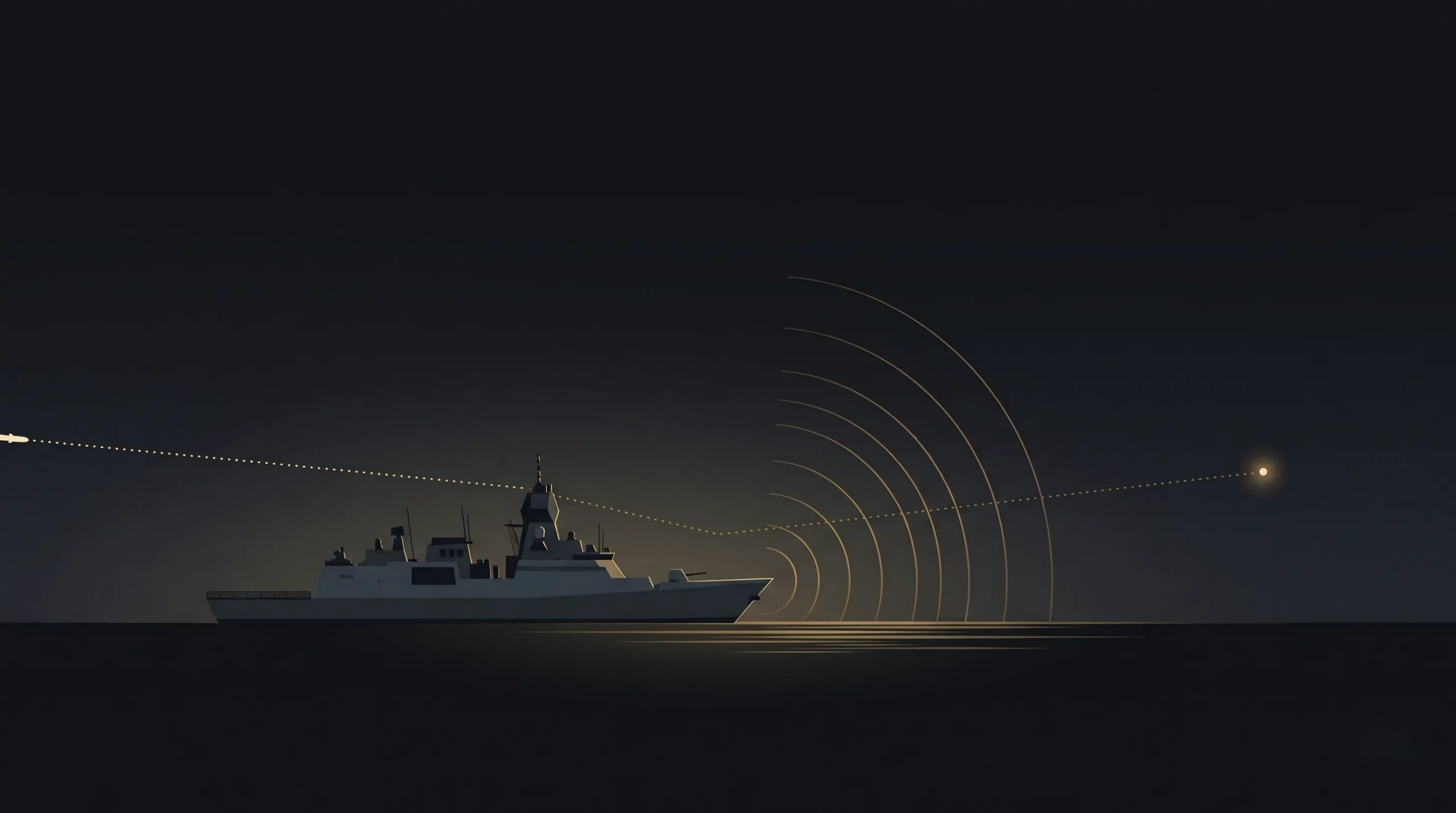
Public descriptions of comparable systems explain the category. The US Navy’s fact file on its MK 53 decoy launching system, Nulka, calls it a rapid-response active expendable decoy. After launch the decoy radiates a large, ship-like radar signature while flying a path that draws radar-guided anti-ship missiles away from the vessel. Australia developed the hovering rocket and the United States the electronic payload. India’s design has not been published.
Two words in the name carry the meaning. “Active” indicates a decoy that generates its own signal, unlike chaff, which the ministry itself has called a passive expendable countermeasure. “Offboard” indicates that it leaves the ship, so the missile’s seeker is drawn towards a point away from the hull. This is TES’s reading of the ministry’s terminology. The release does not confirm that the AODS follows the Nulka pattern.
The idea has a hard origin. On 4 May 1982 an Exocet missile struck HMS Sheffield during the Falklands War, killing 20 crew and injuring 26, according to Australia’s Defence Science and Technology Group, whose account of the Nulka decoy opens with that attack.
India Already Fields Passive Decoys and Torpedo Countermeasures: What an Active System Adds
India has built its own decoys before. In April 2021 the ministry announced that a DRDO laboratory, Defence Laboratory Jodhpur, had developed short-, medium- and long-range chaff rockets, after Navy trials in the Arabian Sea found their performance satisfactory, and said the technology would pass to industry. In June 2020 the Navy inducted the Maareech anti-torpedo decoy, designed by DRDO, with Bharat Electronics Limited (BEL) producing it.
Both followed one path: DRDO development, Navy user trials against the service’s stated requirements, then production by industry or a public-sector unit. The release does not say whether the AODS follows it. If it does, the Naval Staff Qualification Requirements, the standard the Navy cited for Maareech, would be the likely yardstick. That is a TES assessment.
Chaff forms a passive cloud, and a torpedo decoy answers an underwater threat. An active offboard decoy system addresses a third problem, the radar-guided missile, which the ministry’s sentence names directly. For the Navy the gain is a further layer that diverts a missile instead of destroying it, alongside the interceptors and guns already on its ships. How much the layer adds depends on range, the seeker types countered and reload capacity, and the release states none of these.
The package also cleared counter-drone systems for the Army, a different threat with its own economics, which TES has examined in its analysis of the counter-drone cost exchange. Decoy launchers are fitted to hulls, so the pace of Indian Navy warship inductions at GRSE and Mazagon Dock sets the pace at which any new system could find ships to protect.
Which Indian Firms Could Build It? The Release Names None
No company is named in the DAC release, so any list of beneficiaries is inference. The ministry says about 82 per cent of procurements in the package will come from Indian industry. At that share, about ₹1.74 lakh crore of the ₹2.12 lakh crore would go to Indian suppliers. That is TES arithmetic and assumes the 82 per cent is by value, which the release does not state. An AoN is not an order.
Defence stocks rose in early trade on 27 October, press reports said, but a decoy line with no value and no named supplier gives investors little to price. BEL’s valuation and order-book position are set out in TES’s comparison of BEL, Cochin Shipyard and BEML.
What to Watch After the Active Offboard Decoy System Clearance
An AoN precedes a request for proposals, and the release gives no timeline. The ministry’s release of 3 July 2025 stated that its AoNs were accorded under the Buy (Indian-IDDM) category, for items indigenously designed, developed and manufactured. This release carries no category for the decoy system, so the first request for proposals will be the signal.
Who will develop the active offboard decoy system?
The release names no developer. Precedent points to DRDO laboratories and public-sector production, as with the chaff rockets and Maareech, but the release does not rule out other routes. TES will not name a supplier until a document does.
Which ships will carry the active offboard decoy system first?
The release does not say. It describes the other major naval platforms as indigenously designed and constructed, which is a separate line item. A fitting plan for existing and new hulls will emerge from the request for proposals and trial documents, if the ministry publishes them.
The Takeaway: One Sentence Now, a Request for Proposals Next
The Navy has an approved need for a layer that diverts radar-guided missiles, and a ministry sentence that names the threat. In public it does not yet have a design, a supplier or a date. A single Exocet in 1982 opened the story of the Nulka decoy; India’s own story begins with a one-sentence approval.
The next documents, a request for proposals and a trial schedule, will show whether the active offboard decoy system follows the DRDO-to-industry route that produced India’s chaff rockets and Maareech. Until then the verifiable record is the ministry’s one sentence, and the useful signal is the procurement category it chooses.
Source note: Ministry of Defence release of 26 October 2026 (PIB), the ministry’s April 2021 chaff statement, the Navy’s June 2020 Maareech release, and public US Navy and Australian defence science descriptions of the Nulka decoy. Interpretation of how India’s system may work is TES’s own reading.