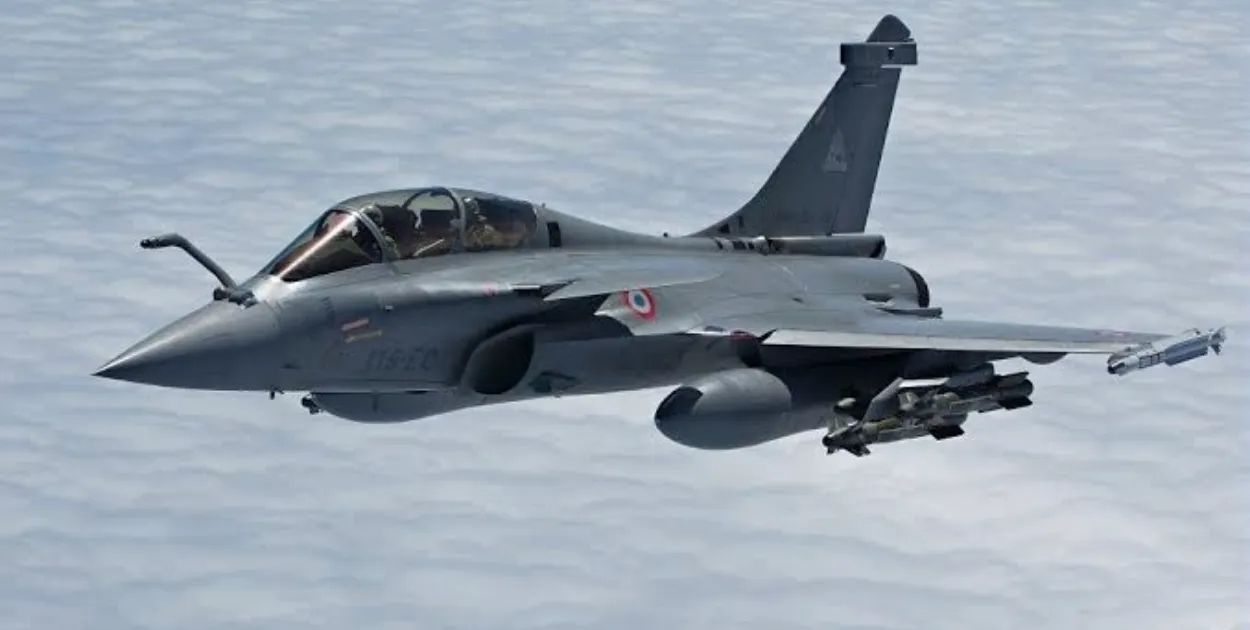
India’s proposed 114-jet Rafale order is worth about ₹3.25 lakh crore, roughly €30 billion at ₹108.4 to the euro, yet France’s public finances barely register it. By TES arithmetic the sum is about a fifth of one year’s French deficit, and most of the aircraft would be assembled in India. The weight of the order falls on Dassault, which booked no new Rafale orders in the first half of 2026. That gap is the source of India Rafale deal leverage in the talks now under way.
Does France’s Debt Give India Rafale Deal Leverage?
France’s debt is large and still growing. Insee, the national statistics office, puts public debt at €3,595.5 billion, or 119.0 per cent of GDP, at the end of June 2026. The Paris government expects it to reach 121.7 per cent in 2027 and the annual debt charge to rise from about €79 billion this year to €91 billion, Euronews reported.
Defence is being shielded from that squeeze. The 2027 budget bill lifts armed forces appropriations to €63.4 billion from about €57 billion, according to OpexNews, and Prime Minister Sébastien Lecornu has promised to leave the armed forces untouched while most ministries face at best a flat year. Parliament has also adopted a €36 billion increase to the 2024–2030 military programming law, Lecornu said. The cost-of-living protests of 17 October, which ended with a group attacking and burning Limoges city hall, show how little room Paris has for cuts elsewhere.
French debt therefore does not translate into French defence cuts, and it is not the source of India Rafale deal leverage by itself. What it does is raise the value, to Paris, of defence money that does not come from the French budget. TES has set out the wider partnership in its analysis of the India–France strategic partnership.
How Much of the ₹3.25 Lakh Crore Would Reach France?
Trade reporting carries a range of $30 billion to $39 billion for the deal. Quwa notes that the higher figure appears to restate the Indian industrial share and not the full contract. TES uses ₹3.25 lakh crore, the figure in the Quwa report on the bid. Dassault, France’s Direction générale de l’armement and India’s Ministry of Defence had not publicly confirmed the filing, which the report dates to 6 or 7 August 2026.
| Measure | Figure | Basis |
|---|---|---|
| Proposed order value | ₹3.25 lakh crore (about €30 billion) | Quwa; TES conversion at ₹108.4 per euro |
| Aircraft split | 20 flyaway, 94 built in India | Quwa |
| French public debt | €3,595.5 billion (119.0% of GDP) | Insee, end-June 2026 |
| Annual deficit | About €154 billion (5.1% of GDP) | TES arithmetic from Insee ratios |
| Debt charge, 2026 and 2027 | About €79 billion; €91 billion | French government figures via Euronews |
| Dassault backlog, 30 June 2026 | €45.4 billion | Dassault results, as reported |
| Order against backlog | About two-thirds | TES arithmetic; booking basis may differ |
Set against the French state, the order is modest: under 1 per cent of the debt stock, and about a fifth of one year’s deficit even if the whole sum arrived in France at once, which it would not. Set against Dassault, it is large, and that asymmetry is what gives India Rafale deal leverage. At headline value the order equals about two-thirds of the manufacturer’s entire backlog, though Dassault’s own booking could be lower because of the Indian assembly share.
Why Dassault’s Empty First Half Raises India Rafale Deal Leverage
The comparison year is telling. Dassault’s first half of 2025 included India’s order for 26 Rafale Marine fighters, signed on 28 April 2025 for about ₹63,000 crore (roughly $7.4 billion), according to Seeking Alpha. Without a comparable contract, first-half 2026 order intake fell by almost two-thirds. Dassault’s cash position has been supported by advance payments from export customers, a report on the results said, which gives export orders a financing role as well as a commercial one.
The production line adds pressure. Dassault delivered 26 Rafales in 2025, 15 for export and 11 for France, AeroTime reported, against a stated aim of four a month. It delivered 12 in the first half of 2026 and needs 16 in the second to meet guidance of about 28, according to summaries of the results.
France is not filling the gap with its own orders. The 2024–2030 programming law update left the fighter format at 225 aircraft and moved about 20 Rafale deliveries from 2031–32 to 2033–34 so that they arrive at the F5 standard, Opex360 reported. The stated reason is technical and linked to deterrence, not fiscal. The effect is that Dassault’s near-term loading depends on exports.
The history is a reminder that leverage cuts both ways. The original 126-jet Rafale plan stalled over who would answer for aircraft built by Hindustan Aeronautics Limited, and India bought 36 aircraft in a government-to-government deal instead. This time Dassault is reported to have accepted direct responsibility for the aircraft, with most built in India.
Where the Rafale Talks Are Stuck: Source Code, Integration and Timing
The Defence Acquisition Council cleared the Acceptance of Necessity on 12 February 2026, India issued its Letter of Request in May, and France asked for time until mid-August to respond, according to reporting by Migflug citing ANI. The Defence Secretary also said Dassault has agreed to integrate Indian weapons and systems on the aircraft, which would be built under a buy-and-make programme. Other Indian reporting puts signature at around March 2027. Dassault’s results call, as summarised, described the Indian order as in single-source negotiation.
The extra India Rafale deal leverage has limits. The Rafale is France’s airborne nuclear delivery platform, so Paris has a security reason to guard core software that has nothing to do with money. TES’s assessment is that Delhi can press harder on localisation, price and weapons integration through defined interfaces than on source code. The earlier phases of the relationship are covered in TES’s report on the Macron India visit and the Rafale deal, and the aircraft’s capabilities in its analysis of the 114 Rafale deal and the F4 and F5 standards.
What to Watch Between Now and March 2027
- Signature: clearance by India’s Cabinet Committee on Security and a contract date, whether at year-end or by March 2027.
- Integration terms: the clearest test of India Rafale deal leverage is any announcement on Indian weapons fitted through controlled interfaces, which would show where France has drawn its line.
- Dassault deliveries: whether the 16 aircraft needed in the second half arrive, as a test of the production ramp.
- Dassault full-year orders: whether any Rafale contract is booked before the year closes.
- Indian budgets: how the capital outlay is provided, as discussed in TES’s preview of India’s defence budget 2027.
In TES’s assessment, the money will matter less in the final contract than the terms, and India Rafale deal leverage will be spent on those terms. France’s debt raises Paris’s cost of a failed negotiation without loosening its hold on core software, so the likelier outcome is a deal that gives India more local work and weapons integration than source code. The test is whether the signature lands before the French election cycle absorbs Paris’s attention.