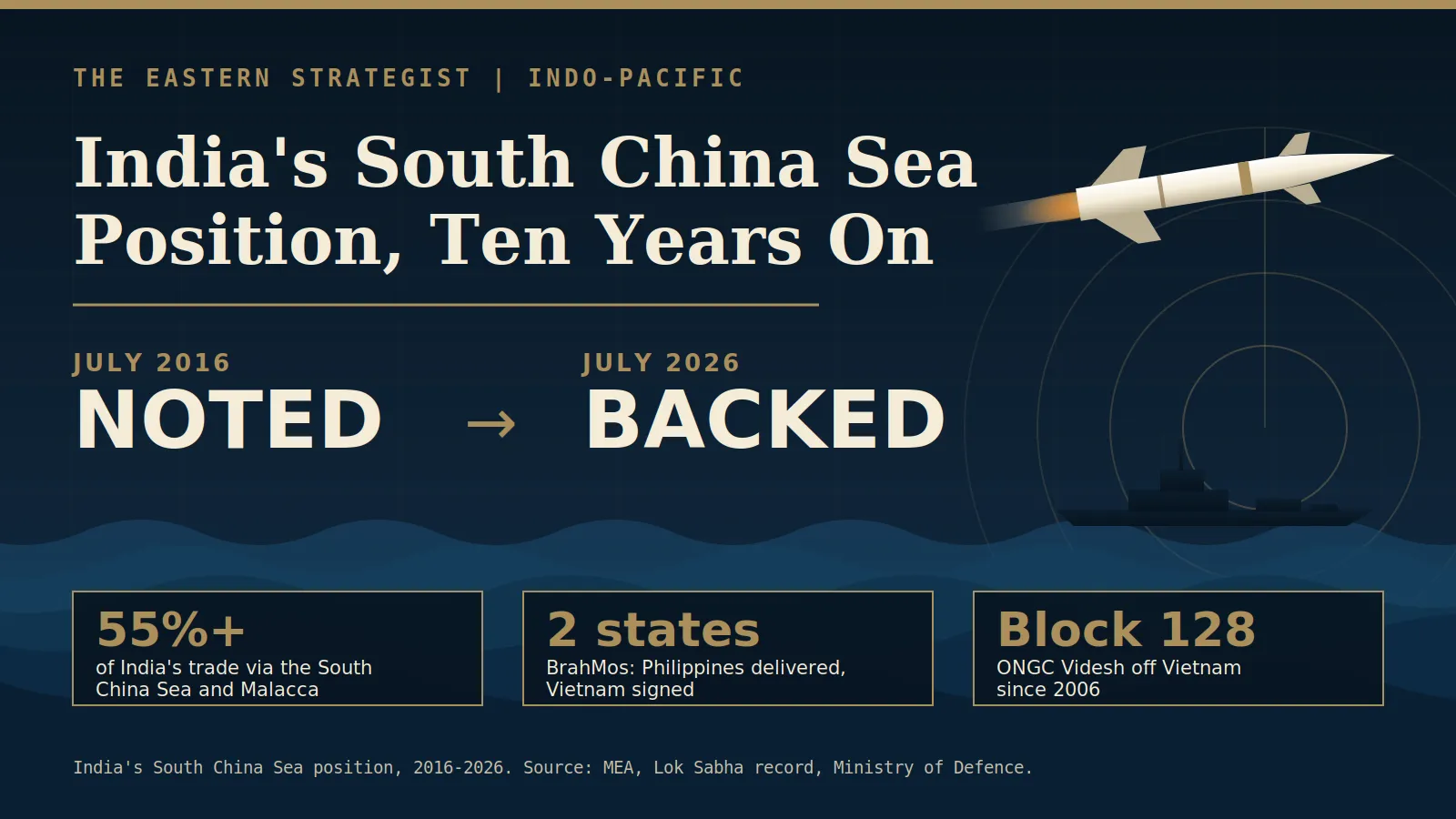
India claims no feature in the South China Sea. It has nonetheless delivered BrahMos missiles to the Philippines, signed a similar deal with Vietnam, and held an oil block off Vietnam since 2006 without finding commercially recoverable reserves. India’s South China Sea position, as the Ministry of External Affairs (MEA) put it on 14 July 2026, now rests on the 2016 arbitral award, which it called a significant milestone and the basis for settling disputes peacefully. In 2016 Delhi said only that it had noted the ruling.
The statement came two days after the United States, the United Kingdom and 12 other countries marked the award’s tenth anniversary with a joint statement. India was not a signatory, and the MEA spokesperson was answering a question about it. October has since brought a spike in Philippine-Chinese encounters, according to maritime-security trackers, while the Association of Southeast Asian Nations (ASEAN) and China work to finish a Code of Conduct by the end of 2026.
What the 2016 Arbitral Award Decided and Why China Rejects It
A tribunal constituted under Annex VII of the United Nations Convention on the Law of the Sea (UNCLOS) delivered its award on 12 July 2016, in a case brought by the Philippines. It found no legal basis for China’s claim to historic rights over the waters inside its nine-dash line, because UNCLOS defines what maritime rights coastal states hold. China rejects the ruling.
UNCLOS gives a coastal state sovereignty over a territorial sea of up to 12 nautical miles and sovereign rights over fisheries and energy in an exclusive economic zone (EEZ) of up to 200 nautical miles. The tribunal also ruled that many of the features China holds in the sea are rocks or low-tide elevations, not full islands, which limits the zones they can generate. That distinction decides who may fish, drill and patrol around a given reef.
Beijing claims sovereignty over almost the entire sea, which is why India’s stake in the South China Sea is largely about rules, not territory. Vietnam, the Philippines, Malaysia, Brunei and Taiwan hold overlapping claims. India is a State Party to UNCLOS and, in a 2022 Lok Sabha reply, the MEA said India had urged all parties to show utmost respect for the Convention.
Why India’s South China Sea Position Now Backs the 2016 Award
India’s stance has moved in three public steps. In July 2016 the MEA said it had noted the award. In June 2023 an India-Philippines joint statement urged adherence to UNCLOS and the 2016 award, the first such reference. On 14 July 2026 the MEA spokesperson called the award the basis for resolving disputes peacefully, while stressing freedom of navigation, overflight and unimpeded commerce.
The wording is measured. As reported, the July statement names no country, ties the award to UNCLOS, and calls India’s position well known. In TES’s assessment, that lets Delhi put a legal text on record without joining a group statement, which fits India’s strategic autonomy.
Analysts tie the change to the continental front. Amrita Jash and Don McLain Gill argue in a 2026 journal article that the 2020 Galwan clash sharpened India’s threat perception, while Southeast Asian states’ growing willingness to engage India opened space for a larger role, which makes the shift cumulative, not abrupt.
USNI News reported in 2023 that the border dispute and India’s place in the Quad’s vision of a free and open Indo-Pacific had made it more supportive of partners such as the Philippines. In TES’s assessment, a stated legal basis also gives Indian defence exports and naval visits a footing that does not depend on joining any coalition.
Analysts read the shift differently. Indian maritime analyst Abhijit Singh argued after the 2023 text that India had not abandoned caution in balancing China. India’s South China Sea position in 2026 came from the MEA spokesperson at a media briefing, in India’s own voice, not from a bilateral text negotiated with a partner.
Figure: Key public markers in India’s South China Sea position. Source: MEA statements and Lok Sabha record.
How Much of India’s Trade Rides on the South China Sea and Malacca
In a Lok Sabha reply of 1 April 2022, the MEA said over 55 per cent of India’s trade passes through the South China Sea and the Malacca Strait, and that over US$5 trillion of world trade uses the region’s sea lanes. The figure covers both waterways together, so it should not be read as a measure of India’s South China Sea exposure alone.
The two are not the same route. Trade with Malaysia, Indonesia, Singapore and Thailand moves through Malacca without entering the South China Sea, while cargo to and from Vietnam, China and the Koreas does enter it. One analyst estimate puts the South China Sea share at roughly a quarter of India’s maritime trade; it is not an official figure.
The goods behind the exposure are specific. The Commerce Ministry has told Parliament that most Indian imports from China are raw materials, intermediate goods and capital goods: active pharmaceutical ingredients, auto components, electronic parts, mobile phone parts and machinery. The Embassy of India in Hanoi lists electronic and telecom equipment, machinery, chemicals, plastics and textiles among imports from Vietnam. In TES’s assessment, a disruption on these lanes would reach Indian factories before it reached shop shelves.
Alternatives to Malacca already feature in Indian strategic debate. TES has examined two of them: the Lombok Strait and the proposed Kra Isthmus land bridge.
What India Holds on the Water: Block 128 and the Eastern Fleet
India’s physical presence is small in scale and long in duration. ONGC Videsh Limited (OVL), the overseas arm of ONGC, holds the 7,058 sq km deepwater Block 128 off Vietnam under a contract signed in May 2006, with its exploration licence last reported extended to 15 June 2026. The Indian Navy’s Eastern Fleet called at Singapore, Vietnam and the Philippines between 16 July and 3 August 2025.
Block 128 has yielded no commercially recoverable reserves, and officials have said OVL stays for strategic reasons. Part of the block lies inside the nine-dash line, and China has objected to Indian activity there. The licence has been renewed eight times in all.
The 2012 episode set the pattern. In May that year India’s junior oil minister told Parliament that OVL had decided to return the block to Vietnam because exploration was not commercially viable. In June, China’s state-owned CNOOC offered nine blocks to foreign bidders, including parts of Block 128. Vietnam then offered OVL fresh data, and OVL reversed course.
It has stayed ever since.
Elsewhere off Vietnam, OVL holds 45 per cent of the producing Block 06.1, where its contract was extended by 16 years to 2039. The block produced 0.693 million tonnes of oil and oil-equivalent gas in 2022-23.
The Ministry of Defence’s Annual Report 2025-26 records the Eastern Fleet deployment, in which INS Shakti, Satpura, Delhi and Kiltan held exercises with host navies at each port. In the same reporting year INS Sahyadri deployed to the Sea of Japan and Guam from 26 September to 11 December 2025 and took part in Malabar 2025.
BrahMos Exports Make India a Supplier to Two Claimant States
India signed a US$375 million contract in January 2022 to supply the Philippines three shore-based BrahMos anti-ship missile batteries; the first two were delivered in April 2024 and April 2025. On 30 May 2026, Defence Secretary Rajesh Kumar Singh confirmed at the Shangri-La Dialogue that Vietnam has signed a similar deal. He said talks with Indonesia were in final stages and gave no financial details.
The export line is widening. BrahMos Aerospace, the Indo-Russian joint venture that makes the missile, now has deliveries to one claimant state, a signed deal with a second and talks with a third Southeast Asian customer. Singh described India’s commitment to ASEAN nations as strong and the region’s countries as trusted partners.
TES has covered both deals: how BrahMos is changing deterrence in the South China Sea and the Vietnam deal. Analysts caution that a coastal battery may carry more symbolic than strategic weight against a navy and coast guard of China’s size, and Jash and Gill note that India’s wider role has not made it a decisive security provider. In TES’s assessment, a battery does not need to defeat a fleet to matter: area-denial weapons raise the cost of operating close to a coastline, which is their purpose.
Why BrahMos Export Orders Matter for Indian Defence Manufacturing and Investors
BrahMos exports are landing on a production network that its chief executive says is already running at full capacity. BrahMos Aerospace chief executive Jaiteerth Joshi said on 22 October 2026 that its plants at Hyderabad, Nagpur, Pilani and Lucknow are at full capacity, with deliveries owed to the Army, Navy and Air Force. The Lucknow integration and testing facility, inaugurated in May 2025 at a reported cost of ₹300 crore, is the newest of the four.
Domestic orders are also arriving. On 6 October 2026 the Ministry of Defence signed a ₹661.50 crore contract with BrahMos Aerospace for fire control systems and launchers for Indian Navy ships, under the Buy (Indian-IDDM) category, with at least 68 per cent indigenous content and a role for MSMEs.
Export value is the part still unconfirmed. Press reports put the Vietnam contract at about ₹6,000 crore (US$629 million), a figure the Defence Secretary did not give and the Ministry of Defence has not published. At that scale it would exceed the Philippine contract of US$375 million.
BrahMos Aerospace is a private company, not a listed one, so orders reach the stock market only through its vendors. Company disclosures and sector reporting name several. PTC Industries received a ₹110 crore order for titanium castings in August 2025 and a further sub-system order on 17 July 2026, whose value it did not disclose. Premier Explosives holds a ₹26.40 crore order for propellant casting and booster assembly over two years.
Data Patterns supplies electronic sub-systems and test equipment and has developed a fire control system and seeker. Jindal Stainless’s Hisar plant was accredited as a BrahMos Aerospace vendor in August 2024, and Goodluck India makes launcher structures.
The exposure is uneven. None of these firms is a BrahMos-only business, and no sub-vendors were named for the October contract, so company filings, not headlines, show how much work reaches each.
Disclaimer: This article is analysis for information only and is not investment advice. Companies are named from their own disclosures and sector reporting, not as recommendations. Readers should check company filings and consult a SEBI-registered adviser before acting on any market theme.
What October’s Clashes and the Code of Conduct Deadline Mean for Delhi
ASEAN foreign ministers said in July that they aim to conclude an effective and substantive Code of Conduct with China before the end of 2026. If they miss it, Singapore, the next chair, takes the talks forward. Chatham House analysts had judged in December 2025 that a deal in 2026 was unlikely.
Maritime-security trackers counted at least eight close encounters between Chinese and Philippine forces across the sea and the Luzon Strait from 1 to 20 October. The Philippines recorded 31 Chinese naval and coast guard vessels near four contested areas on 13 to 19 October, up from 27 the week before. On 19 October Manila summoned China’s ambassador over a remark that China could easily prevail in a conflict but would not choose force. On 20 October China said its naval forces had tracked a US Navy ship near Sabina Shoal.
The hardest unresolved point in the Code of Conduct is whether it will be legally binding, a position several Southeast Asian states support and China has not publicly endorsed. More than two decades after the non-binding 2002 Declaration on Conduct, the talks still turn on that question.
For India’s South China Sea interests, four markers will show how far the July position travels: whether ASEAN and China close the code by 31 December, whether the Vietnam and Indonesia BrahMos contracts reach delivery, how plants already at full capacity absorb them alongside Indian orders, and what happens to the Block 128 licence.
In ten years India has moved from observer to rule-supporter and supplier, still with no claim to any feature. The next phase will be judged on delivery: missiles, licences and the Code of Conduct.
India’s Four Levers in the South China Sea at a Glance
| Lever | What India has | Figure on record | Status |
|---|---|---|---|
| Legal | UNCLOS State Party; MEA backs the 2016 award | 14 July 2026 statement names no country | Stated position; no claim to any feature |
| Energy | OVL Block 128 (exploration) and Block 06.1 (producing, 45%) | 7,058 sq km; 0.693 million tonnes from Block 06.1 in 2022-23 | Block 128 licence last reported to 15 June 2026 |
| Defence exports | BrahMos to the Philippines and Vietnam | US$375 million (Philippines, three batteries); Vietnam value not disclosed | Two Philippine batteries delivered; Indonesia in final stages |
| Naval | Eastern Fleet port visits and exercises | 16 July to 3 August 2025 | Singapore, Vietnam and the Philippines |
Quick Answers on India and the South China Sea
Is India a claimant in the South China Sea?
No. India claims no feature or waters there. Its interests are trade, freedom of navigation, energy exploration under Vietnamese licences and defence partnerships.
What is India’s position on the South China Sea award?
On 14 July 2026 the MEA called the award a significant milestone and the basis for resolving disputes peacefully, consistent with UNCLOS.
Does India explore for oil in the South China Sea?
Yes, through ONGC Videsh under Vietnamese licences. Block 128 is an exploration block signed in 2006, and Block 06.1 is a producing block in which OVL holds 45 per cent.
Source note: MEA statements and Lok Sabha records, the Ministry of Defence Annual Report 2025-26, the 2016 award text, company licence disclosures, and reports from major news agencies and maritime-security trackers.