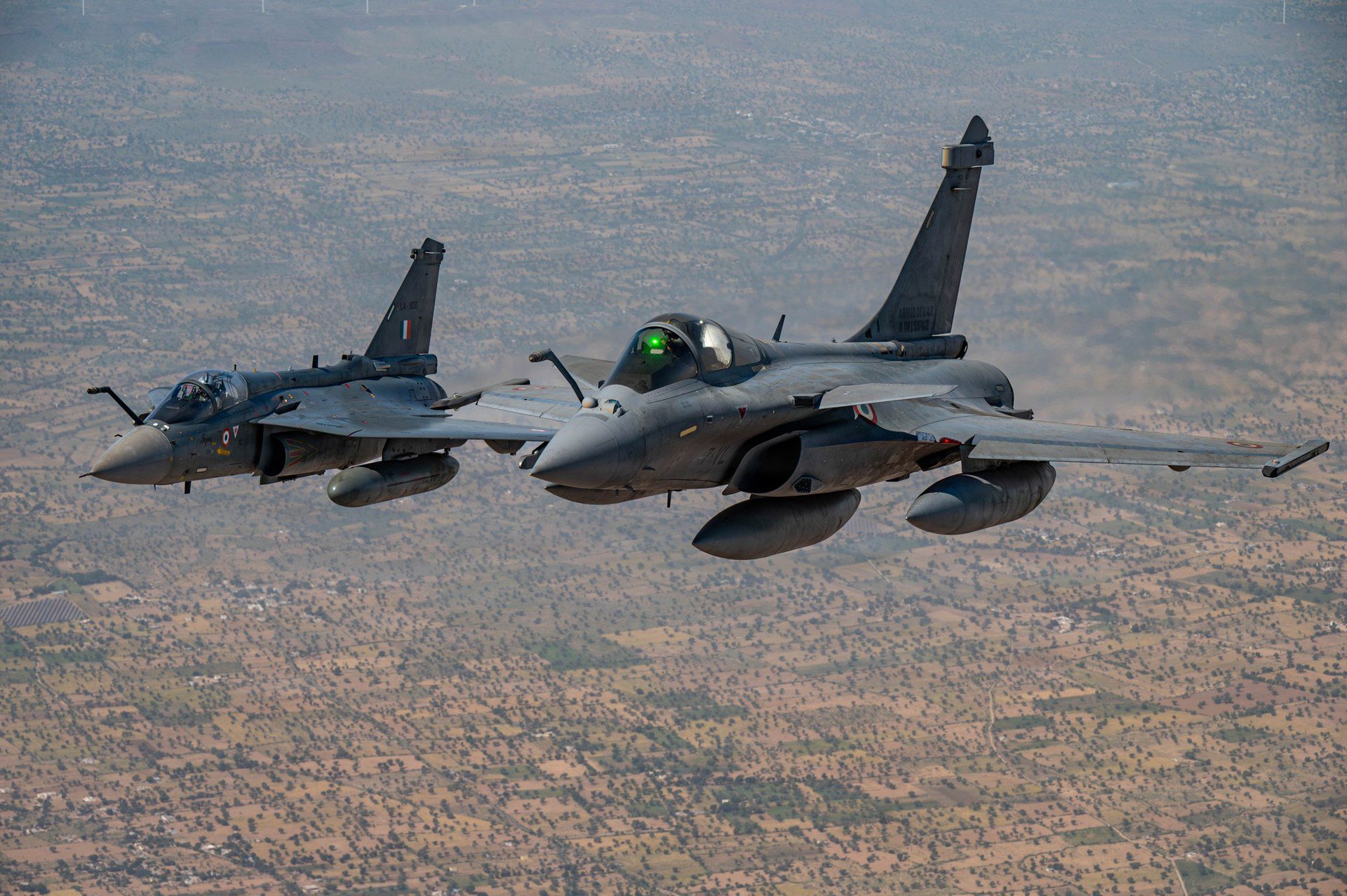
Multinational air combat exercises conventionally serve one of two purposes: military bloc integration under rigid command hierarchies, or superficial bilateral diplomatic posturing. On 12 October 2026, the Indian Air Force concluded Exercise Tarang Shakti 2026 at Air Force Station Jodhpur, demonstrating a consequential third path: directing premier Western combat aircraft alongside regional air arms under sovereign Indian airspace command, while transforming multinational wargames into an operational proving ground for domestic defence manufacturing.
For New Delhi, bringing seven Friendly Foreign Countries—Australia, Bangladesh, France, Germany, Sri Lanka, the United Arab Emirates, and the United States—into joint high-tempo flight operations across the Thar Desert is not routine interoperability. It is a live demonstration of multi-alignment translated into air combat doctrine. While alliance-based aerial exercises demand shared cryptographic protocols and unified geopolitical postures, South Block demonstrated that complex air warfare can be orchestrated across diverse platforms without compromising strategic autonomy.
What Happened at Exercise Tarang Shakti 2026?
Exercise Tarang Shakti 2026 concluded on 12 October 2026 at Air Force Station Jodhpur, marking India’s premier multinational air combat exercise. Hosted by the Indian Air Force, the drill brought together seven Friendly Foreign Countries—Australia, Bangladesh, France, Germany, Sri Lanka, the United Arab Emirates, and the United States—alongside 32 observer delegations, validating complex aerial strike, refuelling, and electronic warfare operations.
Running from 26 September to 12 October 2026, the second edition of the wargames built systematically upon the foundational drills conducted in 2024. Combat contingents deployed advanced fighter aircraft, airborne early warning and control (AEW&C) assets, tactical transport lifters, and air-to-air refuelling tankers. Operational sorties integrated mixed-force packages designed to simulate complex contested airspace scenarios, demanding seamless coordination across different data-link environments.
The scale of international observation underscored the shifting gravitational centre of Indian Ocean security. With 32 observer nations monitoring flight corridors and combat coordination protocols, New Delhi utilized the exercise as both a diplomatic platform and a demonstration of sovereign operational command. The drills paralleled maritime power projection exercises, such as the Indian Navy’s deployment during Exercise Konkan 2026, reflecting an integrated push to demonstrate cross-domain military professionalism.
Strategic Autonomy in Contested Skies
In operational terms, Exercise Tarang Shakti 2026 establishes New Delhi’s sovereign doctrine of strategic autonomy in high-intensity combat aviation. By orchestrating disparate Western, European, and regional air platforms through Indian Air Force command networks, the exercise demonstrated that India can conduct complex multinational aerial warfare without subscribing to formal military alliances or sacrificing operational discretion.
Rigid alliance frameworks often produce structural vulnerabilities. During the 1999 Kosovo air campaign, Colonel Zoltán Dani’s Serbian 250th Air Defence Missile Brigade exploited fixed NATO flight paths and predictable electronic emission patterns to shoot down an American F-117 stealth aircraft near Buđanovci. Centralized doctrine, Dani demonstrated, creates systemic blind spots that adaptive air defence networks can exploit.
India’s air doctrine operates on an entirely distinct premise. Rather than standardizing under external alliance command structures, the Indian Air Force maintains sovereign data networks capable of tactical interoperability with American, European, and regional partners simultaneously. Exercise Tarang Shakti 2026 validated that Indian mission commanders can integrate diverse electronic architectures without granting third-party access to critical communication backbones.
Atmanirbhar Pitch: Tejas and Prachand in Frontline Action
Beyond tactical combat drills, Exercise Tarang Shakti 2026 functioned as an operational proving ground for India’s indigenous aerospace platforms, notably the LCA Tejas and LCH Prachand. Demonstrating high-tempo sortie generation alongside premier international combat jets directly bolsters New Delhi’s credibility as an emerging aerospace exporter targeting partners across the Global South.
The operational presence of the Light Combat Aircraft (LCA) Tejas and the Light Combat Helicopter (LCH) Prachand within complex exercise envelopes sent an unambiguous signal to observing air delegations. Rather than cordoning domestic hardware off in static displays, the Indian Air Force operated indigenous platforms in mixed offensive and defensive counter-air scenarios alongside Western heavy fighters.
This operational exposure directly serves India’s expanding defence export offensive. Having already successfully finalized foreign air defence sales, notably covered in TES analysis on Akash missile system exports, the Ministry of Defence is actively positioning Tejas and Prachand for export customers in Southeast Asia, Africa, and the Middle East. Over 20,000 visitors attended the Jodhpur Open Day, while industrial tours gave foreign military attachés direct access to Indian tier-1 aerospace suppliers.
Market Impact: Defence PSUs and Aerospace Capex
The successful conclusion of Exercise Tarang Shakti 2026 signals accelerating order execution for domestic aerospace manufacturers, led by Hindustan Aeronautics Limited (HAL) and Bharat Electronics Limited (BEL). As the Ministry of Defence scales capital allocations for indigenous fighter squadrons, private tier-1 suppliers across titanium machining, radar sub-assemblies, and composite fabrication face expanding multi-year order books.
From an equity and macroeconomic perspective, the operational vindication of domestic aerospace platforms directly de-risks multi-year order execution cycles. Hindustan Aeronautics Limited (HAL) maintains an order book exceeding ₹1,20,000 crore ($14.4 billion), with manufacturing lines at Bengaluru and Nashik scaling production of the Tejas Mk1A. Bharat Electronics Limited (BEL) similarly secures multi-year earnings visibility through radar processing, electronic warfare suites, and avionics supply contracts.
Furthermore, broader defence infrastructure and industrial modernisation programmes—mirroring capital allocations in strategic maritime works like Project Seabird Karwar—continue to anchor domestic manufacturing. Private precision engineering majors such as Tata Advanced Systems, Larsen & Toubro, and Dynamatic Technologies stand to capture expanding sub-tier contracts as airframe and subsystem manufacturing deepens within Indian supply chains.
What Happens Next for Indian Air Power?
As the Indian Air Force marks its 94th Anniversary, the strategic trajectory shifts toward institutionalizing biennial multinational exercises while accelerating serial production of domestic combat platforms. Balancing squadron strength through Atmanirbhar procurement remains New Delhi’s operational priority to sustain multi-front deterrence across the Himalayas and the wider Indian Ocean Region.
The Indian Air Force currently operates below its sanctioned strength of 42 fighter squadrons, sitting at roughly 31 active combat squadrons as older legacy airframes retire. The institutional response from the Defence Acquisition Council (DAC) and South Block has been decisive: locking in serial procurement for 83 LCA Tejas Mk1A fighters followed by an additional sanction for 97 aircraft, while advancing the Advanced Medium Combat Aircraft (AMCA) fifth-generation programme under state-backed design reviews.
Exercise Tarang Shakti 2026 proved that numbers alone do not define air power. Systemic networking, operational flexibility, and sovereign technological autonomy establish real-world deterrence. By bringing seven air forces to Rajasthan and concluding two weeks of demanding wargames without doctrinal compromises, New Delhi has reinforced its stature: an indispensable aerospace power shaping the strategic architecture of the Indo-Pacific.
Source Note: Operational details and participant delegations drawn directly from official Ministry of Defence communications via the Press Information Bureau (PRID: 2322473) and the official Ministry of Defence portal released on 12 October 2026. Analysis of squadron trajectories, industrial order books, and strategic doctrine reflects The Eastern Strategist desk assessment.
Frequently Asked Questions
What was the primary focus of Exercise Tarang Shakti 2026?
The wargames focused on multi-domain air combat integration, tactical interoperability, and operational experience exchange among the Indian Air Force and seven participating friendly nations, alongside operational validation of indigenous platforms such as LCA Tejas and LCH Prachand.
Which countries participated in Exercise Tarang Shakti 2026?
The exercise featured seven Friendly Foreign Countries—Australia, Bangladesh, France, Germany, Sri Lanka, the United Arab Emirates, and the United States—alongside 32 observer nations hosted at Air Force Station Jodhpur.
How does this exercise impact India’s defence exports?
By operating indigenous systems including LCA Tejas and LCH Prachand in high-intensity multinational combat sorties, India demonstrated operational maturity and reliability to observing international delegations, boosting export pitches across Southeast Asia, Africa, and the Middle East.