
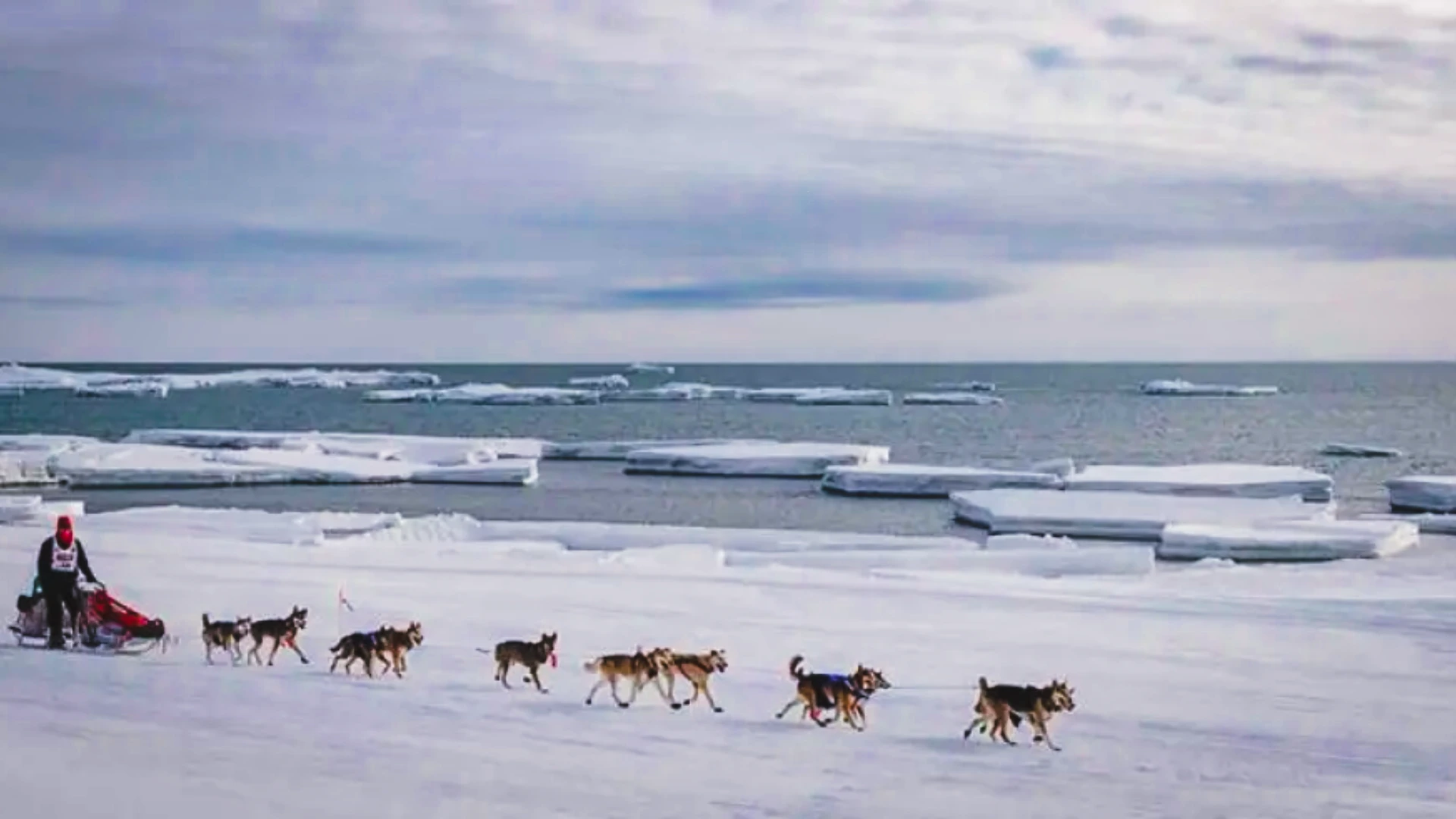
Bering Strait shipping set a record in 2026 through a gate only 82 kilometres wide. By 30 September, the Centre for High North Logistics (CHNL) had counted 104 full transits of Russia’s Northern Sea Route (NSR), against 103 for the whole of 2025. Every one of those voyages entered or left the Arctic Ocean through the strait, the only sea passage between the Pacific and the Arctic, and the place where the United States and Russia lie closest, 3.8 km apart at the Diomede Islands.
The season’s emblem was a container ship. By the CHNL’s count, four Asia-Europe transits were completed by 30 September, against one in all of 2025. Sea Legend’s Dubai Tower sailed from Qingdao to Tees in 21 days, Riyadh Mukaab from Ningbo to Felixstowe in 21, and Panstar Acro from Busan to Felixstowe in 20. Zhejiang Seaport, a Chinese state-owned port operator, puts the Suez alternative at more than 40 days.
Key takeaways
- The CHNL counted 104 full NSR transits by 30 September 2026, one more than all of 2025. Each one is Bering Strait shipping.
- Bering Strait shipping is a small part of NSR volume. Rosatom put total route cargo at 37.02 million tonnes (Mt) in 2025, much of it generated by projects inside the Russian Arctic.
- China moved from trial voyages to a timetable: Sea Legend completed eight scheduled departures with seven ships, and the CHNL counted four Asia-Europe transits against one in 2025.
- Bellona counted 50 oil tankers and 18 LNG carriers of Russia’s so-called shadow fleet on the route by mid-September, more than in all of 2025.
- The US ratified the 1990 maritime boundary agreement. Russia never did, and both have applied it provisionally for 36 years.
Why Bering Strait shipping runs through a gate only 82 km wide
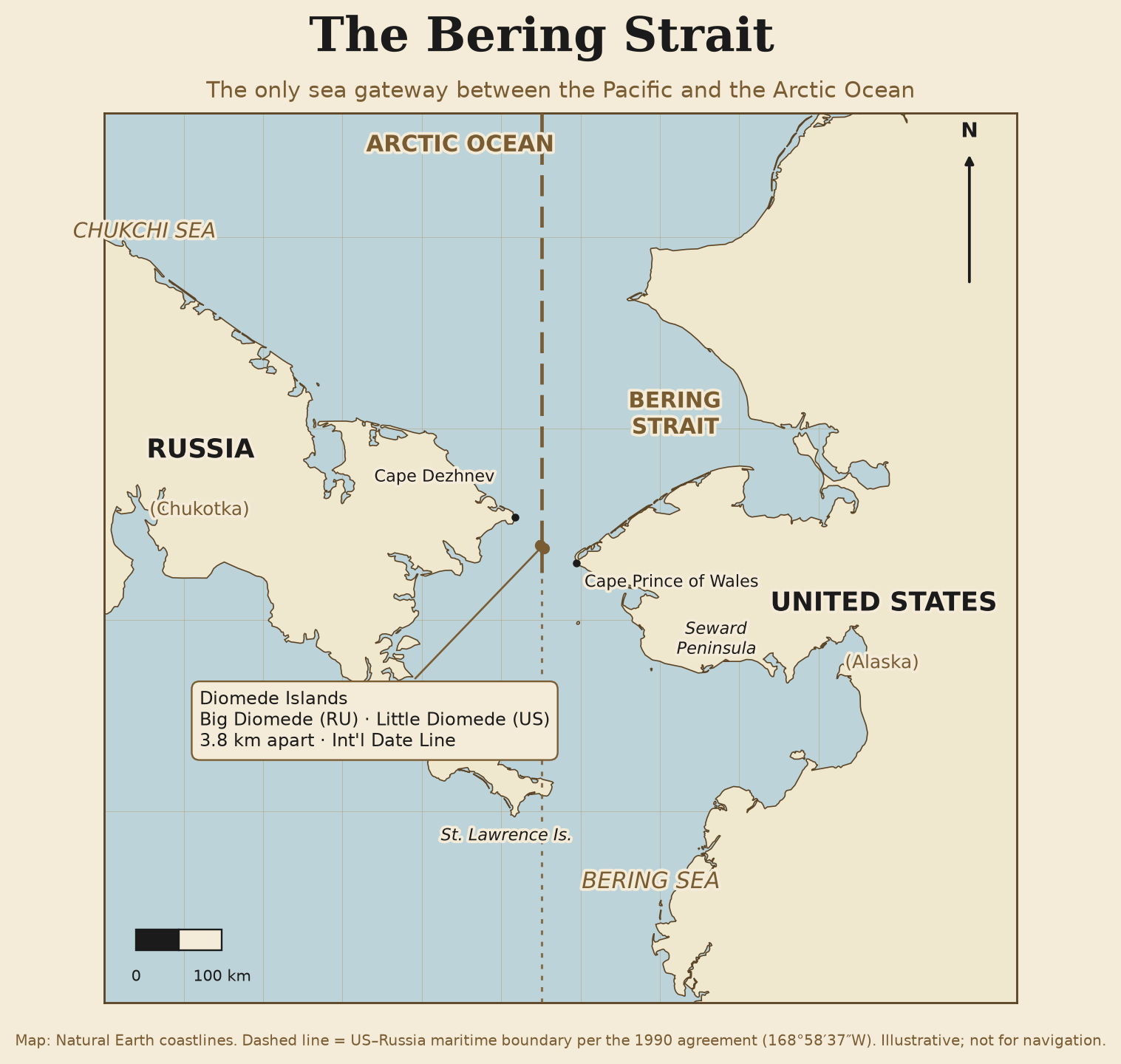
Every ship that sails the Northern Sea Route from Asia, or the Northwest Passage from the Pacific, must pass the Bering Strait. It is about 82 kilometres (51 miles) wide at its narrowest, between Cape Dezhnev in Russia’s Chukotka and Cape Prince of Wales in Alaska. Bering Strait shipping therefore funnels the Arctic’s entire Pacific-side traffic into one lane.
Two islands sit in the middle of it. Big Diomede is Russian and Little Diomede is American, and their closest points are 3.8 km (2.4 miles) apart. The International Date Line runs between them, so Big Diomede is 20 hours ahead of its neighbour while Alaska observes daylight-saving time, and 21 hours ahead in winter. Big Diomede holds a Russian border-guard station and little else. Little Diomede has fewer than 100 residents, nearly all Iñupiat.
Bering Strait shipping rules: voluntary routes drawn up by Moscow and Washington
The two governments jointly proposed a system of two-way routes in November 2017. The International Maritime Organization (IMO) approved it in May 2018, and it took effect on 1 December 2018. The US Coast Guard described six two-way routes and six precautionary areas in US and Russian territorial waters, meant to keep ships clear of shoals, reefs and islands. The routes are voluntary for all ships.
TES Analytical Assessment: The 2018 routes show that the two coast guards can still agree technical rules for the strait. They say nothing about who enforces anything in a crisis.
How much of the Northern Sea Route boom really crosses the Bering Strait?
Only a fraction. The CHNL’s 104 confirmed transits all had to cross the strait, but Rosatom reported total NSR cargo of 37.02 Mt in 2025. Bellona’s review of April traffic, for instance, found the main cargo generated by the Yamal LNG and Arctic LNG 2 projects, Russian oil fields and Norilsk Nickel. Bering Strait shipping is the eastern door of the route, not its main source of volume.
Not all Bering Strait shipping is trade flow. The CHNL’s count is 51 eastbound and 53 westbound voyages. Eastbound tanker and bulk carrier voyages were mostly loaded, but a substantial share of westbound bulk carriers were repositioning ships between Asia and Europe. The 104 voyages total about 7.8 Mt of deadweight, which measures ship capacity, not cargo carried.
Transit cargo was 3.2 Mt in 2025, according to a Rosatom statement that CHNL’s own estimates matched. For 2026 the CHNL’s indicative estimate is about 3.7 Mt. It was also tracking 45 further voyages on 30 September. If most complete, it says, the season could approach 150 transits and more than 4.5 Mt of transit cargo, though it calls both figures scenarios and not forecasts.
Rosatom’s chief executive, Alexey Likhachev, told Interfax on 1 September that he expects NSR cargo to grow about 14 per cent in 2026. On the 2025 base, that implies roughly 42 Mt. Shipments between Chinese and Russian ports made up 5.4 Mt of the 2025 total, and 23 container voyages ran between those ports. Chinese carriers plan more than 30 this year, he said.
The change that matters in Bering Strait shipping is the timetable. Likhachev said Sea Legend would run eight voyages from Ningbo to Felixstowe between August and October, about one a week, in contrast to earlier one-off trials. Trade reports say all eight were completed with seven ice-strengthened ships, carrying more than 14,000 twenty-foot equivalent units (TEU). The last two sailed on 27 September, earlier than planned, because the ice forecast worsened. The operator intends to return next summer and lengthen the season.
| Measure | Figure | Source |
|---|---|---|
| 2025: total NSR cargo | 37.02 Mt | Rosatom |
| 2026: expected total cargo (+14%) | about 42 Mt | Rosatom CEO; TES arithmetic |
| 2025: Russia-China cargo | 5.4 Mt | Rosatom |
| 2025: transit cargo | 3.2 Mt | Rosatom |
| 2026: transit cargo to 30 September | about 3.7 Mt | CHNL estimate |
| 2025: full transit voyages (whole season) | 103 | CHNL |
| 2026: full transit voyages to 30 September (season ongoing) | 104 | CHNL |
TES Analytical Assessment: The route is seasonal. The navigation window runs from about July to October, so any shipper using it needs a separate plan for the rest of the year. That limits how far Bering Strait shipping can substitute for the southern routes, whatever the headline transit times.
Is Bering Strait shipping now a route for Russian oil and LNG that Western sanctions target?
Partly. Bellona, an Oslo-based environmental organisation, counted 50 oil tankers and 18 LNG carriers of what it calls Russia’s shadow fleet on the NSR by mid-September 2026. That exceeds its totals for 2025, which were 38 and 13. About three-quarters of the oil tankers and nearly 40 per cent of the LNG carriers it observed were under sanctions.
The counts cover the whole route, not the strait alone. Bellona found at least 11 LNG carriers loading at the Utrenniy terminal serving Arctic LNG 2, and at least 14 oil tankers carrying oil to China or other Asian destinations. Eastbound voyages of the second kind would cross the Bering Strait. Cargoes from Utrenniy that head west never come near it.
Condition is a separate concern. Of the 50 oil tankers, 26 had an ice class of Ice3 or lower, or none at all, and 33 were at least 15 years old, according to Bellona.
More volume is likely. The European Union’s ban on Russian LNG imports applies in full from the start of 2027, and shipping analysts say it adds pressure on Moscow to find Asian buyers and shorter routes to them.
TES Analytical Assessment: For commodity markets, the Arctic works as a pressure valve rather than a new artery. Its value to Russian exporters lies in an eastbound path that does not depend on Suez or the Red Sea, as TES has traced in its explainer on why ships still round Africa. Volumes remain bounded by ice, vessel class and the short season.
Why does the US-Russia maritime border at the Bering Strait still lack Russian ratification?
The boundary rests on the Baker-Shevardnadze agreement of 1 June 1990, which follows the line fixed in 1867 when Russia sold Alaska to the United States, along 168 degrees 58 minutes 37 seconds west. The US Senate approved the agreement in 1991. Russia never ratified it, and both governments have applied it provisionally for 36 years.
Critics in Russia have argued that Moscow ceded more of the formerly disputed area than Washington did, as Fridtjof Nansen Institute (FNI) researchers Erdem Lamazhapov and Andreas Østhagen note in the 2025 Arctic Yearbook. The line through the strait follows the 1867 boundary, and Russian objections have centred on fishing grounds farther south. In January 2020, senior Russian officials and parliamentarians backed ending provisional application, the Jamestown Foundation reported at the time. Moscow has not done so.
Provisional is the operative word.
The strait was a closed border for four decades. The Soviet Union sealed its side in 1948 and cut the Iñupiat communities on the two Diomede Islands off from one another. In 1987 the American swimmer Lynne Cox crossed the gap in about two hours, in near-freezing water, two years before the Berlin Wall fell.
TES Analytical Assessment: Nothing in the public record suggests Moscow intends to reopen the line. But as the strait’s commercial value grows, an unratified boundary becomes a lever that either capital could pull quietly.
Who can rescue a ship in the Bering Strait if something goes wrong?
Not quickly, and with little public information. Bellona reports that Russia’s NSR administration no longer publishes incident and accident notices. Response capacity for Bering Strait shipping sits mainly with Russia’s icebreaker fleet on one side and the US Coast Guard on the other, and Russia’s fleet is the larger by a wide margin.
Bellona’s April review counted eight nuclear icebreakers working the NSR, mostly in the western sector. The United States, Canada and Finland announced the ICE Pact, the Icebreaker Collaboration Effort, in July 2024 and signed a memorandum of understanding in November 2024 to expand icebreaker production. Arctida, a project that tracks NSR traffic, notes that spill response on the route would be extremely difficult given its remoteness and lack of infrastructure.
China describes itself as a “near-Arctic state” in its 2018 Arctic white paper and treats the northern routes as part of its Polar Silk Road. The FNI paper examines joint Russian-Chinese naval exercises in the Bering Sea region as part of wider North Pacific security dynamics. On the Atlantic side, TES has looked at the Greenland security deal and Russia’s Atlantic gateway, and its wider briefing on Arctic geopolitics in 2026 sets out the contest as a whole.
What does Bering Strait shipping mean for India?
For India, Bering Strait shipping is a hedge and a variable, not a replacement for the southern sea lanes. India has been an Arctic Council observer since 2013. Its first Arctic Policy, released in March 2022 by the Ministry of Earth Sciences, lists transportation and connectivity among its six pillars, with the National Centre for Polar and Ocean Research as the nodal institution.
TES Analytical Assessment: Three channels matter. First, the Arctic is a possible hedge against disruption on the Suez and Red Sea routes, which TES compared in its piece on Bab el-Mandeb and Hormuz. Second, it is a variable in freight and insurance costs.
Third, it bears on Indian refiners that buy Russian crude. Tankers designated by the United States, European Union or United Kingdom can complicate insurance, payment and port access, even though New Delhi’s stated position is that it recognises UN-mandated sanctions and not unilateral ones. TES covers the commercial side in its reporting on Indian refiners and the Russian oil tariff.
Scale is the caveat. Only a small fraction of East Asia-Europe trade could realistically move to Arctic routes, so the strait is an option to watch, not a near-term substitute.
What to watch after the 2026 navigation season
- The CHNL’s December review and the NSR Directorate’s official figures. Ships without ice class taper off from mid-October, while ice-class vessels can run into mid-November.
- Whether Sea Legend returns to Bering Strait shipping in 2027 and extends its season, and with what vessel sizes (the largest this year was 4,890 TEU).
- The effect of the EU’s Russian LNG ban from 1 January 2027 on eastbound Arctic volumes.
- Any Russian move to withdraw from provisional application of the 1990 boundary line.
- Winter ice conditions, and any spill, grounding or rescue incident in the strait.
In 1987 a swimmer crossed the gap between the Diomede Islands to show it could be done. In 2026, Bering Strait shipping carried 104 full transits in a single season. Ice, not the border, set the limits of that season, and the border’s legal footing is still provisional. Whether safety systems and diplomacy catch up before volumes do is the test the 2027 season will set.
What do readers ask most about Bering Strait shipping?
How wide is the Bering Strait? Bering Strait shipping squeezes through about 82 km (51 miles) at the narrowest point. At the Diomede Islands, the US and Russian sides are 3.8 km (2.4 miles) apart.
How many ships used the Northern Sea Route in 2026? The CHNL counted 104 full transits by 30 September 2026, against 103 in all of 2025. Each crosses the Bering Strait. Total route cargo is far larger: transit cargo was about 3.2 Mt of 37.02 Mt in 2025, according to CHNL and Rosatom figures.
Has Russia ratified the 1990 US-Russia maritime boundary agreement? No. The United States ratified it in 1991. Russia has applied it provisionally for 36 years without ratifying it.
Source note: Transit counts, deadweight and transit-cargo estimates are from the CHNL’s reviews, whose cargo figures are indicative. Total cargo and container-voyage data come from Rosatom statements reported by Interfax. Shadow-fleet counts are from Bellona, routing details from the US Coast Guard, and treaty details from the 1990 agreement. Sea Legend’s season summary relies on shipping-trade reports. Judgements are labelled as TES Analytical Assessment.