
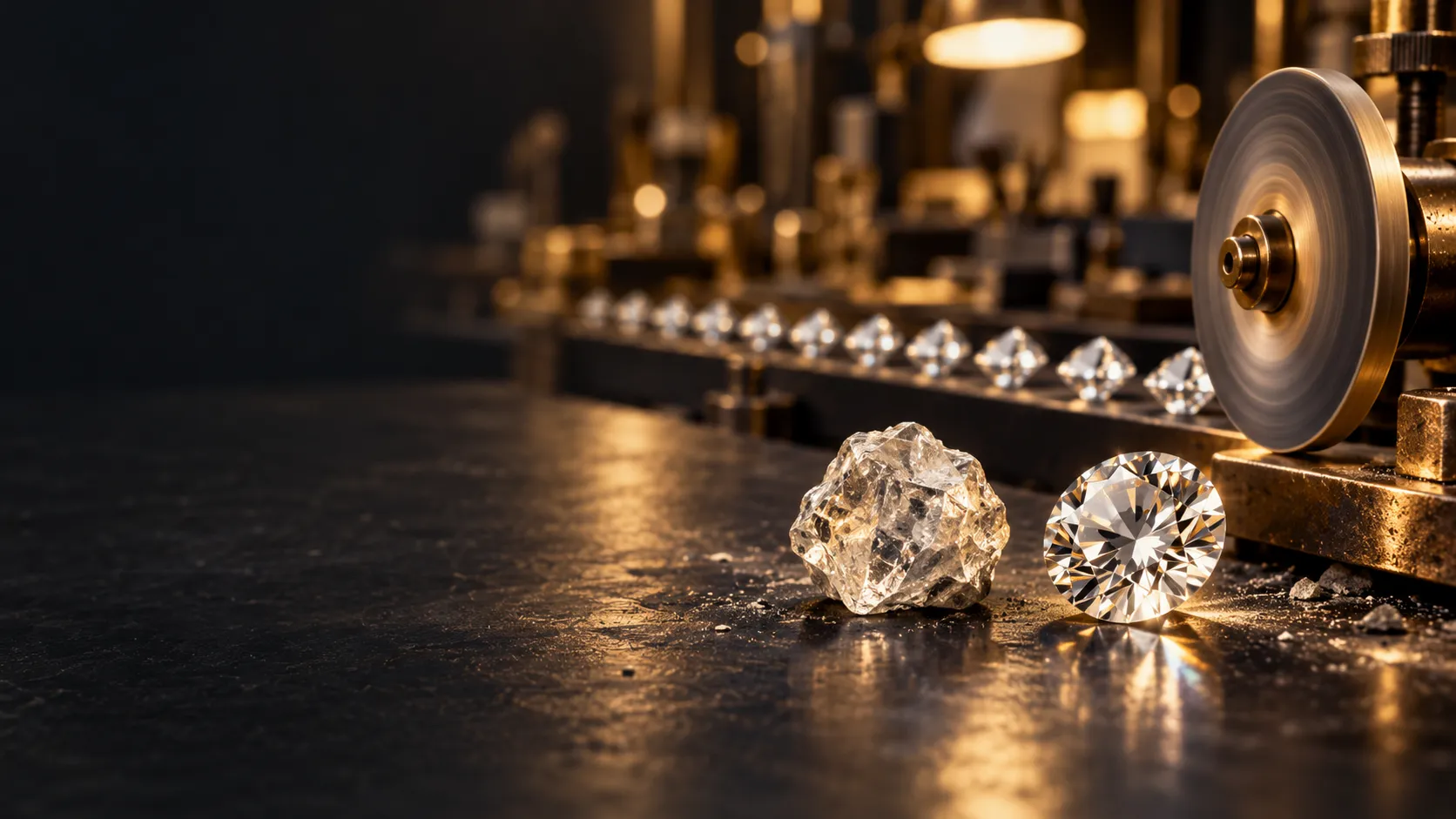
A one-carat natural diamond now averages about $3,898, down 51% from $8,007 in 2021, according to price data reported in September 2026. Diamond prices falling this fast has a simple cause: factories can now make the same stone. India feels it more than most. About nine in ten of the world’s diamonds are cut and polished here, mostly in Surat, and India also chairs the Kimberley Process, the global rulebook for natural diamonds.
This guide keeps it plain. It explains why prices are dropping, who is feeling the pain, what New Delhi is doing about it, and what a shopper should check before buying.
Rough: an uncut stone, as it comes from the mine.
Polished: a cut stone, ready for jewellery.
Carat: a unit of weight, equal to 0.2 gram.
Lab-grown: a real diamond grown in a machine over a few weeks.
Diamond Prices Falling: Factories Now Make the Same Stone
Lab-grown diamonds are not fakes. They are the same carbon in the same crystal, and only a lab instrument can tell them apart. A machine grows one in a few weeks, while a mine needs years of digging and sorting. That cost gap is behind diamond prices falling, and buyers have noticed.
The Knot’s 2026 wedding study found lab-grown stones in 61% of US engagement rings sold in 2025, up 239% since 2020. A one-carat lab-grown stone now sells for about $750 to $1,000, against $3,410 in 2020, according to Draco Diamond. Global stone prices are quoted in US dollars, so the table below keeps dollars.
| One-carat stone | Earlier price | Latest price |
|---|---|---|
| Natural | $8,007 (2021) | about $3,898 (September 2026), down 51% |
| Lab-grown | $3,410 (2020) | about $750 to $1,000 (2026) |
Sources: price data reported in September 2026; Draco Diamond. Averages, not quotes for any one stone.
Diamond prices falling is not only a natural-stone story: lab-grown prices are down too. Analyst Edahn Golan’s index shows wholesale lab-grown prices down 96% since 2018, as reported by South Africa’s Financial Mail. So this is not simply natural against lab-grown. It is a market splitting in two. De Beers says demand for natural stones above two carats has begun to firm, which is a company claim, while the wider market is still under pressure.
The old giant shows the scale of the shock. Anglo American owns 85% of De Beers and wrote its book value down to $2.3 billion in February. Bloomberg reported in July that Anglo was negotiating a sale for about $1 billion to a group led by former De Beers chief Gareth Penny. De Beers was valued above $18 billion in 2001, the Korea Herald noted. Behind the diamond prices falling headlines sits a company that has also paused its Venetia mine in South Africa for more than two years to cut supply.
India Cuts Nine in Ten of the World’s Diamonds, So the Price Drop Lands in Surat
India mines almost no diamonds of its own. It buys rough stones from abroad, cuts and polishes them, and sells them on. Think of a tailor who buys cloth, stitches the suit and sells it. If suit prices fall, the tailor feels it, though he never owned the sheep. About 90% of the world’s diamond cutting and polishing happens in India, according to Reuters.
A 2025 industry report put the workforce at more than 800,000 artisans. That is why price news from New York or Antwerp becomes jobs news in Gujarat. Surat is where diamond prices falling turns into rupees and livelihoods.
The Gem and Jewellery Export Promotion Council (GJEPC) reports that India exported cut and polished diamonds worth ₹55,336 crore ($5.81 billion) in April to September 2026. In rupees that is 2.31% higher than a year earlier. In dollars it is 6.96% lower. The number of carats shipped rose 4.64%, to 83.98 lakh.
Read together, the figures say Surat shipped more stones and earned less per stone. The rupee number looks better only because the rupee has weakened against the dollar, which is why the two growth rates differ (TES reading). GJEPC itself says cut diamond prices have been recovering in recent months.
US Tariffs and Russian-Rough Rules Squeezed Surat From Two More Sides
Diamond prices falling was not Surat’s only problem. In 2025 the United States raised tariffs on Indian goods to 50%, and the G7 tightened rules on stones that began as Russian rough. Both landed on an industry already earning thinner margins, so each new cost was harder to absorb.
GJEPC data show India’s gem and jewellery exports to the US fell 44.42% in April to December 2025. One 2025 industry report put the US at about 32% of India’s diamond exports. On 6 February 2026, India and the US issued a joint statement on a framework for an interim trade agreement. The US agreed to cut its tariff on Indian goods to 18% and said it would remove tariffs on gems and diamonds once the interim agreement is concluded. GJEPC says lab-grown stones stay at 18%.
In the latest reports we found, the zero-duty step still depended on that agreement being concluded, so exporters are waiting for a signature. TES followed the talks in earlier coverage of the India-US trade deal’s hard phase and what the 18% tariff reset meant for textiles.
Russia is the second squeeze. The G7 banned direct imports of Russian-origin diamonds from 1 January 2024, then extended the ban to Russian stones cut in third countries from March 2024. For Indian polishers that means proving where each stone’s rough came from. The Department of Commerce told Parliament that talks with the G7 had moved the full-traceability date from 1 March 2025 to 1 January 2026, as set out in its reply on diamond exports. Commerce Minister Piyush Goyal has said the G7 has the right to set such rules.
India Chairs the Natural-Diamond Rulebook While Its Factories Grow More Lab-Grown Stones
India took over the Kimberley Process chair on 1 January 2026, for the third time, the Commerce Ministry said. The Kimberley Process is the global system that certifies rough diamonds as conflict-free. India’s theme for the year is credibility, compliance and consumer confidence in natural diamonds. It hosted a mid-year meeting in Mumbai from 11 to 14 May, and a plenary is due in New Delhi later this year.
At the same time, Surat’s factories are leaning into lab-grown stones. Polished lab-grown exports reached ₹6,522 crore ($685.1 million) in April to September, up 17.08%, and jumped 40.72% in September alone. Natural cut diamonds remain the bigger business, about eight times larger by value (TES arithmetic). The rating agency ICRA expects lab-grown to reach 10 to 12% of India’s polished diamond exports within two to three years.
One sign of the shift: this year an Indian Sightholder, a buyer with a seat at De Beers’ private rough sales, gave up that status to focus on lab-grown stones, Miningmx reported. The government backs the new side as well. The Commerce Ministry gave IIT Madras a five-year grant of about ₹243 crore to set up a centre for lab-grown diamond research.
With diamond prices falling, both tracks make sense for India. Natural diamonds carry most of today’s jobs and export value, and the rulebook protects trust in them. Lab-grown stones carry the growth. Not everyone is comfortable: Indian Jeweller reported that several African producer countries voiced unease about India’s chairmanship after unresolved reform debates.
With Diamond Prices Falling, Buy a Diamond to Wear, Not to Save
If you want a stone to wear, lab-grown gives far more size for the money. If you want to protect savings, a diamond is a weak choice, because jewellers usually offer well below what you paid when you sell. That is TES’s assessment, not a quoted rate, and diamond prices falling make the point sharper: a stone is a purchase, not a bank account. Gold works differently, because central banks buy it.
Gold has a buyer of last resort that diamonds lack. The Reserve Bank of India held 880.52 tonnes at 31 March 2026, a stock TES covered in its report on RBI gold reserves. No central bank holds diamonds as reserves.
Before buying, ask for a grading certificate and check that the label says natural or lab-grown. Indian Jeweller reported that the Bureau of Indian Standards adopted IS 19469:2025 on 15 January 2026, with clear disclosure required for laboratory-grown stones. Ask the seller to show the stone type on both the certificate and the invoice.
What to Watch in the Diamond Market Over the Next Six Months
Are diamond prices falling for good?
Nobody can say. De Beers says demand for natural stones above two carats has begun to firm, which is a company claim. The wider market is still under pressure, and Anglo American’s reported $1 billion sale talks show how far confidence has dropped. Watch the De Beers sale, the final US tariff on Indian stones, and GJEPC’s monthly export data.
Will lab-grown prices keep falling?
They have fallen 96% since 2018 on Golan’s index, though GJEPC described recent lab-grown export prices as stable. The risk is a price war among lab-grown makers, which Miningmx flagged as the likely next phase of the market.
What happens to Surat’s workers?
Natural cut diamonds still bring in about eight times the export value of lab-grown ones, so most jobs still depend on natural stones. The test is whether carat volumes hold while dollar values recover. GJEPC publishes data around the middle of each month, and the Kimberley Process plenary in New Delhi is the next policy marker.
Diamond prices falling is a reset, not a collapse of Surat. India shipped 4.64% more carats while dollar value fell 6.96%, which says the skill and scale are intact and the price is what moved. That edge in cutting and polishing carries over to lab-grown stones, and the Kimberley Process chair gives India a voice on trust in natural ones. If diamond prices falling continues, the risks are a lab-grown price war and slow US tariff relief. Three markers will show which way it goes: GJEPC’s monthly data, the US duty on Indian diamonds, and the New Delhi plenary.
Disclaimer: This article is analysis for information only and is not investment or purchase advice. Company valuations and sale terms are as reported by the named outlets and may change.
Source note: GJEPC and India Brand Equity Foundation export data, a Department of Commerce reply to Parliament, Commerce Ministry statements on the Kimberley Process, The Knot, Reuters, Bloomberg, Financial Mail and trade press reports. Figures labelled TES arithmetic or TES reading are TES calculations.