
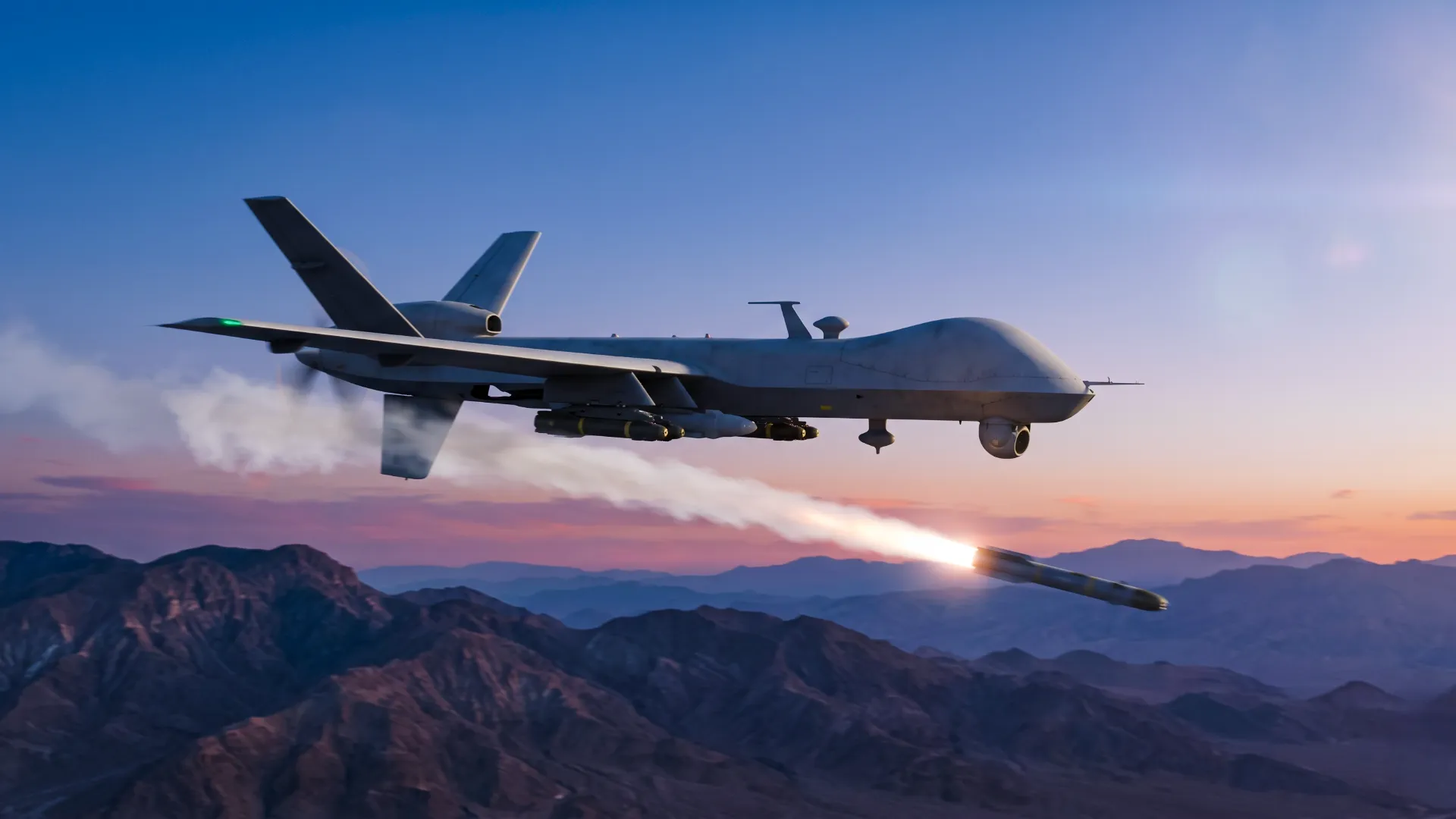
On 13 October 2026, United States Secretary of Defense Pete Hegseth directed the formal establishment of the Autonomous Warfare Command, ordering an immediate halt to further procurement allocations for the M10 Booker combat vehicle. Ground combat telemetry from eastern Ukraine and the Middle East has delivered an unequivocal verdict: on a battlefield saturated with thermal sensors, electronic sniffers, and first-person-view (FPV) loitering munitions, medium-armoured fighting vehicles lacking all-aspect active protection systems represent high-cost targets rather than mobile direct fire solutions.
The directive initiates a structural transformation across the United States Army Infantry Branch. Frontline rifle squads are being reorganized from the ground up, stripping unmanned aerial systems of their legacy designation as exquisite intelligence-surveillance-reconnaissance (ISR) aircraft. Instead, strike drones are officially categorized as Class V expendable organic ammunition, distributed to infantry platoons in wooden crates alongside 5.56mm linked rounds and 40mm grenades. The shift marks the operational arrival of the US Army drone warfare overhaul, abandoning decades of capital-intensive vehicle procurement in pursuit of expendable autonomous mass.
Yet writing doctrine cannot bypass physical manufacturing chokepoints. By truncating the M10 Booker, the Pentagon is divesting from proven heavy-metal industrial capacity while staking frontline combat power on an autonomous drone industrial base that remains critically dependent on Asian supply chains for rare-earth magnets, solid-state batteries, and microcontrollers. The United States military is attempting to adopt Silicon Valley iteration speed while its underlying industrial base remains tethered to foreign component processing.
The M10 Booker Dilemma: Why Medium Armour Failed the Drone Test
The M10 Booker, developed by General Dynamics Land Systems (GDLS) under the Mobile Protected Firepower (MPF) programme, was conceived to solve an operational problem from a bygone tactical era. Lightweight infantry brigades operating in restrictive terrain required organic, direct-fire capabilities to reduce enemy bunkers, machine-gun nests, and light fortifications without relying on divisional artillery or air support. General Dynamics engineered a capable platform: a 38-tonne tracked vehicle armed with a 105mm M35 rifled cannon, advanced thermal sights, and an MTU diesel powerpack.
The battlefield changed faster than the acquisition cycle could adjust. The war in Ukraine demonstrated that the tactical zone spanning fifteen kilometres across the line of contact has become entirely transparent. Multi-spectral optical sensors, commercial thermal cameras, and signals intelligence payloads detect any vehicle larger than an all-terrain utility truck within ninety seconds of its emergence from concealed revetments.
Survival on this transparent front line requires either extreme passive protection—such as the 70-tonne composite armour arrays found on the M1A2 SEPv3 Abrams—or comprehensive, 360-degree hard-kill Active Protection Systems (APS) capable of intercepting incoming projectiles from steep overhead angles. The M10 Booker possessed neither. Its aluminium-steel hull was optimized against 30mm autocannon rounds along its frontal arc and 14.5mm heavy machine-gun fire along its flanks. Against a tandem-charge PG-7VR warhead piloted directly into its thin engine deck by a $700 loitering munition, the vehicle was completely vulnerable.
At an estimated flyaway unit cost of $13 million, fielding battalions of Bookers presented a prohibitive asymmetric liability. As examined in our analysis of attrition dynamics during high-tempo operations, modern warfare punishes exquisite platforms deployed in sensor-dense saturation zones.
Secretary Hegseth’s designation of the drone initiative as “Project Agincourt” draws on a direct tactical parallel. On 25 October 1415, heavily armoured French cavalry advanced into restricted, muddy terrain at Agincourt, expecting their plate armour to dominate the engagement. Instead, massed English archers deploying the low-cost longbow shattered the mounted assault through concentrated volume of fire. Plate armour was not defeated by another suit of armour; it was made obsolete by the industrial-scale delivery of inexpensive kinetic energy from standoff distances.
Ammunition, Not Aircraft: Restructuring the Modern Rifle Squad
For more than twenty years, the United States Department of Defense treated uncrewed aerial systems as aviation assets. A RQ-11 Raven or RQ-20 Puma was tracked on property books like a scout helicopter, requiring formal maintenance logs, flight clearances, and specialist operators at the battalion level. If an operator crashed a reconnaissance drone, an administrative investigation followed.
The new Autonomous Warfare Command has discarded that entire bureaucratic apparatus. Strike drones are now designated as Class V stores—the exact logistical classification assigned to mortar rounds, grenades, and small-arms ammunition. Infantry squads are expected to consume them in volume. In high-intensity clearing operations, expending thirty FPV munitions to breach an urban block is now treated with the same tactical indifference as expending three thousand rounds of 5.56mm ball ammunition.
To support this doctrinal pivot, the United States Army has begun reorganizing its baseline nine-man infantry rifle squad into a three-element formation:
- The Assault Element (3 Soldiers): Retains carbines and designated marksman platforms to secure physical foothold areas and maintain immediate security.
- The Uncrewed Strike Element (4 Soldiers): Consists of two primary drone pilots and two payload technicians tasked with arming, launching, and managing local drone magazines.
- The Command & Electronic Warfare Element (2 Soldiers): The Squad Leader paired with a spectrum technician operating portable passive radio-frequency direction-finders and localized tactical jammers.
This restructuring shifts the infantry’s primary tactical engagement envelope. The rifle squad no longer relies exclusively on line-of-sight kinetic fire out to 500 metres. Instead, through the deployment of man-portable, vertical-take-off loitering platforms, an isolated squad projects lethal, non-line-of-sight precision strike effects across an eight-kilometre radius without requesting fire support from higher headquarters.
The Industrial Bottleneck: The Chokepoint of Attritable Scale
The central paradox of the Pentagon’s autonomous transformation is not doctrinal; it is industrial. While the Department of Defense has recognized that combat requires millions of low-cost attritable systems, the Western defense industrial base is optimized to build small quantities of highly complex, multi-million-dollar weapon systems over decadal timelines.
According to comprehensive procurement assessments from the Army University Press, commercial drone manufacturing capacity remains overwhelmingly concentrated across East Asian industrial corridors. Over 75% of the rare-earth elements required for permanent-magnet synchronous motors—specifically neodymium, dysprosium, and praseodymium—are mined or refined in mainland China. The specialized high-discharge lithium-polymer batteries that power standard 7-inch to 10-inch strike airframes are produced almost entirely by commercial manufacturers in Shenzhen and surrounding provinces.
Furthermore, electronic warfare has fundamentally eliminated the viability of off-the-shelf commercial drones in contested environments. Analogue video signals and standard 2.4 GHz and 5.8 GHz control frequencies are jammed within seconds of crossing the forward line of own troops. To remain tactically effective, the United States Army requires unjammable physical links—such as spooled micro-filament fibre-optic tethers—or hardened onboard optical guidance computing units capable of executing terminal target recognition autonomously when radio frequencies are severed.
This requirement immediately inflates the cost structure. A basic hobbyist FPV airframe costs $400; an industrially hardened, edge-AI-guided autonomous strike munition produced within a certified National Defense Authorization Act (NDAA)-compliant supply chain costs between $3,500 and $7,000. Scaling that production to deliver three hundred thousand rounds annually requires dedicated machine-tooling, domestic magnet fabrication, and automated assembly infrastructure that currently does not exist in North America.
| Metric / Parameter | M10 Booker (Legacy MPF) | Expendable FPV Strike Swarm | Fiber-Optic Guided Loitering Round |
|---|---|---|---|
| Unit Procurement Cost | ~$13,000,000 | ~$1,200 (Military Grade) | ~$7,500 |
| Effective Engagement Range | ~4 km (Direct Fire) | ~10–14 km (Non-Line-of-Sight) | ~15–20 km (Unjammable Tether) |
| Logistics Footprint | Heavy Transporters, 38-Tonne Bridges | Backpack / Tactical Utility Vehicle | Man-Portable Canisters |
| EW Resistance | High (Armour/Optics) | Low to Moderate (Jam-Vulnerable) | Immune (Physical Optical Carrier) |
| Replacement Lead Time | 18 to 24 Months | 48 Hours (Assembly Scale) | 2 to 3 Weeks |
Defence Markets and Equities: The Capital Reallocation from Steel to Software
For decades, institutional defence investors viewed prime contractor revenue through the lens of long-term metal-bending programmes. A platform like the M1A2 Abrams, the Stryker combat vehicle, or the M10 Booker represented a predictable, decades-long revenue model: high-margin research and development, multi-billion-dollar low-rate production contracts, and thirty years of lucrative depot-level maintenance, spare parts, and mid-life upgrades. General Dynamics Land Systems built its core operational valuation upon this exact industrial continuity.
The cancellation and curtailment of the M10 Booker shatters that traditional valuation model. General Dynamics (NYSE: GD) faces an immediate contraction in its Combat Systems backlog. While the company retains substantial revenue through nuclear submarine construction at Electric Boat and business jet deliveries at Gulfstream, its tracked vehicle division must now compete for capital against software-defined autonomy contractors.
Conversely, pure-play autonomous system manufacturers and defense software integrators are capturing expanding shares of the Department of Defense’s procurement budget. Companies like AeroVironment (NASDAQ: AVAV)—manufacturers of the Switchblade series—and Kratos Defense & Security Solutions (NASDAQ: KTOS) are transitioning from niche technology suppliers into primary ammunition providers. Meanwhile, non-traditional defense primes such as Anduril Industries are leveraging venture-backed capital structures to build automated manufacturing plants capable of stamping out thousands of autonomous airframes per month on commercial fixed-price contracts.
Yet institutional investors must account for a critical margin reality. Software-defined autonomous warfare offers high gross margins on intellectual property and autonomous command-and-control software suites, but the underlying hardware—the composite shells, electric motors, and printed circuit boards—operates on the razor-thin margins of commercial consumer electronics. Defense primes cannot extract traditional 12% to 15% cost-plus margins on expendable wooden-crated munitions that infantrymen treat as disposable brass.
Strategic and Industrial Signals: The 90-Day Outlook
1. Tactical Indicator: Brigade Combat Team Integration and Field Exercises
The primary military milestone to observe is how rapidly the newly activated Autonomous Warfare Command integrates organic drone strike elements into the Army’s rotational training centers at the National Training Center (NTC) in Fort Irwin, California, and the Joint Readiness Training Center (JRTC) in Fort Johnson, Louisiana. If opposing forces (OPFOR) equipped with dense electronic warfare systems successfully neutralize entire platoons of FPV munitions, the Army will be forced to accelerate procurement of expensive fibre-optic and edge-AI payloads, driving unit costs upward.
2. Congressional & Industrial Indicator: The Battle for Lima Army Tank Plant
The political battle over the M10 Booker will unfold in the halls of Congress. The Joint Systems Manufacturing Center in Lima, Ohio—the primary production facility for the Booker and the Abrams—relies on consistent congressional appropriations to sustain its skilled welding and engineering workforce. Lawmakers representing Ohio and Michigan will strongly resist the outright cancellation of the Booker programme, likely attempting to mandate modified production runs or redirect funding toward unmanned ground vehicle (UGV) conversions of the chassis.
3. Supply Chain & Mineral Indicator: Allied Rare-Earth Agreements
Investors and strategic analysts must closely track whether the Department of Defense formalizes Title III Defense Production Act grants to establish domestic and allied processing for neodymium magnets and lithium-metal battery chemistries. Collaborative procurement corridors with partners such as India, Australia, and Japan will serve as the leading indicator of whether the United States can convert its ambitious autonomous doctrine into an enduring, wartime-resilient manufacturing reality.