
Indo-Pacific · Guest Analysis
Beijing’s new joint facility at Ban Keun is modest on paper. Its significance lies less in the aircraft parked there than in the military access it may normalise across mainland Southeast Asia.
Key Takeaways
- China’s Ministry of National Defence announced on 29 September 2026 that the China–Laos Joint Support and Training Centre and the China–Laos Friendship Aviation Academy had begun operating at Ban Keun. The arrangement confirms a joint military presence, but it does not establish unrestricted Chinese combat-basing rights.
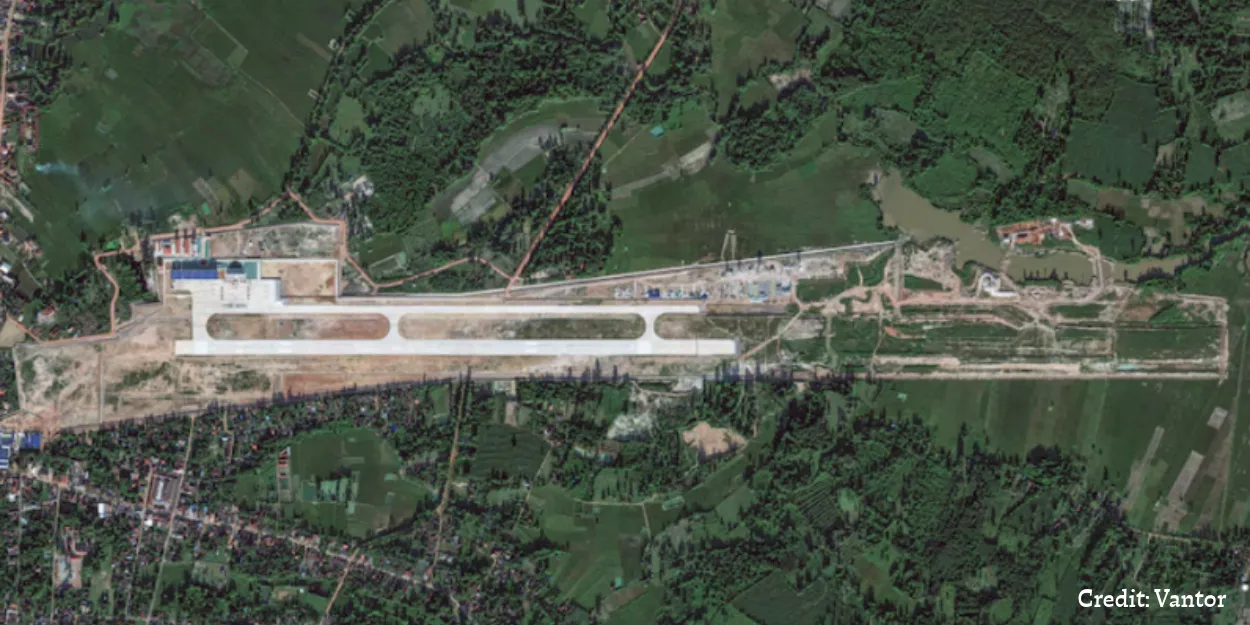
- Satellite imagery reported by Reuters showed eight K-8/JL-8 trainer and light-attack aircraft and more than two dozen support vehicles on 30 September, with construction continuing around the runway. Expansion to larger aircraft remains a possibility, not an established fact.
- Ban Keun should be read alongside China’s joint support facility at Cambodia’s Ream naval base and its logistics base in Djibouti. Their functions and access terms differ, so an integrated network should not be assumed.
- For India, the development reinforces mainland Southeast Asia’s place within Act East policy. Education, technical assistance and defence exchanges offer New Delhi a practical way to expand the options available to regional governments.
- India, the United States, Australia and Japan should compare assessments and coordinate useful assistance without turning Laos into a public test of geopolitical loyalty.
What China announced at Ban Keun — and what it did not
On 29 September 2026, China’s Ministry of National Defence announced that the China–Laos Joint Support and Training Centre and the China–Laos Friendship Aviation Academy had begun operating at Ban Keun. Beijing described their purpose as training Lao air force pilots and said both countries would maintain the facilities. This confirms a joint military presence, although the announcement does not establish unrestricted Chinese combat-basing rights: Beijing and Vientiane have not disclosed the personnel, equipment, command arrangements or access terms governing use of the airfield, as Janes reported when the centre opened.
Reuters subsequently reported that satellite imagery from 30 September showed what analysts identified as eight K-8 trainer and light-attack aircraft and more than two dozen support vehicles. Construction continued around the runway. Analysts suggested that future expansion could accommodate larger aircraft, including surveillance platforms. Such deployments remain possibilities, rather than established facts.
The strategic significance begins before larger aircraft arrive. In my assessment, recurring training, maintenance and personnel exchanges can embed Chinese practices and relationships within the Lao military. Over time, these arrangements may make continued Chinese access easier to sustain politically and practically.
Three models, not one network: Ban Keun, Ream and Djibouti
Ban Keun should also be assessed alongside China’s joint support facility at Cambodia’s Ream naval base and its logistics base in Djibouti. Their functions and access arrangements differ; an integrated network should not be assumed. Nevertheless, they show Beijing developing several models for maintaining a military presence abroad.
What Ban Keun changes for Washington and Bangkok
For the United States, the central question is what additional access Ban Keun provides beyond China’s existing ability to operate from its own territory. A training facility has different implications from a location supporting persistent intelligence collection, transport operations or combat deployments. Washington should assess those distinctions before allowing the language of strategic encirclement to outrun the evidence.
Thailand’s position deserves particular attention. A U.S. treaty ally, it has recognised Laos’s sovereign right to permit a Chinese base while indicating that it will monitor developments. Washington should consult closely with Bangkok about regional air activity and transparency, while respecting Thailand’s interest in maintaining constructive relations with its neighbours. Public pressure to choose sides could undermine that cooperation.
Australia’s stake in Southeast Asian military access
Australia also has a stake in how military access develops across Southeast Asia. Should Ban Keun eventually support sustained surveillance operations, the implications could extend to regional partners’ military activities and the operating environment for Australian and American forces. The extent would depend on the equipment deployed, its missions and the permissions Laos grants.
Canberra’s response should combine careful monitoring with practical engagement. Professional military education, civilian aviation safety, disaster preparedness and technical cooperation offer useful avenues where welcomed by Laos. Australia should also support regional requests for clarity about foreign military personnel, permitted activities and future expansion.
For India, a case for deeper Act East engagement
For India, the development reinforces the importance of mainland Southeast Asia within Act East policy. Maritime security remains essential, but inland training institutions and logistics arrangements can also reshape the regional balance. New Delhi should strengthen relationships through education, technical assistance and defence exchanges that give regional governments meaningful options.
India, the United States, Australia and Japan should compare assessments and coordinate useful assistance without making Laos a public test of geopolitical loyalty. Their objective should be to expand regional choices and discourage opaque military arrangements.
Laos retains agency, and its development and security needs deserve serious consideration. Effective engagement must offer tangible benefits rather than simply express concern about China.
The question that will decide Ban Keun’s importance
Ban Keun’s importance will be determined by who can use it, for what purposes and under whose authority. India, America and Australia should seek those answers now, while investing in the relationships that make Southeast Asian sovereignty meaningful in practice.
Source note: Official statements from China’s Ministry of National Defence and the Lao government; Reuters and AP reporting on commercial satellite imagery of Ban Keun; Janes and Lowy Institute analysis of the facility and China’s overseas military presence. This is a guest analysis; the assessments are the authors’ own.