News Analysis · 25 October 2026 · STW-2 inaugurated 24 October
The indigenous AIP system for the Navy’s diesel-electric submarines has entered Setting to Work Phase-2 (STW-2) at Larsen & Toubro’s (L&T) Hazira complex, the Ministry of Defence (MoD) said on 24 October. The air independent propulsion (AIP) energy module, developed by DRDO’s Naval Materials Research Laboratory (NMRL), will now be energised and tested to Navy protocols, then handed to Mazagon Dock Shipbuilders Limited (MDL) for integration on a Kalvari-class submarine in early 2027. It follows the ₹1,990 crore plug contract signed with MDL in December 2024.
- The MoD says STW-2 of the DRDO-developed AIP energy module was inaugurated on 24 October at L&T’s Hazira complex.
- The module will next be energised, tested to Navy protocols and handed to MDL for integration in early 2027.
- Reports say the indigenous AIP system was approved in 2014 with a 2017 target. The Defence Secretary now points to a refit around mid-2027.
- The release does not name the boat or give power output or endurance figures.
What Setting to Work Phase-2 Means for the Indigenous AIP System
The MoD says the Setting to Work Phase-2 activity of the AIP energy module was inaugurated at L&T’s AM Naik Heavy Engineering Complex in Hazira on 24 October. Defence Secretary Rajesh Kumar Singh, who is also Secretary of the Department of Defence R&D and Chairman of DRDO, joined virtually. Vice Admiral B Sivakumar, the Navy’s Chief of Materiel, and Dr R Balamuralikrishnan, Director General (Naval Systems & Materials) at DRDO, attended at Hazira.
In the next phase the module will be energised for power production and tested as per the Navy’s protocols before handover to MDL. The ministry’s account of Singh’s remarks says the indigenous AIP programme has “culminated into productive reality on the shop floor”, and that he stressed meeting the Navy’s induction timelines while keeping the safety culture that hydrogen and fuel cell systems demand.
The release leaves out the details that would let the milestone be measured: which boat will receive the module, its power output, the endurance it will add, and what the first phase covered. It gives early 2027 as the date for handover to MDL for integration, while the Defence Secretary said on 1 October that the AIP would go into a submarine at a refit around mid-2027. The two statements fit together if handover comes first, though neither says so.
Why a Fuel-Cell Plug Changes How Kalvari-Class Boats Operate
The MoD’s Annual Report 2025-26 describes AIP as a technology that lets a conventional diesel-electric submarine operate without atmospheric oxygen, lifting submerged endurance from days to weeks. A boat without it must periodically raise a snorkel mast and run its diesels to recharge batteries, which is when it is easiest to detect. The six Kalvari-class boats were built without AIP, and the indigenous AIP system is meant to be added through their refits.
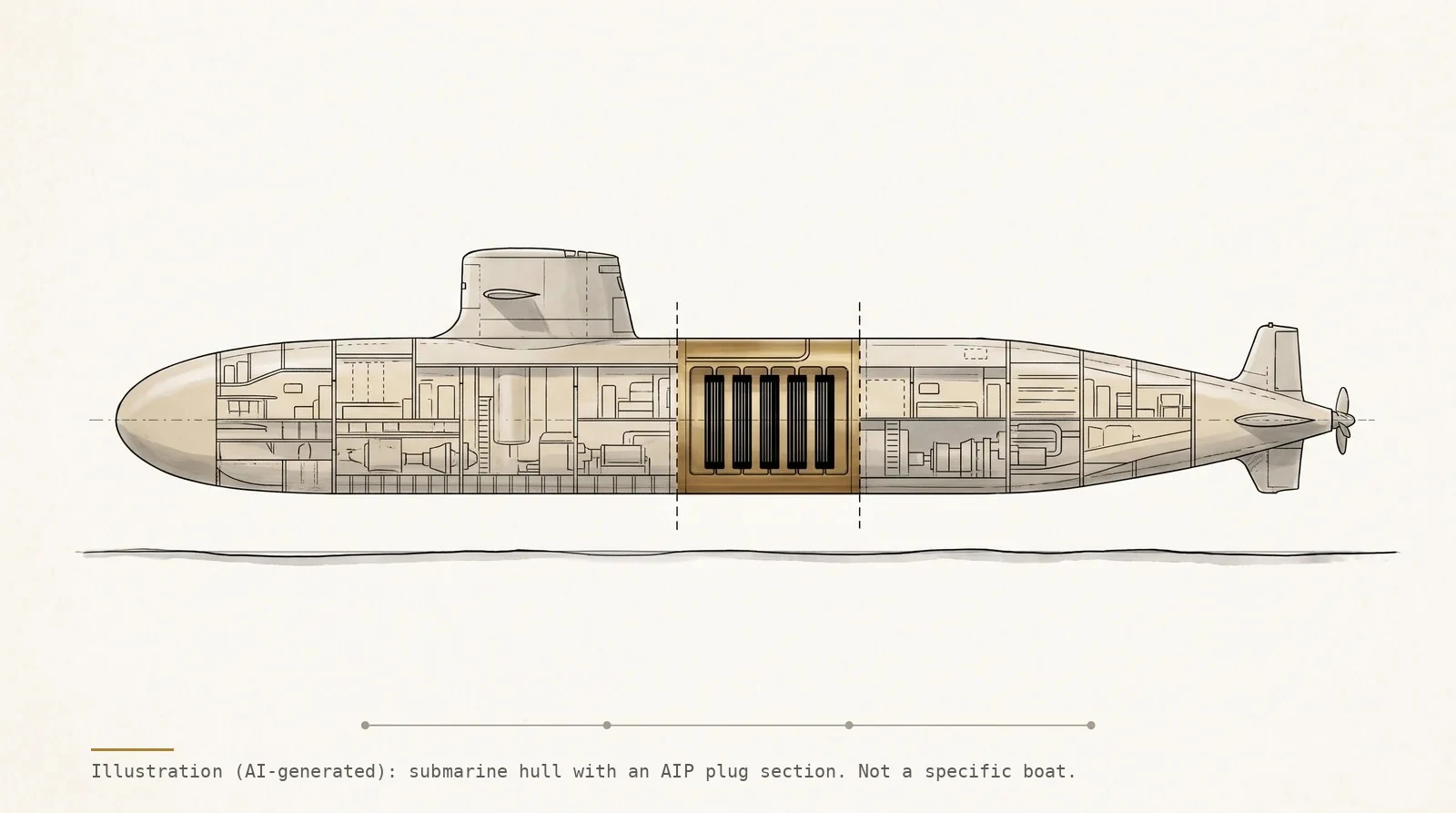
The retrofit is physical. Defence reports describe cutting the pressure hull and inserting a new section, the plug, that carries the energy module, and the December 2024 contract with MDL is for building that plug and integrating it. The work therefore runs through the shipyard and the refit calendar. L&T says the indigenous AIP system generates hydrogen on demand, so the submarine does not carry hydrogen, which the company describes as a major safety concern on a boat.
The timing has a regional edge. The Pakistan Navy says it commissioned the first of eight Chinese-built Hangor-class AIP submarines on 30 April 2026, a development TES covered in its analysis of the Navy’s submarine pipeline. India’s answer on propulsion is home-built, and it is now in testing.
How the Indigenous AIP System’s Schedule Moved From 2017 to 2027
Reports citing defence sources say the project was approved in 2014 at ₹270 crore, with completion expected in 2017. An August 2025 report said INS Kalvari had finished its maintenance refit without the plug, and Navy sources hoped the system would be ready for INS Khanderi’s refit in mid-2026. The MoD now points to integration on a Kalvari-class boat from early 2027, a gap of about a decade against the original target.
| Date | Milestone |
|---|---|
| 2014 | Project approved at ₹270 crore; completion expected by 2017 (reported) |
| 2021 | Transfer-of-technology documents for the DRDO system handed to L&T at Aero India 2021 (L&T release) |
| 2023 | DRDO signs a contract with L&T for two AIP energy modules for the Kalvari class (L&T release) |
| 30 December 2024 | MoD signs ₹1,990 crore with MDL for the AIP plug and its integration; a separate ₹877 crore Naval Group contract covers torpedo integration |
| August 2025 | INS Kalvari completes refit without AIP; hopes move to INS Khanderi’s mid-2026 refit (reported) |
| 2025-26 | Annual Report: liquid oxygen module manufacture complete; energy module components in progress |
| 1 October 2026 | Defence Secretary says DRDO’s AIP will go into a submarine at a refit around mid-2027 |
| 24 October 2026 | STW-2 inaugurated at L&T Hazira; handover to MDL planned for early 2027 |
The record since December 2024 is one of contracts and hardware: a plug contract with the yard, a manufactured oxygen module, and now a full-scale module under powered testing at an industrial partner. Each step can be dated and checked.
The boats waiting for the plug have their own long history. India signed the Scorpene contracts on 6 October 2005, and the first boat was commissioned on 14 December 2017. The sixth, INS Vaghsheer, followed on 15 January 2025. A propulsion module built in India for a French-origin hull has had to move at the pace of that hull’s own refit calendar.
Who Builds the Module: NMRL, L&T, MDL and Naval Group
NMRL, a DRDO laboratory, developed the indigenous AIP system’s energy module. L&T hosted STW-2 at Hazira. Its own release says DRDO signed a contract with it in 2023 for two AIP modules for the Kalvari class, and calls L&T the prime industry partner in an association of more than a decade. MDL holds the ₹1,990 crore MoD contract to build the plug and integrate it, work the ministry said would generate nearly three lakh man-days of employment. The Navy tests the module to its own protocols before handover.
Naval Group, the French designer of the Scorpene, enters in two ways. Reports say MDL signed an agreement with it for technical support, proprietary components and training to integrate the DRDO system. Separately, the other contract signed on 30 December 2024, worth ₹877 crore, is with Naval Group for integrating the electronic heavy weight torpedo (EHWT) on the Kalvari class. That is a weapon contract, not an AIP one. The two contracts together come to about ₹2,867 crore.
The division of labour carries an industrial point beyond one submarine: a DRDO laboratory design, a private-sector engineering major building the module, and a public-sector yard doing the hull work.
What the Indigenous AIP System Means for MDL and L&T Investors
STW-2 is an execution milestone, not a new order. MDL’s ₹1,990 crore plug contract was signed in December 2024, so the milestone changes delivery risk, not the contract. For scale, the contract equals about 11 per cent, by TES’s calculation, of the ₹18,218 crore order book MDL reported at 30 June 2026, though the sources reviewed do not itemise the plug within that figure. L&T’s 2023 release gave no contract value and expected follow-on orders for the other five Kalvari-class boats; TES found none announced.
TES’s reading is that the numbers to watch sit elsewhere. A Cabinet Committee on Security decision on Project 75(I) or the additional Scorpene boats would move MDL’s order book far more than the indigenous AIP system does, as TES set out in its analysis of why the stock has not moved on Project 75(I). The AIP milestone matters to the shares mainly if the early-2027 handover slips and pushes the refit slot further out. TES has also tracked how MDL’s delivery record has improved on surface ships.
What to Watch After STW-2 at Hazira
Which Kalvari-class boat will get the plug?
The release says a Kalvari-class submarine and does not name it. Defence media have named INS Khanderi, the second boat, and an August 2025 report pointed to its refit, then expected in mid-2026. The Defence Secretary’s mid-2027 date suggests the refit has since moved, though the MoD has not named the boat.
Is early 2027 the handover or the integration?
The MoD’s wording covers both. The Defence Secretary placed the first fit at a refit around mid-2027. MDL disclosures and Navy statements are where the two dates should separate.
When would sea trials start?
Some defence reports still cite sea trials of the indigenous AIP system in July and August 2027 and a return to service in 2028. Those dates come from the earlier schedule, when the refit was to begin in mid-2026, and they do not fit a refit that starts around mid-2027. The MoD has published no trial date. MDL’s September-quarter results, expected on 27 October, are the next company disclosure to watch.
What will powered testing show about output and endurance?
No figures have been published. The Annual Report says only that endurance rises from days to weeks. Test results, once released, would let the claim be measured against the Navy’s requirement.
Will the module go beyond the first boat?
The Defence Secretary said the indigenous AIP system would extend to Scorpene-class boats as they come in for refit. Reports on additional Scorpene submarines do not say whether they would take DRDO’s AIP at build or at a later refit. Both questions sit within TES’s India maritime security coverage.
The Takeaway: From Contract to Powered Hardware
The indigenous AIP system has moved from sanction and contracts into powered testing on an industrial partner’s shop floor, and the MoD has named the next dates. Early 2027 is the handover. A refit around mid-2027 is the first fit. Sea trials of the fitted boat follow, and the MoD has published no date.
The first test is the one the Navy sets: whether a fuel-cell plug built in India holds stable output through its protocols at Hazira. The ministry says the next phases will be run to the Navy’s induction timelines. Early 2027 is the date to hold it to.
Source note: Ministry of Defence and Press Information Bureau releases of 24 October 2026 and 30 December 2024; MoD Annual Report 2025-26; the Defence Secretary’s remarks of 1 October 2026; L&T’s 2023 release; earlier programme history from published defence reporting.