
Strategic Analysis · India-China Border · The Eastern Strategist
China told the world on 13 October that it has “never recognised” the Union Territory of Ladakh. India’s reply came in two sentences from the Ministry of External Affairs (MEA). Behind them sits a decade of India China border infrastructure: tunnels to Tawang and Daulat Beg Oldie, a road at 19,400 ft and an airfield at about 13,700 ft. The Border Roads Organisation (BRO) alone spent a record ₹16,690 crore in 2024-25.
The row began on 2 October, when the Ministry of Home Affairs announced standard names for 28 places and geographical features in Ladakh on the Survey of India’s official map. The list includes Gogra and Hot Spring, friction points of the 2020 standoff. Chinese Foreign Ministry spokesperson Mao Ning called the move “illegal and void” and said the western sector of the boundary belongs to China. MEA spokesperson Randhir Jaiswal said the names were fixed in consultation with the Union Territory administration and local stakeholders, so that the public can recognise these places accurately.
On 20 October India marks 64 years since the 1962 conflict, which the MEA’s own bilateral brief describes as a setback to ties. The Government told Parliament in December 2024 that China occupies 38,000 sq km of Indian territory in Aksai Chin as a result of that conflict and the events before it. The naming row concerns the same ground, argued this time on a map, with India China border infrastructure now part of the argument.
The Official 1962 Record Is Thin, but Rezang La Is Not
India has released little official detail on how the 1962 conflict was fought. The Defence Minister told the Rajya Sabha in July 2014 that the Army’s Henderson Brooks report is a top secret document, not declassified, and that disclosing it would not be in the national interest. What the public record does hold is Rezang La: the Ministry of Defence says Charlie Company of 13 Kumaon defended ground above 16,500 ft on the Kailash Range on 18 November 1962.
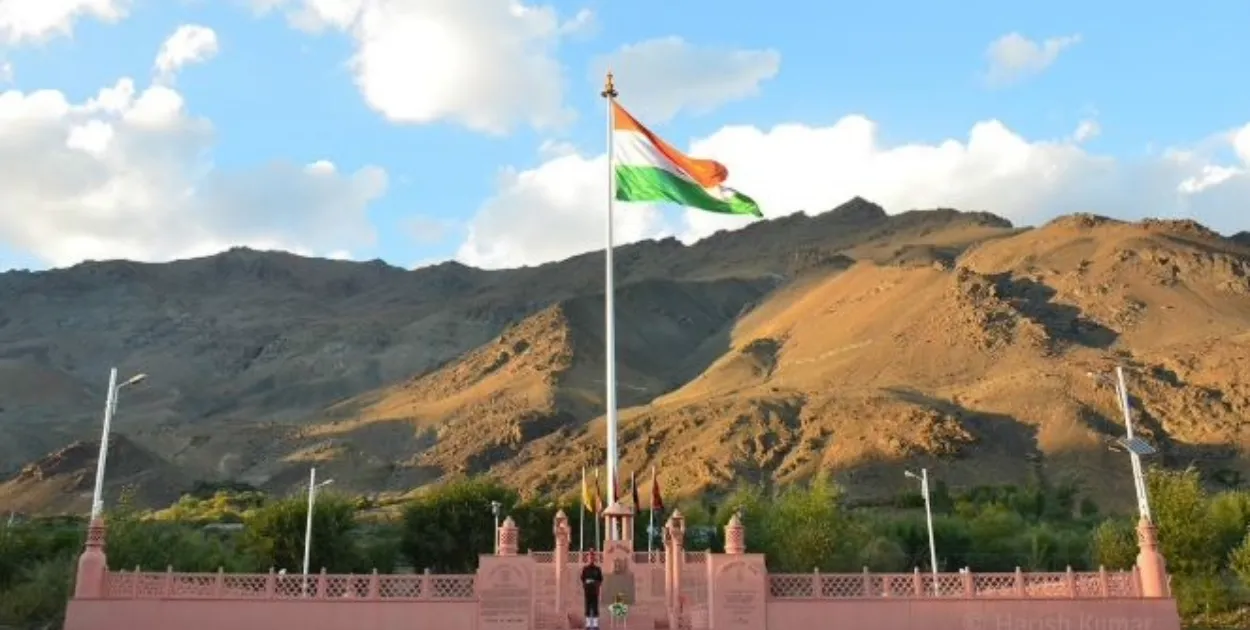
Raksha Mantri Rajnath Singh rededicated the renovated Rezang La memorial at Chushul on 18 November 2021 and said 114 soldiers gave their lives in that battle. The memorial was first built in 1963 on the Chushul plains, above 15,000 ft, right at the India-China border. The Chushul Brigade, the formation that defended the Ladakh sector in 1962, led the renovation.
That record honours courage and says little about the system behind the picket. For that, TES turns to Parliament. Rajnath Singh told the Rajya Sabha in September 2020 that the armed forces’ rapid deployment, made during COVID, was possible because of the importance the Government had placed on border infrastructure in recent years. That sentence is the working doctrine of the post-1962 era, and the rest of the record tests it.
India China Border Infrastructure Carried the 2020 Counter-Deployment
When China massed troops and armaments along the Line of Actual Control (LAC) from April 2020, India’s armed forces counter-deployed. External Affairs Minister Dr S Jaishankar told the Lok Sabha in December 2024 that they did so rapidly and effectively despite logistical challenges and COVID. He tied that response to border infrastructure: BRO’s expenditure is now three times its level a decade ago.
The cost was human. On 15 June 2020, Colonel Santosh Babu and 19 soldiers died at Galwan, the Raksha Mantri informed the Rajya Sabha. Dr Jaishankar later noted that these were the first fatalities along the boundary in 45 years.
The Raksha Mantri was candid about the starting position. China, he said, had undertaken significant infrastructure construction over many decades that raised its deployment capability in the border areas. India’s response was to raise the border infrastructure budget to about double earlier levels.
The spending has kept climbing. A Press Information Bureau (PIB) backgrounder of January 2026 shows BRO’s Union Budget allocation moving from ₹6,500 crore in 2024-25 to ₹7,146 crore in 2025-26, against actual expenditure of ₹16,690 crore in 2024-25. At the dedication of 125 projects from Ladakh on 7 December 2025, the Raksha Mantri set a ₹18,700 crore target for 2025-26.
Forward roads show the same trend in border infrastructure. Over FY 2020-21 to 2024-25, the Ministry of Defence allocated about ₹23,625 crore for general staff roads, which built roughly 4,595 km in forward areas, about 769 km of it in 2024-25. Since its raising in 1960, BRO has built over 64,000 km of roads, 1,179 bridges, seven tunnels and 22 airfields.
Sela, Shyok and Mig La Show Where the Money Went
India China border infrastructure is now visible in physical assets: the Sela tunnels to Tawang, the 920-metre Shyok Tunnel on the road to Daulat Beg Oldie, and a motorable link at Mig La, 19,400 ft above sea level. The Ministry of Defence’s Annual Report 2025-26 and PIB give the official figures, collected below.
| Asset | Where | Official figure | Status |
|---|---|---|---|
| Sela Tunnel system | Balipara-Charduar-Tawang Road, Arunachal Pradesh | 13,000 ft; ₹825 crore; tunnels of 1,003 m and 1,595 m | Dedicated 9 March 2024 |
| Nechiphu Tunnel | Same road | 500 m | Dedicated September 2023 |
| Pinjoli Bridge | Tenga-Bomdila-Tawang axis | 135 m | Completed 2025 |
| Shyok Tunnel | Darbuk-Shyok-Daulat Beg Oldie Road, Ladakh | 920 m | Completed 2025 |
| Mig La road | Likaru-Mig La-Fukche, eastern Ladakh | 19,400 ft | Connectivity established 1 October 2025 |
| Mudh-Nyoma airfield | Eastern Ladakh | About 13,700 ft | Operational November 2025 |
| Shinku La Tunnel | Nimu-Padam-Darcha road | 4.1 km; ₹1,681 crore; 15,855 ft | Ongoing |
Zoji La, the gateway to Ladakh from Srinagar, reopened on 1 April 2025 after a winter closure of 32 days, PIB reported. In Arunachal Pradesh, the Annual Report says the Pinjoli Bridge supports the induction of troops, equipment and administrative echelons along the route to Tawang. With the Sela and Nechiphu tunnels, it completes an all-weather chain to the district.
Nyoma and High-Altitude Systems Put Capability Where the Roads End
India’s newest high-altitude air asset is Mudh-Nyoma in eastern Ladakh, which the Annual Report calls India’s highest airfield at about 13,700 ft. Air Chief Marshal AP Singh landed a C-130J special operations aircraft there on 12 November 2025, and the airfield became operational for Indian Air Force (IAF) use that month. Raksha Mantri Rajnath Singh had laid its foundation stone on 12 September 2023. TES’s explainer on IAF high-altitude operations covers the Leh evacuation flown on 18 October.
Border infrastructure and systems arrive together here, and the Annual Report names those built for this terrain. A contract with Hindustan Aeronautics Limited (HAL) for the Light Combat Helicopter was signed on 28 March 2025; the report describes it as able to operate above 5,000 metres, with over 65 per cent indigenous content and more than 250 domestic companies in the chain. The Army Air Defence destroyed two targets at high altitude in Ladakh with the upgraded Akash Prime, and Larsen & Toubro’s articulated all-terrain vehicle was contracted for patrolling in Eastern Ladakh and Kutch.
On the Army side, the report lists new formations deployed along the Northern Borders: Rudra all-arms brigades, Shaktibaan regiments, Divyastra batteries and Bhairav light commando battalions, with ASHNI drone platoons planned for infantry battalions.
TES assessment: a road, a tunnel or a runway fires nothing. Each changes the arithmetic for anyone planning to test the line. Reinforcements can move in winter, aircraft can operate nearer the disputed ground, and new formations have routes to reach it. Deterrence by denial is assembled from such unglamorous things, and the Ministry’s wider border technology push builds on them.
What Remains Unfinished: Shinku La, De-escalation and China’s Head Start
India’s record on India China border infrastructure is strong but incomplete. The Shinku La Tunnel, approved in February 2023 at ₹1,681 crore with a December 2025 target, was still listed as ongoing in PIB’s January 2026 backgrounder. Disengagement in eastern Ladakh is complete after the 21 October 2024 agreement, the diplomatic frame TES examined in its Modi-Xi Summit analysis, but de-escalation, which addresses the massing of troops, is the next stated priority. The Annual Report itself notes that the Northern adversary has built layered road networks, axial and lateral, with last-mile links.
Dr Jaishankar told the Lok Sabha that in a few places other than Depsang and Demchok, steps of a temporary and limited nature apply to both sides and can be revisited.
Army Chief General Upendra Dwivedi called the LAC “stable but sensitive” in January 2025. The Annual Report records a significant reduction in People’s Liberation Army (PLA) deployment opposite the Northern Borders in 2025 and describes the Army’s own deployment as robust. It also lists the 33rd and 34th meetings of the Working Mechanism for Consultation and Coordination (WMCC) (March and July 2025), Special Representatives’ talks in December 2024 and August 2025, and the 23rd Corps Commander-level meeting on 25-26 October 2025.
On the civilian side, the Ministry of Home Affairs told the Lok Sabha on 3 February 2026 that 2,558 projects worth ₹3,431 crore had been sanctioned under Vibrant Villages Programme-I across 662 northern border villages. It also said 1,954 villages are identified under Phase II, which the Cabinet approved on 4 April 2025 with an outlay of ₹6,839 crore for the other land borders. No impact assessment has yet been carried out, it added. China’s side of that contest is mapped in an independent satellite-imagery study published by TES on Xiaokang villages opposite Arunachal Pradesh.
What to Watch After the 28-Name Row
Will the row reopen the LAC?
Neither government has linked it to troop postures. The channels the Annual Report lists, the WMCC, the Special Representatives and commander-level meetings, remain the forum for de-escalation talks.
When will Shinku La open?
No revised completion date appears in the official sources TES reviewed. PIB lists the tunnel as ongoing.
What should readers track on border infrastructure?
BRO’s 2025-26 outturn against its ₹18,700 crore target, a revised Shinku La date, and the de-escalation talks that Dr Jaishankar has called the next stage.
In 1962 a company of 13 Kumaon held Rezang La at over 16,500 ft. In November 2025 an Air Chief landed a C-130J at 13,700 ft in the same Union Territory. China will keep contesting Ladakh by cartography, and India will keep answering with surveyors, tunnellers and runway crews. Delivery of India China border infrastructure will settle that argument: the 2025-26 figures, the Shinku La date and the pace of de-escalation.
Source note: Parliamentary statements by the Raksha Mantri (September 2020) and External Affairs Minister (December 2024), PIB releases, the Ministry of Defence Annual Report 2025-26 and MEA statements. Chinese Foreign Ministry remarks are as reported.