
Modern warfare is routinely compartmentalised into separate domains: satellites operate 36,000 kilometres in geostationary orbit, while heavy torpedoes patrol beneath 400 metres of ocean depth. Yet on 15 October 2026, the Ministry of Defence bridged that divide by finalizing major procurement contracts for GSAT-7C and Varunastra in a single unified acquisition effort.
In New Delhi, the Department of Defence concluded contracts totaling ₹4,106 crore ($492 million) for two indispensable sovereign capabilities. The formal agreements deliver the dedicated GSAT-7C military communication satellite for the Indian Air Force and production batches of the Varunastra heavy weight torpedo for the Indian Navy. The dual acquisition of GSAT-7C and Varunastra addresses long-standing operational gaps across two contested operational environments simultaneously.
Sovereign control over communication links and strike weaponry has become non-negotiable. Modern military platforms are only as capable as the secured data feeds that steer them and the domestic ordnance that arms them. The concurrent greenlighting of GSAT-7C and Varunastra establishes that electronic resilience and kinetic punch must mature together.
What Do the GSAT-7C and Varunastra Deals Mean for Indian Defence?
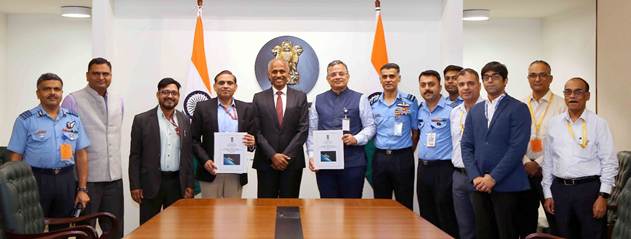
On 15 October 2026, the Ministry of Defence signed two significant capital procurement contracts valued at ₹4,106 crore ($492 million) in New Delhi. Under the agreement, New Space India Limited will deliver the GSAT-7C dedicated military communication satellite for the Indian Air Force worth ₹2,563 crore ($307 million). Concurrently, Bharat Dynamics Limited was awarded a ₹1,543 crore ($185 million) contract to manufacture indigenous Varunastra heavy weight torpedoes developed by DRDO for the Indian Navy.
The formal signing ceremony was executed in the presence of Additional Secretary and Director General (Acquisition) Shri A Anbarasu. The procurement was executed under the Defence Acquisition Procedure (DAP) within the indigenous Buy (Indian-IDDM) classification. This capital commitment underscores New Delhi’s operational calculus to eliminate dependence on overseas supply chains for frontline ordnance and strategic communications.
The contract structure distributes ₹2,563 crore ($307 million) to Bengaluru-based New Space India Limited (NSIL), the commercial arm of the Indian Space Research Organisation (ISRO). Simultaneously, ₹1,543 crore ($185 million) flows to Hyderabad-based Bharat Dynamics Limited (BDL) for industrial manufacturing of the torpedoes developed by the Naval Science and Technological Laboratory (NSTL) in Visakhapatnam. Together, the synchronized contracts for GSAT-7C and Varunastra reflect an integrated procurement doctrine designed to secure India’s strategic frontiers.
How Does GSAT-7C Upgrade the Indian Air Force’s Network-Centric Combat?
GSAT-7C provides the Indian Air Force with a dedicated, jam-resistant geostationary communications architecture that links airborne early warning aircraft, frontline fighters, and unmanned strike platforms in real time. Designed and manufactured indigenously through New Space India Limited, the ₹2,563 crore ($307 million) satellite extends secure beyond-line-of-sight voice and data connectivity across disputed northern borders and maritime approaches, integrating seamlessly into the service’s Integrated Air Command and Control System.
The Indian Air Force operates across severe geographical terrain, from the high-altitude friction along the Line of Actual Control (LAC) to oceanic airspace across the northern Indian Ocean. Previously, tactical airborne communications relied heavily on ground relays, line-of-sight VHF/UHF tactical radios, and the earlier GSAT-7A satellite launched in 2018. As frontline squadrons induct modernized platforms including the Su-30MKI, Rafale, Tejas Mk1A, and forthcoming autonomous unmanned strike systems, bandwidth and orbital coverage have faced acute demand.
The satellite directly bridges this architectural requirement. Operating in secure military spectrum bands, the spacecraft functions as an unblinking orbital switchboard. It enables Software-Defined Radios (SDR) aboard airborne assets to share real-time target tracks, radar pictures, and electronic warfare data. This space-based backbone reinforces India’s geosynchronous satellite surveillance architectures, allowing air combat commanders to orchestrate theatre-wide strikes without relying on vulnerable ground nodes.
Data sovereignty in high-intensity combat decides survivability.
Why Are Varunastra Torpedoes Essential for Indian Navy Deterrence in the IOR?
The ₹1,543 crore ($185 million) contract for Varunastra heavy weight torpedoes equips frontline Indian Navy destroyers and frigates with advanced anti-submarine strike capability across the Indian Ocean Region. Developed by the Naval Science and Technological Laboratory and manufactured by Bharat Dynamics Limited, the electrically propelled, wire-guided torpedo operates at depths up to 600 metres with a 40-knot sprint speed, directly countering expanding Chinese and regional submarine deployments.
The undersea theatre across the Indian Ocean Region has grown intensely competitive. China’s People’s Liberation Army Navy (PLAN) maintains persistent submarine patrols in regional waters, while Pakistan’s navy is actively inducting eight Hangor-class air-independent propulsion (AIP) submarines from Beijing. In this maritime theatre, surface combatants lacking long-range, deep-diving torpedoes remain acutely vulnerable to hostile undersea ambushes.
By executing contracts for GSAT-7C and Varunastra, New Delhi guarantees that Indian surface groups possess verified lethal answers beneath the surface. Designed by DRDO’s NSTL with over 95 per cent indigenous content, Varunastra is equipped with conformal acoustic homing arrays, sophisticated digital signal processing, and robust counter-countermeasure capabilities. When launched from Kolkata-class, Visakhapatnam-class, or Project 17A frigates, the torpedo maneuvers against evasive undersea targets with active and passive acoustic guidance.
During the 1982 Falklands War, the Argentine submarine ARA San Luis repeatedly evaded British anti-submarine screens because escort vessels lacked reliable acoustic weapons and integrated tracking data. Forty-four years later, New Delhi’s deployment of Varunastra prevents any such vulnerability in the waters between the Strait of Malacca and the Gulf of Aden.
What Is the Market and Supply Chain Impact for BDL and Defence Equities?
The ₹4,106 crore ($492 million) allocation expands Bharat Dynamics Limited’s executable order book by ₹1,543 crore ($185 million) while accelerating commercial aerospace supplier revenues for New Space India Limited. This procurement stimulates high-grade domestic supply chains for titanium alloys, marine maraging steel, silver-zinc battery packs, and space-grade gallium nitride electronics, reinforcing capital expenditure cycles across private sub-tier vendors and defence public sector undertakings alike.
For investors tracking defence capital expenditure, the ₹1,543 crore ($185 million) order marks an inflection point for Bharat Dynamics Limited (NSE: BDL). While BDL’s revenue profile has historically been dominated by surface-to-air missiles and anti-tank guided missiles, serial orders for Varunastra cement its position as the sole industrial producer of heavy weight naval torpedoes in India. The contract extends production visibility at BDL’s Visakhapatnam and Bhanur manufacturing facilities through the late 2020s. Along with satellite systems, the combined industrial pipeline of GSAT-7C and Varunastra guarantees sustained high-margin order execution.
The parallel ₹2,563 crore ($307 million) satellite allocation to NSIL benefits the wider private aerospace manufacturing cluster. Precision fabrication contractors, space-qualified payload fabricators, and electronic subsystem suppliers will absorb significant component demand. Furthermore, the combined manufacturing cycle of GSAT-7C and Varunastra draws heavily upon specialized strategic raw materials, including marine-grade titanium, high-strength maraging steel for torpedo hulls, and advanced silver-zinc battery chemistries engineered for extreme underwater pressures.
Capital expenditure commitments from the Ministry of Defence have moved from sporadic orders to steady industrial production streams, aligning with broader initiatives like integrated multi-layered air defence networks.
Investment Disclaimer: The analysis presented herein regarding defence public sector undertakings, order books, and equity valuations is published solely for strategic, informational, and educational purposes. It does not constitute financial advice, equity research, or an offer or recommendation to buy or sell securities. Investors must conduct independent due diligence or consult a SEBI-registered financial advisor before making investment decisions.
Strategic Trajectory: Connecting the Orbital High Ground to the Sea Floor
By committing ₹4,106 crore ($492 million) to dual aerospace and undersea manufacturing lines, New Delhi establishes an integrated doctrine linking high-altitude situational awareness to sovereign underwater strike deterrence. This concurrent induction of sovereign space and naval platforms ensures that Indian frontline formations maintain uninterrupted command resilience across contested frontiers, mitigating foreign supply vulnerabilities while providing credible deterrence throughout the wider Indo-Pacific maritime domain.
Modern military deterrence is an unbroken chain. A supersonic fighter operating along the Himalayan ridge without secure satellite datalinks is blind to beyond-visual-range threats; a multi-billion-rupee stealth frigate in the Arabian Sea without heavy weight torpedoes is powerless against a submerged adversary. By funding GSAT-7C and Varunastra simultaneously, South Block reinforces deterrence across both dimensions.
By authorizing these capital investments, New Delhi has addressed both vulnerabilities in tandem. The strategic integration achieved through GSAT-7C and Varunastra reinforces India’s capability to protect sovereign airspace and secure maritime approaches.
Just as the naval lessons of 1982 demonstrated that unguided torpedoes and broken links compromise whole battle fleets, New Delhi’s dual procurement ensures that India’s armed forces retain decisive sovereign leverage from the thermosphere to the sea floor.
As domestic production lines accelerate in Bengaluru and Hyderabad, the parallel induction of GSAT-7C and Varunastra demonstrates that true deterrence lies in building sovereign answers to complex strategic challenges.
Source Note: This analysis is derived from primary official statements issued by the Ministry of Defence on 15 October 2026, technical documentation from the Naval Science and Technological Laboratory (DRDO), and corporate filings from Bharat Dynamics Limited.