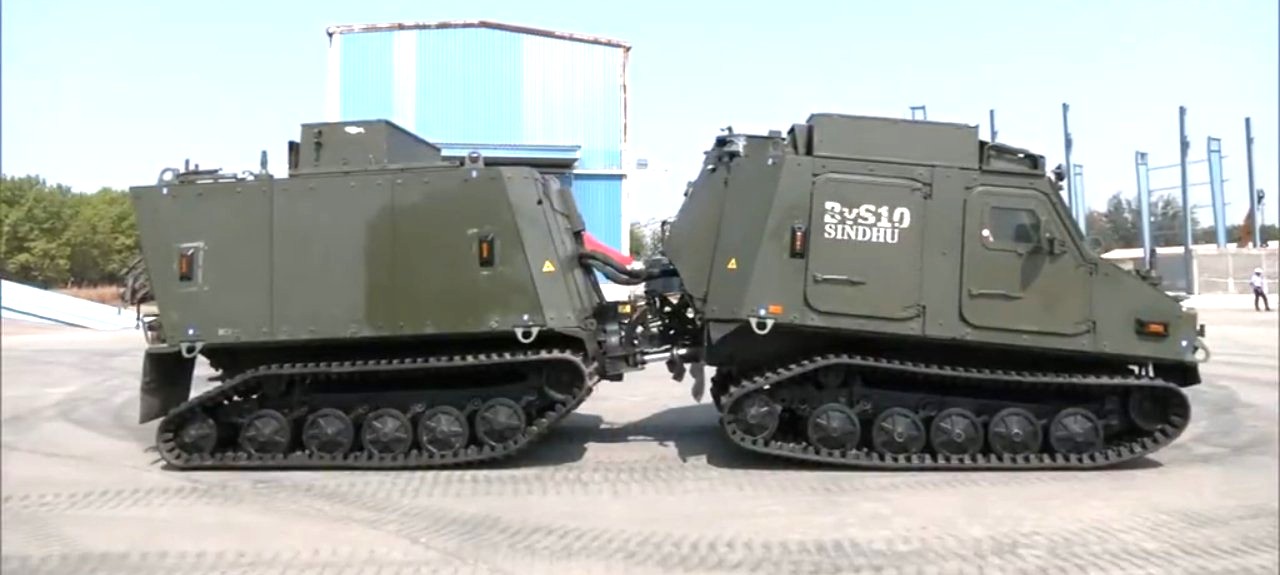
The Army put its requirement for 18 articulated all-terrain vehicles on paper in March 2022. On 28 October 2026, Larsen & Toubro (L&T) and BAE Systems began BvS10 Sindhu production at Hazira in Gujarat, with the vehicles scheduled for Ladakh and Kutch, ANI reported. The Ministry of Defence (MoD) has listed an articulated all-terrain vehicle developed by L&T among contracts signed in financial year 2025-26. The price and the delivery dates are not public.
The Sindhu is a tracked, twin-cabin carrier adapted from the BvS10, which BAE Systems Hägglunds builds in Sweden. L&T makes the Indian version under licence at its Armoured Systems Complex, with design and technical support from the Swedish company. The Army is the only customer named so far.
BvS10 Sindhu Production at Hazira: What Is Confirmed and What Is Not
L&T’s filing to the stock exchanges on 19 November 2025 confirms that the Army signed a contract for the Sindhu, to be built at Hazira with BAE Hägglunds design support and a logistics package covering deployment, maintenance and life-cycle support. The filing carries no value, quantity or delivery schedule. The MoD’s Annual Report 2025-26 describes the system and its terrain but names neither the platform nor a price.
The figure of 18 vehicles rests on the Army’s 2022 requirement and on ANI’s account of the launch, where L&T’s Arun Ramchandani called the day the start of the manufacturing journey and said the two companies would build at larger scale together. That is a stated ambition, not an order. The MoD calls the vehicle an indigenous system developed by L&T; L&T’s own filing describes licensed production of a BAE Hägglunds platform. Both descriptions are on the record. The contract text is not.
Why the Army Asked for a Carrier That Works on Glaciers and Salt Flats
The Army’s request for information of 25 March 2022, as reported at the time, sought 18 articulated all-terrain vehicles: 12 for Nimu in Ladakh and six for Bhuj in Gujarat. Each had to carry ten soldiers with full combat load, work at 18,000 feet on glaciated, snow-bound ground and on salt marsh, cover at least 150 km cross-country and last 15 years in service.
The MoD’s annual report gives its own summary: a twin-cabin vehicle with STANAG (NATO standardisation) level 1 ballistic protection for ten personnel, a range of 150 km with full load and fording to 240 mm, built for patrolling and domination of inaccessible ground in Eastern Ladakh and Kutch, from mud flats and salt plains to snow-bound permafrost.
Then the clock ran. L&T and BAE Systems signed a licensing and manufacturing agreement in September 2023, as the BvS10 entered Army trials. Trade reports name the Talwar from Prominent Comtech as its rival. The contract was announced on 19 November 2025, and BvS10 Sindhu production began on 28 October 2026, four years and seven months after the request for information. The procurement file is not public, so the dates are the record.
Why the Army Placed 12 of the 18 Vehicles in Ladakh
In the 2022 requirement, twelve of the 18 vehicles were meant for Nimu (also spelt Nimmu), in Leh district, where heavy snow has historically cut the road routes on which forward supply depends. The Army stocks food, fuel and ammunition ahead of each winter for that reason, as its 2020 preparations in Ladakh showed. Roads are improving, and the likely role of a tracked carrier is the stretch where the road ends and snow begins.
The Border Roads Organisation (BRO) has built the 298-km Nimmu–Padum–Darcha road through Zanskar, which the government describes as an alternative corridor to the Srinagar–Leh and Manali–Leh highways. TES has covered how India’s border infrastructure has changed since 1962 and the Zojila Tunnel breakthrough. The Army has not said which posts the vehicles will serve, and BvS10 Sindhu production at Hazira does not change that.
Why Kutch Needs a Vehicle for Marsh, Salt Flats and Tidal Creeks
The 2022 requirement placed six vehicles at Bhuj, for the Rann of Kutch, where salt marsh and tidal creeks leave wheeled vehicles struggling. Reports of Border Security Force (BSF) operations along Sir Creek describe shallow water, tidal change and wide marshland that complicate movement and surveillance.
The ground has been contested for decades. In April 1965 the Indian Army’s 31 Brigade and Pakistan’s 8 Division fought in the Rann, each side fielding more than 5,000 troops according to a CIA report. The 1968 tribunal awarded India about 90 per cent of the area but left Sir Creek outside its award, an analysis by the Manohar Parrikar Institute for Defence Studies and Analyses notes.
On 2 October 2025, at Bhuj, Defence Minister Rajnath Singh alleged that Pakistan was expanding military infrastructure near Sir Creek and warned that any adventure there could “change both history and geography.” TES examined India’s Sir Creek border strategy in an earlier report. BvS10 Sindhu production will give that frontier six vehicles, on the requirement’s numbers. The Army has not described how they will be used.
How BvS10 Sindhu Production Works, and Why a 60 Per Cent Indian Content Floor Matters
BvS10 Sindhu production rests on a licence. L&T is the prime contractor for India and builds the vehicle; BAE Systems Hägglunds licenses the design and supports it. BAE has said the programme carries more than 60 per cent Indian content, calls it the first expansion of the BvS10 into Asia, and says the arrangement widens security of supply for BvS10 parts worldwide.
For India, the arrangement puts a foreign-origin design on a domestic production line with a logistics package behind it. Hazira is also where, as TES reported, DRDO’s air-independent propulsion module entered its second setting-to-work phase.
What to Watch Before the First Delivery in Late 2027
When do deliveries fall due? BAE Systems Hägglunds has said the 18 vehicles are to be delivered within two years. Counted from the contract signed in November 2025, that points to late 2027. This is a TES calculation; no official delivery date is public.
Will the Army order more? No follow-on order is on the public record. Ramchandani’s remark about building at larger scale is the only signal so far, and it came from the company.
What is the contract worth? Neither L&T’s filing nor the MoD’s annual report gives a value.
The programme will be judged on two dates. The first is the delivery window in late 2027, when the first vehicles reach Ladakh and Kutch or do not. The second is any repeat order, which would show the Army treating 18 as a first tranche. India has the requirement, the licence, the Hazira line and the logistics package in place. The public record still lacks a price and a delivery date, and those two numbers will decide how BvS10 Sindhu production is read a year from now.
Source note: MoD Annual Report 2025-26; L&T’s filing of 19 November 2025 to the stock exchanges; ANI’s report of the 28 October 2026 launch; reporting on the Army’s 2022 requirement; MP-IDSA on Sir Creek. The late-2027 date is a TES calculation.