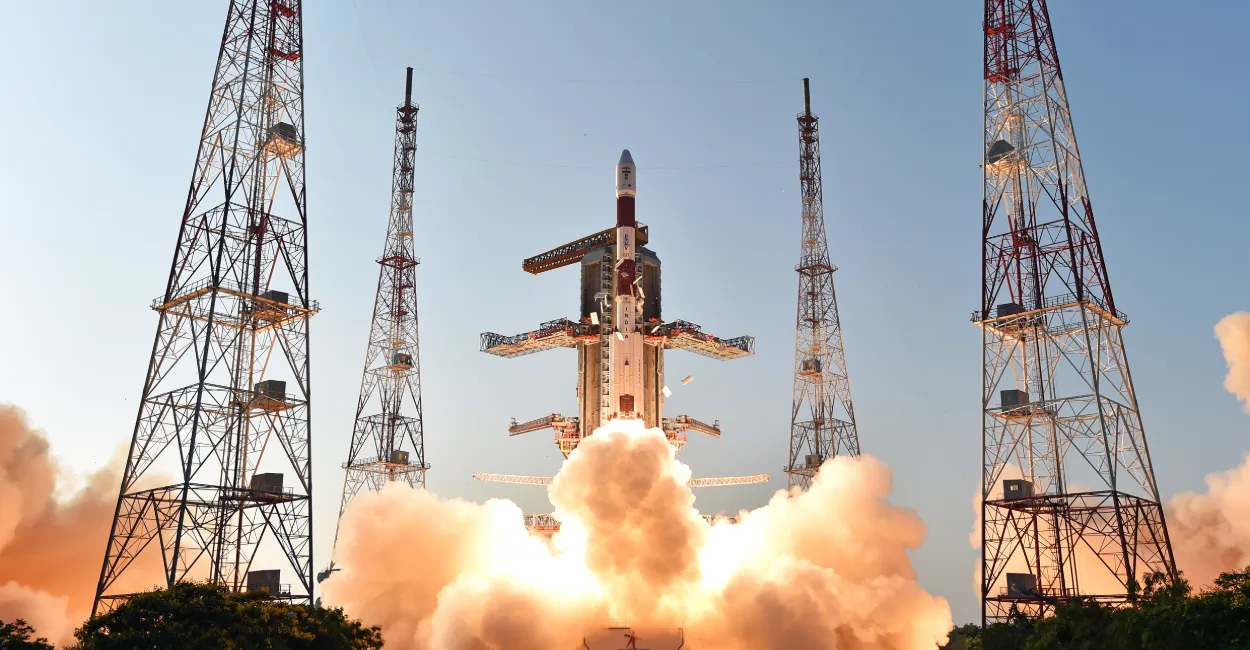
In August 2025, the Department of Space told Parliament that NVS-03 would be launched by the end of that year. The satellite will instead fly in a reported window of 15 to 20 October 2026, and the ten-month delay has changed what the NVS-03 launch is for. Since 13 March, India’s own navigation constellation has had too few working satellites to fix a position on its own.
NavIC still keeps time. It cannot, by itself, tell a phone, a fishing boat or a guided weapon where it is. The NVS-03 launch, on a Geosynchronous Satellite Launch Vehicle (GSLV) from Sriharikota, is the first chance in seven months to restore the minimum the system needs.
How India reached this point says more about the programme than the rocket does. A failed orbit-raise in 2025, a first-generation fleet worn down by clock failures, and a replacement schedule that ran late have left a regional navigation system with no spare satellite. One successful flight fixes the count. It does not fix the margin.
Key takeaways
- NavIC needs four working satellites for standalone positioning. Since IRNSS-1F’s last atomic clock stopped on 13 March 2026, it has had three: IRNSS-1B, IRNSS-1I and NVS-01.
- The government told Parliament in July and August 2025 that NVS-03 would fly by the end of 2025. The reported NVS-03 launch window is now 15–20 October 2026.
- The main risk comes after liftoff. NVS-02 reached transfer orbit in January 2025 but never reached its working slot because a pyro valve did not open.
- A successful mission returns NavIC to exactly four positioning satellites, one of which, IRNSS-1B, is already past its ten-year design life.
- NVS-04, NVS-05 and one further satellite are planned. Their pace will decide whether NavIC stays above the floor.
Why the NVS-03 launch matters: NavIC is one satellite short
NavIC, the Navigation with Indian Constellation, needs signals from at least four satellites to calculate a three-dimensional position. A receiver must solve for latitude, longitude, altitude and the error in its own clock, and four unknowns need four measurements. With only three satellites providing positioning, navigation and timing (PNT) services, NavIC can still distribute accurate time but cannot compute a location without help from GPS or other foreign constellations.
The government has said so on the record. In a written reply to the Lok Sabha in July 2026, Minister of State for Space Dr Jitendra Singh said that after IRNSS-1F completed its mission life, only IRNSS-1B, IRNSS-1I and NVS-01 remained operational for PNT services. The constellation, he said, “cannot provide standalone positioning service; however, timing service is functional.”
The original design makes the shortfall sharper. NavIC was planned as a seven-satellite constellation in geostationary and geosynchronous orbits, covering the Indian landmass and the region up to 1,500 km beyond its boundaries, according to a 2022 Lok Sabha reply. Four is the floor below which that design stops working as an independent system, and the NVS-03 launch is an attempt to climb back to it. Seven is what NavIC was meant to have.
How the NavIC constellation fell below four
India has launched 11 NavIC satellites since July 2013. Many first-generation spacecraft lost their imported rubidium atomic clocks, NVS-02 failed to reach its operational orbit in January 2025, and IRNSS-1F’s last working clock stopped on 13 March 2026, three days after the satellite completed its ten-year design life. That final failure took the number of positioning satellites from four to three.
The clock problem is a decade old. Each first-generation satellite carried three imported rubidium clocks for redundancy, and failures spread through the fleet. Of the 11 satellites launched, six have failed, largely because of defective imported clocks and, in some recent cases, orbital problems, GPS World reported in March. Several survivors now serve only one-way broadcast messaging.
IRNSS-1F held on longest. ISRO said the satellite, launched in March 2016, completed its design life on 10 March 2026 and that its procured on-board clock stopped functioning on 13 March. It had been running on the last of its three clocks. The spacecraft still carries limited messaging but no longer contributes to positioning.
NVS-02 was supposed to prevent this. Launched on GSLV-F15 on 29 January 2025, ISRO’s 100th launch from Sriharikota, the satellite reached geosynchronous transfer orbit but could not climb to its working slot. ISRO’s failure analysis traced the fault to a pyro valve on the orbit-raising engine that did not open because the command signal never reached it.
TES assessment: had NVS-02 reached orbit, it would have been a fifth positioning satellite, and the loss of IRNSS-1F would have left NavIC at four.
A promise that slipped by ten months
In written replies to the Lok Sabha on 23 July 2025 and the Rajya Sabha on 7 August 2025, the government said NVS-03 would launch by the end of 2025, with NVS-04 and NVS-05 following at six-month intervals. None of the three flew in 2025. The NVS-03 launch is now reported for 15–20 October 2026, about ten months behind that schedule, and the delay ran straight through the March loss of IRNSS-1F.
| Date | Event | Basis |
|---|---|---|
| 29 Jan 2025 | NVS-02 launched on GSLV-F15; later fails to reach its operational orbit | ISRO |
| 23 Jul and 7 Aug 2025 | Parliament told NVS-03 will launch by end-2025, then NVS-04 and NVS-05 at six-month gaps | Official statement |
| 2 Nov 2025 | Pyro-system corrective measures flown and tested on CMS-03 (LVM3-M5) | Official statement |
| 31 Dec 2025 | End-2025 target for NVS-03 passes without a launch | Verified fact |
| 13 Mar 2026 | IRNSS-1F’s last clock stops; NavIC drops to three PNT satellites | ISRO |
| Jul–Aug 2026 | Lok Sabha told NVS-03 is ready; NVS-04 and NVS-05 in advanced stages; one more satellite planned | Official statement |
| 14 Sep 2026 | GSLV launch campaign begins at Sriharikota | Media reports |
| 15–20 Oct 2026 | Reported NVS-03 launch window | Media reports citing ISRO |
ISRO has not publicly explained the full length of the delay. Two pieces of context are on the record. The government told the Lok Sabha that corrective measures from the NVS-02 review had been implemented and tested on the CMS-03 satellite, launched on 2 November 2025, and would be applied to NavIC satellites with bi-propellant systems. ISRO’s flight calendar also thinned in 2026: the Times of India reported that the agency’s 4 September launch was its first successful mission of the year.
TES assessment: with the pyro fix validated only in November 2025, an end-2025 NVS-03 launch was always tight. What the public record lacks is a revised date issued between the missed deadline and March 2026, the months in which NavIC’s fourth positioning satellite was running on its last clock.
What NVS-03 carries, and where it could fail
NVS-03 is the third second-generation NavIC satellite, built to the same design as NVS-01 and NVS-02 on ISRO’s I-2K platform and weighing about 2,250 kg at lift-off. It broadcasts navigation signals in the L1, L5 and S bands. Its hardest test comes after the NVS-03 launch itself, when the satellite’s own engine must raise it from transfer orbit to its geosynchronous slot.
The L1 signal and the clock question
The L1 band is the commercial change. It is the frequency that ordinary GPS chips already use, so adding it lets NavIC reach phones, wearables and low-cost trackers. ISRO’s mission brochure for NVS-01 describes the second-generation series as adding the L1 band and an indigenously developed rubidium atomic clock, built by the Space Applications Centre in Ahmedabad, with a mission life of 12 years.
The Indian clock does not end the import problem. The NVS satellites fly a mix of indigenous and imported clocks, according to reporting by The Week and ETV Bharat. Whether India’s own units outlast the imported ones that failed across the first generation is something only years in orbit will show.
The orbit-raising test after the NVS-03 launch
A GSLV places its payload in geosynchronous transfer orbit. The rest of the climb depends on the satellite’s own propulsion. NVS-02 cleared every rocket stage in January 2025 and then stalled at exactly that handover. NVS-03 will fly the same profile on a GSLV Mk II, listed as flight F18, following the GSLV mission that carried EOS-05, India’s first geosynchronous imaging satellite.
Liftoff will draw the cameras. The engine firings over the following days will decide the outcome.
Sovereign navigation and the armed forces
NavIC offers an open Standard Positioning Service for civilians and an encrypted Restricted Service for authorised users, including the armed forces. The government has said the forces use a multi-constellation setup that includes NavIC alongside foreign systems. A successful NVS-03 launch would restore a positioning source that India controls from satellite to ground segment, one no foreign operator can degrade or withdraw during a crisis.
The argument for that control rests on two dates. During the 1999 Kargil conflict, the United States refused India’s request for GPS data on the region, according to accounts carried by the Press Trust of India. In May 2000, Washington switched off Selective Availability, the deliberate degradation it had applied to civilian GPS accuracy for years. Both decisions were made in Washington. India had no say in either.
For military planners, the issue is assurance. Precision munitions, maritime surveillance and the timing behind secure communications all depend on position and time data, which foreign constellations can supply today. An independent Indian fix is what would remain available whatever another government decides, and orbits are becoming more contested: TES has examined how declassified US on-orbit space control capabilities are changing assumptions about satellite survivability.
GPS, Russia’s GLONASS, the European Union’s Galileo and China’s BeiDou are global systems; Japan’s QZSS, like NavIC, is regional. A regional footprint suits India’s interests in the Indian Ocean and along the Himalayan frontier. It also leaves NavIC with no large fleet to absorb a loss.
The civilian and industrial stake
NavIC’s civilian footprint is already broad. In December 2025, the government told the Lok Sabha that NavIC support was enabled on more than 10,000 trains, 30,000 fishing vessels and 15 lakh vehicles, and that over 60 smartphone models supported it. Most of these receivers also use GPS, so the loss of standalone positioning since March has gone largely unnoticed by users.
Unnoticed is not the same as harmless. Those deployments were justified by a signal under Indian control; while the constellation is short, the devices lean on foreign satellites for position.
The minister also told Parliament in December 2025 that the government has not mandated NavIC in phones. That matters for chipset vendors, handset makers and the vehicle-tracking industry, whose product plans follow policy. TES assessment: a constellation that cannot fix a position on its own weakens the case for any mandate. A successful NVS-03 launch followed quickly by NVS-04 would restore the technical argument; a second orbit-raising failure would set adoption policy back along with the satellite programme.
After the NVS-03 launch: a constellation with no spare
A successful NVS-03 launch returns NavIC to exactly four positioning satellites: IRNSS-1B, IRNSS-1I, NVS-01 and NVS-03. That restores standalone service but leaves no redundancy. The government says NVS-04 and NVS-05 are in advanced stages of realisation and that one more satellite will follow, but the replies reported so far have not given launch dates.
The age profile is the concern. IRNSS-1B was launched in April 2014 and is already beyond its ten-year design life. IRNSS-1I, launched in April 2018 to replace the clock-failed IRNSS-1A, reaches ten years in 2028. A four-satellite system with one member past design life can drop below the floor again with a single failure.
Speed is the remedy. The August 2025 plan envisaged six-month gaps between NVS satellites. TES assessment: if ISRO holds something close to that cadence after October, NVS-04 would fly in the first half of 2027 and NVS-05 later that year, giving the constellation its first real margin since 2025. If the gaps stretch the way NVS-03’s did, the margin stays at zero. Within India’s crowded space programme, that cadence is a matter of priority as much as engineering.
What to watch
When is the NVS-03 launch?
Reports citing ISRO put the window at 15–20 October 2026 from the Satish Dhawan Space Centre, Sriharikota. The final date depends on mission-readiness reviews; ISRO’s official announcement of the NVS-03 launch date is the signal to watch.
Will NVS-03 reach its operational orbit?
That is decided in the days after liftoff, when the satellite’s engine raises it from transfer orbit to its geosynchronous slot. This is the step that failed on NVS-02. ISRO says the pyro-system fix was tested successfully on CMS-03 in November 2025.
Once NVS-03 reaches its slot and completes in-orbit testing. ISRO has not published a commissioning timeline, so the gap between launch and restored service is unknown.
What comes after NVS-03?
The government says NVS-04 and NVS-05 are in advanced stages and that one more navigation satellite is planned. Their launch dates will show whether NavIC builds a margin or stays one failure from losing standalone positioning.
Kargil taught India that a navigation signal is only as dependable as the government that controls it. NavIC was built to move that control to New Delhi. The NVS-03 launch poses a narrow test: can ISRO put one satellite into orbit and raise it to its slot? The test that follows is broader, and the August 2025 promise sets the benchmark. India’s navigation independence will depend on whether ISRO can replace satellites faster than they age.
Sourcing note. Satellite status, failure dates and schedule commitments are drawn from ISRO statements and written replies to Parliament published through the Press Information Bureau (July and August 2025, December 2025, July and August 2026). The launch window, campaign dates and NVS-03 mass come from media reports citing ISRO, as ISRO had not published an official launch date at the time of writing. Passages marked “TES assessment” are The Eastern Strategist’s analysis, not official statements.