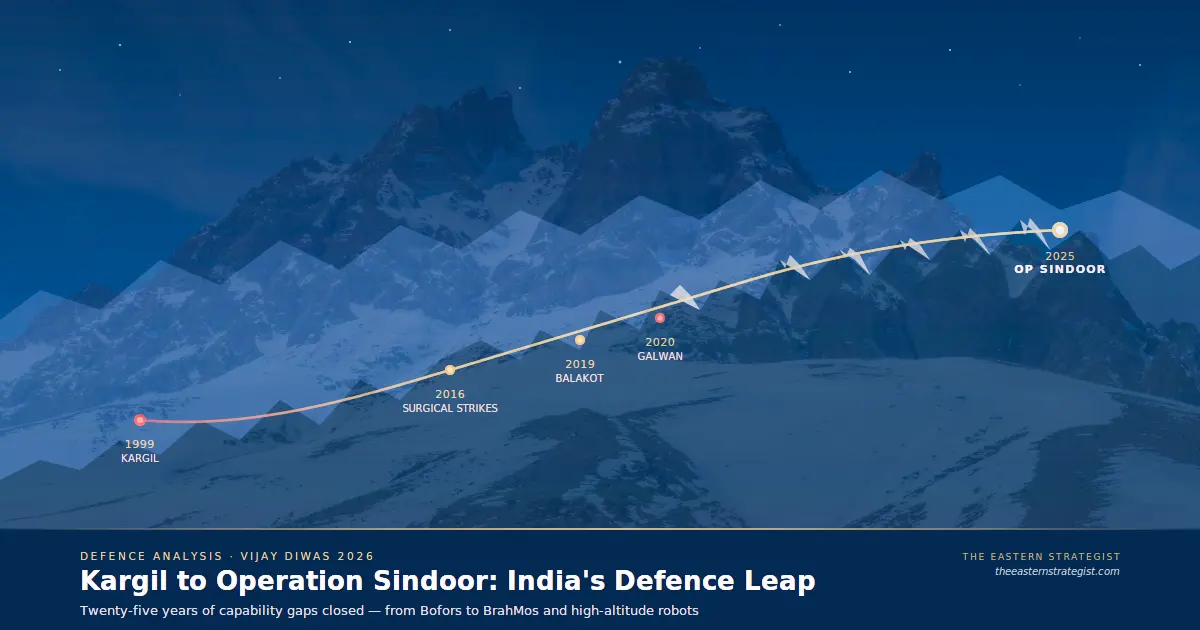
Twenty-five years separate the Bofors gun from the BrahMos missile. Both fought the same mountain.
Kargil to Operation Sindoor traces 25 years of Indian defence modernisation: from borrowed Israeli laser-designation pods and an improvised Bofors gun in 1999, to indigenous BrahMos missiles, the Akashteer air-defence network and high-altitude robotic mules deployed by 2025-26. The throughline is altitude — India’s most persistent adversary in Ladakh and Kargil alike.
In the summer of 1999, the Indian Air Force could not send its Mi-35 gunships above 10,000 feet. The rotors lost lift, the engines lost breath, and helicopters that had drawn blood in Afghanistan and Sri Lanka simply had no answer for the Himalaya. Twenty-five years on, in the autumn of 2024, an American-built Stryker infantry vehicle failed a very similar test in Ladakh — its drivetrain overheating on a 40-degree gradient while an indigenous Tata-DRDO platform crossed the same slope without drama.
Two different militaries, two different eras, one unbroken lesson: in the mountains that ring India’s northern frontier, altitude has been a more consistent adversary than Pakistan or China. Vijay Diwas is usually remembered as the day India defeated an infiltrating army. It is less often read as the day India discovered it had been fighting terrain all along — and that the terrain was winning.
This piece is not a retelling of the Kargil War. It is an account of what India built afterward, and an honest look at whether the newest tools — autonomous ground robots now under trial in Ladakh — can finally do what neither the Mi-35 nor the Stryker could.
01What Actually Failed at Kargil in 1999
The infiltration succeeded partly because Indian surveillance simply could not see Pakistani positions dug into the ridgelines above Dras and Batalik. Unmanned aerial vehicles existed elsewhere in the world by 1999; India did not yet have a mature indigenous programme to field them at scale. When the Mirage 2000s did strike, they did so with Litening pods sourced from Israel — a precision capability India could operate but not yet manufacture.
Then there was the Bofors gun itself. Ironically, the same howitzer that had been mired in a political corruption scandal through the 1980s became, according to veterans who later spoke at Vijay Diwas commemorations, the decisive weapon of the campaign — used for the first time in a direct-fire role against bunkers hidden behind mountain ridges. It worked. But it worked as improvisation, not doctrine.
Air Marshal Narmdeshwar Tiwari, now Vice Chief of the Indian Air Force, was among the officers who operationalised the Litening pod during the war — a detail later commentary framed less as a footnote than as the origin point of India’s precision-strike culture, one that would eventually feed into the country’s fighter jet programmes and DRDO’s broader push toward indigenous defence innovation. The gap between borrowed precision and owned precision would take a generation to close.
02Timeline: What India Built From Kargil to Operation Sindoor
Infographic — Elevation Profile: India’s Capability Ridge, 1999–2026
Peaks mark capability demonstrations; dips mark shocks that forced the next reform cycle. Galwan (2020) and Kargil (1999) are the two lowest points on the ridge — both preceded major procurement acceleration.
Between 2013 and 2017, integration of the BrahMos supersonic cruise missile with the Su-30 MKI fleet moved from proposal to combat-ready reality. Russia had quoted roughly $200 million to execute the integration; DRDO did it domestically for close to Rs 80 crore, with the first test firing in November 2017 — a data point that now sits alongside India’s expanding private missile manufacturing base.
Then came a sharp discontinuity. The 2020 Galwan clash with China turned Eastern Ladakh into India’s most demanding live procurement laboratory. Emergency Procurement powers — allowing contracts up to Rs 300 crore to be placed and delivered within a year — became the Army’s preferred route for high-altitude equipment. Under the fourth such round, the Army inducted 100 robotic mules in 2022–23, rated to operate between minus 40 and plus 55 degrees Celsius. By 2024, the DRDO–L&T Zorawar light tank, purpose-built for Ladakh, entered advanced trials at Hajira — the same season a US-built Stryker failed comparative trials on power-to-weight grounds.
03How India Is Defending Today — The Layered Shield
General Anil Chauhan, India’s Chief of Defence Staff, captured the doctrinal shift in August 2025 when he observed that nations increasingly achieve political objectives through short-duration conflicts rather than protracted wars. Operation Sindoor was built for exactly that calculus — an 88-hour campaign, not an open-ended one. India’s parallel push toward Iron Dome-style manufacturing extends the same layered logic to point defence of critical sites.
“A well-integrated, doctrinally disciplined network can outperform a technologically superior but isolated platform.” In 1999 — the same year as Kargil — a Yugoslav air-defence officer, Zoltán Dani, used a decades-old SA-3 system, patient radar discipline and short activation windows to shoot down a stealth F-117 Nighthawk over Serbia. Operation Sindoor’s layered defence, however much newer its components, rests on the same underlying logic. Historical parallel — 1999 NATO air campaign over Serbia
Loitering munitions played their own supporting role. Between 7 and 9 May 2025, systems reported to include Israeli-origin Harop and Harpy platforms degraded Pakistani radar coverage ahead of the decisive strike wave. BrahMos, alongside French-origin SCALP-EG and Rampage missiles, carried out long-range precision strikes launched from within Indian airspace in the early hours of 10 May — a sequencing several independent reconstructions describe as the campaign’s turning point.
04Operation Sindoor as the Answer Key, Not the Subject
Director General of Military Operations Lieutenant General Rajiv Ghai told reporters in New Delhi on 11 May 2025 that strikes across nine terror hubs in Pakistan and Pakistan-occupied Jammu and Kashmir killed around 100 terrorists, including individuals linked to the 1999 IC-814 hijacking and the 2019 Pulwama attack. That figure rests on a single official briefing rather than independently verified casualty data, and this piece treats it accordingly — as an official claim, not an established fact.
What is better corroborated is the hardware mix. Independent reconstructions, including Carnegie Endowment’s assessment and War on the Rocks’ analysis, converge on the same broad picture: indigenous and jointly developed systems carried a disproportionate share of the operational load compared with 1999, when India leaned on Israeli sensors and designation pods to fight at all.
05The Market Behind the Mountain
That trend carries a commodities dimension too. Defence production tied to domestic steel, electronics and precision-engineering supply chains means sustained high-altitude procurement cycles — tanks, robotic mules, missile systems — feed directly into order books at listed defence public-sector undertakings and private manufacturers alike, a linkage tracked in more depth in India’s post-Sindoor export targets under Rajnath Singh’s 2029 roadmap and in TES’s ultimate guide to Indian defence stocks.
None of this converts a procurement announcement into a stock recommendation. But the pattern is now consistent enough — Emergency Procurement rounds, DRDO-private sector joint trials, indigenous content targets — that investors watching defence PSU order flow have a genuine, recurring signal to follow each time the Army moves on a new Ladakh-specific platform.
06Can Autonomous Robots Guard India’s High-Altitude Frontier?
The current generation is instructive precisely because of what it does not do. AeroArc’s robotic mule, inducted in 2022–23, can cross rivers and recognise obstacles using electro-optic and infrared sensors, according to comments from the firm’s leadership at the Himtech industry event — but a soldier still directs it. DRDO’s R&DE(E) Pune prototype, shown in March 2026, and the indigenous Param mule under trial since May 2026 extend the same model: load-carrying, semi-autonomous navigation, human oversight retained at every stage. For a deeper look at this specific question, see TES’s dedicated analysis on whether military robots can protect Siachen.
Weaponisation is the harder step, and DRDO has made no public commitment to it. A robot that recognises an obstacle is a different engineering and ethical proposition from a robot authorised to identify and engage a human target on a disputed frontier, where misidentification carries diplomatic as well as human cost. India’s own past robotics ambitions — DRDO spoke publicly in 2012 about developing mine-clearing “robotic soldiers” — moved slower than announced, a caution worth remembering before treating any current trial as a settled trajectory.
The more plausible near-term path is manned-unmanned teaming rather than fully autonomous sentry duty: robots such as Param handling logistics and persistent surveillance on the Zorawar tank’s flanks, while human crews retain the decision to fire. That is a meaningful advance over 1999’s Bofors improvisation. It is not, yet, a robot standing guard alone on a Himalayan ridge.
07What to Watch
Will the Zorawar light tank meet its projected 2027 induction date?
DRDO Chairman Dr Samir V Kamat has indicated the tank could enter Army service by 2027 following completion of trials at Larsen & Toubro’s Hajira facility. Any slippage would be worth tracking against the Stryker’s earlier failure in the same terrain.
Will DRDO signal a move from load-carrying robots toward weaponised or autonomous ground platforms?
Current systems remain human-directed. A public shift in that framing — rather than incremental sensor upgrades — would mark a genuine doctrinal change rather than an equipment update.
Will the indigenous Param mule move from trials to serial production?
Cost comparison against imported alternatives will determine whether India’s high-altitude robotics push scales the way the robotic mule programme did after 2022, or remains a trial-stage demonstration.
Related on The Eastern Strategist

3 thoughts on “Why Altitude, Not the Enemy, Has Been India’s Toughest Adversary Since Kargil”