On 27 March 1999, a Yugoslav air-defence battery shot down an American F-117 Nighthawk over Serbia. The aircraft was, on paper, invisible. A radar operator named Zoltán Dani had studied its flight patterns for weeks, adjusted his radar’s wavelength, and waited. Stealth had not failed as physics. It had failed as a plan against a patient adversary willing to work around it.
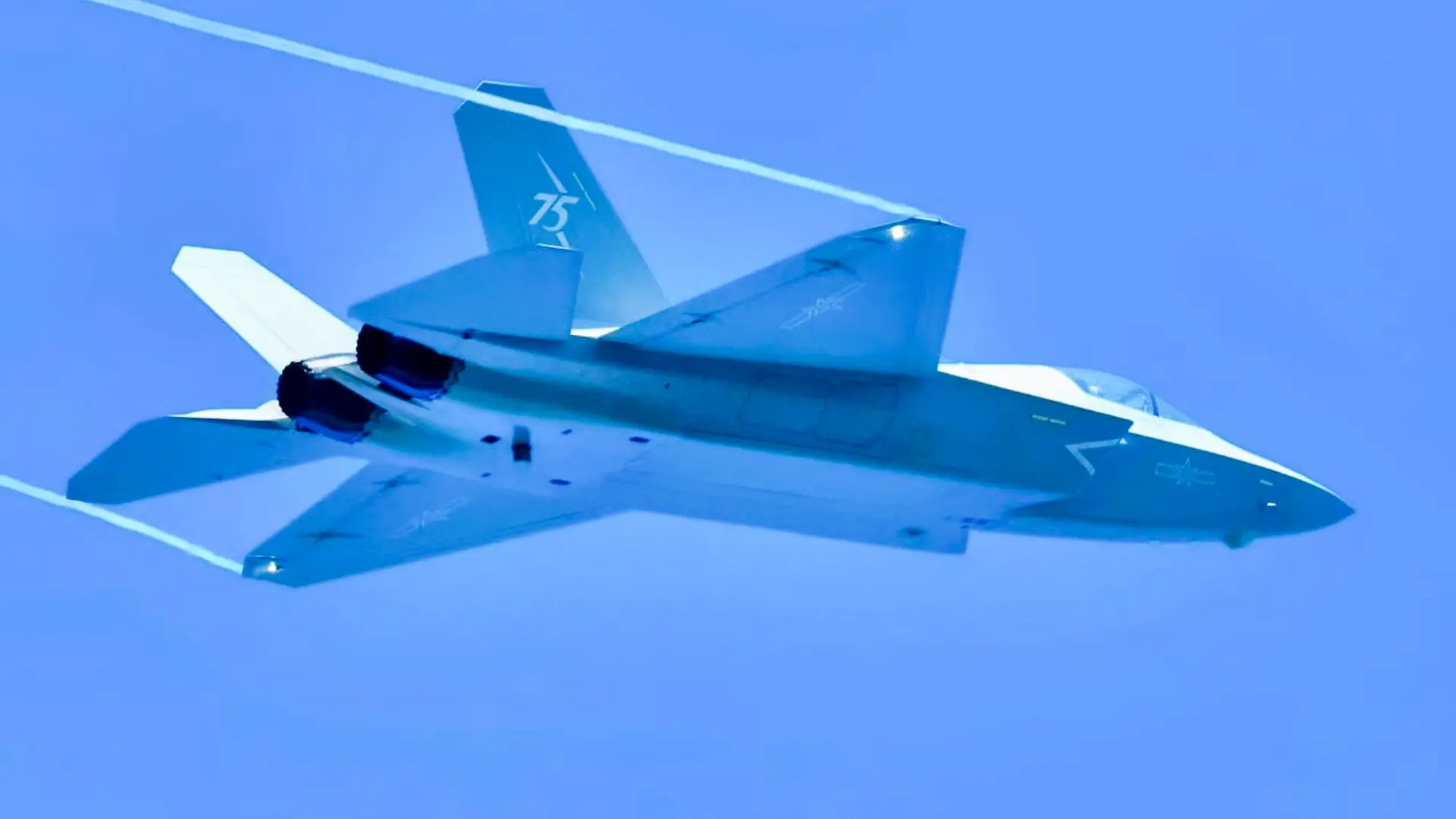
That story is worth remembering as reports harden around a Pakistan J-35 stealth fighter deal that would make Islamabad the first foreign operator of China’s most advanced combat aircraft.
Pakistani and Chinese officials haven’t formally confirmed a sale. But the signals have moved well past speculation. Prime Minister Shehbaz Sharif’s administration has publicly acknowledged that China offered Pakistan a package built around roughly 40 fifth-generation J-35 aircraft, KJ-500 airborne early warning aircraft, and HQ-19 missile-defence systems, according to Pakistani government statements reported by regional defence outlets. Industry reporting puts the programme’s overall cost at USD 5–6 billion, with per-unit costs estimated between USD 80–100 million.
None of these figures have been independently confirmed by Beijing or Islamabad.
Will one aircraft — even a genuinely capable one — overturn a military balance India has spent a decade building across air, land, sea, space, and the electromagnetic spectrum? Zoltán Dani’s radar operators would have a view on that.
What Pakistan Is Actually Buying
Military procurement rarely begins with technology. It begins with strategy.
India’s conventional capabilities have expanded steadily over the past decade. Rafale fighters are in frontline service. The S-400 has strengthened long-range air defence. Indigenous missile programmes are maturing. The navy is extending its reach across the Indian Ocean. Following the Pahalgam terror attack and Operation Sindoor, New Delhi also placed the Indus Waters Treaty in abeyance — a signal that military, diplomatic, and economic pressure now move together rather than in sequence.
Pakistan cannot match that spending. It cannot rapidly expand its industrial base to run a conventional arms race against a much larger economy.
So it has reached for something else: disproportion.
The reported J-35 package doesn’t stop at the aircraft. It bundles in airborne early warning and missile-defence systems — an ecosystem, in the words of one Pakistani defence analyst quoted by regional media, not a purchase. And the value of that ecosystem has less to do with stealth itself than with the uncertainty it creates. Indian planners who cannot reliably predict where a low-observable aircraft might appear have to prepare for a wider range of contingencies at once. Deterrence, in this sense, starts working before a single sortie is flown.
What the Pakistan J-35 Stealth Fighter Deal Actually Includes
Stealth is not invisibility. It never has been. It buys a pilot time — the distance at which a radar picks up the aircraft shrinks, and everything downstream, detection, decision, response, gets compressed for the defender.
The J-35’s reported specifications follow that logic closely: low-observable shaping, internal weapons bays, an active electronically scanned array radar, sensor fusion, infrared search-and-track, electronic warfare suites, long-range PL-15 air-to-air missiles. Nothing here departs from what a fifth-generation aircraft is supposed to do.
What’s more interesting is what the aircraft can’t do alone. Chinese doctrine leans hard on network-centric warfare, and the J-35 is built to receive targeting data from early-warning aircraft, satellites, ground radars, and secure datalinks rather than lighting up its own radar and giving its position away. Cut the aircraft off from that network, and its effectiveness drops sharply. It’s less a lone predator than a forward sensor node with weapons attached — which means the question worth asking isn’t about the aircraft at all. It’s about the network underneath it, and whether India can see into that instead.
Can India Actually Detect It?
Short answer: not with one system. Nobody’s air force works that way anymore.
Modern air defence fuses satellites, airborne early warning aircraft, passive sensors, infrared detection, ground radar, and machine correlation into a single continuously updated picture. Zoltán Dani beat an F-117 with a 1960s-vintage Soviet radar and patience. Today’s networks are built to do that fusion automatically, at scale, against aircraft considerably more capable than the Nighthawk ever was.
India has been assembling exactly this kind of layered detection for years. The Integrated Air Command and Control System already links a large number of military sensors into one operational picture. The S-400 provides long-range engagement. The Space-Based Surveillance Phase III programme is meant to expand India’s military satellite constellation for more persistent regional monitoring.
The newest piece is Project Kusha. The Defence Acquisition Council has cleared five squadrons of the indigenous long-range system alongside five additional S-400 squadrons, according to Indian defence reporting. Officials describe the twin clearance as the foundation of “Mission Sudarshan Chakra” — a fully networked, multi-layered air defence doctrine rather than a collection of standalone systems. Developed by DRDO with Bharat Electronics and Bharat Dynamics as key industrial partners, Kusha is a three-tier interceptor with a range of roughly 400 km, comparable to the S-400, and is expected to begin phased induction between 2028 and 2030. Unlike the Russian system, whose software India cannot modify independently, Kusha is designed to give the control over its own electronic warfare responses — sovereignty over the code, not just the hardware.
No layered network guarantees catching every stealth aircraft every time. But it doesn’t need to. It needs a platform that slips past one sensor to get caught by the next one, until enough incomplete observations stack into a picture clear enough to act on.
One radar against one aircraft was always going to be an unfair fight, for whoever had the aircraft. One network against one aircraft is a different contest entirely.
The Reality of China Stealth Fighter Export
Selling the J-35 looks straightforward for Beijing. Pakistan is its closest defence partner. A sale deepens that relationship and advertises Chinese aerospace to other buyers watching from the sidelines.
It isn’t that simple.
The aircraft carries some of China’s most sensitive military technology — stealth materials, electronic warfare systems, mission software, sensor fusion architecture — sitting at the core of Beijing’s own modernisation rather than at its export-friendly edges, unlike the older J-10CE India’s neighbours have already received. The PLA Air Force and Navy are expanding their own fifth-generation and carrier-aviation fleets at the same time; every jet sent to Pakistan is one the PLA doesn’t get. Stealth aircraft also need specialised maintenance, expensive logistics, and constant software support, and Pakistan’s economy makes sustaining that without ongoing Chinese financing genuinely difficult. Then there’s the neighbourhood: arming Pakistan with stealth aircraft raises the temperature between two nuclear-armed states in ways Beijing has to weigh against the goodwill of the sale itself.
China may go ahead anyway. But this is why the China stealth fighter export question has dragged through 2026 without a confirmed contract — the decision was never just about the aircraft.
Stealth in the Air, Vulnerable on the Ground
Here’s the thing about the Nighthawk that gets left out of the stealth mythology: it was hit approaching a target it had flown toward on a predictable path, at a predictable altitude, more than once. The vulnerability wasn’t in the air. It was in the routine.
Modern militaries have absorbed that lesson at scale — most air campaigns now open by hitting airbases before they hit aircraft. Runways. Fuel depots. Command centres. Radar stations. Shelters. Destroy the base, and the jet parked on it never gets airborne.
India’s BrahMos missile is built for exactly that opening move. Flying close to terrain at nearly Mach 3, it compresses the reaction time available to whoever’s defending the target below it. Pakistan’s HQ-9P and HQ-16 systems, built by China, can handle a great deal — but not the specific problem of a fast, terrain-hugging cruise missile arriving with almost no warning. Defending every airbase against that threat, all the time, would cost more than Pakistan can sustain.
Buying the J-35 may turn out to be the easy part.
Systems Win, Not Single Platforms
BrahMos gets called India’s trump card fairly often. It isn’t one, not by itself.
Satellites detect. Electronic warfare disrupts. Drones confirm. Missiles strike. Aircraft exploit the gap those strikes open. Cyber operations scramble the enemy’s communications while all of this happens. Logistics keep the whole chain fed.
Pull one thread and the rest loosens.
India’s Response Is Already Under Way
The idea that India has nothing until the AMCA fighter jet shows up misses just how much that programme has shifted in 2026 — not just in timeline, but in who’s actually building it.
The Cabinet Committee on Security cleared AMCA’s design and prototype phase in 2024 at roughly Rs 15,000 crore. Since then, the Defence Ministry has opened the programme to private industry on equal footing with the public sector — a first for a major Indian fighter project.
Hindustan Aeronautics Limited has led every Indian fighter programme since the HF-24 Marut in the 1960s.
It didn’t make AMCA’s final shortlist.
Tata Advanced Systems, Larsen & Toubro, and Bharat Forge have gone through to final evaluation instead, according to Indian defence-industry reporting from mid-2026. Six decades of institutional default, set aside in one procurement cycle. On propulsion, the National Aero Engine Mission — launched February 2026 alongside a Rs 61,000 crore, ten-year agreement with France’s Safran — aims at a jointly developed 110–120 kilonewton engine, with full technology transfer to India’s Gas Turbine Research Establishment. New Delhi isn’t just trying to build another airframe. It’s trying to stop needing someone else’s engine underneath it.
Russia’s Su-57 remains on the table as an interim option, with technology transfer and local production attached, if India decides it wants fifth-generation capability sooner than AMCA can deliver it. Add Project Kusha and Space-Based Surveillance to the mix, and the pattern isn’t “India waiting for a fighter.” It’s India building detection, interception, and platform design on parallel tracks — with AMCA’s first prototype targeted for around 2029, and series production some distance past that.
Turkey’s KAAN Adds Another Layer
China isn’t Pakistan’s only door into fifth-generation aviation. Turkey’s KAAN programme has opened a second one — industrial collaboration and training, not just an aircraft sale, and a route to less dependence on Beijing over time.
KAAN is still under development. Its early production aircraft run on imported American engines, which means any future export depends partly on Washington’s sign-off, not Ankara’s alone. Pakistan could end up flying both Chinese and Turkish jets eventually. Whichever arrives first, or arrives at all before India’s own indigenous fighter — that’s genuinely open. Fighter programmes are reliably more ambitious on paper than in the hangar.
The Real Contest Isn’t Between Aircraft
J-35. Rafale. KAAN. Su-57. AMCA. It’s tempting to stack these up as rivals in a straight fight, and it makes for a tidy headline.
It isn’t how this plays out.
Air superiority increasingly comes down to whichever country can wire satellites, AI, electronic warfare, cyber operations, long-range missiles, secure communications, industrial capacity, and trained people into one adaptive network — not whichever aircraft has the smallest radar cross-section.
Pakistan fielding the J-35 would complicate India’s planning. It would force faster innovation and new investment. It would not, by itself, rewrite the regional balance.
Zoltán Dani’s SA-3 battery is a museum piece now. The lesson it taught outlived the equipment by decades: the fight that decides the next war is usually already over, quietly, years before the first jet takes off.
What to Watch
Whether Beijing formally confirms the sale. The deal currently rests on Pakistani acknowledgment and Chinese state-linked reporting — not a signed, disclosed contract.
Whether HAL’s exclusion from AMCA sticks. The RFP and contract award to TASL, L&T, or Bharat Forge over the coming months will show whether the shift toward private-sector leadership holds.
Whether Project Kusha keeps its 2026 timeline. Its path toward 2028–2030 induction will show how much of India’s layered answer to stealth is capability already in hand, and how much is still intent on paper.