
SpudCell : Major Scientific Breakthrough
Scientists in the United States have achieved a landmark breakthrough in synthetic biology by developing a laboratory-built system that mimics several essential behaviours of a living cell. The innovation, known as SpudCell, has quickly become one of the world’s most searched science topics, sparking discussions about artificial life, biotechnology and the future of medicine.
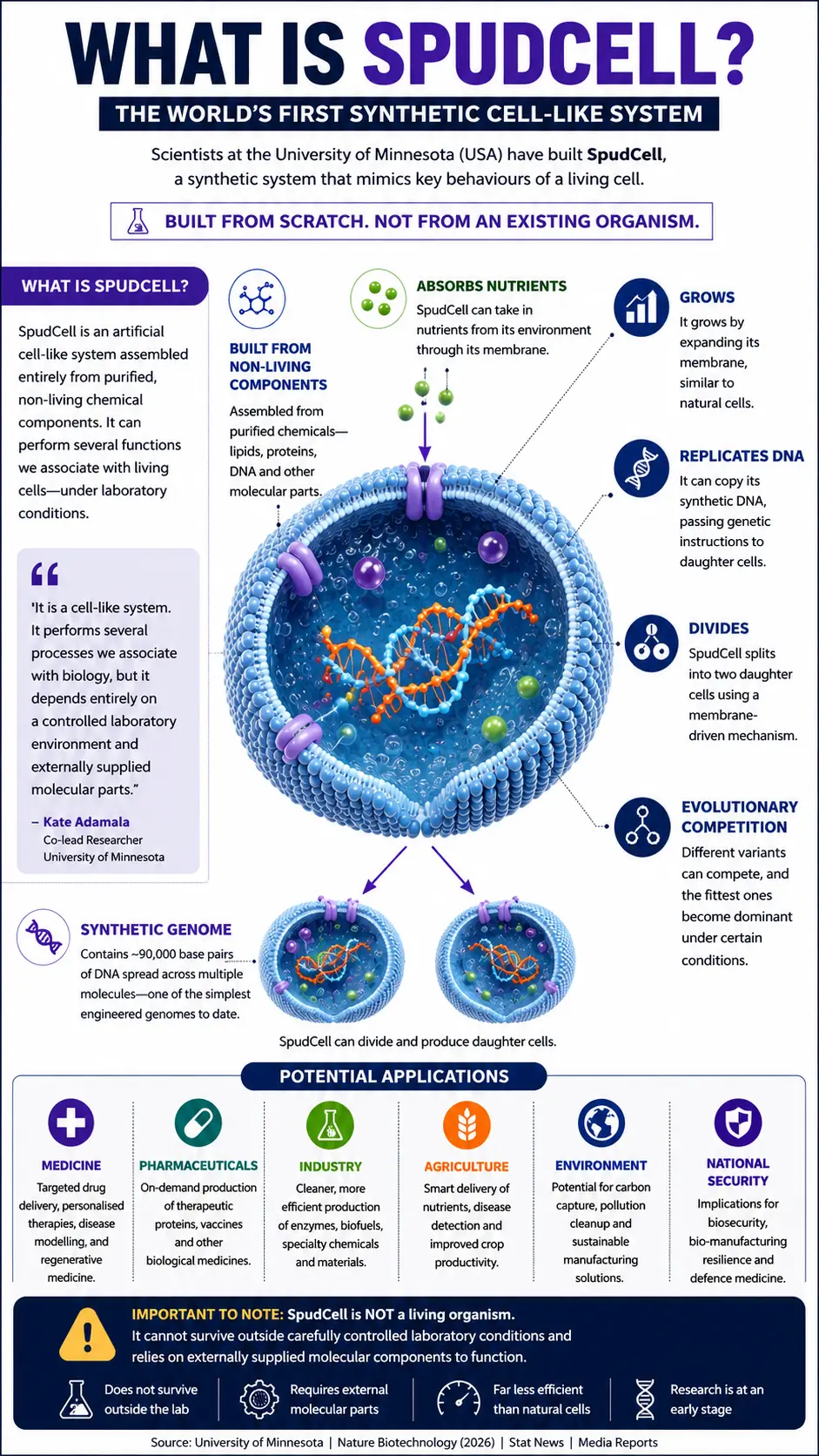
Developed by researchers at the University of Minnesota, SpudCell is assembled entirely from purified, non-living chemical components rather than by modifying an existing organism. Researchers report that the system can absorb nutrients, grow, replicate its DNA, divide into daughter cells and even undergo a limited form of evolutionary competition.
Although headlines have described the development as the creation of “artificial life,” the research team strongly disagrees with that interpretation.
“It is a cell-like system,” said synthetic biologist Kate Adamala, who co-led the project. “It performs several processes we associate with biology, but it depends entirely on a controlled laboratory environment and externally supplied molecular parts.”
What are Synthetic Cell?
A synthetic cell is an artificial system built from chemical building blocks such as lipids, proteins, DNA and enzymes to imitate selected functions of living cells.
Unlike genetically modified organisms, synthetic cells are not created by altering existing life. Instead, scientists assemble them from scratch to better understand the fundamental processes that make life possible.
For decades, researchers have successfully recreated isolated cellular functions such as protein synthesis or DNA replication. However, integrating multiple biological processes into a single engineered platform has remained one of synthetic biology’s greatest challenges.
SpudCell represents one of the most significant advances towards overcoming that challenge.
Why Is SpudCell Different?
SpudCell is built around a compact synthetic genome of approximately 90,000 base pairs distributed across multiple DNA molecules.
Researchers demonstrated that it can:
- Absorb nutrients
- Grow by expanding its membrane
- Replicate its DNA
- Divide into daughter cells
- Compete with other variants under laboratory conditions
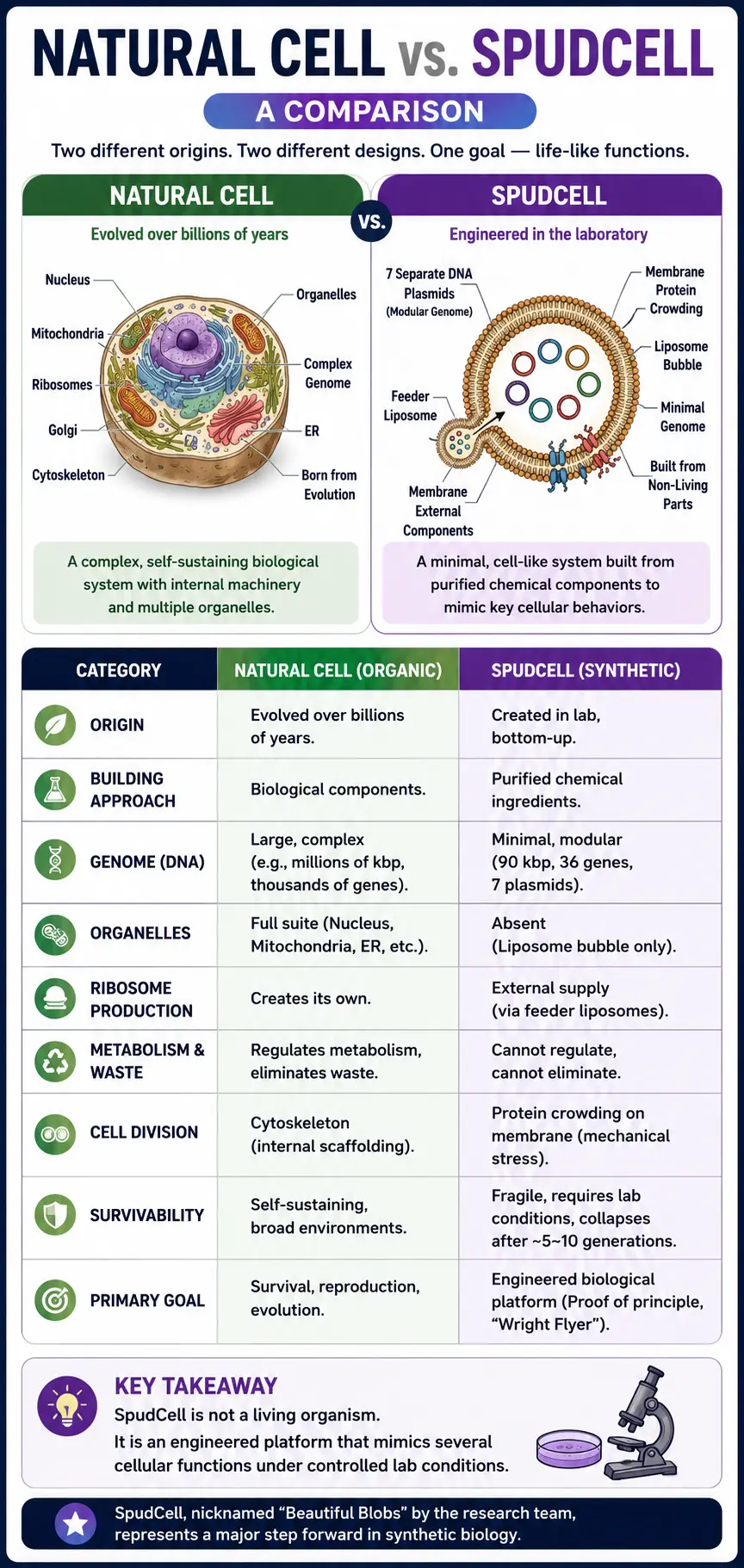
Unlike natural cells, which rely on complex cytoskeletal proteins during cell division, SpudCell divides through a membrane-driven mechanism engineered by researchers.
Importantly, scientists describe this as a cell-like system, not a living organism.
Is SpudCell Alive?
The simple answer is No.
Despite performing several life-like functions, SpudCell lacks the characteristics required to be considered a living organism.
It:
- Cannot survive outside carefully controlled laboratory conditions.
- Depends on externally supplied molecular components.
- Has no independent metabolism.
- Is far less complex than even the simplest natural cells.
Researchers therefore consider it a proof-of-concept engineering platform rather than artificial life.
Why This Breakthrough Matters
Although still in its early stages, synthetic cell technology has the potential to transform multiple sectors.
Medicine
Future synthetic cells could become programmable microscopic systems capable of:
- Delivering drugs directly to diseased tissues
- Producing therapeutic molecules inside the body
- Accelerating personalised medicine
- Improving cancer treatment
Biotechnology
Modern biotechnology depends heavily on genetically modified bacteria and yeast.
Synthetic cells could provide cleaner, more predictable manufacturing platforms for:
- Pharmaceuticals
- Vaccines
- Industrial enzymes
- Specialty chemicals
Sustainable Manufacturing
Scientists also envision applications in:
- Biofuels
- Carbon capture
- Environmental remediation
- Advanced materials
- Sustainable industrial productio
Why Governments Are Paying Attention
Synthetic biology is increasingly viewed as a strategic technology alongside artificial intelligence, quantum computing and advanced semiconductors.
Countries investing in this field could strengthen capabilities in:
- Pharmaceutical manufacturing
- Pandemic preparedness
- Bio-manufacturing
- Defence medicine
- Food security
- Industrial competitiveness
However, synthetic biology is also considered a dual-use technology, meaning scientific advances could potentially be applied for both civilian and malicious purposes.
This has prompted growing discussions around biosafety, biosecurity and international regulation.
Ethical Questions
The breakthrough also raises important philosophical and policy questions.
Among them:
- What defines life?
- Should humans engineer increasingly complex synthetic systems?
- How should synthetic biological platforms be regulated?
- Who owns intellectual property related to artificial cellular systems?
As synthetic biology progresses, these debates are likely to become more significant.
What Does This Mean for India?
India has rapidly expanded its biotechnology capabilities through investments in genomics, vaccine manufacturing and bio-industrial research.
If synthetic cell technology continues to mature, it could contribute to:
- Next-generation pharmaceutical manufacturing
- Agricultural biotechnology
- Climate-resilient industrial processes
- Biosecurity preparedness
- Scientific innovation
Developing domestic expertise in synthetic biology could also strengthen India’s position in the emerging global bioeconomy while reducing dependence on imported advanced biological technologies.
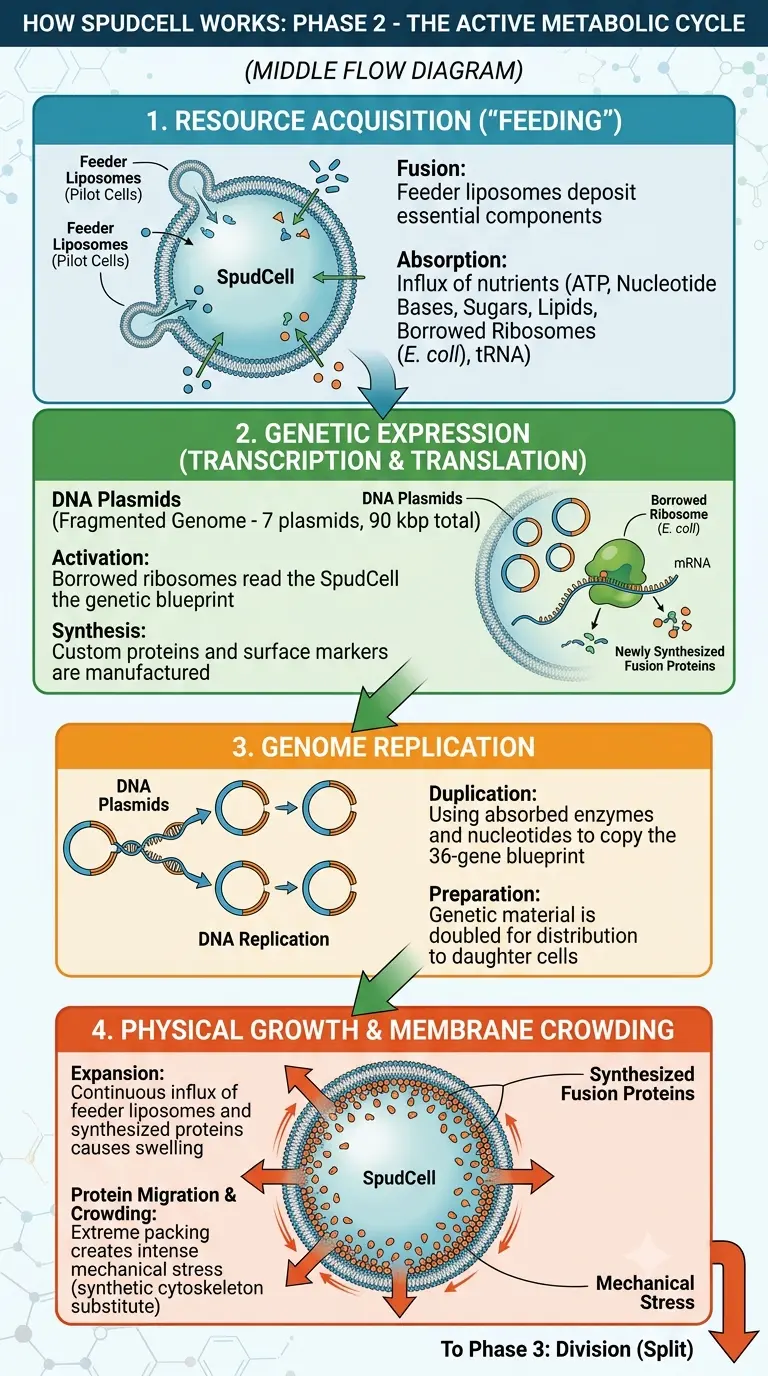
How SpudCell Works
Challenges Ahead
Despite the excitement, researchers caution against overstating the achievement.
SpudCell remains an experimental laboratory platform that:
- Cannot survive independently
- Requires externally supplied molecular components
- Operates only under carefully controlled laboratory conditions
- Is significantly less efficient than natural cells
The current work represents an important proof of concept rather than the creation of artificial life.
Conclusion
SpudCell represents one of the most important advances in synthetic biology in recent years. While scientists have not created life, they have demonstrated that many fundamental cellular behaviours can be reconstructed from non-living chemical components.
As research progresses, synthetic cells could reshape medicine, biotechnology, sustainable manufacturing and national security. At the same time, they will require robust scientific oversight, thoughtful regulation and international cooperation to ensure that this powerful technology benefits society while minimising potential risks.