
Geopolitics · Defence Analysis
Indian Army disaster response — from Operation Brahma to theatre commands and Quad logistics — is quietly becoming India’s fastest strategic instrument in the Indo-Pacific.
TES Brief
- Operation Brahma (March 2025): India delivered 625 tonnes of relief material to earthquake-hit Myanmar within four days; a 118-member Army medical task force ran a 60-bed field hospital in Mandalay.
- Integrated Theatre Commands: leadership structure finalised April 2026; CDS General NS Raja Subramani expected to present the roadmap to Rajnath Singh, pending Cabinet Committee on Security clearance.
- Quad logistics: the Indo-Pacific Logistics Network went from pilot to permanent status in April 2026; the Maritime Domain Awareness partnership was operationalised via Gurugram in May 2026.
- Defence exports: Rs 38,424 crore in FY 2025-26 (+63%), driven chiefly by Operation Sindoor-proven missile systems, against a Rs 50,000 crore target by 2029.
- Agniveer retention: first batch exits on its four-year tenure in October 2026; the 25% retention cap is under active review.
When a 7.7-magnitude earthquake tore through Myanmar’s Sagaing Fault on 28 March 2025, more than two dozen countries mobilised aid within days. China, which shares a land border with Myanmar and has deep commercial stakes there, dispatched rescue teams the following morning and pledged $137 million — more than any other single donor. India, roughly 1,500 kilometres away by sea, sent naval ships within 24 hours and had a 118-member Army medical task force running trauma surgeries out of a field hospital in Mandalay within the week.
Nobody won a race, exactly. What the earthquake actually revealed was a difference in kind, not speed: one power showed up with a cheque and a rescue team; the other showed up with a deployable hospital. That distinction — between contributing to a crisis response and constituting one — is where the next contest for influence in the Indo-Pacific is actually being fought.
Why Disaster Response Has Become a Geopolitical Instrument
Operation Brahma is the clearest recent proof of what that reach looks like in practice. According to the Ministry of External Affairs, India had delivered 625 tonnes of humanitarian material to Myanmar within four days, using six aircraft and five naval ships. A 118-member Army medical task force, the Airborne Angels, set up a 60-bed treatment centre in Mandalay under Lieutenant Colonel Jagneet Gill. The branding was deliberate: New Delhi has consistently called itself the region’s “first responder,” tying the mission to its Neighbourhood First policy.
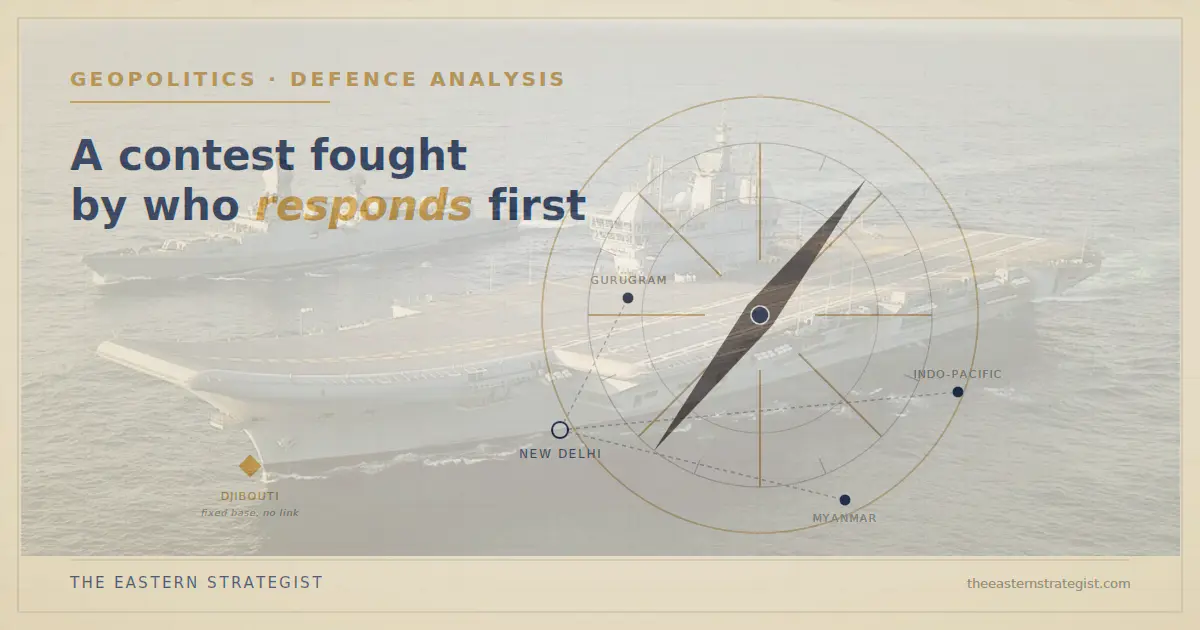
That contest extends well beyond any single earthquake. Beijing is playing a parallel game, only with concrete instead of ships. China’s $590-million support base in Djibouti, opened in 2017, was explicitly framed around peacekeeping, anti-piracy and humanitarian relief — and by the time it opened, the People’s Liberation Army already had more than 2,000 personnel stationed in the wider Red Sea region, a figure separate from its long-running UN peacekeeping deployments elsewhere in Africa, including South Sudan. One power has invested in a fixed foothold. The other is betting on networked reach. Which model smaller Indo-Pacific and Indian Ocean states actually prefer over the next decade is an open question, and arguably a more consequential one than most of the hardware headlines this year.
The Command Overhaul Accelerating Indian Tempo
The pieces have moved quickly through 2026. In April, the services finalised a leadership structure — Northern Command under an Army officer, Western Command under the Air Force, Maritime Command under the Navy — and sent a formal proposal to the government. General NS Raja Subramani, who took over as India’s third Chief of Defence Staff on 31 May, is expected to present the implementation roadmap to Defence Minister Rajnath Singh this month. The single remaining hurdle is clearance from the Cabinet Committee on Security.
Officials point to Operation Sindoor, in May 2025, as the proof of concept: the first major operation where the Army, Navy and Air Force functioned in a genuinely integrated format rather than through parallel, deconflicted commands. Air Marshal Ashutosh Dixit, India’s Chief of Integrated Defence Staff, has argued the shift is “not aspirational,” pointing to hybrid threats — drone swarms, cyber intrusions, disinformation — that ignore the boundaries services were built around. Planning, he said in April, was already more than 90 percent complete.
The connection to disaster response is not incidental. The same jointness architecture designed to shave hours off a war-fighting decision cycle is the architecture that would let a future Operation Brahma move even faster than the last one did.
Competing Models: China’s Bases vs India’s Logistics Web
The Quad’s Indo-Pacific Logistics Network moved from pilot programme to permanent status this April, designed to pre-position food, fuel and medical supplies at strategic hubs across the region. It runs alongside the Indo-Pacific Partnership for Maritime Domain Awareness, which India operationalised through its Information Fusion Centre in Gurugram — confirmed at the Quad Foreign Ministers’ meeting in New Delhi this May. Four countries have now run annual HADR tabletop exercises since 2022, the most recent in Honolulu last December.
The comparison with Djibouti is instructive rather than flattering to either side. A fixed base guarantees presence but requires a host government to sign away a piece of sovereignty, which is precisely the kind of arrangement many Indian Ocean states are wary of extending to any single foreign power. A coalition logistics network avoids that friction but has never been stress-tested at the scale a truly major disaster would demand. Neither model has yet proven itself decisively better. That test is still ahead.
The Market Angle Nobody’s Pricing In
The numbers back that split. Annual production reached Rs 1.78 lakh crore in FY 2025-26 alongside that export record, according to the Ministry of Defence, and officials and industry reporting attribute the surge chiefly to combat performance: the BrahMos supersonic cruise missile, the Akash air defence system and loitering munitions all saw live use in May 2025, and buyers including the Philippines, Vietnam, Indonesia and Armenia have since signed or advanced contracts reportedly worth several thousand crore rupees. It is battlefield performance, not humanitarian performance, doing the heavy lifting toward the government’s Rs 50,000 crore export target by 2029. Investor sentiment moved with that story too — the Nifty India Defence Index, which tracks listed defence manufacturers, had rallied more than 30 percent in three months by May 2025.
HADR missions sell a narrower, quieter case. A field hospital does not win a missile contract. But it is exactly what a foreign defence ministry’s logistics or medical corps notices when deciding whether Indian-made support equipment — utility helicopters, transport aircraft, sealift, medical modules — is dependable enough to buy. That is a smaller, slower sales pitch running alongside the missile-driven one, not powering it.
None of it is guaranteed to convert. A field hospital that performs well in Mandalay does not automatically become a signed contract in Jakarta or Manila; that conversion needs financing, after-sales support and sustained diplomatic follow-through India has not always managed well historically. But it is one more reason HADR missions increasingly sit in the Ministry of Defence’s economic calculus alongside its strategic one — a narrower, more specific point than it might first appear.
What Changes Inside the Force Itself
The multi-domain shift matters for disaster response as much as for war-fighting. If theatre commands fuse cyber, space and logistics under one authority, as intended, a future HADR mission could draw on satellite damage assessments, secure communications and airlift scheduling as a single coordinated stream, rather than as three separate requests routed through three separate service headquarters. Air Marshal Dixit’s own framing of threats that “do not respect domain boundaries” applies as well to a collapsed bridge or a flooded coastline as it does to a cyberattack.
The workforce question is more unsettled. The first batch of Agniveers recruited under the Agnipath scheme completes its four-year tenure in October 2026, and under current policy only 25 percent can be retained for a longer, 15-year commission — the rest exit with a lump-sum payout. All three services have asked the Department of Military Affairs to raise that ceiling: the Army and Air Force are reportedly seeking 50 percent, the Navy up to 75 percent for its technical specialists. No decision had been made as of this writing. The outcome matters directly for missions like Operation Brahma: a higher retention rate would give the Army a deeper bench of experienced personnel for short-notice medical and logistics deployments, while a rate that stays at 25 percent keeps the force leaning on a young, fast-rotating pool better suited to single high-tempo deployments than to the repeated joint exercises that build institutional muscle memory.
What to Watch
Will the Cabinet Committee on Security approve Integrated Theatre Commands this year, and how long will the move from paper plan to operating commands actually take?
Institutional approvals are reportedly close, but raising new commands and reassigning personnel historically takes longer than the announcements suggest.
Can the Quad’s logistics network survive contact with a genuinely major disaster?
Tabletop exercises and pre-positioning agreements are not the same as real-time performance under pressure, and that gap has not yet been tested at scale.
Will the government raise the Agniveer retention rate above 25 percent, and by how much?
The Army and Air Force have asked for 50 percent, the Navy for 75 percent in technical roles — the decision, expected as the first batch exits in late 2026, will shape how large a pool of experienced personnel the force can draw on for the next major deployment.
The next major test in the Indo-Pacific may not announce itself with an invasion. It is more likely to arrive as a tremor, a storm surge, or a collapsed bridge. Whoever shows up with more than a cheque will have already won something no treaty can guarantee: the benefit of the doubt.