
The Eastern Strategist
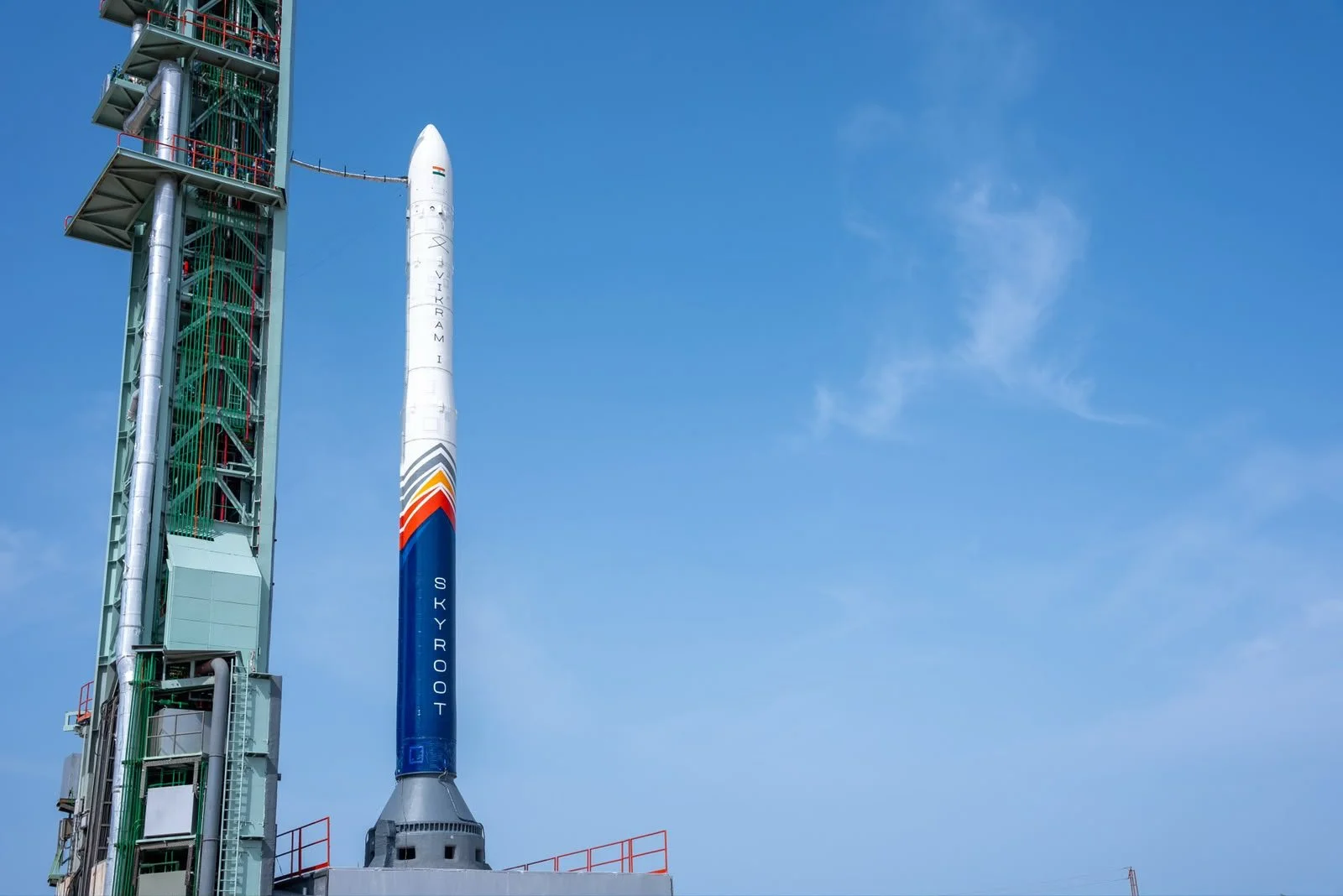
At 12:05 pm on 18 July 2026, a seven-storey rocket built by an eight-year-old Hyderabad company punched through the coast at Sriharikota and, sixteen minutes later, was travelling at roughly 7.66 kilometres a second in a 450-km orbit around the Earth. Skyroot Aerospace‘s Vikram-1 had done what no privately built Indian rocket had ever done before. Mission Aagaman — Sanskrit for “the arrival” — had arrived.
The applause was immediate and, for once, not overstated. Prime Minister Narendra Modi called the founders within minutes of confirmation. Pawan Kumar Chandana, Skyroot’s co-founder and chief executive, managed only four words for the cameras: “Absolutely no words.” His co-founder Naga Bharath Daka stood beside him, equally lost for language after eight years of trying to build precisely this moment.
But the headline — India’s first private company to reach orbit — undersells what actually happened on Saturday. The real story is not that a rocket flew. It is what its success says about the credibility of a six-year policy experiment, the vulnerability it quietly exposes in India’s state launch programme, and the industrial machinery it could now set in motion.
A Launch That Landed at an Awkward Moment for ISRO
Timing matters in this story more than most coverage has acknowledged.
Vikram-1 lifted off five months after the Indian Space Research Organisation suffered its second consecutive launch failure. In May 2025, PSLV-C61 lost the EOS-09 radar imaging satellite. Then, on 12 January 2026, PSLV-C62 failed during the third-stage burn — a drop in chamber pressure destroyed the mission and, with it, sixteen satellites, including a DRDO hyperspectral payload and commercial spacecraft from Brazil, Spain, Nepal and Europe. It was the first time ISRO had failed to reach orbit while carrying international commercial customers on board, a reputational blow at precisely the moment India was courting foreign satellite operators.
Skyroot’s rocket and ISRO’s PSLV share a propulsion category — both rely on solid motors in their lower stages — but not a manufacturing lineage. Skyroot’s Kalam-series stages are wound in-house from carbon composite; the PSLV’s third stage uses more conventional materials. The failure modes are, in principle, unrelated. That distinction will matter little in the public imagination. What will matter is the optics: a private eight-year-old start-up succeeded at an orbital debut while the fifty-year-old state agency was still working through the findings of its second straight failure.
This is not a story about ISRO’s decline. The agency remains the backbone of India’s space programme, and its PSLV, GSLV and LVM3 fleets have carried the country from its first satellite to the Moon and to Mars. But Vikram-1’s success does something ISRO’s own missions cannot currently do: it demonstrates that reliable Indian orbital access no longer runs through a single government-controlled channel. For a country whose launch manifest — commercial, scientific, strategic — has long queued behind a finite number of state-owned pads and rockets, that is a structural change, not a symbolic one.
Six Years of Policy Betting, One Data Point
Vikram-1’s flight is the first hard evidence that a bet placed in May 2020 is paying off.
That was when Finance Minister Nirmala Sitharaman announced the liberalisation of India’s space sector, declaring that the private sector would be “a co-traveller in India’s space journey.” The Indian National Space Promotion and Authorisation Centre, or IN-SPACe, was created weeks later as the single-window regulator meant to authorise and supervise non-government space activity. Skyroot became its proving ground almost immediately, flying the suborbital Vikram-S in November 2022 under IN-SPACe’s authorisation — India’s first privately built rocket to reach space, if not orbit.
The foreign investment rules have loosened alongside the institutional architecture. Automatic approval now covers up to 74 percent foreign investment in satellite manufacturing and operations, up to 49 percent in launch vehicles and spaceports, and up to 100 percent in the manufacture of satellite components and subsystems. NewSpace India Limited, ISRO’s commercial arm, has transferred technology to private manufacturers and expanded commercial launch services on the government’s own vehicles. None of this guaranteed Vikram-1 would fly cleanly. Rocket science does not reward policy intent. Chandana himself has previously admitted that the timeline ran ahead of reality — the company once expected to reach orbit two to three years after Vikram-S, not eight.
That gap between ambition and execution is worth remembering, because it is the same gap the government’s own space economy targets will have to close. IN-SPACe’s Decadal Vision projects India’s space economy growing from roughly $8.4 billion today to somewhere between $40 billion and $45 billion by 2030, with a longer-term aspiration of $100 billion by 2040. Those numbers assume a functioning ecosystem of private launch providers, satellite manufacturers and downstream data companies operating at a cadence India has not yet demonstrated. Vikram-1 is one flight. What comes next will determine whether it was proof of concept or a lucky first attempt.
Why a Rocket That Carries No Weapons Still Matters to Strategists
Vikram-1 is explicitly a commercial vehicle. It carries no military payload, and Skyroot has framed it — in Chandana’s own words — as a “cab to space” for satellite operators who currently either fly as secondary passengers on larger rockets or wait months for a dedicated slot. That commercial framing should not obscure the vehicle’s strategic relevance.
Modern military power increasingly depends on assets that never enter a battlefield. Secure communications, precision navigation, missile warning, and persistent surveillance all run through orbit. The war in Ukraine demonstrated how commercial satellite constellations can sustain military communications and imagery even when government systems are degraded or denied. In the Indian Ocean Region, satellite-based intelligence already underpins how India and its partners track naval movement across contested waters.
India’s own surveillance architecture — optical imaging satellites for daylight coverage, synthetic aperture radar for observation through cloud cover and darkness, and electronic intelligence satellites for signals collection — depends not only on capability but on availability. A satellite that cannot be replaced quickly after failure or obsolescence is a gap in coverage. A domestic launch industry with more than one active provider narrows that gap. Decisions on national security launches will remain with the government regardless of who builds the rocket, but a mature private sector expands the government’s options when it needs to act quickly.
The Indian Ocean is where this logic bites hardest. India’s maritime responsibilities span one of the world’s busiest and most contested sea lanes, where commercial shipping, naval deployments, illegal fishing and grey-zone activity intersect in a space too vast to monitor from ships and aircraft alone. Satellites already support ship tracking, coastal monitoring and the detection of vessels that switch off their identification transponders — a persistent tactic in grey-zone maritime activity. As China’s naval presence in the Indian Ocean Region has expanded, the premium on persistent, replenishable maritime domain awareness has risen with it. A launch ecosystem capable of getting Earth observation satellites into orbit more frequently, without waiting on a single government manifest, is a quiet but real contribution to that objective.
The Industrial Argument: What Defence Manufacturing Already Taught India
The more durable case for Vikram-1 may have nothing to do with any single satellite it eventually carries.
India’s defence sector offers a template for how a strategic industry compounds. Programmes such as Make in India, dedicated defence industrial corridors, higher indigenous procurement targets and a growing export push have, over roughly a decade, built a production ecosystem now numbering more than 6,000 companies — from large integrators to MSMEs and start-ups — supplying everything from missile components and radars to composites and electronics, according to the Press Information Bureau.
The space sector is earlier in that curve, but the trajectory looks similar. Government data cited by the Press Information Bureau puts the number of Indian space start-ups at more than 400, having attracted upward of $500 million in private investment since liberalisation began. These companies span launch vehicles, satellite manufacturing, propulsion, Earth observation, communications and downstream data services. Skyroot alone has raised $60 million in a May 2026 funding round that valued the company at $1.1 billion — evidence that private capital is now willing to underwrite Indian orbital-class hardware, not just downstream applications built on someone else’s satellites.
A successful orbital flight does something a funding round cannot: it de-risks the entire value chain for everyone watching. Investors gain more confidence to back deep-tech ventures further up the stack. Component suppliers expand. Universities see stronger reasons to build out aerospace engineering programmes. Satellite manufacturers gain a genuine domestic launch option rather than a queue behind ISRO’s national priorities. None of this is guaranteed by one flight, but the defence sector’s experience suggests that flagship successes are frequently what catalyses the supplier network that follows, rather than the other way round.
Former ISRO chairman S. Somanath’s decision to join Skyroot as honorary chief technical advisor ahead of this launch is itself a small data point in that direction — a sign that India’s most senior space engineering talent increasingly sees the private sector as worth lending credibility to, not merely watching from a government vantage point.
What Vikram-1 Does Not Change
None of this should be read as private industry displacing ISRO. The agency’s own priorities — Gaganyaan, deep-space missions, and the next generation of heavier launch vehicles — sit outside the market Skyroot is targeting. Vikram-1 can lift up to roughly 350 kilograms to low Earth orbit; ISRO’s LVM3 operates in an entirely different payload class. The more accurate framing, and the one Chandana himself has used, is complementary rather than competitive: government agencies handling high-priority national missions while private companies absorb commercial and small-satellite launch demand that would otherwise compete for scarce PSLV slots.
It is also worth stating plainly what a single test flight cannot yet prove. One successful mission establishes that Vikram-1’s design works in real flight conditions. It does not establish launch cadence, cost competitiveness against established international players such as SpaceX’s rideshare missions or Rocket Lab’s Electron, or the manufacturing consistency needed to fly repeatedly without the kind of anomaly that grounded ISRO’s PSLV twice in eight months. Skyroot has stated its ambition to develop larger, eventually reusable, launch vehicles — a signal that the company itself views Vikram-1 as a starting point rather than a finished product.
What to Watch Next
Three things will determine whether 18 July 2026 is remembered as an inflection point or a single good day.
The first is cadence. Skyroot’s ability to fly Vikram-1 again — ideally with a shortening turnaround between missions — will be the clearest signal of whether India’s private launch industry can move from demonstration to service. A single successful flight proves engineering; a repeatable one proves a business.
The second is customer conversion. Vikram-1 carried Skyroot’s own SCOPE performance-monitoring satellite alongside technology-demonstration payloads, including Cosmoserve Space’s Embrace debris-capture experiment. Whether international and Indian satellite operators now commit paying contracts to Skyroot, rather than treating it as a promising but unproven option, will determine whether the $1.1 billion valuation converts into revenue.
The third is whether other Indian private players — several of the 400-plus start-ups counted by the government — follow with launches of their own. A single successful company is a headline. Two or three with independent flight heritage is an industry, and it is the industry, more than any one rocket, that will eventually matter to India’s space resilience, its maritime domain awareness, and its aerospace industrial base.