
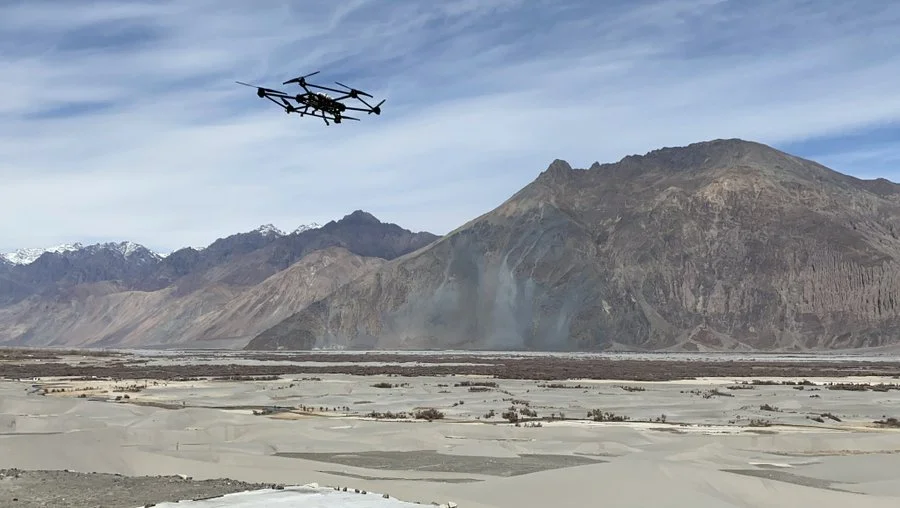
Operation Sindoor exposed the gaps. A $100 million funding round and a DRDO deal signed this week show how the India drone industry is trying to close them — and why investors are already pricing it in.
On 1 June 2025, Ukraine’s Security Service smuggled 117 first-person-view drones into Russia inside the false roofs of parked trucks, triggered them by mobile network, and struck five air bases from Murmansk to Irkutsk. By Kyiv’s own account, the operation damaged or destroyed 41 aircraft, including Tu-95 and Tu-22M3 strategic bombers Moscow can no longer manufacture. Independent analysis puts the damage near $7 billion. The drones themselves cost a few thousand dollars apiece.
That arithmetic — thousands of dollars destroying billions — is what every air force on earth is now trying to absorb. The India drone industry did not need to look abroad to learn it. A year earlier, on the night of 8–9 May 2025, Pakistan sent an estimated 300–400 drones and loitering munitions across 36 locations between Leh and Sir Creek during Operation Sindoor, the latest chapter in India’s defence modernisation arc since Kargil. India’s Integrated Counter-UAS Grid neutralised every one of them, and the Indian Air Force says it silenced Pakistan’s Chinese-supplied air defence network in 23 minutes. Verified · PIB
It was a clean result. It was also, by New Delhi’s own admission, a warning. Defence Secretary Rajesh Kumar Singh called the conflict a “reality check,” pointing to gaps in electronic warfare, counter-unmanned aerial systems, and India’s ability to manufacture military-grade drones that survive GPS-denied, jammed environments. Chief of Defence Staff General Anil Chauhan made the same point to an industry workshop on UAV indigenisation: none of Pakistan’s drones caused damage, but foreign-technology dependence remained a preparedness risk. Verified
That is the backdrop against which India’s drone industry is now being built — not as a hobbyist sector chasing agricultural subsidies, but as a contested strategic domain and, increasingly, a live theme for defence investors.
More Than an Aircraft: What Is Actually Inside India’s Drone Ambitions
A drone is not one product; it is a stack of dependencies — propulsion, composite airframes, flight-control computers, secure datalinks, navigation, imaging payloads, electronic warfare suites and autonomy software. If even one layer depends on a foreign supplier, an export control or a shipping delay can ground the platform. This is the real constraint shaping the India drone industry today.
India’s own numbers make the exposure explicit. The Ministry of Civil Aviation has acknowledged the ecosystem still imports an estimated 50 to 60 percent of high-value components even after years of production-linked incentive support tied to India’s drone procurement budget. The original PLI scheme, notified in September 2021 with an outlay of just ₹120 crore, has since been superseded by a more ambitious PLI 2.0 framework, a proposed ₹10,000 crore Mission Drone Shakti manufacturing push, and an ANRF-backed MAHA Drones research call launched in May 2026. Policy has shifted from rewarding assembly to underwriting the harder, slower work of component research. Industry estimate
This is the distinction analysts increasingly draw between countries that assemble drones and countries that own them. Assembly scales quickly and photographs well at defence expos. Ownership — of the chips, the radar, the flight software — is what survives an export ban.
New Delhi’s Bigger Bet: The DRDO AEW&C Mk-II Deal
The clearest sign that this logic now extends beyond small tactical drones arrived this week. On 23 July 2026, DRDO’s Centre for Air Borne Systems signed two contracts to build India’s next-generation Airborne Early Warning and Control aircraft, the AEW&C Mk-II or Netra Mk-II. AI Engineering Services Ltd will convert six commercial Airbus A321 jets into military-ready airframes, while Adani Defence Systems and Technologies Ltd, expanding on DRDO’s wider defence-innovation push, has been named Development-cum-Production Partner for the mission systems. Verified
Unlike a conventional jet purchase, this is a lifecycle bet: the agreement reportedly bundles logistics and maintenance support running up to 30 years, with induction into the Indian Air Force targeted for 2032–33. The read-across to unmanned platforms is direct: once DRDO is comfortable handing sensor and mission-system ownership to a private production partner for a manned surveillance jet, the same model applied to drones looks less like an experiment and more like the ecosystem’s direction of travel.
Building the Entire System: Inside Raphe mPhibr’s Wager
Few companies illustrate that ambition as starkly as Raphe mPhibr. Founded in 2017 by brothers Vikash and Vivek Mishra — Vikash trained in aerospace engineering and nuclear science at MIT, Vivek holds a PhD in electrical and computer engineering from Georgia Tech — the Noida-based firm has grown into a roughly 650,000-square-foot campus with around 600 employees, a third of them in research.
In June 2025, Raphe mPhibr raised $100 million in a Series B round led by General Catalyst, taking total funding past $150 million — at the time, the largest private capital raise in Indian military drone history. Verified According to the company, it manufactures its own batteries, flight controllers, composite structures and communication systems domestically, sources no components from China, and plans to localise radar and camera manufacturing within eighteen months of the raise. Company claim
These are the company’s own claims, worth stating plainly as such — they have not been independently audited the way a government contract or exchange filing would be. What is independently verifiable is the client list: Raphe mPhibr says it serves more than ten government agencies, including the Army, Navy, Air Force and central paramilitary forces, across a family that includes the mR10 swarm system, the mR20 high-altitude logistics drone, and the X8 maritime patrol variant.
Engineering Around Operational Reality
The most instructive detail from Raphe’s Army work is not a spec sheet; it is a design failure. During high-altitude logistics operations of the kind explored in our reporting on whether military robots can protect Siachen, the company’s automatic cargo-release system created a real problem when bad weather delayed troop movements, leaving supplies stranded before recovery teams arrived.
The fix was almost unglamorous: engineers modified the platform so drones would land and wait, releasing cargo only after a soldier issued a manual command. It captures something true about how military technology matures — not in a laboratory demo, but in the gap between what an engineer assumes a soldier needs and what conditions on a mountainside actually allow.
The Market Has Already Started Pricing This In
None of this is happening in a vacuum, and India defence drone stocks have moved on it directly. On 3 July 2026, the Defence Acquisition Council granted Acceptance of Necessity for capital proposals worth roughly ₹52,000 crore, covering next-generation air defence, anti-tank guided missiles, anti-drone electronic warfare, loitering munitions and naval unmanned platforms — including the AKASH TARANG anti-UAV electronic warfare system. By the following Monday, the Nifty India Defence index was trading roughly 1.2 percent higher, with brokerages flagging Bharat Electronics, Bharat Dynamics, HAL, Zen Technologies, Paras Defence, Data Patterns, Solar Industries, Astra Microwave and listed pure-play ideaForge Technology as likely beneficiaries. Verified
ideaForge itself tells the volatility of this moment better than any index. The stock fell over 7 percent in July 2025 on a weak quarter, with revenue down more than 85 percent year-on-year, even as its chief executive pointed to a fresh ₹137 crore emergency-procurement order as evidence of resilience. Less than a year later, in June 2026, the same stock touched highs near ₹900, lifting market capitalisation past ₹4,000 crore, on a swing to a ₹60 crore quarterly profit and a ₹500 crore institutional placement. As the only direct listed proxy for the India drone industry, its swings have been correspondingly violent.
The government’s own budget arithmetic reinforces the picture. The Union Budget for 2026–27 lifted defence capital expenditure by roughly 22 percent and earmarked ₹1.39 lakh crore for indigenous defence manufacturing, with 75 percent of the capital acquisition budget reserved for domestic industry. Separately, the Drone Federation of India has said the country’s drone procurement budget has roughly tripled to around $470 million — an industry-body estimate rather than an audited government figure. Estimate The broader India defence drone market is now sized at approximately $1.27 billion for 2026, still a fraction of Chinese or American spending but growing off a base that was negligible five years ago.
Where India Still Falls Short
Ambition and capability gap in at least four places, and none of them close quickly. High-performance electro-optical and infrared sensors, along with advanced radar, remain among the most sophisticated components in any drone, and import dependence here is improving only slowly. Artificial intelligence for autonomous navigation, target recognition and swarm coordination — the same frontier explored in our earlier analysis of India’s military AI push — is advancing largely on private capital rather than mature government programmes.
Electronic warfare resilience, operating through jamming and GPS denial, is precisely the gap Defence Secretary Singh flagged after Operation Sindoor, and it will not be solved by a single vendor or contract. Manufacturing at scale — turning a promising prototype into thousands of certified, quality-controlled units — may prove harder than any of the engineering problems that preceded it.
The Ecosystem Taking Shape
Raphe mPhibr is one node in a widening network rather than an isolated success story. ideaForge remains the largest listed player in tactical and hybrid VTOL systems and supplied drones to the Army after Operation Sindoor. Bharat Forge’s defence arm, Kalyani Strategic Systems, has fielded its own multi-payload platform, the Bharat 150, tested by the Army in Leh-Ladakh, and is understood to be competing for the Army’s revised tactical-drone tenders — a detail we treat as a live process rather than a confirmed award. India’s fast-maturing loitering-munition ecosystem, which Bharat Forge and several startups are chasing, is itself one of the more crowded corners of the sector.
Adani Defence & Aerospace anchors the conglomerate end of the ecosystem, pairing its Drishti-10 MALE platform’s maritime surveillance role with its new position as DRDO’s production partner on AEW&C Mk-II. NewSpace Research and Technologies and Tata Advanced Systems round out a field where private capital, DRDO laboratories and armed-forces feedback are beginning to move in the same direction rather than in parallel.
| Player | Type | Flagship Platform(s) | Capital / Status | Government Anchor |
|---|---|---|---|---|
| Raphe mPhibr | Private, unlisted | mR10 swarm, mR20 logistics, X8 maritime | $100M Series B, Jun 2025 (General Catalyst) | Army, Navy, IAF, CAPFs |
| ideaForge Technology | Listed · NSE: IDEAFORGE | SWITCH VTOL, tactical UAS | ~₹4,000 Cr m-cap (Jun 2026) | Army emergency-procurement cycles |
| Bharat Forge / Kalyani Strategic Systems | Listed parent · NSE: BHARATFORG | Bharat 150 multi-payload VTOL | Diversified defence conglomerate | Army tactical-drone tenders |
| Adani Defence & Aerospace | Listed parent · part of Adani Enterprises | Drishti-10 MALE; AEW&C Mk-II mission systems | DcPP for AEW&C Mk-II, Jul 2026 | DRDO, IAF |
Beyond Drones
None of the technology built for unmanned platforms will stay confined to them. Secure datalinks, autonomous navigation stacks and AI-driven sensor fusion are the same building blocks future crewed fighters, unmanned combat aerial vehicles and “loyal wingman” concepts will need. The distinction between manned and unmanned aviation is already blurring in what DRDO and its private partners are building today; a logistics drone engineered to survive a Himalayan winter is not a large conceptual step from an autonomous wingman flying beside a future fighter.
What to Watch
Will the DRDO AEW&C Mk-II timeline hold?
Induction is targeted for 2032–33. Any slippage in Airbus A321 conversion or mission-system integration will be an early test of the co-development model DRDO is now extending toward unmanned platforms as well.
Can India’s drone PLI scheme actually cut import dependence?
The Ministry of Civil Aviation’s own figure of 50–60 percent imported high-value components is the number to track; a meaningful drop over the next two budget cycles would show policy is reshaping supply chains rather than just subsidising assembly.
Does ideaForge’s order book stabilise as India’s listed drone stock?
As the only direct listed proxy for the India drone industry, its swing between a loss-making quarter and a profitable one within twelve months says as much about the immaturity of the investable universe as it does about the company itself.
The Bottom Line
Nine years ago, two brothers left campuses in Massachusetts and Georgia convinced India needed to build its own unmanned aircraft from first principles rather than assemble someone else’s. A defence secretary now uses the phrase “reality check” in public to describe what happens when that conviction is tested in an actual four-day war. Somewhere between those two facts sits the honest state of the India drone industry: real money, real contracts, real capability gaps, and a strategic logic — proven in miniature over Russian airfields and validated in full over the Line of Control — that will not wait for the industry to finish growing up.
A Note on Sourcing
Verified via independent, multi-source reporting: Operation Sindoor’s timeline and outcome (PIB, Tribune, News on Air, Deccan Herald); the AEW&C Mk-II contracts signed 23 July 2026 (Republic World, Upstox/PTI, Business Today, Oneindia); the DAC’s ₹52,000 crore Acceptance of Necessity on 3 July 2026 and the Nifty India Defence index reaction (Upstox, HDFC Sky, Goodreturns); and Operation Spiderweb’s execution (CSIS, multiple Western sources, though Ukrainian and Russian damage figures diverge).
Company claims, attributed but not independently audited: Raphe mPhibr’s in-house manufacturing capabilities, localisation timeline and the cargo-release engineering anecdote, drawn from company statements and founder interviews.
Industry-body estimates, cited with attribution rather than treated as government data: the $470 million drone-procurement figure from the Drone Federation of India, and the $1.27 billion market-size estimate. Bharat Forge’s specific tender standing is drawn from a single industry social-media source and remains unconfirmed pending an official award notification.