
India’s foreign exchange (forex) reserves declined by $5.65 billion to $666.93 billion for the week ended June 26, according to data released by the Reserve Bank of India (RBI). The decline was largely driven by a sharp fall in the valuation of gold reserves, while foreign currency assets—the largest component of India’s reserves—remained broadly stable.
At first glance, the weekly movement appears to be just another economic statistic. However, in today’s increasingly uncertain geopolitical environment, forex reserves have evolved into much more than a financial buffer. They underpin India’s ability to import energy, procure advanced defence equipment, stabilise the rupee during market volatility and maintain confidence in its economy during external shocks.
As global conflicts, supply chain disruptions and financial uncertainties continue to reshape the international order, the strength of India’s forex reserves has become an important indicator of the country’s strategic resilience.
What Are Forex Reserves?
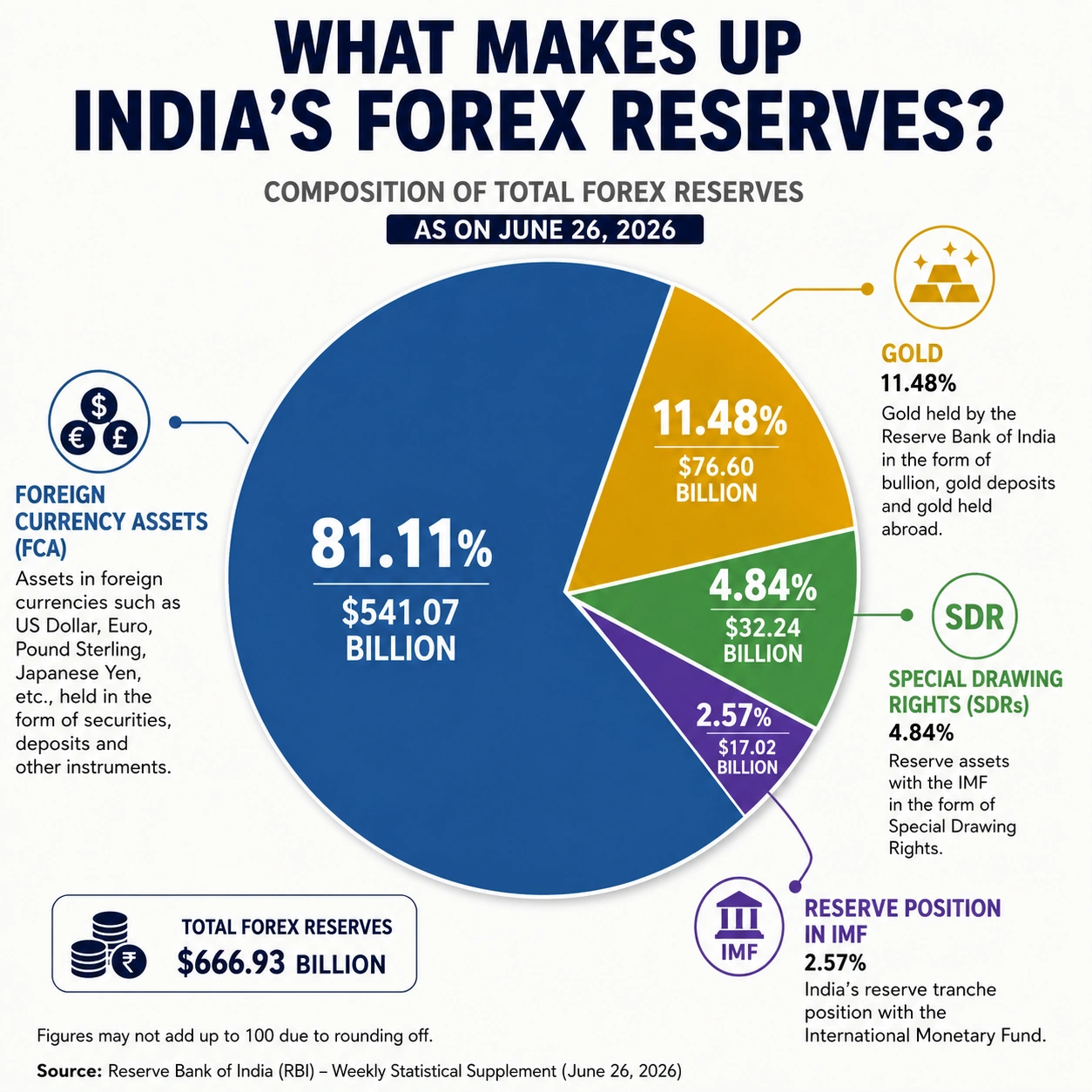
Foreign exchange reserves are external assets held by the Reserve Bank of India to support the country’s financial stability and meet international payment obligations.
India’s reserves primarily consist of:
- Foreign Currency Assets (FCA)
- Gold
- Special Drawing Rights (SDRs)
- Reserve Position in the International Monetary Fund (IMF)
Among these, Foreign Currency Assets account for the largest share, making them the backbone of India’s reserve portfolio.
Why Did India’s Forex Reserves Decline?
The latest decline should not automatically be interpreted as capital leaving India or a sign of economic weakness.
Several factors contributed to the weekly fall.
Gold Valuation
The biggest contributor was a decline in the value of India’s gold reserves. Since gold prices fluctuate daily, changes in international markets directly affect the valuation of RBI’s holdings.
Foreign Currency Movements
Although foreign currency assets declined only marginally, exchange-rate movements among currencies such as the euro, pound sterling and yen can alter the dollar value of reserves.
RBI Market Operations
The Reserve Bank also intervenes in foreign exchange markets whenever necessary to smooth excessive volatility in the rupee. Such interventions can temporarily affect reserve levels without indicating any underlying weakness in the economy.
Weekly fluctuations of this nature are common and often reflect valuation effects rather than structural changes.
RBI’s Strategy: Safety Comes Before Returns
One of the most overlooked aspects of India’s forex reserves is how they are managed.
According to the RBI’s latest Half-Yearly Report on Management of Foreign Exchange Reserves, reserve management follows three guiding principles:
- Safety
- Liquidity
- Return optimisation
In simple terms, the RBI does not treat reserves like an investment portfolio designed to maximise profits. Instead, it prioritises preserving capital and ensuring sufficient liquidity so that reserves remain readily available during periods of financial or geopolitical stress.
This conservative approach ensures India can respond quickly to currency volatility, financial crises or sudden disruptions in global trade.
Why Forex Reserves Matter for National Security
Foreign exchange reserves are increasingly recognised as a strategic national asset.
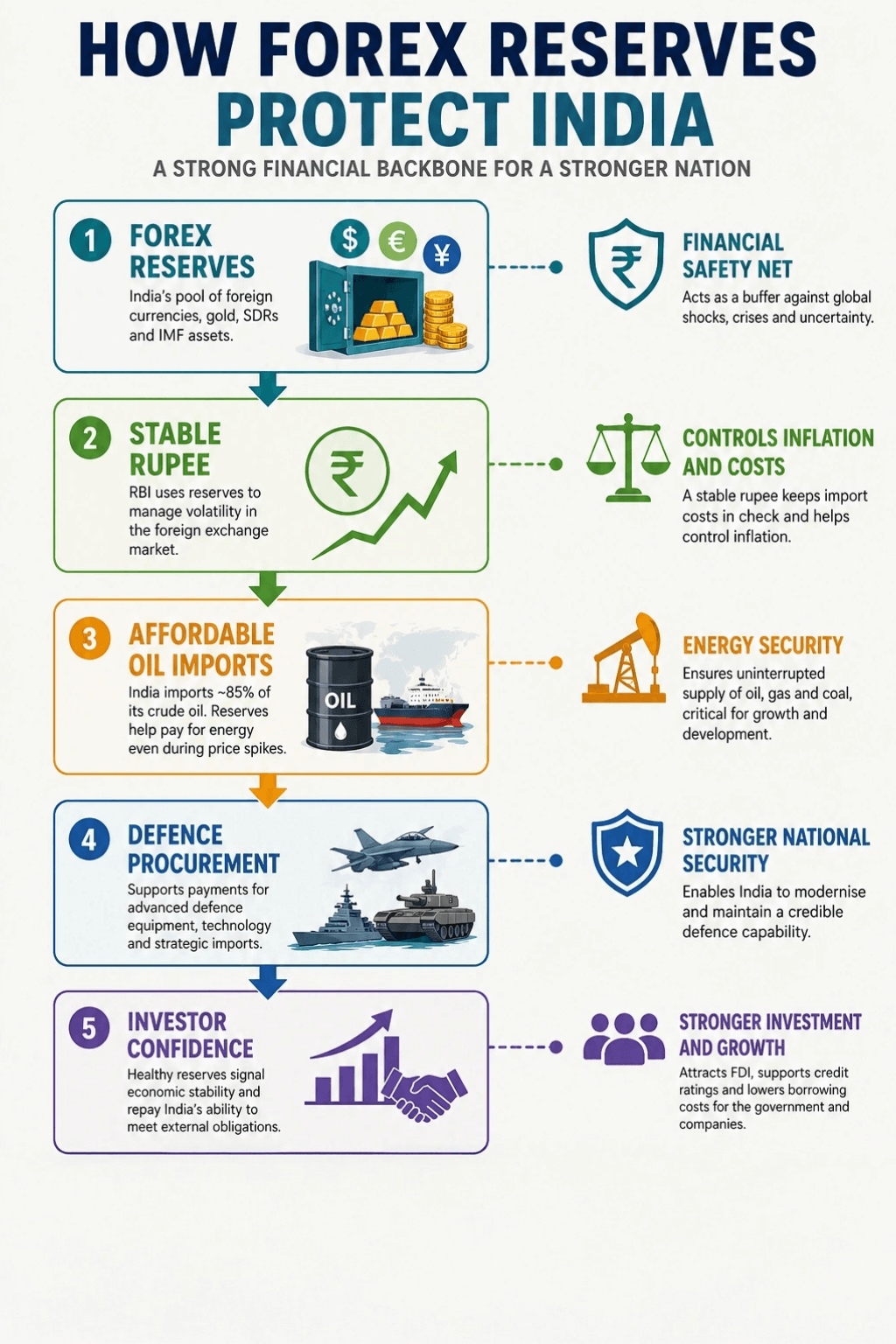
Defence Preparedness
India imports a significant share of its advanced military platforms, aircraft engines, precision weapons, surveillance systems and critical technologies.
Payments for these imports are largely denominated in foreign currencies, particularly the U.S. dollar. Adequate forex reserves ensure that defence procurement programmes can continue even during periods of financial instability.
Energy Security
India imports nearly 85% of its crude oil requirements.
Any disruption in global energy markets—whether caused by conflict in West Asia, sanctions or shipping disruptions—can sharply increase India’s import bill.
Strong forex reserves provide the financial cushion needed to absorb such shocks without placing immediate pressure on the domestic economy.
Rupee Stability
The RBI frequently uses forex reserves to reduce excessive fluctuations in the rupee.
A stable currency helps contain imported inflation, lowers uncertainty for businesses and supports investor confidence.
Strategic Autonomy
Countries with substantial foreign exchange reserves possess greater flexibility during geopolitical crises.
Whether facing sanctions, supply-chain disruptions or global financial turbulence, strong reserves enable governments to maintain essential imports while avoiding abrupt economic adjustments.
What the RBI Report Reveals
Beyond the weekly data, the RBI’s latest reserve management report provides several important insights into India’s external financial position.
As of March 2026, India’s foreign exchange reserves stood at $691.11 billion, with Foreign Currency Assets amounting to $552.28 billion. The RBI also held 880.52 metric tonnes of gold, of which approximately 680 tonnes are stored domestically, while the remainder is held with the Bank of England, the Bank for International Settlements (BIS) and as gold deposits.
The report further notes that gold’s share in India’s total reserves has increased to 16.7%, reflecting both higher international gold prices and the RBI’s evolving reserve composition.
Importantly, India’s reserves continued to provide around 10.8 months of import cover at the end of December 2025, underscoring the country’s ability to withstand external shocks.
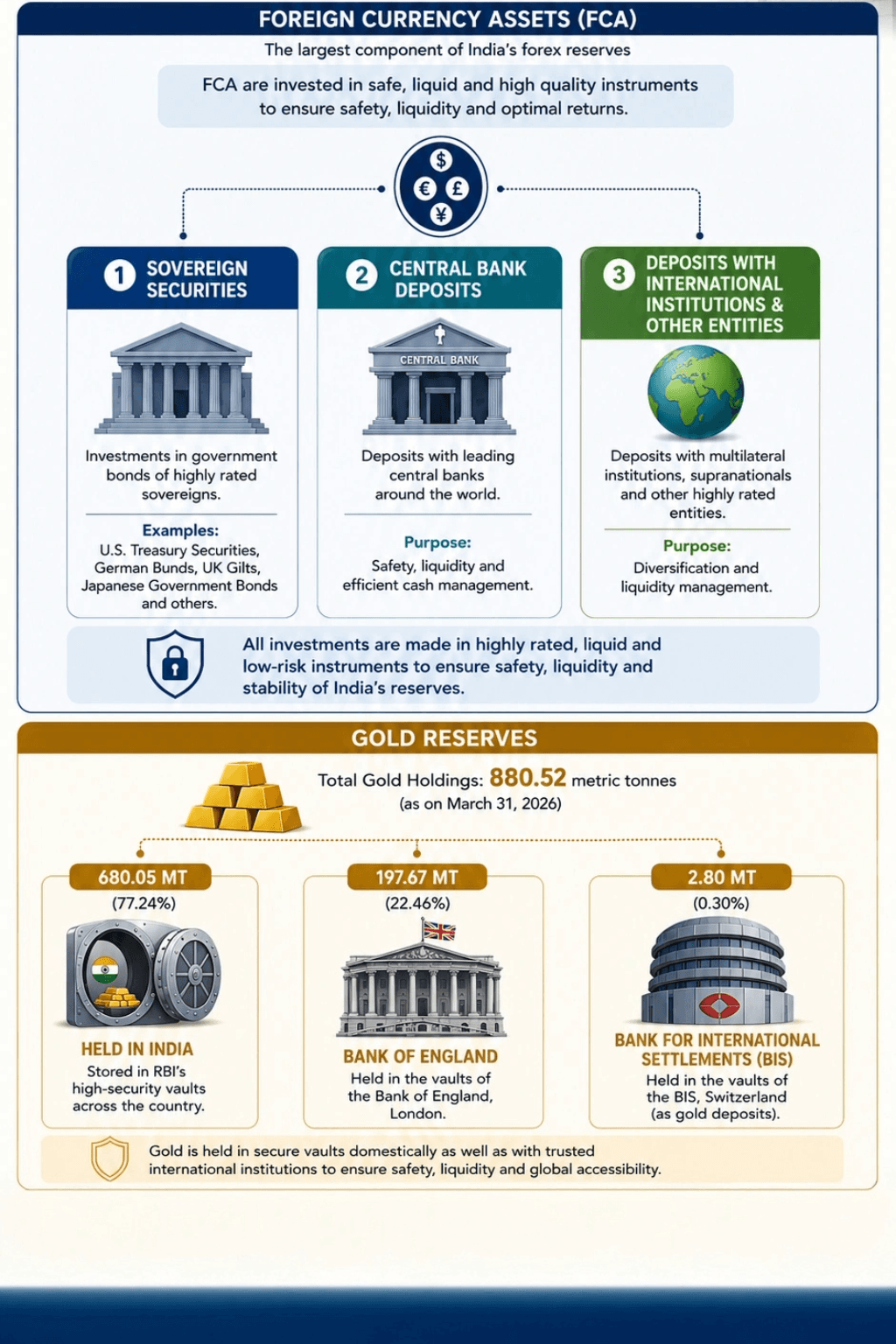
(Illustration showing Foreign Currency Assets invested in highly rated sovereign securities and central-bank deposits, alongside the distribution of India’s gold holdings between domestic vaults, the Bank of England and BIS.)
Should India Be Concerned?
The short answer is no.
A weekly decline in reserves is neither unusual nor necessarily a cause for alarm. Reserve values change regularly due to fluctuations in gold prices, exchange rates and RBI operations in the currency market.
What matters more is the broader trend and the overall adequacy of reserves.
Even after the latest decline, India continues to maintain one of the world’s largest foreign exchange reserve holdings, providing a substantial buffer against external risks.
The Bigger Strategic Picture
Economic security and national security are becoming increasingly intertwined.
Recent geopolitical developments—including tensions in West Asia, disruptions to global shipping routes and persistent uncertainty in international financial markets—have reinforced the importance of maintaining strong external buffers.
For India, forex reserves support not only macroeconomic stability but also strategic objectives ranging from energy security and defence modernisation to investor confidence and economic resilience.
As New Delhi seeks to strengthen its position in an increasingly multipolar world, the management of foreign exchange reserves will remain a critical pillar of national strategy.
The latest decline in India’s forex reserves should be viewed in context rather than isolation.
While the headline figure reflects a weekly fall of $5.65 billion, much of the movement stems from valuation changes and routine reserve management rather than any fundamental deterioration in India’s economic position.
More importantly, the episode serves as a reminder that foreign exchange reserves are no longer just an economic statistic. They are a strategic asset that enables India to weather global uncertainty, finance critical imports, stabilise its currency and safeguard national interests during periods of international volatility.
In an era where economic resilience increasingly underpins geopolitical influence, India’s forex reserves remain one of the country’s most important—yet often overlooked—pillars of national strength.