
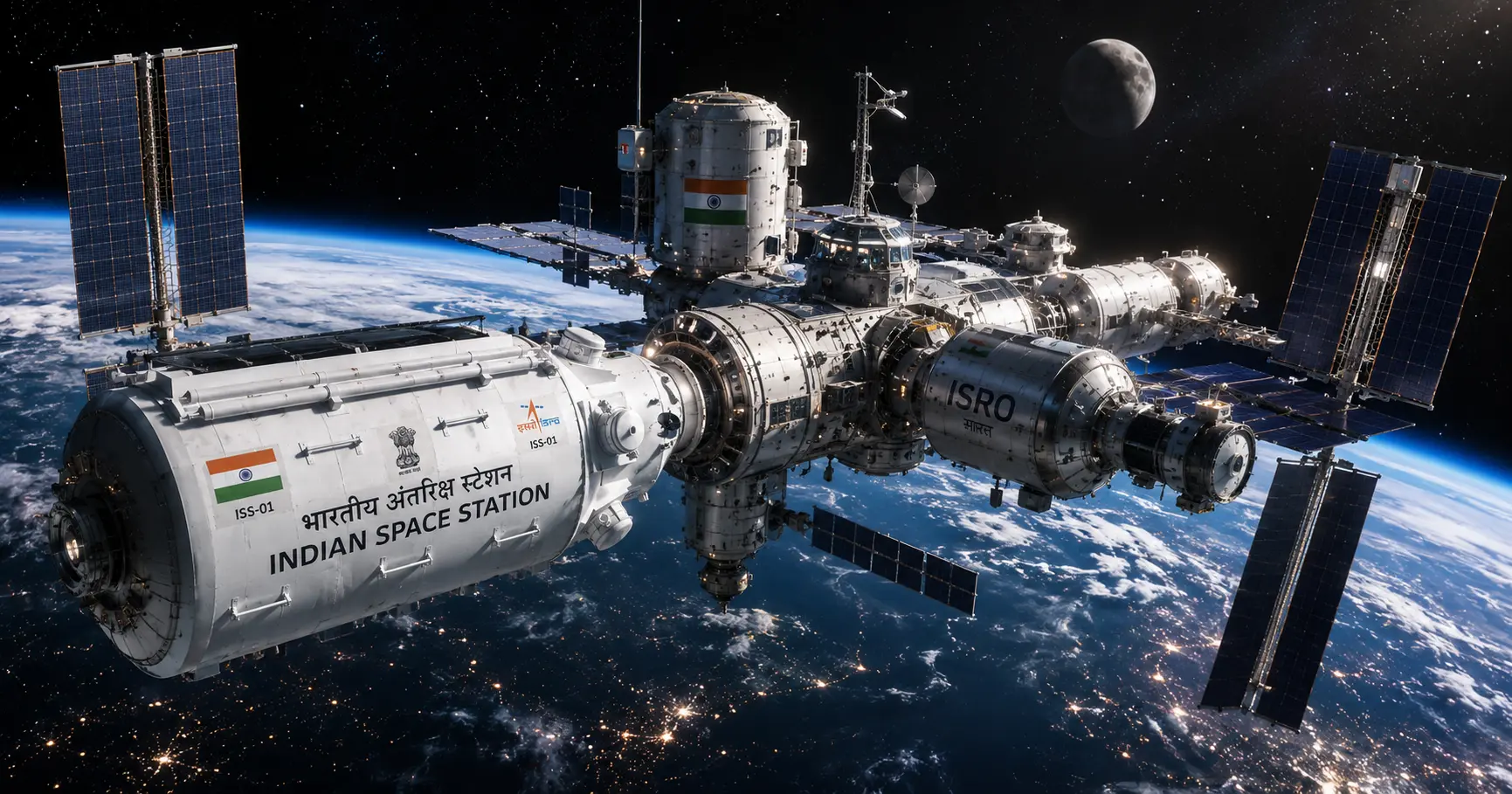
India’s Space Station · Defence & Space Industrial Analysis
In December 1998, Indian reconnaissance satellites were reportedly redirected to photograph the American bombing of a military headquarters in Baghdad — real-time imagery of a war on someone else’s continent. Four months later, on the Indian side of the Line of Control, more than four thousand Pakistani soldiers and irregulars had occupied over a hundred peaks and dug in for weeks, undetected. India found out not from a satellite, but from a shepherd named Tashi Namgyal, who was looking for a lost yak.
That is not a story about India lacking eyes in orbit. It is a story about India pointing them at the wrong sky, inside a much larger chain — surveillance coverage, force posture during the winter withdrawal of forward posts, inter-service coordination, and the speed of the intelligence-to-decision cycle — where any single gap could have let the infiltration through. It is also the uncomfortable historical backdrop against which India’s latest orbital commitments deserve to be read differently. India has approved two connected but distinct programmes in the same budget window — the Bharatiya Antariksh Station (BAS) and the SBS-3 military satellite constellation — worth close to ₹47,000 crore combined. Covered almost everywhere as a single science-and-prestige story, the defence-relevant half of that bill, SBS-3, is better understood as one of the most significant standing-watch procurements in Indian history.
This is not an article about astronauts. It is an article about who watches India’s borders, who gets paid to build the watching, and what the country is willing to spend to close one specific gap in that chain — persistent surveillance — that failed once already.
TES Brief
- India has committed close to ₹47,000 crore across two connected but distinct programmes — the civil Bharatiya Antariksh Station and the military SBS-3 satellite constellation.
- SBS-3’s 31 of 52 satellites go to three named private firms — the largest private allocation in Indian military space history.
- SBS-3’s core design reportedly answers one specific piece of the 1999 breakdown: the absence of continuous, standing border-watch coverage — not the full chain of command, coordination, and logistics failures the Kargil Review Committee identified.
- India’s space economy targets $44 billion by 2033, up from $8.4 billion today — but private funding fell over 50 percent in 2024 even as government orders accelerated.
India’s Space Station and SBS-3: Two Programmes, One ₹47,000 Crore Bill
India is funding two connected but legally and technically distinct space assets. India’s Space Station — the Bharatiya Antariksh Station — is a five-module, roughly 52-tonne orbital outpost, its first unit approved by the Union Cabinet in September 2024 within a revised ₹20,193 crore Gaganyaan programme budget — a civil human-spaceflight budget line, not a defence one. The Space-Based Surveillance-III (SBS-3) constellation is a separate, military-specific programme: 52 satellites, approved by the Cabinet Committee on Security at a reported cost of roughly ₹26,968 crore. Add the two together and India has committed close to ₹47,000 crore to permanent orbital presence over its own territory and its immediate strategic neighbourhood — though only the SBS-3 portion carries an explicit security mandate.
The Cabinet’s September 2024 decision added ₹11,170 crore to the existing Gaganyaan human spaceflight programme specifically to fund BAS-1, the station’s first module, targeted for launch by 2028, with the full five-module complex — Base, Core, Science, Lab, and a Common Berthing Module — operational by 2035. The station is planned to orbit at 400-450 km with a 51.5-degree inclination — a figure broadly consistent with the standard inclination for a crewed station launched from Sriharikota’s latitude, similar to the International Space Station’s 51.6-degree inclination from Baikonur, chosen primarily for orbital-mechanics and fuel-efficiency reasons. A side effect of that geometry is that the station’s ground track sweeps across the Indian subcontinent and the wider Indo-Pacific on every orbit; there is no public indication this inclination was selected specifically for surveillance purposes rather than standard launch-site mechanics.
SBS-3 is the less-discussed half of the ledger, and the more directly defence-relevant one. It splits 52 satellites across low earth and geostationary orbit — 21 built by ISRO, and, in a genuine first for Indian defence procurement, 31 built entirely by three named private firms. The programme’s timeline was reportedly compressed following Operation Sindoor, with first launches now targeted for 2026 rather than the original multi-year schedule.
Why SBS-3 Is a Border-Security Story, Even Though Its Companion Station Isn’t
SBS-3 is reportedly designed around satellites that cross-cue each other automatically — a geostationary satellite that flags unusual activity tasking a lower-orbit satellite for a closer, sharper look, without a human first deciding, case by case, which stretch of border deserves attention that particular week. This capability is drawn from trade-press accounts of the programme rather than an official MoD technical disclosure, but if accurate, it is not a generic engineering flourish. It would be a direct, structural answer to one specific element of the chain that broke down before Kargil: the absence of continuous, standing watch over the Line of Control.
It is worth being precise about what that chain actually involved, because collapsing it into a single “intelligence failure” understates how the breakdown actually happened. The Kargil Review Committee’s findings pointed to several compounding gaps operating together: surveillance coverage that wasn’t standing or continuous; the winter-season thinning of forward troop posture along high-altitude sectors; a February 1999 aerial reconnaissance pass that reportedly did capture Pakistani activity but went unexploited up the chain; and a command and coordination response that was, in the war’s opening days, slower than the situation warranted.
Days after the shepherd’s warning reached the Army, the local corps commander told reporters the situation was “local” and could be resolved within 48 hours. The Air Force chief was in Europe. These were failures of standing attention and coordinated response, not of hardware alone — and it is worth being honest that hardware alone has never fully solved that class of problem, anywhere, for any nation.
Even the CIA’s own satellite fleet — including cloud-penetrating radar imaging birds — failed to detect India’s preparations for the 1998 Pokhran-II nuclear tests, partly because Indian technicians reportedly timed sensitive movements to coincide with seasonal sandstorms that blinded optical coverage. Persistent orbital watch narrows the odds of being caught unaware. It does not, by itself, guarantee the force posture, interpretation, and command response that has to follow what a satellite sees.
SBS-3’s reported architecture, whether its planners frame it this way publicly or not, would be a structural fix for one specific piece of the 1998-99 breakdown: continuous coverage of the LAC, the LoC, and the Indian Ocean Region removes the discretionary human decision point — which border sector gets watched this week — that failed India once already. It does not, on its own, fix inter-agency coordination, interpretation speed, or the force-posture decisions that also mattered in 1999. Whether BAS itself adds meaningful border-security value beyond SBS-3 is a separate, more speculative question: its stated mission is scientific and it is funded through the civil Gaganyaan line, and there is no public indication that crew aboard the station will be tasked with reviewing border imagery or performing any surveillance function.
This is precisely why treating SBS-3 purely as a routine satellite-procurement story undersells its real function. Microgravity research aboard BAS matters in its own right, and BAS itself was funded through the civil Gaganyaan programme rather than a defence budget line — its subcontinent-spanning orbital coverage is best read as an incidental byproduct of standard launch-site orbital mechanics, not evidence of a hidden security purpose. SBS-3, by contrast, was funded separately and explicitly through the Cabinet Committee on Security, and its load-bearing justification is Intelligence, Surveillance, and Reconnaissance: persistent presence over contested terrain that no satellite on a fixed revisit schedule fully replaces.
Who Actually Gets Paid to Build This
SBS-3’s private allocation names three established primes: Ananth Technologies, Centum Electronics, and Alpha Design Technologies, building 31 of the 52 satellites between them. Alongside this state-mandated allocation sits a separate, more entrepreneurial wave of Indian space companies whose commercial work increasingly overlaps with defence demand, mandate or no mandate.
Ananth Technologies, one of India’s oldest private space companies, already operates a dedicated satellite manufacturing facility near Bengaluru and has built satellites for foreign customers in France and Sweden — an unusually mature production base to be bringing into a military allocation of this scale. Centum Electronics and Alpha Design Technologies bring established defence-electronics manufacturing into the constellation, which matters: SBS-3 is being built by firms with existing military-supply relationships, not by first-time space entrants learning the sector on a government contract.
Outside the state mandate, the picture is more entrepreneurial and, in places, more advanced than the government programme itself. GalaxEye Space, a Chennai-headquartered startup founded roughly four years ago, has developed a synthetic aperture radar satellite capable of 0.5-metre resolution — precise enough to identify individual vehicles or structures through cloud cover, day or night, a capability optical satellites alone cannot match in Himalayan winter conditions, the exact conditions under which the Kargil infiltration was originally missed.
Pixxel, backed by Google, launched the first three satellites of its six-satellite Firefly hyperspectral constellation in early 2025 aboard a SpaceX rocket, and has already signed roughly 65 clients spanning mining, agriculture, and India’s own Ministry of Agriculture — proof that dual-use Indian space capacity can build a genuine commercial client base well beyond its defence relevance. Digantara has moved into space situational awareness specifically, launching its own tracking satellite, SCOT, to monitor the orbital environment itself rather than the ground below it.
| Company | Role | Notable Detail |
|---|---|---|
| Ananth Technologies | SBS-3 private prime | Existing satellite plant near Bengaluru; built satellites for French, Swedish clients |
| Centum Electronics | SBS-3 private prime | Established defence-electronics manufacturer |
| Alpha Design Technologies | SBS-3 private prime | Existing military-supply relationships |
| GalaxEye Space | Independent SAR satellite developer | 0.5-metre resolution, all-weather, day/night imaging |
| Pixxel | Independent hyperspectral constellation | Google-backed; ~65 commercial clients including government agriculture ministry |
| Digantara | Space situational awareness | Operates SCOT, a dedicated orbital-tracking satellite |
The Numbers Investors Should Actually Be Watching
India’s Space Station and the SBS-3 procurement sit inside a much larger ambition: India’s space economy is currently valued near $8.4 billion, roughly 2 percent of the global total, against an official target of close to $44 billion and an 8-10 percent global share by 2033. The global satellite-imagery market alone is projected to reach $19 billion by 2029, with hyperspectral imaging — the specific niche Pixxel is targeting — expected to capture $500 million to $1 billion of that figure.
Set against that growth ambition is a genuinely under-reported risk factor: Indian space-tech private funding reportedly fell by more than 50 percent in 2024 compared with 2023, even as government-mandated defence-space spending accelerated in the same window. That divergence changes who the real near-term beneficiaries are. Government procurement — SBS-3’s ₹26,968 crore, BAS’s ₹20,193 crore — is currently doing more to sustain the sector’s growth trajectory than private venture capital is. Companies with confirmed government allocations sit on firmer commercial ground right now than commercially-funded pure-plays competing for a shrinking private pool, however strong their individual technology looks on paper.
India’s roughly 300 space startups are, collectively, chasing a market officialdom wants to grow more than fivefold within a decade. Whether that growth over the next several years is procurement-led or investment-led is, for anyone tracking this sector financially, arguably a more consequential question than the station’s 2035 completion date.
What to Watch
Does SBS-3 fix the surveillance gap that contributed to the Kargil War?
It addresses one specific piece of the 1998-99 breakdown — the discretionary-tasking problem, where nobody had made continuous border watch a standing priority. Automated cross-cueing between orbital layers, as reported in trade-press accounts of the programme, would reduce the chance a border sector goes unwatched simply because no one chose to look that week. It does not, on its own, fix inter-agency coordination, interpretation speed, or force-posture decisions, which the Kargil Review Committee identified as equally significant contributors to the failure.
Is India’s Space Station itself a defence programme, or is SBS-3 the defence-relevant piece?
SBS-3 is the defence-relevant programme: a military satellite constellation approved by the Cabinet Committee on Security with an explicit surveillance mandate. The Bharatiya Antariksh Station (BAS) is funded through the civil Gaganyaan budget with a stated scientific mission; its border-relevant value is an incidental byproduct of its orbital geometry, not its stated purpose. The two are frequently discussed together because they were funded in the same budget window, but they are legally, financially, and operationally distinct.
Which private companies are building India’s SBS-3 satellites?
Ananth Technologies, Centum Electronics, and Alpha Design Technologies are reported as the three private primes building 31 of the 52 SBS-3 satellites, with ISRO building the remaining 21. The Ministry of Defence has not issued an official public breakdown of individual satellite assignments.
Is India’s space economy growth currently driven by government spending or private investment?
Currently more the former than industry narratives often suggest. Space-tech private funding fell over 50 percent in 2024 even as SBS-3 and BAS budgets were finalised, meaning near-term sector growth is being carried disproportionately by defence and government procurement rather than venture capital.
Two decades ago, the gap between what India could see and what it needed to see was closed by a shepherd’s missing yak. It will not be closed that way again. Whether the surveillance layer that failed in 1999 is closed by SBS-3 — while command, coordination, and force posture are addressed through separate reforms, and BAS pursues its own scientific mission alongside it — is the question this ₹47,000 crore combined budget line is actually answering, whatever the press releases call it.
Editorial Transparency Note
- Verified fact: BAS’s September 2024 Cabinet approval, the ₹20,193 crore revised Gaganyaan budget, and module/orbital specifications are drawn from official government statements (PMO, Cabinet communications) and corroborated across multiple news outlets. BAS’s funding through the civil Gaganyaan line, rather than a defence budget, is likewise drawn from official Cabinet communications.
- Reported, not officially confirmed: SBS-3’s ₹26,968 crore budget, the naming of Ananth Technologies, Centum Electronics, and Alpha Design Technologies as the three private primes, and SBS-3’s cross-cueing design capability come from industry and trade-press reporting citing government and ISRO sources; the Ministry of Defence has not issued an official public breakdown, so these details should be read as reported rather than confirmed.
- Single-source attribution: The claim that Indian reconnaissance satellites were tasked toward Baghdad in December 1998 rather than the LoC is attributed to a published account by former IAF fighter pilot M.P. Anil Kumar and should be read as his characterisation, not an official disclosure.
- TES analysis: The framing of SBS-3’s cross-cueing design as addressing one specific piece of the 1998-99 institutional breakdown — and the distinction drawn between SBS-3’s explicit security mandate and BAS’s civil, scientific mandate — is this publication’s own analytical argument, not an official government characterisation of either programme.
- Market data: The 2024 private-funding decline and market-size projections are drawn from industry-tracking sources (New Space Economy, ISpA year-end reporting) rather than official Indian government statistics.
Related reading on The Eastern Strategist: Kargil to Operation Sindoor: India’s Defence Modernisation · India Opens Missile Manufacturing to Private Firms · India’s Military AI