
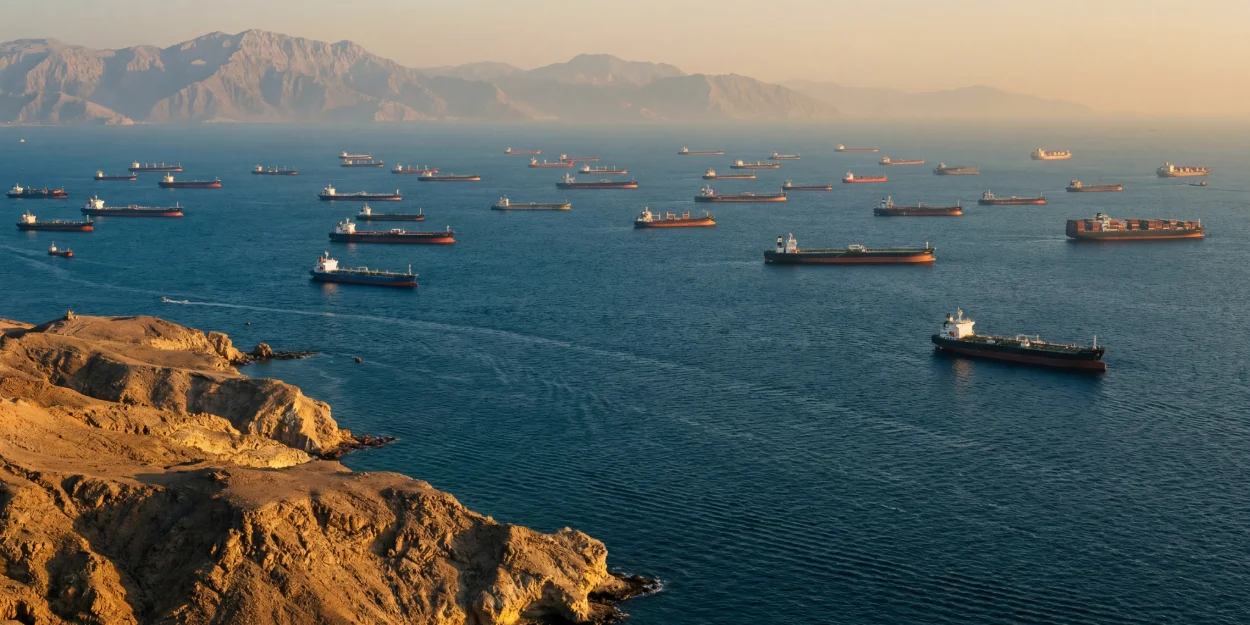
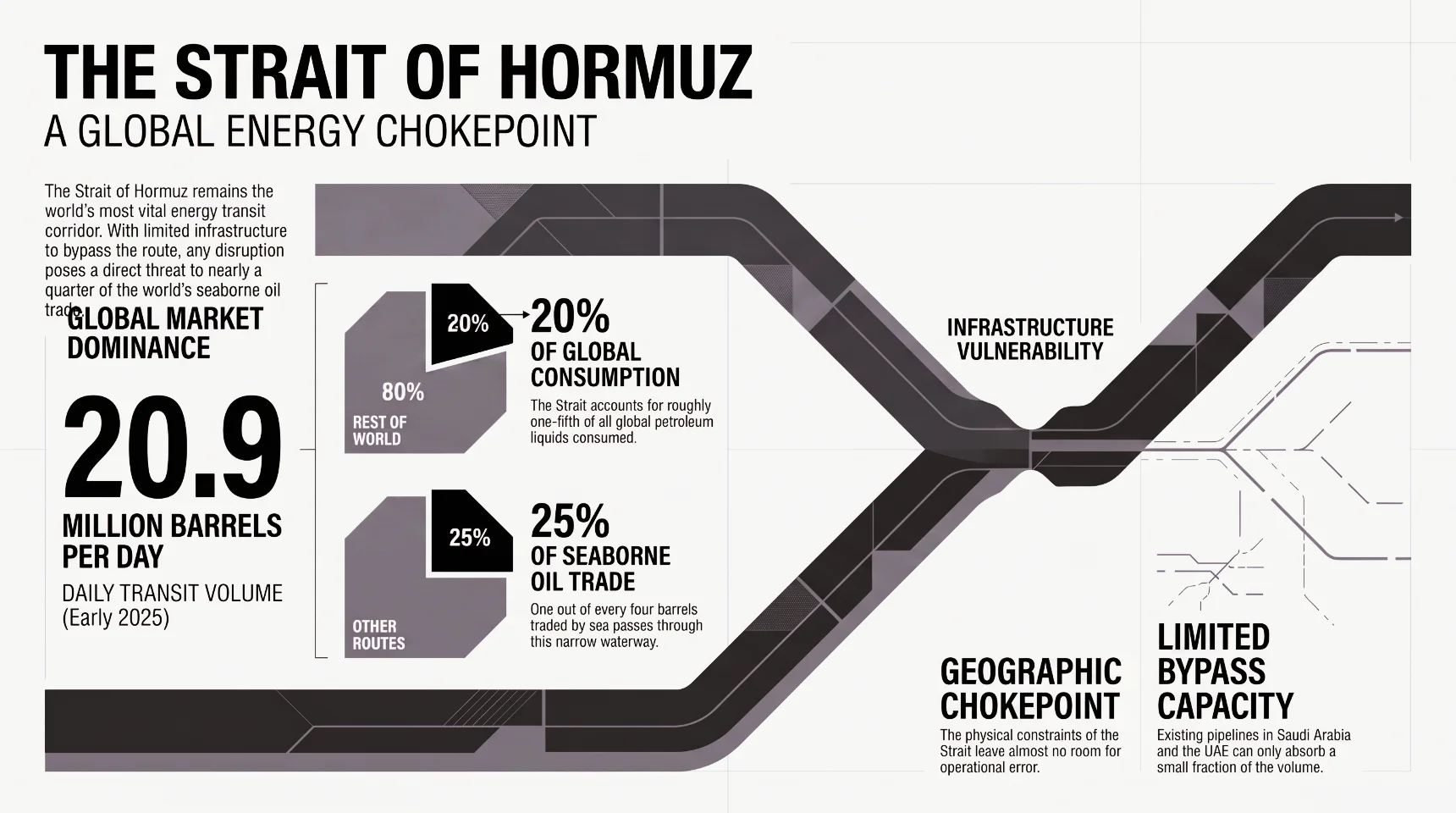
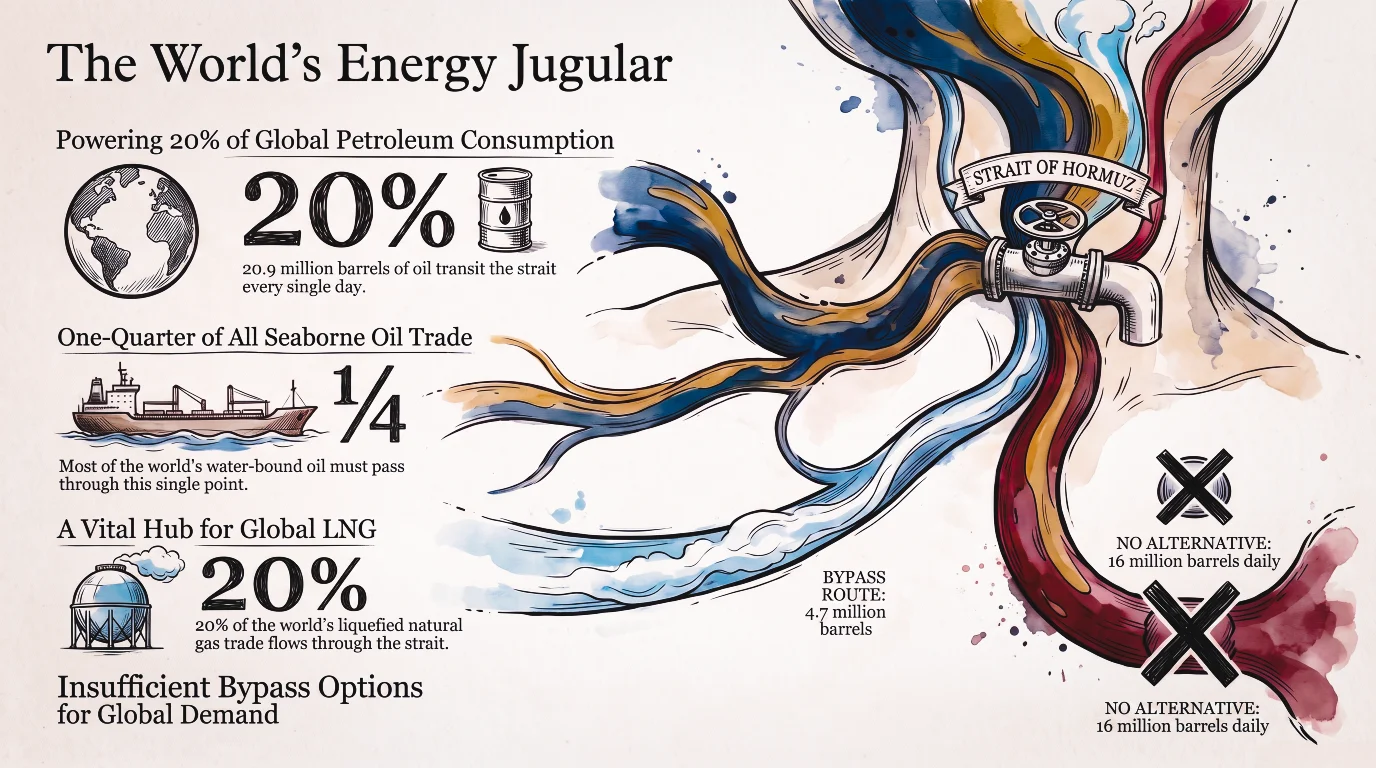
For decades, the Strait of Hormuz has quietly carried one of the world’s greatest strategic burdens. Around one-fifth of globally traded crude oil passes through a waterway barely 40 kilometres wide at its narrowest point. Energy markets have learned to depend on that flow, often treating uninterrupted passage as a permanent feature of international commerce rather than the result of continuous military protection.
That assumption deserves another look.
Washington’s proposal to recover part of the cost of securing commercial traffic through the Strait has reopened a debate that extends well beyond the Persian Gulf. The discussion is no longer limited to naval deployments or regional tensions. It reaches into a larger question that governments, energy companies, and shipping firms can no longer ignore: how the Strait of Hormuz affects global oil trade when security itself begins carrying a financial cost.
Geography leaves little room for error. No other maritime corridor moves as much Gulf energy to international markets in such a confined space. Saudi Arabia and the United Arab Emirates operate pipelines that bypass part of the Strait, but they cannot absorb the full export volumes that normally pass through Strait of Hormuz. For major importers across Asia and Europe, the route remains indispensable.
Commercial shipping reflects that reality every day.
A tanker sailing through Strait of Hormuz carries more than crude oil. It carries contracts, insurance liabilities, refinery schedules, and national energy security plans. When the operating environment becomes less predictable, adjustments begin long before exports slow. Insurers revise risk assessments. Freight rates move. Importers review inventories. Governments monitor strategic petroleum reserves more closely.
Washington argues that protecting this corridor requires resources that have grown steadily more expensive. Carrier strike groups, destroyers, surveillance aircraft, logistics hubs, and intelligence assets remain on constant watch because disruption in Strait of Hormuz would echo through the global economy within days. Asking those who benefit most from secure shipping to contribute financially reflects a broader shift in American policy. Overseas commitments are increasingly judged not only by their strategic value but also by their long-term cost.
Military budgets can accommodate that calculation.
Diplomatic relationships are often less predictable.
Why Iran Doesn’t Need to Close the Strait of Hormuz
The assumption that Iran’s greatest leverage comes from closing the Strait of Hormuz has shaped headlines for years. It has also distorted much of the public debate.
A prolonged blockade would work against Tehran’s own interests. Iranian oil exports rely on the same waterway, and any attempt to physically seal the Strait would almost certainly trigger a broad military response involving the United States and its regional partners. The economic costs would land on Iran almost as quickly as they would on its rivals.
Tehran has invested in a different approach.
Rather than trying to stop every tanker, the Islamic Revolutionary Guard Corps (IRGC) has developed capabilities designed to complicate commercial shipping without taking permanent control of the waterway. Fast attack craft, anti-ship missiles, naval drones, sea mines, electronic warfare systems, and coastal missile batteries all serve the same purpose. They increase uncertainty.
For shipping companies, uncertainty has a price.
A reported drone sighting, electronic interference affecting navigation, or intelligence warning about possible military activity can alter commercial decisions within hours. Insurers reassess exposure. Freight rates adjust. Some operators delay departures until the security picture becomes clearer. Others look for alternative cargo schedules or routes where possible.
None of those decisions requires the Strait of Hormuz to be closed.
History points in the same direction. During the Tanker War in the 1980s, Iran and Iraq repeatedly targeted commercial shipping without completely shutting down Gulf exports. The objective was to raise the political and economic cost of operating in the region rather than achieve permanent control of the sea. Washington eventually launched Operation Earnest Will to escort reflagged Kuwaiti tankers, demonstrating how even limited attacks on merchant shipping could draw outside powers into protecting global energy flows.
The same logic still applies.
Military planners often measure success by territory held or ships destroyed. Commercial shipping follows different metrics. Delays, insurance costs, vessel availability, and delivery schedules often shape decisions long before physical supply is interrupted. A tanker that arrives late can disrupt refinery operations hundreds of kilometres away. A shipping company facing higher insurance costs may pass those expenses through the entire supply chain.
This places Washington in a difficult position.
Keeping Strait of Hormuz open is no longer enough if commercial operators believe the route has become persistently unpredictable. Naval patrols can deter attacks, but confidence cannot be restored by military presence alone. Shipping companies respond to perceived risk as much as actual incidents, making information, signalling, and credibility almost as important as warships operating in the Gulf.
That dynamic explains why every episode of tension in Strait of Hormuz attracts attention far beyond the Middle East. The waterway carries crude oil, but it also carries confidence in the reliability of global trade. Once that confidence begins to weaken, the economic effects spread much faster than the military confrontation itself.
Why China and India Are Rethinking Energy Security Beyond Hormuz
No country controls the Strait of Hormuz, yet many economies depend on it as though they do.
That dependence looks very different from Beijing than it does from New Delhi, but both capitals arrive at the same conclusion: relying too heavily on a single maritime corridor carries growing political and economic risks.
China has spent years trying to reduce those risks without directly challenging the U.S. naval presence in the Gulf. Pipelines linking Central Asia to western China, expanded crude oil storage, investments in Pakistan’s Gwadar Port, and a steadily growing blue-water navy all point toward the same objective. None of those projects replaces Hormuz. Together, they reduce the consequences of disruption if the Strait becomes more difficult or more expensive to use.
Geography still imposes hard limits.
Most Gulf exports travel by sea because no combination of pipelines can move equivalent volumes across land. Even countries investing heavily in alternative routes continue relying on tanker traffic through Hormuz. The result is a gradual shift in strategy rather than a dramatic break from the existing system.
India approaches the problem from another direction.
More than four-fifths of its crude oil requirements come from imports, with Gulf producers supplying a substantial share. That dependence makes stability in Hormuz an economic priority, but New Delhi has been careful not to anchor its energy security to a single diplomatic relationship. Defence cooperation with the United States has expanded, trade with Gulf states has grown, and engagement with Iran has continued where national interests allow.
Those relationships are designed to complement one another.
A prolonged crisis in Hormuz would test that approach. Indian policymakers would need to protect energy supplies while preserving the flexibility that has become a defining feature of the country’s foreign policy. Expanding strategic petroleum reserves, broadening supplier networks, strengthening naval cooperation across the Indian Ocean, and improving port infrastructure all support that objective without forcing India into a rigid geopolitical alignment.
Other major importers face similar calculations.
Japan and South Korea remain heavily dependent on Gulf energy, while many European economies continue importing oil and liquefied natural gas from the region despite broader efforts to diversify supply. None of these countries can treat disruptions in Hormuz as a distant regional problem. A sustained increase in shipping costs eventually feeds into manufacturing, electricity generation, transport, and consumer prices.
The response is already visible.
Governments are building larger emergency reserves. Energy companies are signing longer supply contracts with a wider range of producers. Investment in ports, storage facilities, and alternative transport corridors has accelerated as countries prepare for a future in which supply chain resilience carries as much weight as price.
These decisions rarely make front-page news.
Taken together, they gradually reshape global energy trade. Infrastructure built during periods of uncertainty often remains in place long after tensions ease. Pipelines continue operating. Storage terminals continue expanding. Shipping routes continue evolving.
The legacy of a crisis is often measured less by what happened during it than by what governments built because they believed it could happen again.
How the Strait of Hormuz Affects Global Oil Trade and Shipping
Shipping companies measure risk differently from governments.
Military planners ask whether a waterway can be defended. Commercial operators ask how much it costs to use. Those calculations often move on separate timelines. A navy may conclude that a shipping lane remains secure, while insurers and freight operators quietly raise premiums because they believe the margin for error has narrowed.
That gap shapes global trade more than dramatic headlines.
Even without a prolonged blockade, higher insurance costs, longer voyage planning, additional naval escorts, and stricter compliance requirements make every cargo more expensive to move. Those costs rarely stay with shipping companies. They work their way through refineries, manufacturers, logistics networks, and eventually reach consumers.
Governments have already started adjusting.
Several Gulf producers continue investing in pipelines that reduce dependence on the Strait where geography permits. Importing nations are expanding strategic petroleum reserves, modernising ports, and strengthening partnerships across the Indian Ocean. Shipping companies are reviewing contingency plans more frequently than they did a decade ago. None of these measures removes Hormuz from the global energy system, but together they reduce the shock of future disruptions.
The same pattern has appeared before.
The Suez Crisis changed how European governments thought about energy security. The Tanker War reshaped naval operations in the Gulf long after the fighting ended. Supply chain disruptions during the COVID-19 pandemic pushed governments and businesses to rethink resilience rather than efficiency alone. Each crisis left behind new infrastructure, new investment priorities, and different assumptions about risk.
Hormuz is likely to produce its own legacy.
The most significant change may have little to do with whether commercial shipping eventually pays directly for naval protection. Governments are already planning for a future in which secure sea lanes cannot be taken for granted. Energy diversification, strategic reserves, stronger regional navies, and alternative transport corridors are becoming permanent features of national planning rather than temporary responses to a single crisis.
Those investments will outlast today’s headlines.
Pipelines built over the next decade will continue operating regardless of who occupies the White House or leads Iran. Expanded fuel storage, upgraded ports, and new maritime partnerships will influence trade patterns long after tensions in the Gulf subside. Strategic planning rarely works on election cycles. Infrastructure does.
The Strait of Hormuz remains one of the world’s most important energy corridors. What is changing is the way governments think about protecting it. For much of the post-war period, uninterrupted maritime trade was treated as a stable foundation of the global economy. That confidence is giving way to a more cautious approach in which security carries a visible economic cost and resilience becomes as valuable as efficiency.
The debate surrounding Hormuz is therefore larger than a dispute over one waterway. It reflects a broader shift in how states prepare for uncertainty. The countries that adapt most effectively will not necessarily be those with the largest navies or the biggest energy reserves. They will be the ones that recognise a simple reality: when confidence in a trade route weakens, governments begin redesigning everything connected to it.