
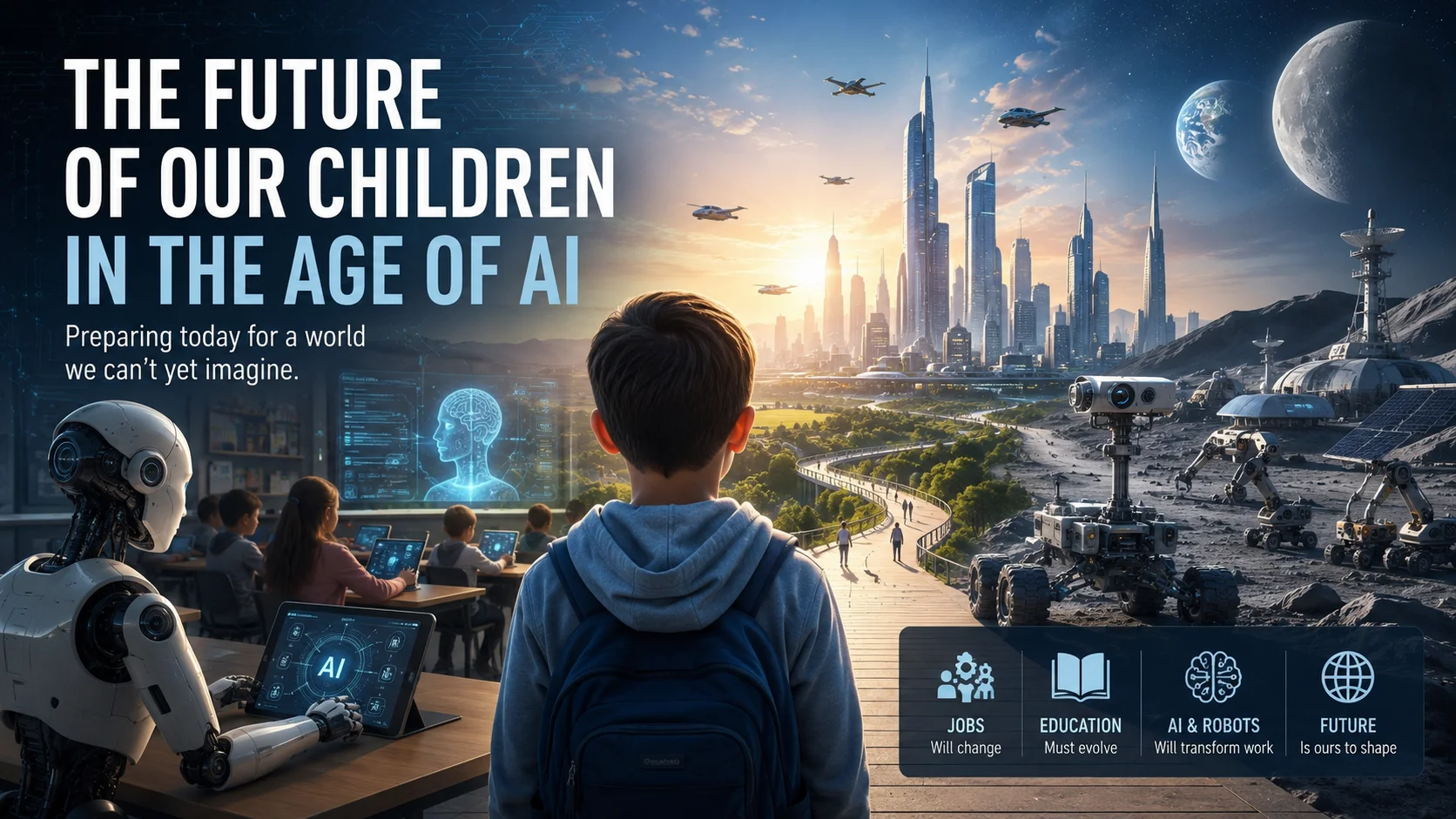
If machines can think, learn, and work, what skills will tomorrow’s children need to thrive?
A child entering first grade this year will likely retire sometime around the year 2085.
Think about that for a moment.
The world of 2085 is as far away from us as the late 1960s are today. Back then, the internet did not exist. Smartphones were science fiction. Artificial intelligence belonged mostly to research laboratories and movies.
Yet many of today’s schools still operate on assumptions developed for a very different economy.
That is why artificial intelligence matters.
The debate is no longer about whether AI can generate images, write essays, or answer questions. The deeper issue is whether societies are preparing children for a future in which machines can perform an increasing share of both physical and intellectual work.
For centuries, economic growth and employment largely moved together. New technologies replaced some jobs but created others. Artificial intelligence may challenge that relationship in ways previous technologies could not.
If that happens, the future of work—and the future of our children—could look very different.
AI by the Numbers
💰 $33.9 billion — Global investment in generative AI during 2024
🏢 78% — Organizations using AI in at least one business function
🌍 170 million — Jobs expected to be created globally by 2030
⚠️ 92 million — Jobs expected to be displaced globally by 2030
📈 22% — Share of jobs expected to experience disruption by 2030
🧠 OpenAI, Google DeepMind, Anthropic, Meta, and xAI are among the companies investing heavily in increasingly capable AI systems
Understanding the AGI Race
Most AI systems today are specialists.
They can generate text, recognize images, write code, or analyze data. They perform specific tasks exceptionally well but remain limited in scope.
Researchers use the term Artificial General Intelligence (AGI) to describe a system capable of performing a broad range of intellectual tasks at a level comparable to humans.
No company has achieved AGI.
Yet some of the world’s largest technology firms are investing billions of dollars in the pursuit of increasingly capable systems.
OpenAI, Google DeepMind, Anthropic, Meta, and xAI are among the organizations leading this effort.
The scale of investment reflects the seriousness of the race. According to Stanford University’s AI Index, generative AI attracted nearly $34 billion in private investment during 2024 alone.
Whether AGI arrives in five years, twenty years, or longer remains uncertain.
What is certain is that governments, businesses, and investors are preparing for a future shaped by more capable AI systems.
The Robot Revolution Is Already Here
When people imagine automation, they often picture humanoid robots walking through offices and factories.
That image may be distracting from what is already happening.
The most important robots are already among us.
Factories around the world use robotic systems to weld vehicles, assemble electronics, inspect products, package goods, and move materials. Warehouses increasingly rely on automation. Advanced software systems already perform tasks that once required teams of workers.
The next phase involves combining these systems with more capable AI.
A robotic machine that once followed fixed instructions can now identify defects, adapt to changing conditions, learn from data, and operate with less human supervision. Similar technologies are being deployed across manufacturing, logistics, agriculture, healthcare, and defence.
The future of automation may not arrive through robots that look human.
It may arrive through machines that simply become smarter.
Will AI Really Replace Jobs?
This is where the debate becomes more complicated.
Many economists argue that fears about technological unemployment are exaggerated.
History provides evidence for their case.
The Industrial Revolution eliminated countless manual jobs but created entirely new industries. Computers reduced demand for some clerical roles while generating millions of technology-related jobs. The internet disrupted industries while creating professions that barely existed a generation earlier.
Artificial intelligence could follow a similar pattern.
The World Economic Forum expects approximately 170 million jobs to be created globally by 2030, even as around 92 million existing roles are displaced.
That sounds encouraging.
But there is an important difference.
Previous technological revolutions primarily automated physical labor.
AI is increasingly automating cognitive labor.
For the first time, machines are beginning to perform tasks once considered the exclusive domain of educated professionals.
That is why many analysts believe white-collar workers may face greater disruption than expected.
Which Jobs Face the Greatest Risk?
The first impact is likely to appear in routine digital work.
Near-Term Risk (1–5 Years)
- Data entry
- Customer support
- Administrative assistance
- Basic content production
- Documentation and transcription
- Routine coding tasks
Mid-Term Risk (5–10 Years)
- Junior legal research
- Accounting support
- Market analysis
- Logistics planning
- Basic software development
- Financial reporting
Long-Term Risk (10+ Years)
- Transportation
- Advanced manufacturing
- Some healthcare support functions
- Portions of engineering and design
- Large sections of office administration
Many professions may not disappear entirely.
Instead, fewer workers may be needed to produce the same output.
What the People Building AI Are Saying
Much of the discussion about artificial intelligence is being shaped by the people creating it.
OpenAI CEO Sam Altman has suggested that increasingly capable AI systems could begin performing meaningful workplace tasks during this decade.
Google CEO Sundar Pichai has described AI as a “once-in-a-lifetime” technological shift.
Elon Musk has argued that advanced AI could eventually exceed human intelligence in many domains and significantly reshape economies and labor markets.
Anthropic CEO Dario Amodei has warned that governments may be underestimating the speed at which AI could affect white-collar employment.
While these leaders disagree on timelines, they largely agree on one point: artificial intelligence is becoming a foundational technology rather than a niche one.
If AI Does the Work, Who Gets Paid?
This question sits at the center of the AI debate.
For centuries, economic systems have been built around a simple assumption: people work and receive income in return.
Artificial intelligence challenges that relationship.
If businesses can generate more output with fewer workers, governments will face difficult questions about taxation, employment, and social stability.
One proposal receiving growing attention is Universal Basic Income (UBI).
Under a UBI system, citizens receive regular payments regardless of employment status. Supporters argue that if AI dramatically increases productivity and wealth, part of those gains could be shared across society. Critics question how such programs would be funded and whether they would create unintended economic consequences.
Other proposals include retraining workers for emerging industries, shortening work weeks, expanding public employment programs, and exploring ways to tax productivity gains created by automation.
There is no global consensus.
But policymakers are increasingly discussing questions that were once confined to academic debates.
What Should Our Children Learn?
This may be the most important question of all.
Many schools were designed for a world where memorizing information created economic value.
That world is changing.
A student can already use AI to summarize books, explain concepts, translate languages, generate software code, and solve many routine problems.
Knowledge remains important.
But the ability to use knowledge may become even more valuable.
Skills likely to grow in importance include:
- Critical thinking
- Creativity
- Communication
- Leadership
- Emotional intelligence
- Adaptability
- Ethical judgment
- Working effectively with AI tools
The future may belong not to those who compete against machines, but to those who learn how to work alongside them.
The Future of AI Beyond Earth
The long-term impact of artificial intelligence may extend far beyond offices, factories, and classrooms.
As the United States, China, and other space powers pursue plans for a sustained presence on the Moon, many of the technologies being developed today could eventually help build humanity’s first off-world infrastructure.
Future lunar missions are expected to rely heavily on autonomous machines capable of construction, maintenance, resource extraction, and exploration. Rather than sending large numbers of people into dangerous environments, space agencies are likely to deploy robotic systems to prepare habitats, install power systems, and support human crews.
Some researchers and companies have proposed concepts ranging from lunar resource extraction to space-based solar power systems. Whether such ideas become commercially viable remains uncertain. But they point toward a future in which intelligent machines could help extend human activity beyond Earth in ways that would be difficult, expensive, or dangerous using human labor alone.
If that future emerges, artificial intelligence will not simply change how people work. It may change where humanity is able to work.
The Real Challenge
The greatest challenge of the AI era may not be building intelligent machines.
It may be preparing humans for a world shaped by them.
Artificial intelligence may reduce the need for certain jobs. It may transform industries, change how economies function, and force governments to rethink assumptions that have existed for centuries.
But history suggests that humanity’s most powerful technologies rarely have a single outcome.
The steam engine replaced manual labor and helped launch the Industrial Revolution. Electricity transformed factories and daily life. The internet disrupted entire industries while creating new ones. Artificial intelligence may follow a similar path—eliminating some roles, creating others, and opening possibilities that are difficult to imagine today.
The same technology that automates routine work could accelerate scientific discovery, improve healthcare, make education more accessible, help tackle climate challenges, and support humanity’s expansion beyond Earth.
Whether AI becomes a source of widespread prosperity or deeper inequality will depend less on the technology itself and more on the choices societies make about education, regulation, opportunity, and access.
The future is unlikely to belong entirely to machines.
Nor will it belong solely to humans working as they do today.
It will belong to those who learn how to combine human creativity, judgment, and ambition with increasingly capable machines.
For today’s children, that may be the most important lesson of all.