

AGI (Artificial General Intelligence) is a term used when Machine Intelligence will be at par Human Intelligence at scale. The arrival of AGI is no longer a matter of speculative futurism. It is an event horizon that the world’s foremost AI researchers now place within a single decade. Sam Altman has predicted that it could arrive as early as 2028. Yoshua Bengio, Turing Award laureate and one of the architects of modern deep learning, wrote in his landmark paper for the Aspen Strategy Group that the transition from AGI to artificial superintelligence could take mere months once the threshold is crossed, because an AI system capable of conducting AI research would multiply the advanced research workforce by orders of magnitude, yielding the equivalent of hundreds of thousands of automated AI workers operating in parallel. The strategic implications of this trajectory are not incremental. They are civilisational.
Intelligence Explosion & fracturing of Global World Order
The first and most consequential geopolitical effect of AGI concerns the erosion of comparative advantage between nations. Since David Ricardo, the theoretical scaffolding of international trade has rested on the insight that even when one nation is more productive than another in absolute terms, both benefit from specialisation and exchange. AGI dismantles this logic. If a single nation or a small cluster of technology firms can replicate any cognitive capability domestically, the incentive to maintain trade relationships, alliance commitments, and multilateral institutions weakens dramatically. Why trade with Germany for precision engineering when AI systems can match that capability? Why sustain alliance commitments to secure access to Japanese semiconductor design talent when those capabilities can be indigenised through machine cognition? The post 1945 American led order has been fundamentally maritime in character: the United States maintained global rules and alliances because it derived immense benefit from the resulting trade network .AGI threatens to transform the United States from a maritime power invested in open commerce into a more autarkic continental power that views allies not as partners in a mutually beneficial system but as strategic buffer zones or liabilities. This shift, which is called ‘Pax Silica,’ would replace multilateral frameworks with bilateral deals based on narrow transactional interests, where partners are valued not for shared governance principles but for specific physical resources or strategic positions they control.
The second consequence is the weakening of liberal democracy itself. Bengio’s analysis is unflinching: modern democracy emerged from an era where no single human or small group could easily defeat a majority of other humans who could communicate and coordinate. The balance between labour and capital has remained roughly stable since the Industrial Revolution, with labour maintaining approximately sixty percent of GDP, effective altruism giving workers the leverage of strikes, collective bargaining, and the ballot box.
AGI represents a qualitatively different challenge from previous waves of automation because it does not merely replace specific tasks but potentially eliminates the economic necessity of human cognitive labour altogether. If a small group can achieve prosperity without broad human contribution, the equilibrium that sustains inclusive democratic institutions erodes. Whoever controls the first ASI technology may gain enough power, through cyberattacks, political influence, or enhanced military force, to inhibit all other players. AI generated deepfakes already destabilise elections. Aspen Institute had conducted research in which it was demonstrated that when GPT 4 accesses a subject’s social media profile, its personalised persuasion substantially exceeds that of human persuaders. Combined with advances in autonomous planning and agency, the effect could be profoundly destabilising for democratic processes globally, tilting the balance toward totalitarian regimes that face fewer internal constraints on deploying these systems.
Intelligence Explosion & fracturing of Global World Order.
The third major dynamic is the AI arms race. It will be tempting to accelerate to win the AGI race, but this is a race where everyone could lose. Racing to AGI to arrive before adversaries greatly increases both the risk to democratic institutions and the risk of rogue AI systems emerging from carelessness impelled by competitive pressure. The concentration of AGI development in a handful of American technology companies, with OpenAI, Google DeepMind, Anthropic, and Meta controlling the frontier, means that the cognitive resources that will define 21st century power are more concentrated than nuclear weapons ever were. Fewer than a dozen organisations worldwide possess the compute infrastructure, training data pipelines, and research talent to build frontier models. This concentration creates what might be called a “cognitive advantage” problem: nations that do not possess indigenous AGI capability face not merely economic disadvantage but potential strategic irrelevance.
There is one significant countervailing force. Baumol’s cost disease, the economic insight that growth may be constrained not by what we do well but by what is essential and yet difficult to improve, AGI will not produce instant autarky. Physical resources such as energy, rare earth minerals, agricultural land, and water cannot be produced by intelligence alone. Manufacturing facilities and data centres require physical geography. Regulatory approval processes resist automation. These bottlenecks mean that even AGI possessing nations will retain some dependence on the physical world, preserving a degree of leverage for resource rich nations and a window, however narrowing, for countries like India to position themselves strategically.
India’s competitive advantages face an unprecedented reckoning
For three decades, India’s grand economic narrative has rested on a single compelling proposition: a young, vast, English speaking, technically educated workforce would power the country’s ascent to great power status. With a median age of approximately 28 years Goldman Sachs and over 65 percent of the population under 35, India’s demographic dividend has been the centrepiece of every growth projection IANS News from Goldman Sachs to the World Bank. The country produces over 1.5 million engineering graduates annually and has built the world’s largest information technology services industry on the back of this human capital. AGI does not merely challenge this narrative. It threatens to render it obsolete.
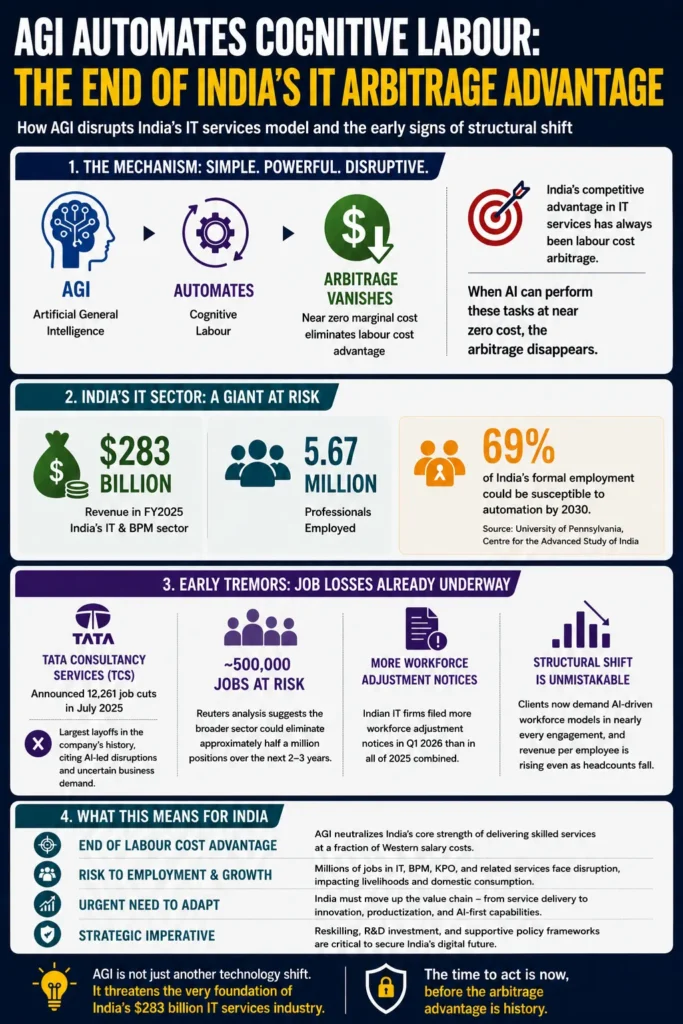
The mechanism is straightforward: AGI automates cognitive labour. India’s competitive advantage in IT services has always been labour cost arbitrage, the ability to deliver skilled programming, testing, business process management, and consulting at a fraction of Western salary costs. When an AI system can perform these tasks at near zero marginal cost, the arbitrage vanishes. The University of Pennsylvania’s Centre for the Advanced Study of India has estimated that 69 percent of India’s formal employment could be susceptible to automation by 2030. India’s IT and business process management sector, which generated $283 billion in revenue in FY2025 and employed 5.67 million professionals, is already experiencing the early tremors of this disruption. In July 2025, Tata Consultancy Services announced 12,261 job cuts, the largest layoffs in the company’s history, explicitly citing AI led disruptions and uncertain business demand. Reuters analysis suggests the broader sector could eliminate approximately half a million positions over the next two to three years. Indian IT firms filed more workforce adjustment notices in the first quarter of 2026 than in all of 2025 combined. The structural shift is unmistakable: clients now demand AI driven productivity gains in nearly every engagement, and revenue per employee is rising even as headcounts fall.
India’s strategic positioning between the United States and the Russia China axis is equally complicated by AGI dynamics. India’s foreign policy doctrine has evolved from Nehruvian nonalignment through post Cold War strategic autonomy to the current framework of multi-alignment, a flexible, issue based approach that allows New Delhi to participate simultaneously in the Quad, BRICS, and the Shanghai Cooperation Organisation. The iCET framework, launched in January 2023 and upgraded to the TRUST initiative in February 2025, has deepened technology cooperation with Washington across AI, quantum computing, semiconductors, and defence. Yet this partnership creates alignment pressure that constrains India’s flexibility with Moscow and Beijing. The exclusion of India from the American led ‘Pax Silica’ semiconductor supply chain initiative in December 2025, even as Quad partners Japan and Australia were included, illustrates how technology dependence can translate into strategic vulnerability. India’s ability to maintain equidistance depends on possessing indigenous technological capabilities that prevent any single partner from exercising leverage through supply chain control.
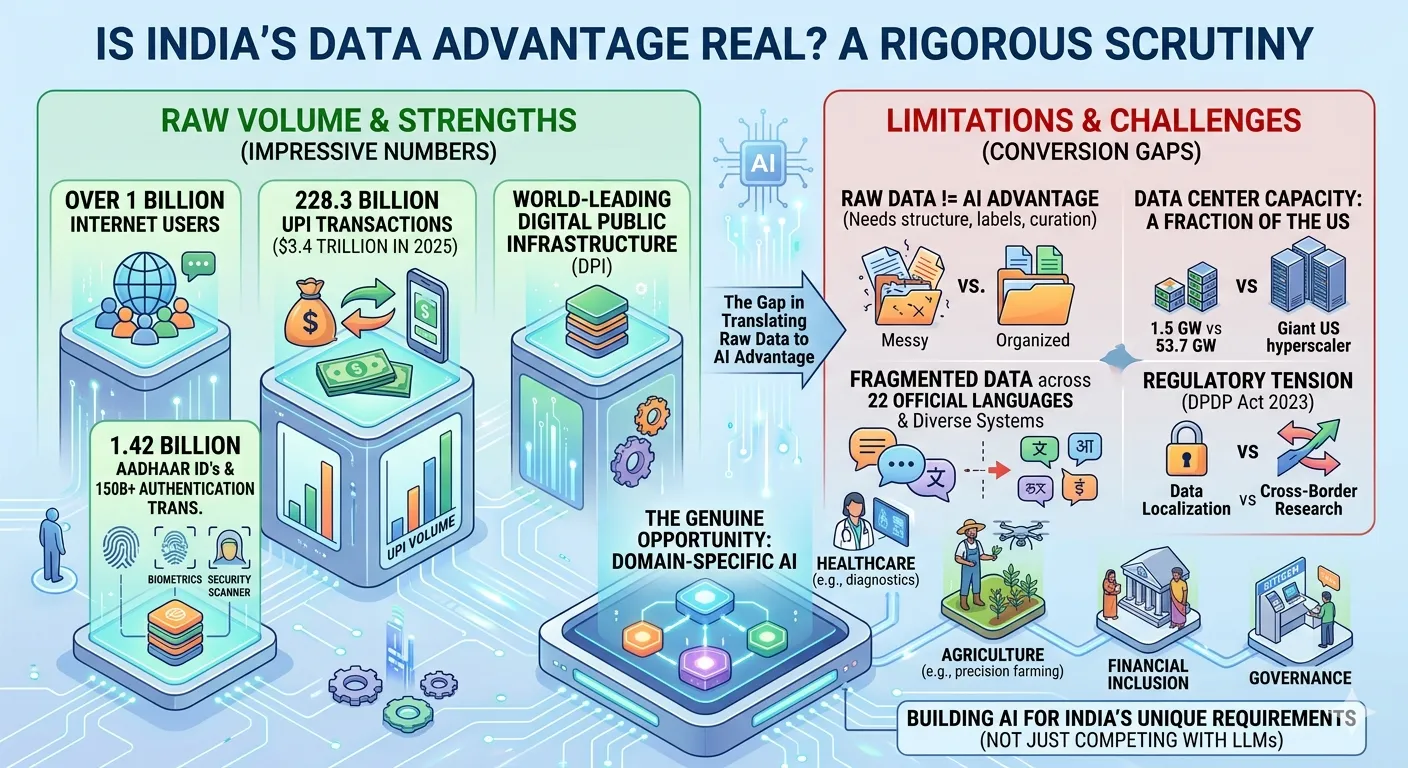
The question of whether India possesses a meaningful data advantage deserves rigorous scrutiny rather than the reflexive optimism it typically receives. The raw numbers are impressive: over one billion internet users, 228.3 billion UPI transactions worth approximately $3.4 trillion in 2025, and 1.42 billion Aadhaar biometric identities generating over 150 billion authentication transactions. India’s Digital Public Infrastructure stack is genuinely world leading. However, raw data volume does not automatically translate into AI training advantage. Data must be structured, labelled, curated, and made accessible through adequate compute infrastructure. India’s data centre capacity of approximately 1.5 gigawatts represents a fraction of the 53.7 gigawatts deployed in the United States. The tension between data localisation requirements under the Digital Personal Data Protection Act of 2023 and the need for cross border research collaboration remains unresolved. India’s data is fragmented across 22 official languages and diverse systems. The genuine opportunity lies not in competing with American hyperscalers on large language models but in building domain specific and linguistically diverse AI systems that serve India’s unique requirements in healthcare, agriculture, financial inclusion, and governance.
The concentration of cognitive advantage poses the starkest challenge. Less than three percent of global AI investment and startup activity originates in the Global South, despite its majority share of world population. The frontier of AI development is concentrated in a handful of American cities. India occupies an unusual position: it ranks third globally in AI competitiveness according to the Stanford AI Vibrancy Index, produces the second largest number of GitHub AI project contributions, and possesses 50,460 top AI authors and inventors, the second largest pool globally. Yet it suffers the world’s largest net outflow of AI research talent, with a brain drain index of negative 16.9. Forty two of the 2025 Forbes AI50 startups were founded or co founded by Indian immigrants. India generates AI talent at scale but haemorrhages it to the very nations it seeks to compete with.
What India’s national leadership must do now
India’s approach to AI governance has thus far been deliberately light touch, eschewing standalone legislation in favour of voluntary, nonbinding guidelines released in November 2025 under seven foundational principles. This posture reflects a conscious prioritisation of innovation over regulatory certainty and stands in deliberate contrast to the European Union’s prescriptive AI Act. While this approach has merit in avoiding premature regulation that could stifle a nascent ecosystem, it carries risks. The allocation of just Rs 20.46 crore for Safe and Trusted AI within the IndiaAI Mission budget is negligible relative to the scale of deployment risks. India must develop a tiered, risk based governance framework that protects democratic institutions and individual rights without strangling innovation. India’s presidency of the G20 in 2023 and its hosting of the AI Impact Summit in February 2026, the first major AI summit in the Global South, have given New Delhi credibility as a norm shaper. Prime Minister Modi’s assertion at the G20 Johannesburg summit that “AI governance must not become a club of rich nations defining rules for the rest” articulates a principle that India must now operationalise through institutional capacity, not merely diplomatic rhetoric.
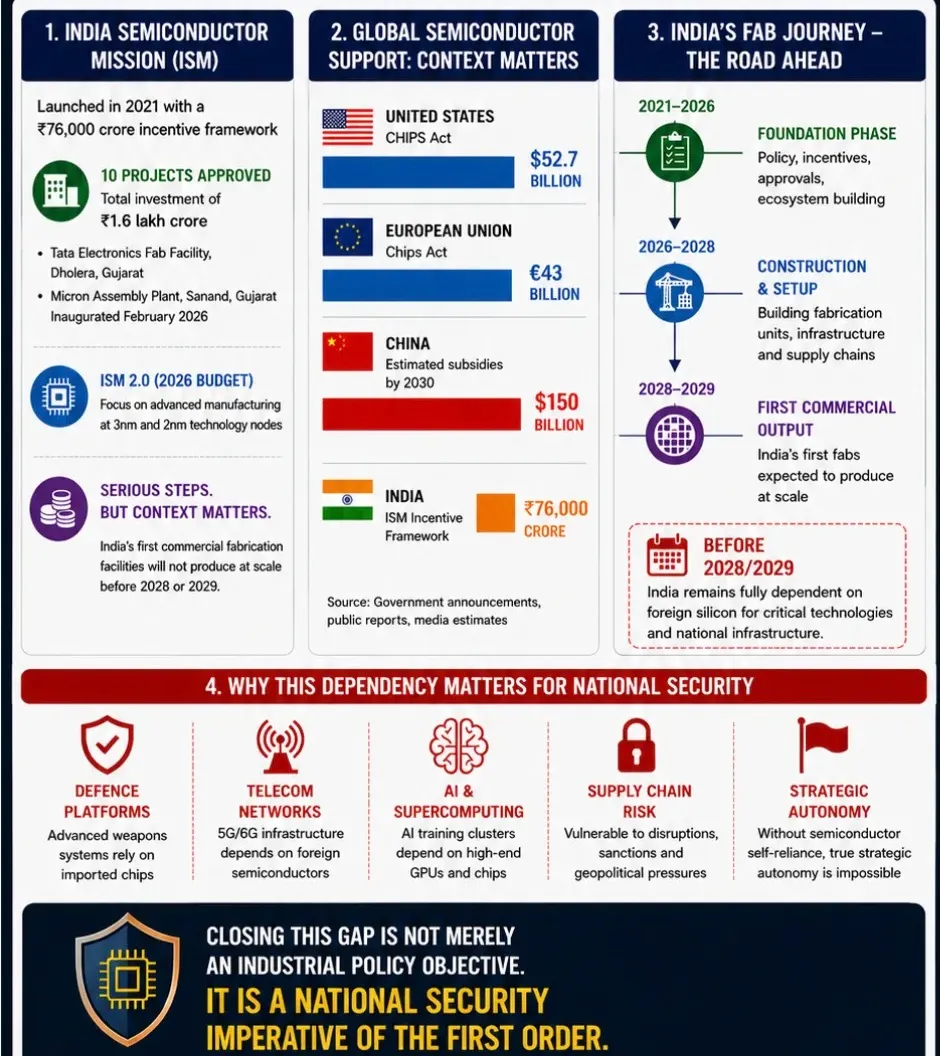
India’s semiconductor dependency constitutes its most acute strategic vulnerability. The country imports approximately 90 to 95 percent of its semiconductor requirements, spending over $25 billion annually on chip imports, with China as the single largest supplier in most years. The India Semiconductor Mission, established in 2021 with a Rs 76,000 crore incentive framework, has approved ten projects worth Rs 1.6 lakh crore, including the Tata Electronics fabrication facility in Dholera, Gujarat, and the Micron assembly plant in Sanand inaugurated in February 2026. The ISM 2.0, announced in the 2026 budget, aims for advanced manufacturing at 3nm and 2nm technology nodes. These are serious steps. But context matters: the American CHIPS Act mobilised $52.7 billion, the European Union’s Chips Act directed 43 billion euros, and China’s semiconductor subsidies are estimated to reach $150 billion by 2030. India’s first commercial fabrication facilities will not produce at scale before 2028 or 2029. Until then, every advanced weapons system, telecommunications network, and AI training cluster in India depends on foreign silicon. Closing this gap is not merely an industrial policy objective. It is a national security imperative of the first order.
The IndiaAI Mission’s budget of Rs 10,372 crore over five years represents approximately $1.25 billion, a figure that must be evaluated honestly. It is roughly one fortieth of the American CHIPS Act alone and a fraction of France’s recently announced $112 billion AI investment commitment. The mission has achieved meaningful results: approximately 40,000 subsidised GPUs deployed at $0.71 per hour (among the lowest globally for research grade compute), indigenous large language models including BharatGen and Sarvam 1, and expanded AI curricula. India ranked first globally in AI skill penetration at three times the global average. Yet the gap between aspiration and investment remains vast. India’s AI diffusion rate of 15.7 percent trails China, Japan, and Singapore. The mission’s startup financing allocation of Rs 1,942 crore lacks clear mechanisms for whether funding will take the form of grants, equity, or loans. A country that aspires to be a pole in a multipolar AI world cannot achieve that ambition with one fortieth of a competitor’s investment in a single programme.
India’s unique value proposition in the AGI era lies precisely at the intersection of its democratic credentials, its Digital Public Infrastructure achievements, and its Global South leadership. India is the only nation that combines the scale of a potential superpower with functioning democratic institutions, a world leading digital payments and identity infrastructure, and the legitimacy to speak for the developing world. The Global Digital Public Infrastructure Repository, cataloguing 54 AI ready digital public infrastructures from 16 countries, is a distinctly Indian contribution to global AI governance. India’s advocacy for inclusive, representative, and democratically governed AI frameworks offers an alternative to both the American model of corporate self governance and the Chinese model of state directed deployment. The One Future Alliance proposed by India for responsible AI governance, alongside the International Solar Alliance and the Coalition for Disaster Resilient Infrastructure, demonstrates the institutional imagination that middle powers must exercise
The One Future Alliance proposed by India for responsible AI governance, alongside the International Solar Alliance and the Coalition for Disaster Resilient Infrastructure, demonstrates the institutional imagination that middle powers must exercise when great power competition threatens to exclude the majority of humanity from the decisions that will shape their future.
The window for action is narrow. AGI will not wait for India’s semiconductor fabs to come online or for its bureaucratic processes to produce comprehensive legislation. Every month of delay increases India’s dependence on foreign compute, foreign models, and foreign strategic choices. The demographic dividend that was supposed to carry India to 2047 may instead become a demographic burden if millions of knowledge workers find their cognitive labour automated before alternative employment pathways exist. India must treat AI sovereignty with the same urgency it brought to nuclear sovereignty in the 1990s: as a matter of existential national importance that demands political will, institutional innovation, and resource commitment commensurate with the scale of the challenge. The alternative is a future where India’s strategic autonomy is nominal, its economic growth constrained by foreign gatekeepers of intelligence, and its billion citizens spectators to a technological revolution shaped entirely by others.
Colonel Anand Bajpai
Indian Army Officer · Strategic Affairs & Artificial Intelligence Researcher
Colonel Anand Bajpai is a decorated Infantry Officer of the Indian Army with over twenty years of distinguished service. He has conducted net assessments of 47 nations, led India-China flag meetings during the Doklam Crisis in 2017, and served in United Nations peacekeeping operations in the Democratic Republic of Congo.
Colonel Bajpai is currently pursuing a Master of Science in Applied Artificial Intelligence from the University of San Diego and has completed the Leadership in AI programme at ISB Hyderabad. He also holds a Post Graduate Diploma in Cyber Law from the National Law University, Bhopal (CGPA 9.0), a Master’s in Defence & Strategic Studies from Madras University, and a Master of Management Studies from Osmania University.
He is the author of Unautomate and has served as Directing Staff in the Strategic Management Department at the College of Defence Management, Secunderabad. His work focuses on artificial intelligence, future warfare, geopolitics, strategic leadership, and emerging security challenges shaping the global order.