
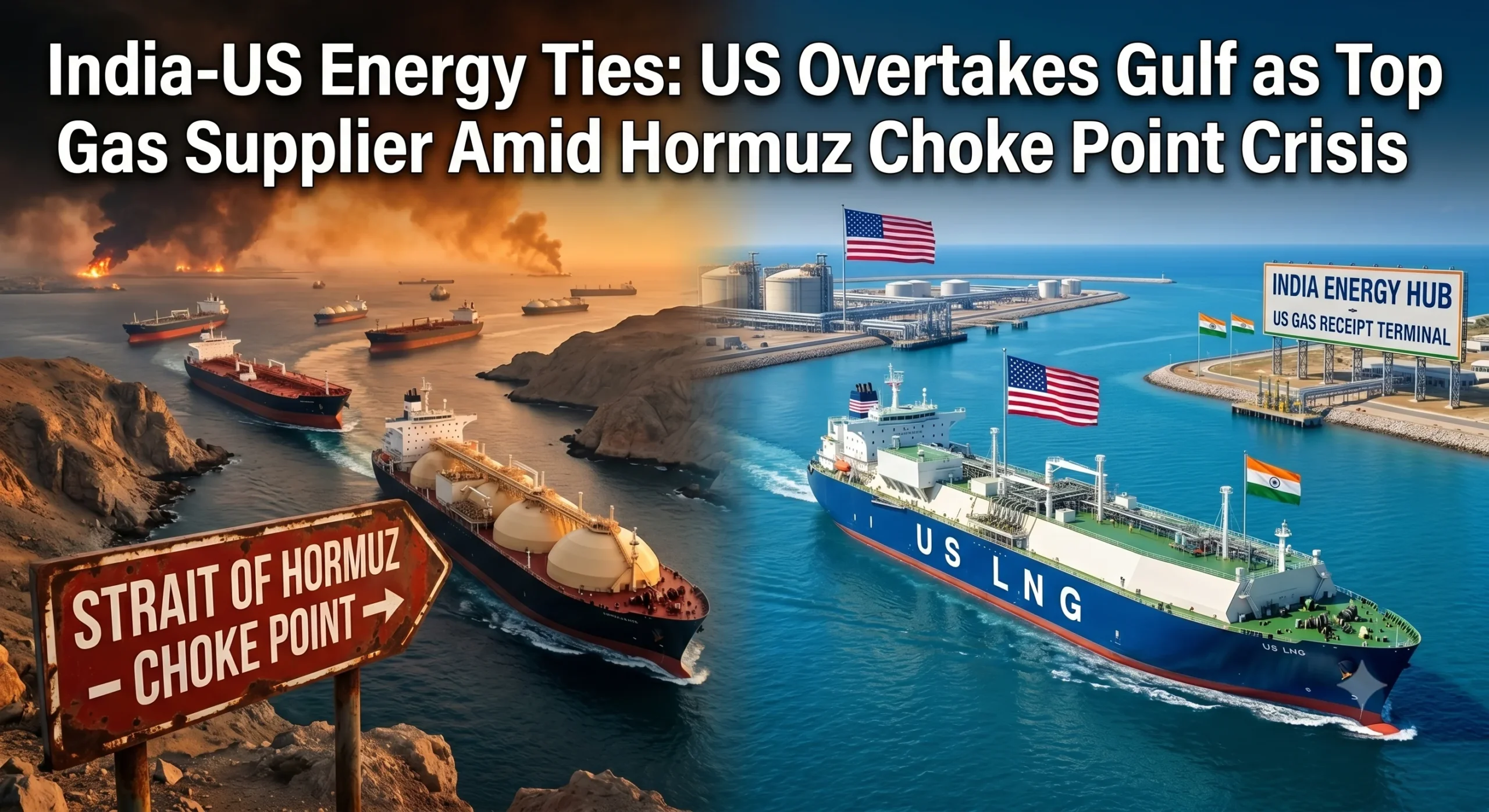
Washington, D.C/New Delhi, JUNE 11, 2026: India-US energy ties have undergone a fundamental structural realignment as ongoing military hostilities in West Asia force a major reshaping of New Delhi’s import architecture. The constriction of shipping lanes through the Strait of Hormuz since late February has forced state-run oil marketing companies to aggressively re-route procurement, positioning Washington as India top gas supplier for both liquefied natural gas (LNG) and liquefied petroleum gas (LPG) throughout the month of May. This commercial pivot highlights a broader shift in bilateral relations, transforming a legacy export-heavy trade surplus into an economic matrix centered on energy and technology supply chains.
The constriction of shipping lanes through the Strait of Hormuz since late February has forced state-run oil marketing companies to aggressively re-route procurement. This commercial pivot highlights a broader structural shift in India-U.S. relations, transforming a legacy export-heavy trade surplus into a strategically balanced economic matrix centered on energy and technology supply chains.
The May Supply Reordering: Key Data Points
Data compiled from port tracking services and energy intelligence firm Kpler outlines an unprecedented drop in standard short-haul volumes and a corresponding surge in Atlantic basin deliveries.
Core Trade Volumes (May 2026)
- U.S. LNG Shipments: Reached 900,000 tonnes, covering over 41 per cent of India’s total natural gas import requirements for the month. This marks a threefold increase compared to April.
- U.S. LPG Deliveries: Scaled to 630,000 tonnes, outstripping the combined volume of 380,000 tonnes received from all Middle Eastern Gulf nations during the same period.
- The Qatari Disruption: Qatar, which historically fulfilled nearly half of India’s natural gas import requirements, recorded zero shipments to Indian terminals for the second consecutive month.
- Middle East Drawdowns: Total LPG intake from Saudi Arabia fell by 75.5 per cent to 45,000 tonnes, while UAE volumes dropped to 100,000 tonnes.
The reliance on high-cost spot cargoes coincided with a sharp spike in domestic power consumption. Heatwave conditions pushed India’s peak electricity demand to a record 270 GW in May, requiring the Ministry of Power to place all gas-fired generation plants on active standby. Financial brokerage Nomura noted that total U.S. gas exports to India have expanded eightfold from pre-conflict baselines.
Operational Bypasses: Strengthening India-US Energy Ties Amid Maritime Realities
To sustain crude and gas processing baselines, Indian refiners are deploying logistical workarounds to bypass the volatile maritime chokepoint entirely.
| Component | Sourcing & Routing Mechanism |
| Outside-Hormuz Sourcing | Indian Oil Corporation (IOC) and Hindustan Petroleum Corporation Ltd (HPCL) are drawing Abu Dhabi National Oil Company (ADNOC) grades directly from terminals outside the Persian Gulf, located at Fujairah (Gulf of Oman) and Sohar (Oman). |
| Off-take Terms | Ship-to-ship (STS) transfers are being executed on a Free-On-Board (FOB) basis to insulate domestic shipping lines from risk. |
| Long-Haul Freight | U.S. spot cargoes are routing entirely via the Cape of Good Hope to avoid the Red Sea corridor. This adds 10 days to the voyage, extending transit to 31–35 days and carrying significant freight premiums. |
Recent spot market clearing highlights the premium Indian buyers are paying for continuity. HPCL recently secured 4 million barrels of UAE Murban crude for August delivery via international trading desks at a premium of approximately 40 cents per barrel over the July Dated Brent benchmark. Additionally, 2 million barrels have been contracted from Brazil and West Africa to feedstock newly expanded inland refining infrastructure.
Macroeconomic Alignment and Tariff Adjustments
This sudden increase in energy procurement serves a secondary geopolitical purpose, balancing the bilateral trade equation with Washington. A recent institutional assessment by the Institute for Energy Economics and Financial Analysis (IEEFA) notes that India-U.S. bilateral trade crossed USD 140 billion in the latest fiscal cycle.
While trade volumes have fluctuated, the sustained growth in procurement of American shale products is the primary driver reinforcing India-US energy ties in the current fiscal cycle. Imports from the U.S. grew by 17.2 per cent, reaching USD 53.5 billion. This rebalancing follows the five-year Bilateral Trade Agreement (BTA) framework targeting USD 500 billion in American purchases.
Bilateral Tariff Negotiations: The energy import surge has directly influenced trade policy. U.S. tariffs on Indian goods, which spiked to 50 per cent in 2025 due to protectionist measures and changes to the Inflation Reduction Act, were negotiated down to 18 per cent in early 2026. Trade analysts attribute this concession to New Delhi’s expanded intake of U.S. shale products.
The Strategic Balance Sheet
The supply chain integration was further cemented during U.S. Secretary of State Marco Rubio’s diplomatic visit to New Delhi in late May. The visit finalized a dedicated bilateral pact on critical minerals and rare earths, integrating India into Western-aligned technology frameworks including the TRUST Initiative, FORGE, and Pax Silica to secure upstream feedstocks for the semiconductor and defence sectors.
However, the transition introduces a distinct strategic paradox for Indian planners. By substituting volatile Persian Gulf routes with long-haul Atlantic supply chains, India reduces its immediate vulnerability to West Asian maritime blockades but ties its industrial feedstocks and domestic fuel pricing structures directly to U.S. domestic policy, infrastructure choices, and potential tariff adjustments.
With domestic strategic LPG reserves sitting at a thin operational buffer of under two days, the medium-term challenge for New Delhi rests on leveraging these secured imports to rapidly scale up domestic deepwater gas extraction and sovereign storage infrastructure.
Ultimately, the stability of these India-US energy ties will hinge on whether New Delhi can successfully pair its new reliance on Atlantic supply chains with a robust expansion of domestic sovereign storage and deepwater extraction capabilities.