
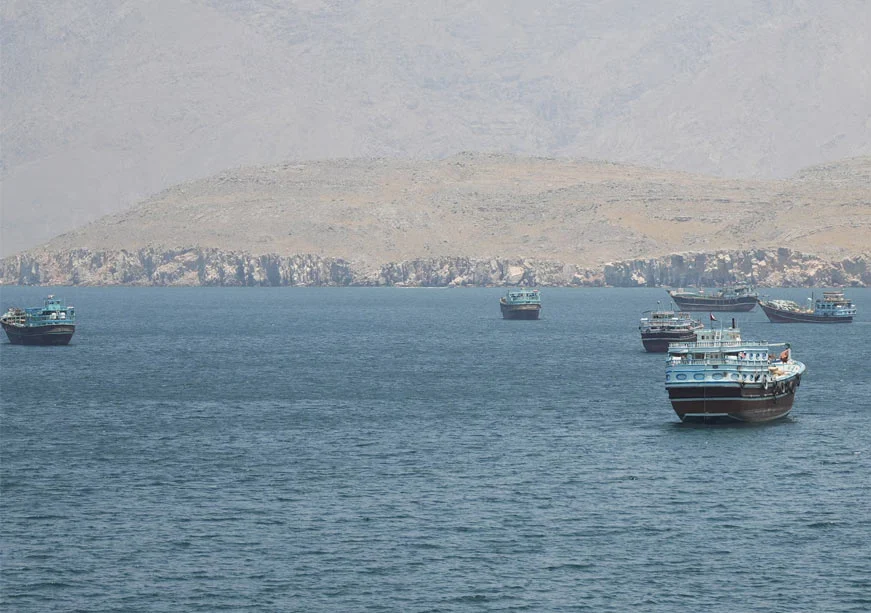
Twenty-one nautical miles of open water dictate the financial heartbeat of modern industry. Every single day, approximately 20.5 million barrels of crude, condensate, and petroleum products traverse the narrow waterway separating the Musandam Peninsula from the Iranian coastline. Yet, as talk of direct conflict intensifies across international desks, the most immediate threat of a Strait of Hormuz oil disruption is not a physical blockade enforced by a conventional armada. Rather, it is the silent, lethal arithmetic of merchant reinsurance, asymmetric anti-ship warfare, and immediate supply shocks to Asian refineries.
Recent operational warnings highlighted in military intelligence assessments by the Institute for the Study of War (ISW) and breaking field disclosures from CBS News confirm that regional naval corridors are entering an acute grey-zone escalation. While retail financial desks track daily fluctuations in the crude oil price today, institutional desks at The Eastern Strategist are monitoring the secondary industrial mechanics: tanker charter day-rates, hull war-risk premiums, and the severe limitations of overland bypass conduits across Saudi Arabia.
The Asymmetric Choke Point: IRGCN Naval Doctrine versus Conventional Fleets
Direct Strategic Assessment: Iran does not require blue-water naval parity to trigger a severe Strait of Hormuz oil disruption. By deploying swarms of Fast Inshore Attack Craft (FIAC), smart naval mines, coastal radar-guided cruise missiles, and loitering munitions, the Islamic Revolutionary Guard Corps Navy can turn the two-mile-wide outbound shipping lane into an uninsurable commercial kill-zone.
Conventional military planning often commits the fatal error of measuring naval balance through displacement tonnage and carrier strike group counts. In the constrained, shallow waters of the Persian Gulf, acoustic reverberations and narrow navigation channels neutralize traditional naval superiorities. The Islamic Revolutionary Guard Corps Navy (IRGCN), operating independently from Iran’s conventional fleet, has spent four decades refining an asymmetric coastal doctrine tailored specifically to engineer a severe Strait of Hormuz oil disruption through commercial shipping paralysis.
This doctrine rests on three operational pillars. First, hundreds of fast attack craft equipped with multiple-launch rocket systems and light anti-ship missiles operate from hidden inlets along the rugged Iranian coastline. Second, mobile land-based anti-ship cruise missile (ASCM) launchers, including the radar-guided Noor and Ghader variants, can blanket the entirety of the 21-nautical-mile strait from concealed inland mountain silos. Third, bottom-laid acoustic and magnetic naval mines present an invisible, lingering threat that naval sweepers require months to clear under hostile fire.
Consequently, any escalation in the broader regional theatre instantly converts the strait into an uninsurable navigation trap. Even without sinking a supertanker, periodic warning shots, boarding seizures, and drone strikes demonstrate that a tangible Strait of Hormuz oil disruption can be executed at negligible financial cost to Tehran, while imposing astronomical costs on international maritime trade.
The Lloyd’s Multiplier: How War-Risk Insurance Triggers a Strait of Hormuz Oil Disruption
The Financial Reality: Global commercial shipping runs entirely on London and Scandinavian maritime insurance syndicates. When the Joint War Committee expands high-risk zones, additional war-risk premiums and hull insurance surge exponentially, making tanker chartering financially prohibitive long before a single shot is fired at merchant hulls.
Markets often assume that physical missile attacks are required to halt petroleum traffic. In reality, maritime commerce halts in boardroom negotiations in London. The Lloyd’s Market Association Joint War Committee (JWC) designates designated high-risk maritime areas. Once a body of water is red-flagged, shipowners are legally required to notify underwriters before entering, triggering mandatory Additional Premiums (AP).
In peacetime conditions, war-risk insurance represents a nominal fraction—often 0.02% to 0.05%—of a vessel’s hull and machinery (H&M) value. During periods of heightened friction in the Gulf, underwriters rapidly hike these rates to 0.5% or even 1.0% per single seven-day voyage. For a modern Very Large Crude Carrier (VLCC) valued at $120 million, a 1% additional premium imposes an instantaneous $1.2 million penalty per transit, excluding hazard pay for crews and soaring bunker fuel surcharges.
When charterers refuse to absorb these punitive costs, shipowners simply halt vessel charters or demand astronomical demurrage rates, illustrating how insurer risk models alone can generate a de facto Strait of Hormuz oil disruption. This economic mechanism transforms a localized security skirmish into an instantaneous spike in the international oil price, demonstrating how systemic vulnerabilities in financial underwriting can precipitate a devastating Strait of Hormuz oil disruption across consumer economies worldwide.
Bypass Pipelines: The Illusion of Strategic Redundancy
Infrastructure Constraint: While Saudi Arabia and the United Arab Emirates operate overland pipelines terminating outside the Persian Gulf, their combined unused spare capacity totals barely 3.2 to 3.5 million barrels per day. This leaves over 17 million barrels per day entirely trapped in the event of an extended maritime blockade.
Energy analysts frequently point to pipeline diversification as an antidote to any prospective Strait of Hormuz oil disruption. A granular examination of Middle Eastern physical infrastructure reveals that this redundancy is largely an illusion. The two primary bypass mechanisms are the Saudi Petroline and the UAE’s Habshan-Fujairah pipeline.
Saudi Aramco operates the 1,200-kilometre East-West Crude Oil Pipeline (Petroline), running from Abqaiq in the Eastern Province to the Red Sea port of Yanbu. While its expanded nameplate rating reaches roughly 5.0 million barrels per day, the pipeline already operates at substantial baseload capacity to supply domestic Red Sea refineries and long-term European export commitments. Consequently, its net incremental spare diversion capacity is capped at approximately 2.0 to 2.5 million barrels per day.
Similarly, the Abu Dhabi Crude Oil Pipeline (ADCOP) transports Murban crude from Habshan to the Indian Ocean port of Fujairah, bypassing Hormuz entirely. Yet its maximum operating throughput is strictly constrained to 1.5 million barrels per day, of which at least 0.7 million barrels are consistently utilized under normal operating conditions. Qatar, Bahrain, Kuwait, and southern Iraqi fields have zero overland bypass options; 100% of their maritime output must clear Hormuz.
In total, existing regional pipelines can re-route at best 3.5 million barrels per day under emergency conditions. Should an unmitigated Strait of Hormuz oil disruption occur, an unavoidable physical deficit of over 16 to 17 million barrels per day would instantaneously hit international supply chains, triggering an uncontrollable global inventory shock.
| Bypass Pipeline Asset | Origin / Terminal Route | Nameplate Capacity | Estimated Spare Capacity |
|---|---|---|---|
| East-West Petroline (Saudi Aramco) | Abqaiq to Yanbu (Red Sea) | 5.0 mbpd | ~2.2 mbpd |
| ADCOP Pipeline (ADNOC) | Habshan to Fujairah (Gulf of Oman) | 1.5 mbpd | ~0.8 mbpd |
| Iraq-Turkey Pipeline (ITP) | Kirkuk to Ceyhan (Mediterranean) | 0.5 mbpd (Intermittent) | <0.2 mbpd (Legal disputes) |
| Goreh-Jask Pipeline (Iran) | Goreh to Jask (Gulf of Oman) | 0.3 mbpd | Negligible / Operational Limits |
The Indian Vulnerability Index: SPR Limitations and Refining Arithmetic
India’s Critical Exposure: Over 50% of India’s crude imports and nearly 70% of its imported Liquefied Natural Gas (LNG) transit the Strait of Hormuz. With India’s Phase-1 Strategic Petroleum Reserve holding just 5.33 million metric tonnes (approximately 9.5 days of net import cover), any sustained transit disruption poses an immediate fiscal and macro-economic crisis.
For India, navigating an acute Strait of Hormuz oil disruption is not an academic geopolitical scenario; it is an existential economic hazard. As documented extensively across The Eastern Strategist Geopolitical Risk Desk, India imports over 87% of its total crude requirements. Despite recent increases in Russian seaborne intake via Urals crude delivered through the Baltic and Black Seas, Middle Eastern grades remain the structural bedrock of India’s coastal public and private refiners.
Heavy and medium sour grades from Iraq, Saudi Arabia, and the UAE are metallurgically essential for the high-complexity catalytic cracking units operated by Indian Oil Corporation Limited (IOCL), Bharat Petroleum Corporation Limited (BPCL), and Reliance Industries at Jamnagar. Substituting these specific crude assays with lighter sweet crude on short notice causes severe operational inefficiencies, lower diesel recovery rates, and acute feedstock mismatches.
Moreover, India’s sovereign emergency cushion remains remarkably lean. The Indian Strategic Petroleum Reserves Limited (ISPRL) manages three underground unlined rock caverns at Visakhapatnam (1.33 MMT), Mangalore (1.50 MMT), and Padur (2.50 MMT). Combined, these caverns store approximately 5.33 million metric tonnes of crude, providing barely 9.5 days of net import cover. While commercial storage across state oil marketing companies (OMCs) and pipeline inventory provides an additional 64 days of buffer, physical delivery to refineries during an active Persian Gulf crisis remains vulnerable to coastal tanker availability.
On the naval front, the Indian Navy has maintained an unbroken presence in the Gulf of Oman and Persian Gulf since mid-2019 under Operation Sankalp. Indian guided-missile destroyers, including frontline Project 15A and 15B warships, regularly escort Indian-flagged merchantmen. However, in the event of unrestricted asymmetric missile salvos or unmapped minefields, military convoys cannot fully insulate commercial vessels against crippling maritime insurance denial, leaving India directly exposed to an inevitable Strait of Hormuz oil disruption.
The Macroeconomic Fallout: Rupee Depletion and Refining Margins
Fiscal Repercussions: Every sustained $10 per barrel increase in crude oil prices expands India’s current account deficit by approximately 0.5% of GDP, exerts direct downward pressure on the Indian Rupee against the US Dollar, and forces the Ministry of Finance to either absorb retail fuel excise losses or fuel domestic inflation.
The macroeconomic transmission mechanism of an extended Strait of Hormuz oil disruption is swift and merciless. When maritime transit is challenged, the immediate spike in freight, demurrage, and benchmark crude prices impacts state oil marketing companies first. If crude climbs sustainably above $90–$100 per barrel during a Strait of Hormuz oil disruption, state refiners face sharp margin compression, as retail fuel pricing in India is politically constrained from fully passing on immediate import spikes.
Simultaneously, India’s trade deficit swells. As petroleum imports consume an outsized share of foreign exchange outlays, currency reserves are drained to defend the rupee from acute depreciation. For institutional investors navigating Indian markets, energy supply shocks trigger an immediate flight from import-dependent consumer discretionary and manufacturing sectors, while elevating domestic exploration and production operators like ONGC and Oil India.
Furthermore, the crisis extends beyond liquid petroleum to fertilizer and food security. The Persian Gulf is the dominant conduit for India’s imported urea, di-ammonium phosphate (DAP), and liquefied natural gas (LNG), compounding the domestic fallout of any Strait of Hormuz oil disruption. A naval blockade instantly disrupts feedstocks for domestic ammonia-urea complexes, forcing the government to balloon agricultural fertilizer subsidy outlays by tens of thousands of crores to protect crop yields.
Strategic Scenarios: What Happens Next?
Horizon Forecast: Over the coming 90 days, the most probable risk vector is not an outright naval blockade, but a calibrated campaign of merchant vessel interdictions, electronic spoofing, and drone harassment designed to trigger maximum economic leverage without inciting full-scale carrier combat.
Examining operational precedents and current fleet deployments points to three distinct escalation trajectories for the Persian Gulf corridor:
Scenario 1: Controlled Grey-Zone Harassment (65% Probability). Under this baseline, partial threats of a Strait of Hormuz oil disruption linger through periodic drone interceptions, GPS spoofing, and selective boardings of Western-linked tankers. This tactical friction sustains elevated war-risk insurance premiums, adds $8 to $12 per barrel in geopolitical risk premium to global crude, but allows baseline transit volumes to continue under heightened naval escorts.
Scenario 2: Asymmetric Mine and Drone Interdiction (25% Probability). A severe Strait of Hormuz oil disruption materialises through the deployment of smart drifting mines and coordinated loitering munition strikes against oil infrastructure in the Gulf of Oman and Bab-el-Mandeb. Commercial insurers formally cancel standard coverage, reducing Hormuz throughput by 40% to 50% as unescorted merchant shipping refuses passage.
Scenario 3: Unrestricted Choke Point Warfare (10% Probability). Direct strikes against regional loading terminals (Ras Tanura, Das Island, Kharg Island) and extensive mine-laying across the strait. This leads to an immediate cessation of commercial tanker operations, triggering an unprecedented Strait of Hormuz oil disruption that drives crude well beyond historic peaks and forces emergency releases from global IEA strategic petroleum reserves.
In all scenarios, the fundamental lesson for New Delhi and global energy planners is unambiguous: relying on reactive diplomatic mediation or carrier patrols is no substitute for physical infrastructure diversification. Accelerating the Phase-2 commercial caverns at Chandikhol and Padur, expanding bilateral rupee-dirham trade settlements, and securing non-Gulf seaborne energy corridors are no longer long-term aspirations—they are immediate national security imperatives.
Frequently Asked Questions Regarding Strait of Hormuz Disruptions
Approximately 20.5 million barrels per day of crude, condensate, and refined petroleum products transit the Strait of Hormuz, representing roughly 20% to 21% of total global petroleum liquids consumption and nearly one-third of all seaborne traded oil.
No. While Saudi Arabia operates the East-West Petroline (5.0 mbpd capacity) and the UAE operates the Habshan-Fujairah pipeline (1.5 mbpd capacity), both are partially utilized under routine conditions. Their combined emergency spare capacity is only 3.2 to 3.5 million barrels per day, leaving over 16 million barrels per day completely dependent on the maritime strait.
India’s Phase-1 Strategic Petroleum Reserve (SPR) stores approximately 5.33 million metric tonnes of crude across caverns in Visakhapatnam, Mangalore, and Padur, providing roughly 9.5 days of net crude import cover. When combined with commercial OMC depot storage and pipeline inventories, India possesses approximately 74 days of domestic petroleum cover.