
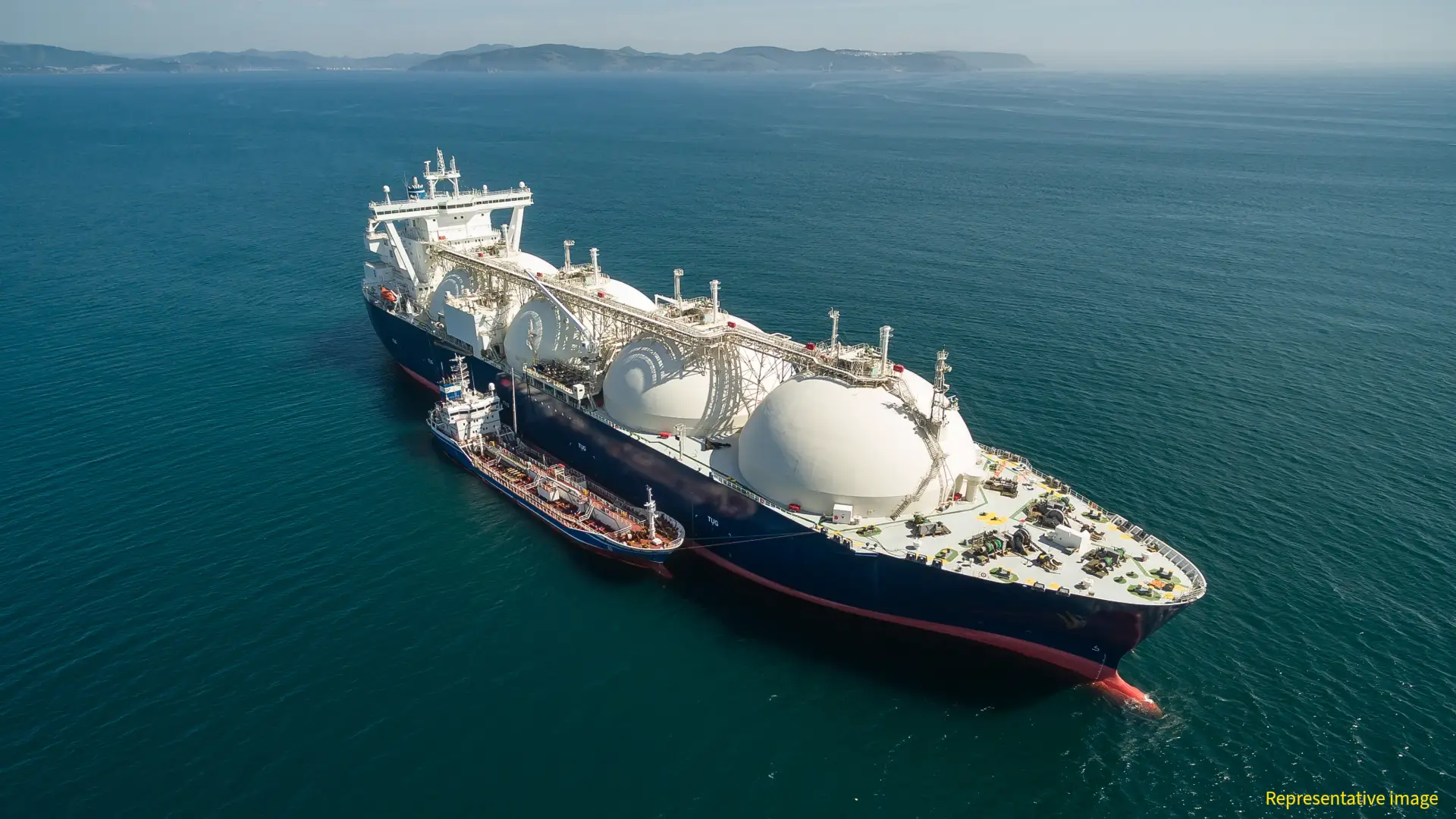
LPG imports through Hormuz are where India’s energy exposure sits, and crude oil is the smaller part of it. The Ministry of Petroleum and Natural Gas has said India imports about 60 per cent of the LPG it consumes, and that about 90 per cent of those imports normally pass through the Strait of Hormuz. By the ministry’s March count, about 70 per cent of crude imports already arrived by other routes.
That gap decides how much the Qatar-mediated talks matter to an Indian kitchen. On 31 October, Iran’s Foreign Minister Abbas Araghchi said the time needed to reopen the strait had been cut to two days, provided Washington meets Iran’s conditions. The timeline is Iran’s claim.
US Secretary of State Marco Rubio said the same day that talks had never stopped and that President Donald Trump had not decided on further military action. For New Delhi the useful question is narrower: what happens to LPG imports through Hormuz under each outcome.
Why LPG Imports Through Hormuz Expose India More Than Crude Does
Crude has substitutes. India buys from about 40 countries, and the ministry said in March that roughly 70 per cent of crude arrived by routes avoiding the strait. LPG has fewer. The Observer Research Foundation (ORF) estimated in March that about 54 per cent of India’s normal LPG availability was directly exposed to a shut corridor, which is simply 90 per cent of the 60 per cent that is imported, as set out in the ministry’s March briefing.
ORF’s illustration of LPG imports through Hormuz puts normal supply at an index of 100: 40 units from domestic refineries, 54 from Hormuz imports and 6 from other imports. A 25 per cent rise in domestic output lifts the first figure to 50 and leaves the system near 56 before emergency cargoes and demand compression. That is a March starting scenario, and the sections below show how far the response has moved since.
Figure: LPG imports through Hormuz as a share of India’s supply, indexed. Source: ORF, March 2026 (illustrative scenario, not a forecast).
Price models miss this channel. ORF’s May study of inflation modelled prices and said plainly that it does not capture the physical unavailability of LPG and natural gas, which no price adjustment resolves. The same study lists LPG’s import share at 60.3 per cent against 0.1 per cent for diesel, which is why petrol and diesel queues were never the risk and cylinder bookings were.
India Held Cylinder Supply by Raising Output and Widening Sources
Petroleum Minister Hardeep Singh Puri said on 27 October that domestic LPG production had risen from 34,000 to 55,000 tonnes a day and that import sources had widened to 41 countries, with the United States and Algeria among them. He said domestic cylinders never became unavailable, even though LPG imports through Hormuz were disrupted by the closure of the strait. That is an official statement, and it describes a response that moved in months, not years.
Demand behaved differently from supply. Cylinder indents rose to nearly 90 lakh a day against a normal 51 to 52 lakh, Puri said, and bookings fell after enforcement drives in which authorities seized cylinders. The earlier phase was sharper: trade data for the week to 19 March showed Middle East cargoes at 34 per cent of India’s weekly LPG imports, the lowest since January, while state-owned carriers Shivalik and Nanda Devi completed transits of the strait. Oil marketing companies had also secured a term tender for 2.2 million tonnes of US-origin LPG for 2026, about four very large gas carriers a month.
Independent estimates add a caution. Kpler analysts expect India’s LPG demand to fall by about 100,000 barrels a day in 2026, with a partial rebound of about 60,000 barrels a day in 2027, according to market reports. TES assesses that the two statements fit together: supply can hold while consumption adjusts to price, rules and the shift to piped gas. TES examined that household trade-off in its PNG versus LPG analysis.
Doha’s Two-Day Reopening Is an Iranian Claim, and the Mine Reports Are Its Test
Araghchi’s two days compress a plan Iran put forward in New York in September, under which the strait would open on day six of a seven-day process. His conditions include lifting sanctions imposed after the Islamabad memorandum, reducing US forces in the region, restoring oil waivers and releasing frozen funds, including money held in Qatar. Parliament Speaker Mohammad Bagher Ghalibaf, Iran’s chief negotiator, has cited seven conditions without publishing all of them.
Security chief Mohsen Rezaei said on 31 October that nuclear talks and any reopening depend on Washington accepting Iran’s demands. Washington, as reported, wants the strait open and nuclear concessions in the same package. Neither side has moved on sequencing, so LPG imports through Hormuz stay tied to a deal for which the two-day claim has no US confirmation.
A separate risk sits on the calendar. MS NOW reported on 30 October, citing three senior Gulf officials, that Washington has told Gulf allies to prepare for a short, intense round of strikes as early as 4 November, the day after the US midterms. The White House did not confirm it, and Secretary Rubio said President Trump had not decided.
What a Doha Deal Would Change for LPG Imports Through Hormuz
Between 29 and 30 October, the Islamic Revolutionary Guard Corps (IRGC) Navy said four tankers had caught fire after striking mines on what it called an unauthorised southern route. The US Central Command (CENTCOM) said minesweeping had cleared the main lanes and denied any IRGC presence in the strait. The UK Maritime Trade Operations centre separately reported a projectile strike on a tanker south of Lavan Island. TES treats the mine reports as unverified claims.
The route dispute is the practical point. Araghchi said Iran also wants recognition of shipping routes it discussed with Oman, and the closure of other routes. TES assesses that a reopening on paper could therefore still leave LPG imports through Hormuz exposed to two route regimes that Washington and Tehran define differently, with insurers deciding which lane is usable.
Iran’s Strait Authority Puts Sanctions Risk on Indian Shipowners Who Pay Its Fees
Iran created the Persian Gulf Strait Authority on 5 May 2026 to approve transits and collect fees, working with the IRGC Navy, a regime Iran intends for any vessel, including those carrying LPG imports through Hormuz. The US Treasury designated the body at the end of May and warned that parties paying it may face sanctions exposure. The designation is a US measure, and India has not adopted it as its own position.
The exposure still reaches Indian owners and insurers, because a US designation travels through banks and underwriters whether or not New Delhi recognises it. ORF noted that India had opened bilateral talks with Iran on safe passage for Indian-flagged vessels. TES assesses that a fee regime would put that channel in direct tension with US sanctions law.
That is why route and toll terms in Doha matter as much as the reopening date for LPG imports through Hormuz. TES has seen no evidence that any Indian-flagged carrier has paid. Its earlier reporting on the Hormuz toll dispute sets out how the fee question entered the talks.
The Bill: About ₹8.5 Lakh Crore for Crude in Six Months, and a Dollar Window With No Published Cap
India’s crude import bill rose 46.3 per cent to about ₹8.5 lakh crore ($90.6 billion) in April to September, on almost unchanged volumes, according to Petroleum Planning and Analysis Cell (PPAC) data. The Indian basket averaged $116.09 a barrel in September against $69.61 a year earlier. The net oil and gas import bill rose 35 per cent to $81.1 billion over the same six months. LPG imports through Hormuz sit inside that net figure, not in the crude bill.
On 10 October the Reserve Bank of India opened a special window, effective 12 October, to meet the entire daily dollar requirement of Indian Oil, HPCL and BPCL until further notice. The RBI has published no cap, and TES does not quote a size for it. The facility takes the three companies’ dollar purchases out of the open market, one source of pressure on the rupee.
On prices, ORF’s May study put peak headline consumer inflation at 5.0 to 5.6 per cent in 2026 at 35 to 50 per cent pass-through, inside the RBI’s 2 to 6 per cent band, from a March reading of 3.40 per cent. ORF called its 4.48-percentage-point ceiling a structural upper bound and not a forecast. Crude, LNG and coal together account for 71 per cent of the modelled price effect.
The same ORF study shows how gas feeds the farm gate. Gas to fertiliser plants was rationed at 70 per cent of earlier supply under the Natural Gas Control Order, and the cost chain from crude through chemicals raises fertiliser prices by 17.8 per cent against a direct effect of 0.19 per cent.
India has met a Gulf shock through its import bill before. In 1990 and 1991 the Gulf War’s oil price spike was one of the pressures behind the balance-of-payments crisis that led to the 1991 reforms. What differs now is a central bank supplying dollars directly to the importers. What repeats is the entry point: the shock arrives through imported energy.
Navy Escorts Cover Missiles and Aircraft, Not Mines, Until the 12 Minesweepers Arrive
Indian Navy deployments under Operation Sankalp in the Gulf of Oman are built for missile and air threats. Defence reporting says the Navy has no dedicated mine countermeasure vessel in service, and the Defence Acquisition Council (DAC) cleared 12 on 3 July 2025, with the programme still at tender stage. If the IRGC’s mine reports prove accurate, clearing lanes for LPG imports through Hormuz falls to a capability still being bought. TES covered the programme in its report on Indian Navy minesweepers, and its Hormuz crisis hub tracks the wider talks.
Three Outcomes for LPG Imports Through Hormuz After Doha
TES does not rank the three outcomes; the first test may come within days if the reported 4 November window holds. A stalemate leaves household supply holding and moves the strain to commercial users and the import bill, while the other two outcomes would change the cargo picture quickly, in either direction.
| Outcome (TES assessment) | What it would mean for LPG cargoes | Marker to watch |
|---|---|---|
| Doha agreement on Iran’s terms | Gulf loadings can resume at volume if routes are accepted, with fee and sanctions questions left open | CENTCOM and IRGC statements on which lane is open; UKMTO incident reports |
| Stalemate continues | 41 sources and higher domestic output carry household supply; commercial users and the import bill carry the strain | Monthly PPAC LPG import data; daily cylinder indents against the normal 51 to 52 lakh |
| Strikes resume | Corridor risk returns toward the March position, when Middle East cargoes were 34 per cent of weekly imports | Reports of a 4 November window; a US decision on military action |
The ministry’s ratio for LPG imports through Hormuz will not change this winter: 60 per cent imported, 90 per cent of that through one strait. The second number is the one that can move, and the response is visible in the 2.2 million-tonne US term tender, the 41 sources and the 55,000 tonnes a day of domestic output. PPAC’s monthly LPG import data will show whether the 90 per cent has already fallen. That figure, more than any Doha communiqué, will say whether the next closure reaches the cylinder.
Source note: Ministry of Petroleum and Natural Gas briefings and statements, PPAC and RBI releases, US Treasury, Observer Research Foundation studies, statements by Iranian and US officials as reported, and market data from Kpler as reported. IRGC and other parties’ statements are presented as claims; assessments are marked as TES analysis.