
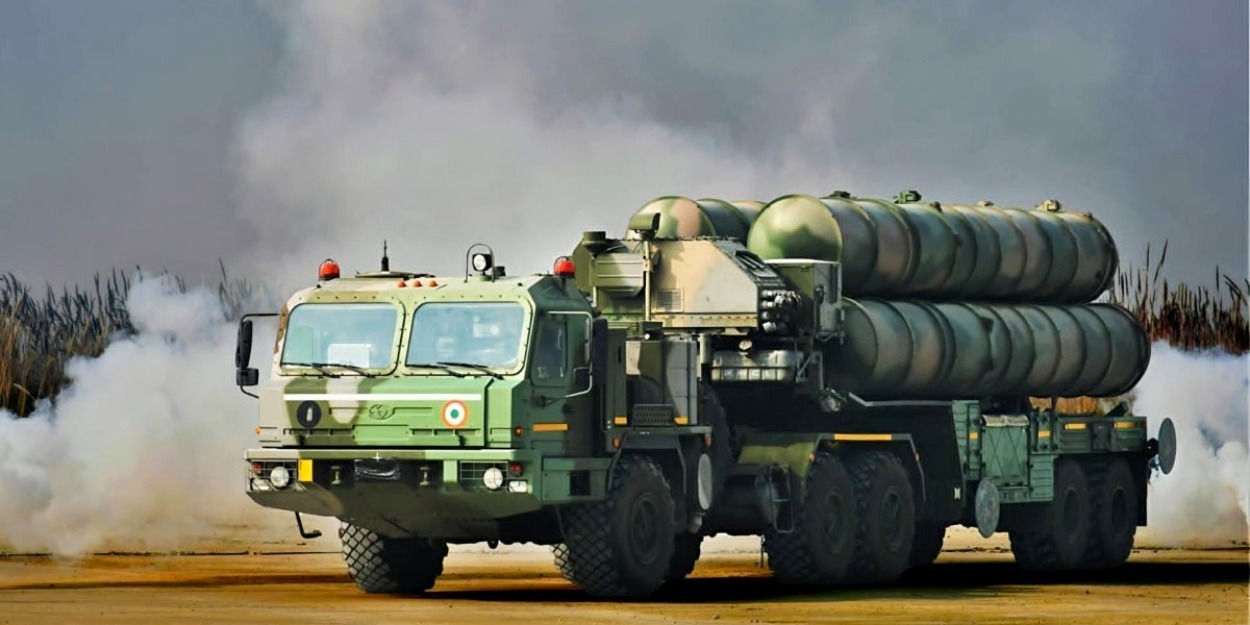
The S-400 314 km kill is now official. Four months after Air Chief Marshal A.P. Singh first spoke publicly of an engagement “at about 300 kilometres,” the Ministry of Defence’s Annual Report 2025–26 has put the achievement on record in precise terms. Page 241 states that an Indian S-400 unit tracked and destroyed a Pakistani special-mission aircraft at a distance of 314 kilometres during Operation Sindoor — the longest surface-to-air kill in the Indian Air Force’s history, and among the longest documented anywhere.
The figure is striking on its own. What it represents for India’s air defence architecture is more significant still: a demonstration, under real operational conditions, that the IAF’s sensor-to-shooter chain can hold a track and complete an engagement at a range few air forces have ever exercised in combat.
Source Transparency
Verified Fact: The S-400 314 km engagement distance and its description as India’s “Longest Surface to Air Kill” come directly from the Ministry of Defence’s Annual Report 2025–26 (Indian Air Force chapter, p.241). Official Statement: Air Chief Marshal A.P. Singh’s August 2025 remarks describing a roughly 300 km AEW&C/ELINT kill are an earlier, independent disclosure that the Annual Report has since confirmed with a precise figure. Reasoned Assessment: Retired Air Marshal Jeetendra Mishra’s account to ANI, describing the target as an AWACS operating near Sargodha, adds operational colour beyond what the Ministry’s own report states — it is marked here as TES Analytical Assessment rather than official confirmation, since the Ministry has not itself named the aircraft type.
Four Months From Disclosure to Documentation
The Indian Air Force built the S-400 314 km record in the open, in stages. Air Chief Marshal Singh’s August 2025 remarks at the LM Katre Memorial Lecture in Bengaluru were the first public acknowledgement: five Pakistani fighters destroyed, plus one large aircraft — “either an ELINT aircraft or an AEW&C aircraft” — brought down at roughly 300 km, which he described at the time as the largest recorded surface-to-air kill on record anywhere. Weeks later, retired Air Marshal Jeetendra Mishra offered ANI a more detailed operational picture: an AWACS operating from the Sargodha sector, engaged after Indian ground radars had already degraded Pakistan’s own airborne surveillance picture.
The Annual Report now formally anchors the engagement in a precise number, framing it in doctrinal terms rather than tactical ones: Indian radars, it notes, tracked the target “in silence” before the missile was guided to intercept. Read together, the three disclosures trace the same story with increasing precision — a capability the IAF quietly possessed, demonstrated once under fire, and now formally entered into the national record.
What the S-400 314 km Engagement Demonstrates
The S-400 314 km shot is not a function of missile motor alone. It requires uninterrupted detection of a moving target well beyond the horizon achievable by ground-based radar in isolation, a fire-control track of sufficient quality to generate a firing solution, and a missile — almost certainly the long-range 40N6 variant — capable of sustaining guidance accuracy across several minutes of flight against a target that may itself be manoeuvring.

Schematic representation of the engagement geometry — not to scale
Most surface-to-air engagements across modern military history, from the Patriot intercepts of the 1991 Gulf War onward, have taken place within a few dozen kilometres of the launcher. The S-400 314 km shot places the integration work the IAF has done around the system in a different category altogether. TES Analytical Assessment: the level of detail the Annual Report devotes to this single engagement, relative to the brief treatment given to most other Sindoor operations in the same document, suggests the IAF sees this as the signature capability demonstration of the entire operation.
Why This Matters for Indian Air Defence Doctrine
Special-mission aircraft — AWACS, AEW&C, ELINT platforms — function as force multipliers rather than combat assets: they extend radar coverage, coordinate fighter patrols, and often determine whether an air force can operate with confidence at all. The S-400 314 km reach effectively extends India’s denial envelope well beyond what ground-based radar alone could cover, and beyond what most regional air forces have had to plan against.
There is a useful historical parallel. In May 1960, the Soviet Union’s downing of Francis Gary Powers’s U-2 near Sverdlovsk ended a long-standing assumption that high altitude alone guaranteed safety from interception. The Sindoor engagement makes an equivalent point about distance: platforms that air planners once treated as operating in a safe standoff zone must now be planned around a substantially larger threat radius. For the IAF, that is not just a battlefield result — it is a doctrinal asset that shapes how India’s layered air-defence network, from the S-400 down to indigenous systems like Akash, is postured and understood going forward.
The Industrial Base Behind the Capability
The engagement itself used imported Russian hardware, but its aftermath has visibly strengthened the domestic side of India’s air-defence ecosystem. On 5 August 2025, the Defence Acquisition Council cleared a basket of proposals worth roughly ₹67,000 crore that included a comprehensive annual maintenance contract for the S-400 Long Range Air Defence Missile System, ensuring the sustained availability of the exact S-400 314 km capability demonstrated during Sindoor. Separately, the Ministry’s year-end reckoning recorded that Bharat Electronics Limited signed contracts during 2025 for Air Defence Fire Control Radars for the Indian Army, placing India’s own defence-electronics industry increasingly close to the sensor-and-fire-control chain around India’s long-range air-defence systems.
TES Analytical Assessment: for those tracking India’s defence-industrial build-out rather than the S-400 programme in isolation, the more durable trend is this expansion of domestic radar, fire-control, and integration content around imported strategic systems — a pattern likely to continue as India replenishes and upgrades its long-range air-defence inventory. This should be read as industrial and strategic context, not as commentary on the prospects of any listed company.
What to Watch
Will the IAF disclose further details of this engagement?
The Ministry has moved from a verbal disclosure to a formal written record within four months, adding precision each time. Further detail on the aircraft type or the exact date of the engagement may follow in future official communication, consistent with this pattern of incremental disclosure.
When does India’s fifth S-400 squadron arrive?
The fifth of five S-400 squadrons contracted from Russia in 2018 is expected around November 2026, completing India’s original order and rounding out the country’s long-range air-defence coverage.
Could this range record be extended further?
The S-400 314 km mark sits close to the publicly stated maximum range of the 40N6 missile associated with its longest-range shots. Any future extension of this record would most plausibly come from India’s own emerging long-range air-defence programmes under DRDO rather than a repeat of the same interceptor.
Related reading on The Eastern Strategist: Kargil to Operation Sindoor: India’s Defence Modernisation · DAC’s ₹1.10 Lakh Crore Push and Defence Stocks · India’s Defence Sector Boom: BEL, HAL and the Risks Ahead