
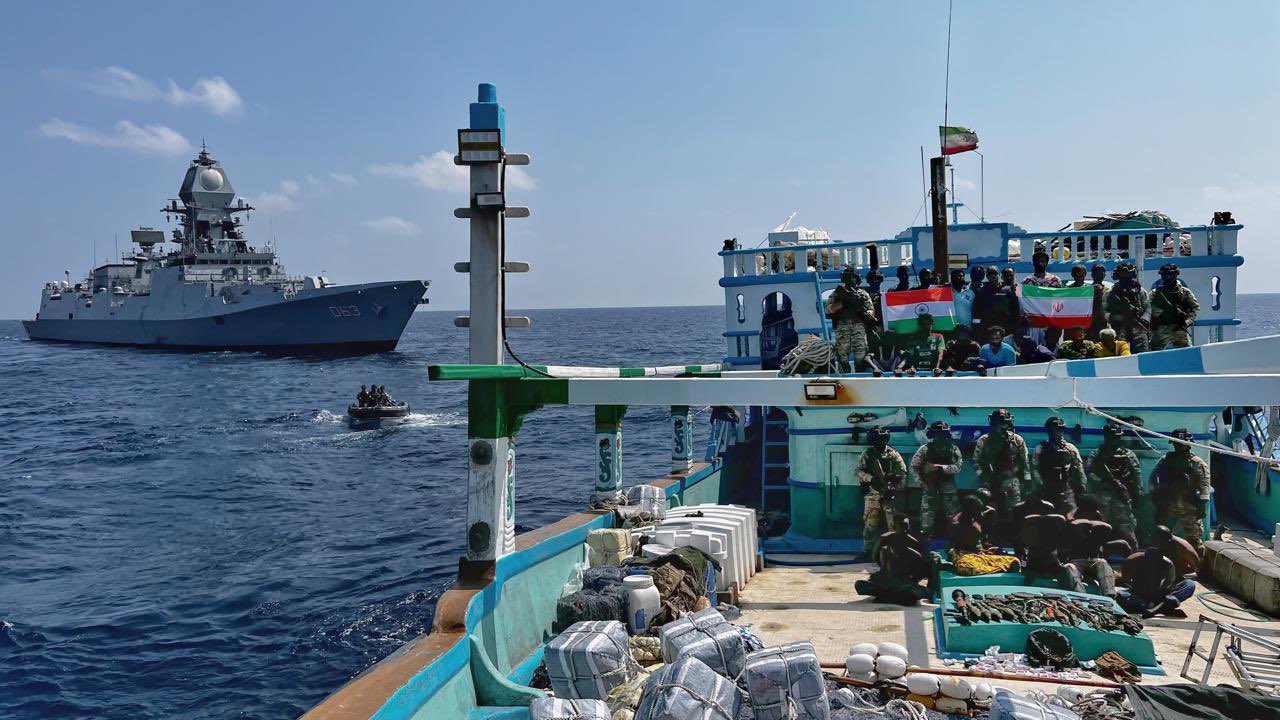
The Indian Navy Azini rescue, completed on 2 November more than 3,000 km from Mumbai, freed all 20 crew of a hijacked fishing vessel with no casualties, according to Defence Minister Rajnath Singh. It is the latest long-range operation by which the Navy keeps Indian Ocean sea lanes open, at a time when Somali piracy has returned to the Gulf of Aden and the Somali Basin after years of relative calm.
Indian Navy Azini rescue: a 48-hour operation 3,000 km from Mumbai
According to the Ministry of Defence (MoD) release, a mission-deployed warship, supported by a maritime reconnaissance aircraft, located the Azini after persistent surveillance, tracked its movements and used calibrated non-kinetic measures to contain it. An Indian Air Force C-17 then augmented the Marine Commandos by precision airdrop, and the Navy secured the vessel and freed all 20 crew. Singh described the pirates as significantly armed and credited timely Air Force support.
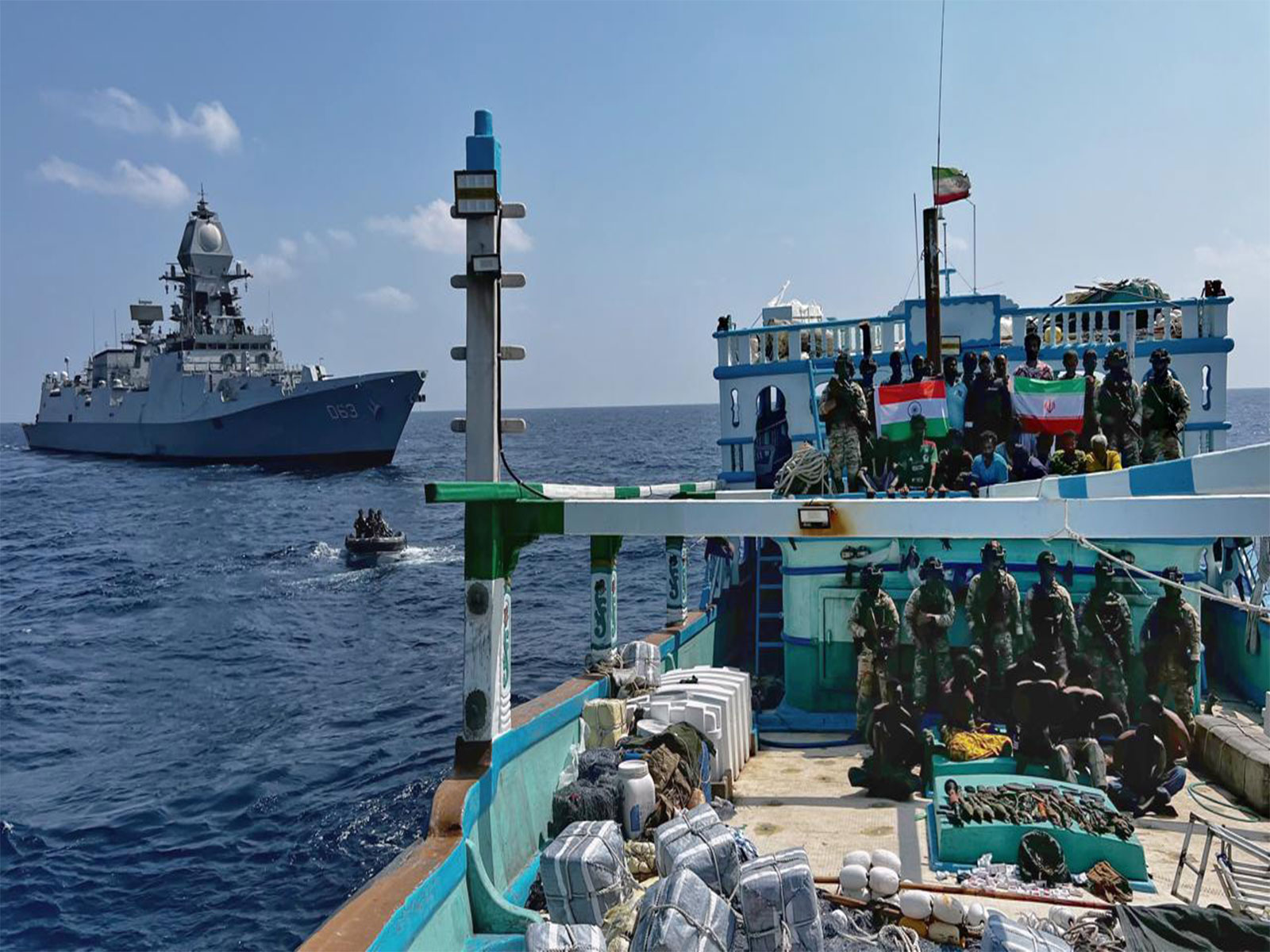
The Azini was hijacked on Thursday, 29 October, between Bandar Bayla and Hafun on Somalia’s north-eastern coast, a Puntland Maritime Police Force officer told the Associated Press (AP). By 31 October the Maritime Security Centre Indian Ocean (MSCIO) had warned that the vessel was approaching a commercial shipping lane and could serve as a mother ship for attacks on merchant vessels. The MoD cites the same risk and calls the hijacking a significant maritime security threat.
Somali pirates operate across the Gulf of Aden, the Somali Basin and the Arabian Sea
Somali pirate groups launch from the Puntland and central Somali coasts and now range across the Gulf of Aden, the Somali Basin and the north-western Arabian Sea. AP counts six commercial vessels hijacked between April and August 2026, including the tanker Sibu 1, seized about 136 nautical miles (252 km) east of al-Mukalla, Yemen. Hijacked fishing dhows serve as mother ships that carry attack skiffs into deep water.
Industry reporting puts mother-ship operations up to 250 nautical miles from the coast. The waters matter because they link the Red Sea to the Arabian Sea: the Royal United Services Institute (RUSI) cites a figure of 14 per cent of global maritime trade for Bab el-Mandeb alone, and notes that four of the six commercial vessels taken this year were tankers. The human cost is real. Puntland authorities said pirates killed five crew of the tanker MT Honour 25, held since April, in September before security forces recovered it.
Why Somali piracy is back: weak coastline control and navies pulled toward Hormuz
The Soufan Center argues that the root causes never went away: weak state control of a coastline of about 3,500 km since the Somali state collapsed in 1991, lost fishing incomes and resilient financier networks. It counts 25 incidents off the Horn of Africa by mid-September 2026, against nine in 2025. What changed in 2026, analysts say, is the opportunity, and the Indian Navy Azini rescue came inside that window.
RUSI points to warships redeployed from the Somali coast to the Strait of Hormuz crisis and to Bab el-Mandeb, and to unusually calm seas that favour small boats. The European Union’s Operation Atalanta and the Combined Maritime Forces still track the groups, but fewer warships cover the Somali coast, the Red Sea and the Gulf of Aden.
The wider picture is mixed. The International Maritime Bureau (IMB) reported in July that global piracy and armed robbery incidents in the first six months of 2026 were the lowest since 1992, while warning that the Somali resurgence demands continued vigilance. Somali piracy is a regional spike inside a quieter global record.
How the Indian Navy safeguards the Indian Ocean: patrols, long-range reach and a legal framework
The Indian Navy has patrolled off Somalia since 2008. Under Operation Sankalp, launched in June 2019, it keeps warships deployed in the Arabian Sea, the Gulf of Aden and the Gulf of Oman to protect shipping. Its Information Fusion Centre-Indian Ocean Region (IFC-IOR) monitors vessel traffic, and the Maritime Anti-Piracy Act, enacted in December 2022, empowers the Navy to arrest pirates at sea.
| Operation | When | Crew freed | Indian assets named officially |
|---|---|---|---|
| Iman and Al Naeemi | January 2024 | 17 on the Iranian-flagged Iman; 19 Pakistani crew on the Al Naeemi | INS Sumitra |
| MV Ruen | March 2024 | 17 | INS Kolkata, INS Subhadra, P-8I, Sea Guardian UAV, IAF C-17 |
| Al-Kambar 786 | March 2024 | 23 Pakistani crew | INS Sumedha, INS Trishul |
| Azini | November 2026 | 20 | Mission-deployed warship, maritime reconnaissance aircraft, IAF C-17 (not named) |
The Ruen operation set the template. On 15 March 2024, INS Kolkata intercepted the former MV Ruen on inputs that IFC-IOR received from the UK Maritime Trade Operations (UKMTO). After 40 hours the Navy retook the ship, freed 17 crew and received the surrender of 35 pirates, with an IAF C-17 airdropping Marine Commandos about 2,600 km from India’s coast. The European Union’s naval force said the Ruen could have supported the hijacking of the MV Abdullah on 12 March. The Indian Navy Azini rescue followed a similar pattern at a greater distance.
The crews freed have been Iranian, Pakistani and, in the Ruen case, included seven Bulgarians, whose foreign minister thanked the Navy. Iran’s embassy in New Delhi has now publicly thanked the Government of India, the Navy and the Air Force for the 20 Iranian crew of the Azini. The legal framework has also run its full course. A Special Court in Mumbai sentenced 44 Somali nationals, 35 from the Ruen and nine from the Al-Kambar 786 operation, to life imprisonment on 20 July 2026, in the first convictions under the 2022 Act.
What the Indian Navy Azini rescue means for India’s sea lanes and energy routes
Rajnath Singh put the Indian Navy Azini rescue more than 3,000 km from Mumbai, beyond the roughly 2,600 km of the Ruen operation. The MoD called the result seamless inter-service coordination and restated India’s aim to remain First Responder and Preferred Security Partner in the Indian Ocean Region. The sea lanes concerned are ones Indian trade depends on.
The piracy risk adds to a corridor already under strain. AP reports that attacks around the Strait of Hormuz and Houthi threats near Bab el-Mandeb have lengthened voyages and pushed up tanker costs. Some oil shipments diverted via the Cape of Good Hope faced journeys up to a month longer, and daily spot charter rates for Hormuz transits reached $1 million, according to AP’s September reporting. TES has tracked the Hormuz-to-Aden attacks near Oman and the wider geopolitics of the Indian Ocean.
What to watch on Somali piracy and the Indian Navy
Three questions frame the Somali piracy threat to Indian shipping: where pirates operate, why they are active again, and how the Navy responds. The answers below draw on official statements, AP and maritime security research, and will change if hijackings or naval deployments change.
Where do Somali pirates operate?
Across the Gulf of Aden, the Somali Basin and the north-western Arabian Sea, using hijacked dhows as mother ships. AP places the seizure of the tanker Sibu 1 about 136 nautical miles east of al-Mukalla, Yemen. The Azini was taken between Bandar Bayla and Hafun.
Why has Somali piracy returned in 2026?
The Soufan Center cites unchanged root causes: weak coastline control, lost fishing incomes and financier networks. RUSI adds warships redeployed to the Hormuz crisis and Bab el-Mandeb, and unusually calm seas.
The Indian Navy Azini rescue follows Operation Sankalp patrols, alerts through IFC-IOR and the legal powers of the 2022 Act. The Azini operation reached beyond 3,000 km from Mumbai with a warship, surveillance aircraft and an IAF C-17 airdrop.
The Indian Navy Azini rescue shows India can field a warship, a surveillance aircraft and an airdropped commando element beyond 3,000 km from Mumbai within 48 hours. The drivers analysts cite for the Somali revival, thin coastal control and navies drawn to Hormuz and Bab el-Mandeb, have not changed. On that evidence TES expects Operation Sankalp deployments and long-range inter-service operations to stay in demand. The next hijacked dhow near a shipping lane will call on the same chain of alert, ship, aircraft and commandos.
Sources: Ministry of Defence and Indian Navy statements, the Defence Minister’s statement, Associated Press, International Maritime Bureau, and think-tank research on Somali piracy.