
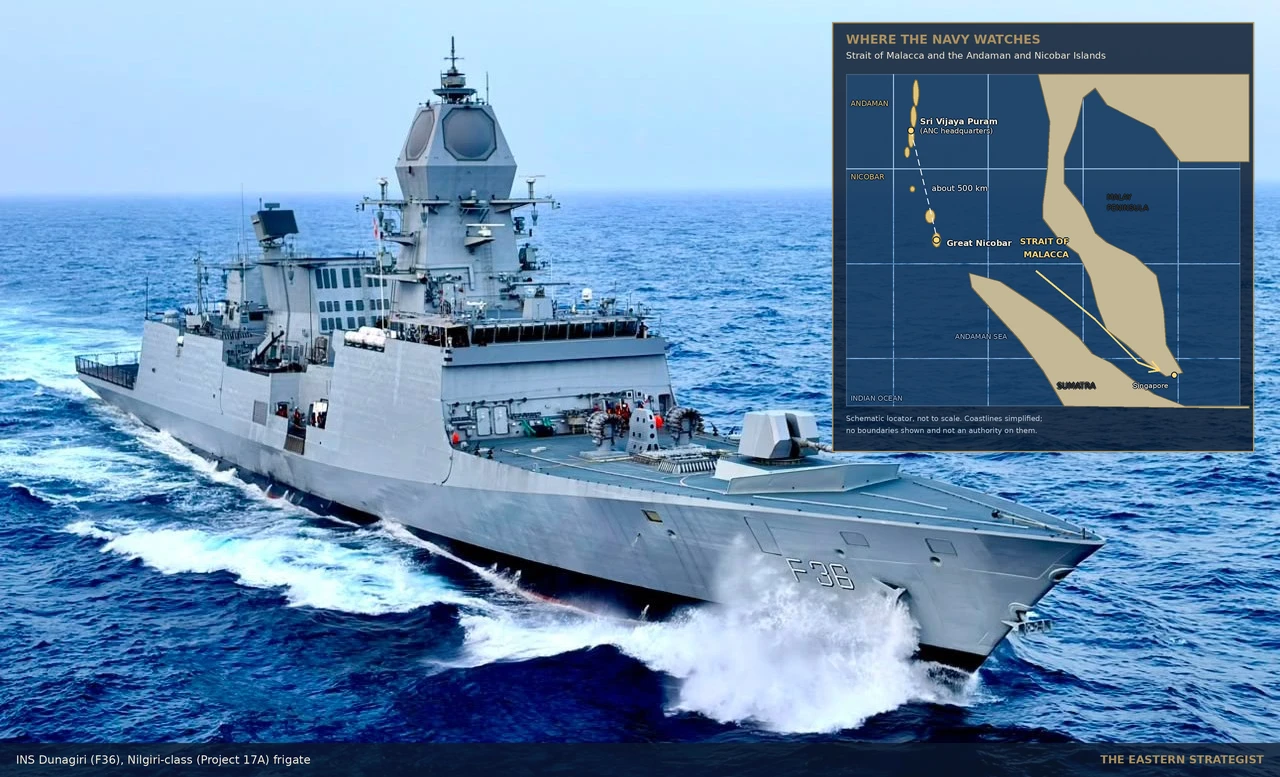
The Indian Navy told Parliament’s Standing Committee on Defence in February 2026 that it runs 142 ships and submarines and plans about 230 by 2037. The committee’s own tables show the Navy’s share of the Defence Services Estimates, the services’ combined budget, dipping from 21.05% to 19.98% in 2026-27, the first fall in the six-year series. Any Indian Navy Malacca Strait plan has to be read against those two numbers together.
This week tests the plan. On 2 November the Ministry of Defence (MoD) signed ₹53,866.50 crore of contracts for eight Next Generation Corvettes. On 5 November INS Sahyadri joins Exercise Malabar south of Honshu with the United States, Japan and Australia. Quad foreign ministers met in Atlanta on 31 October, and US Secretary of State Marco Rubio has said a leaders’ summit is expected in Manila during meetings from 15 to 17 November, the first in more than two years.
- 142 ships and submarines today, per the Navy to Parliament, February 2026
- ~230 by 2037 the Navy’s stated force-level goal
- 50 ships under construction, all in Indian yards
- ₹1,16,863.31 cr Navy allocation for 2026-27, including Joint Staff
- 19.98% Navy share of Defence Services Estimates, down from 21.05%
- ₹53,866.50 cr eight Next Generation Corvettes, signed 2 November 2026
Why the Indian Navy Malacca Strait Question Starts at Great Nicobar
India’s reach towards the Strait of Malacca rests on the Andaman and Nicobar Command, the tri-service command set up in 2001, now under Headquarters Integrated Defence Staff and based at Sri Vijaya Puram, formerly Port Blair. Great Nicobar, the southernmost island, sits nearly 1,600 km from mainland India, near the western approaches to the strait. Shekhar Sinha, a former Vice Chief of the Naval Staff, has described it as “sitting right at the mouth of Malacca.”
The stakes sit in the cargo. The Press Information Bureau’s Navy Day backgrounder puts close to half of global trade and about 40% of oil in the Indo-Pacific, and the Standing Committee record notes that 95% of India’s trade by volume moves by sea. Red Sea disruption since November 2023 and the Navy’s long Gulf of Aden deployment showed how fast a chokepoint turns into a flashpoint. TES has followed the alternatives to Malacca in the Lombok Strait and in Thailand’s Kra Isthmus land bridge proposal.
New Delhi has begun to fund the islands. Headquarters Integrated Defence Staff told the committee that its 2026-27 capital allocation is ₹3,138.71 crore, ₹1,481.57 crore more than in the current financial year. The money goes mainly to a satellite launch with the Indian Space Research Organisation (ISRO) for the Defence Space Agency and to specialised procurement for the Andaman and Nicobar Command, the Armed Forces Special Operations Division and other joint organisations. The committee record does not give the command’s own share.
A retired rear admiral has argued that the command remains under-resourced. The budget line is the visible movement on that point; how far it closes the gap has not been published.
How Far Can 142 Ships Stretch Between the Gulf of Aden and the Pacific?
The Navy gave Parliament three numbers in February 2026: 142 ships and submarines today, about 230 by 2037, and 50 ships under construction in Indian yards. Naval aviation is meant to grow from 264 assets to about 314 by 2030. The Chief of the Naval Staff has publicly set a goal of over 200 by 2035. The records TES reviewed do not say how many of the 142 are based east of the Nicobar Islands.
The reach is visible in the deployment record. MoD’s Annual Report 2025-26 lists 18 bilateral, eight multilateral and 31 maritime partnership exercises in 2025, four coordinated patrols and 12 joint Exclusive Economic Zone (EEZ) surveillance exercises. The Eastern Fleet visited Singapore, Vietnam and the Philippines between 16 July and 3 August 2025. INS Sahyadri then sailed from 26 September to 11 December through Busan, Yokosuka and Guam, taking in Malabar and the AUSINDEX exercise.
The western ocean draws on the same hulls. Since November 2023 the Navy has put 48 capital ships into the Gulf of Aden, and it told the committee that 392 merchant vessels carrying about $7 billion of cargo transited under that cover. Its ships have spent about 16,000 days a year at sea for the past two years. Every Indian Navy Malacca Strait patrol is a ship not in the west, and the 230-ship goal would ease that choice.
China’s Indian Ocean Presence Is Tracked Vessel by Vessel, the Navy Tells Parliament
In February 2026 the Navy told the Standing Committee that every activity of Chinese civilian vessels and Chinese warships in the region, including their transit, is closely monitored, and that Pakistani naval deployments get the same attention. A year earlier it said it tracks about 50 to 60 warships of extra-regional navies in the Indian Ocean Region each month. These are Navy statements to Parliament; the underlying tracking data is not public.
The balance of resources is large. MoD’s own submission to the committee, drawing on the Stockholm International Peace Research Institute (SIPRI), puts China’s 2024 defence spending at about $313.7 billion and Pakistan’s at $10.2 billion, while noting that like-for-like comparisons are difficult. On bases, Djibouti remains the only overseas military facility China acknowledges in the Indian Ocean region, and Beijing formally calls it a logistics facility. Whether Gwadar becomes a second one has been debated by analysts for years; China has in the past called such talk speculation. TES treats port-access claims as assessments, not confirmed bases.
India’s answer includes visibility and partnership as well as hulls. The Information Fusion Centre for the Indian Ocean Region (IFC-IOR) hosts liaison officers from 15 partner nations and has room for 26, according to the Annual Report. India takes the chair of the Indian Ocean Naval Symposium for 2026-28, and the Navy told the committee that 74 countries took part in the International Fleet Review and MILAN at Visakhapatnam in February.
Pakistan’s Saudi Pact and Hangor Submarines Shape the Arabian Sea, Not Malacca
Pakistan and Saudi Arabia signed a Strategic Mutual Defence Agreement in Riyadh on 17 September 2025, treating aggression against either as aggression against both. A Saudi official told Reuters it was not a response to any specific event. PNS Hangor, the first of eight Hangor-class submarines ordered from China, was commissioned at Sanya on 30 April 2026 and reached Karachi on 11 June.
Neither development changes the Indian Navy Malacca Strait picture. Both feed the western theatre, where the Navy’s Gulf of Aden and Gulf of Oman deployments run alongside its North Arabian Sea posture. MoD’s Annual Report says the carrier battle group and submarines were forward deployed there during Operation Sindoor and credits that posture with a role in Pakistan’s request for a ceasefire on 10 May 2025. That is MoD’s account. In December 2024 the Chief of the Naval Staff said many Pakistan Navy ships and submarines are being built with Chinese support.
The name is old. A Pakistan Navy submarine called Hangor sank INS Khukri off Diu on 9 December 1971, five days after Indian missile boats struck Karachi in Operation Trident. The fleet now being planned has to cover two oceans and the strait that joins them.
India Leads Quad Naval Cooperation in the Indian Ocean, but the Quad Has No Joint Command
Exercise Malabar runs from 5 to 12 November south of Honshu, with INS Sahyadri alongside Japan’s JS Ise and JS Mogami, Australia’s HMAS Stuart and a P-8A aircraft, and US Navy forces, according to Japan’s Maritime Self-Defense Force. Malabar is not formally on the Quad’s list of initiatives, and the Quad is not a military alliance.
The Atlanta statement of 31 October, the third Quad foreign ministers’ meeting this year, voiced grave concern over economic coercion without naming a country. Rubio said the Quad is not an anti-China or anti-anybody coalition. Jaishankar spoke of a more contemporary and practical approach to the grouping’s agenda. Reports of the statement cover supply chains, technology and maritime security, and none describes a new naval command role.
India’s strongest naval claim sits in the Indian Ocean, and the record shows it: the Navy calls itself the Preferred Security Partner in the region under the MAHASAGAR vision (Mutual and Holistic Advancement for Security and Growth Across Regions), chairs the Indian Ocean Naval Symposium from 2026, and took command of Combined Task Force 154 at Bahrain in February. In the Pacific, India joins partner-hosted drills, at Guam in 2025 and off Japan now. Leading the Quad’s navies, on this evidence, means leading where India’s ships are home-based and extending that reach with partners.
The Navy’s Budget Grows 12.9%, Slower Than the Army’s 18.4% and the Air Force’s 28.2%
On the Standing Committee’s tables, the Navy’s allocation, including Joint Staff, rises from ₹1,03,502.62 crore in the 2025-26 budget estimate to ₹1,16,863.31 crore in 2026-27, an increase of 12.9% by TES’s calculation. The Defence Services Estimates rise 18.9%, the Army’s allocation 18.4% and the Air Force’s 28.2%. The Navy’s share therefore slips from 21.05% to 19.98%.
Capital, the line that buys ships and submarines, is nearly flat against the revised 2025-26 figure.
Capital rises to ₹70,063.31 crore, 7.2% above the 2025-26 budget estimate and 0.9% above the revised figure. Revenue is set at ₹46,800 crore against a Navy projection of ₹49,888.61 crore, a gap of ₹3,088.61 crore. The 2025-26 revised estimate of ₹1,13,338.73 crore is ₹9,836 crore above that year’s budget estimate, so the Navy received a mid-year top-up.
The Navy has named its own gap. It told the committee that dependence on foreign makers for critical engines has hindered progress, and that main propulsion is now in mission mode under the Make-I and Technology Development Fund routes. MoD’s Annual Report records a project sanction for a 6 MW marine diesel engine with Kirloskar Oil Engines, with over 50% indigenous content and 70% government funding; the report gives no delivery date. The PIB backgrounder puts indigenisation of shipboard machinery at about 90%, 60% and 50% in the float, move and fight categories, and calls the third figure a shortfall.
The orders are moving. The Navy said about ₹1.42 lakh crore of acceptances of necessity across 100 cases had been granted in 2025-26 up to February, and the Ministry reports that 76% of the Navy’s modernisation money had been booked by 31 January. In the corvette order, Garden Reach Shipbuilders & Engineers (GRSE) builds five and Goa Shipyard Limited three, in the first project where Navy-designed ships go to defence public sector yards chosen through competition. Reaching 230 from 142 needs a net 88 more hulls, and eight corvettes are about 9% of that.
What to Watch After Malabar and the Manila Summit
Three markers will show whether the plan holds. The first is the Navy’s year-end induction count against the pace of one vessel every 40 days that the Government cites. The 88 extra hulls needed by 2037 average eight a year, so retirements, which TES has not found published, decide how close that pace gets. The second is how much of the ₹3,138.71 crore Joint Staff capital line reaches the Andaman and Nicobar Command. The third is the Manila summit: whether a Quad leaders’ text adds anything on maritime domain awareness that navies can use.
No. India holds no base inside the strait itself. The Andaman and Nicobar Command, headquartered at Sri Vijaya Puram, formerly Port Blair, covers the islands at its western approach, and Great Nicobar is roughly 500 km from that headquarters, according to Al Jazeera’s reporting.
The Navy told the Standing Committee on Defence in February 2026 that it has 142 ships and submarines and aims for about 230 by 2037. The Chief of the Naval Staff has publicly spoken of over 200 by 2035. About 50 ships are under construction, all in Indian yards.
Neither the joint statement nor the Saudi official quoted by Reuters says so. The 17 September 2025 agreement treats an attack on one as an attack on both, and a Saudi official told Reuters it was not a response to any specific event. For the Indian Navy it adds a planning variable in the Arabian Sea and the Gulf, not a new front at Malacca.
The Indian Navy Malacca Strait plan is funded, and the pace is the open item. If the Navy keeps the pace of one new vessel every 40 days, about nine a year, it reaches 230 by 2037 only if retirements average about one a year, by TES’s arithmetic. A Navy share near 20% of the services’ money is funding 50 ships on the slips now, and the engines, the island infrastructure and the contracts still waiting for approval will show whether it can also stretch from Great Nicobar to the Pacific.
Eight corvettes and one frigate off Japan this week are a first instalment, no more.
For wider context, see TES’s India maritime security hub, the Navy fleet comparison in Indian Navy 2026 and India’s South China Sea position.