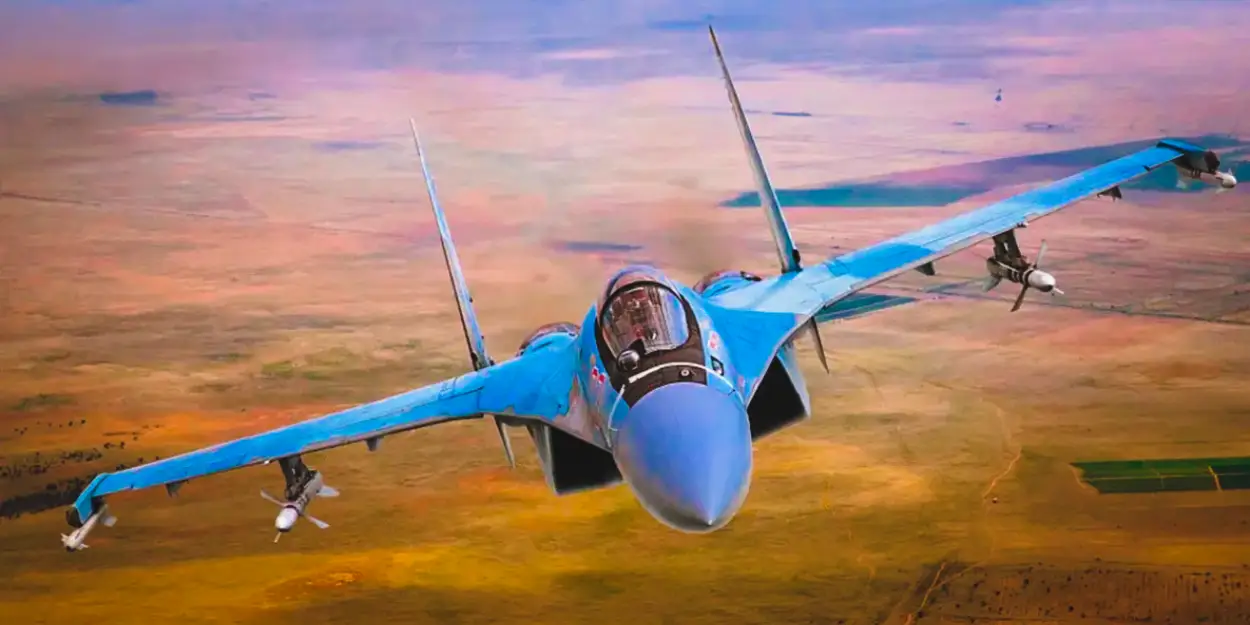
Iran Su-35 delivery now waits on a date nobody can give: the end of the US-Iran war. Iranian Army (Artesh) spokesman Brig Gen Mohammad Akraminia told the Tabnak news site on 31 October 2026 that the purchase, the contracts and the pilot training are complete, and that the jets will arrive once the fighting ends. He named no fleet size and no day. Washington had said in December 2022 that deliveries could begin within the year.
For India, the delay carries a practical lesson. The Indian Air Force (IAF) flies more than 250 Su-30MKI fighters built by Hindustan Aeronautics Limited (HAL), and its modernisation money is going into engines, warning receivers, airfields and an upgrade package, not into a new airframe. Iran’s wait tests that sequence, and this analysis sets the two fleets side by side.
Why Iran Su-35 delivery now waits for the end of the war
Iran’s Army spokesman said on 31 October 2026 that Iran has finished the purchase, contract signing and pilot training for the Su-35, so delivery of the Su-35 to Iran now depends on the war ending. He gave no number of jets and no date, and TES has found no Russian confirmation of a schedule.
Akraminia said the aircraft were “supposed to arrive before the war”, meaning the US-Iran war that began on 28 February 2026. He added that the contracts were handled by bodies outside the Army, and that the Army’s own share of the work, preparation and pilot training, had gone through without problems. The Artesh, Iran’s regular military, includes the Islamic Republic of Iran Air Force, which would fly the jet; the Revolutionary Guards run a separate air arm.
Reports of the interview say he was answering domestic criticism that earlier jets would have reduced the damage to Iran’s air capability. He also tied the jet to the systems around it. A modern air force, he said, needs ground radars, airborne radars and satellite support before an aircraft such as the Su-35 can reach its full potential. He gave no platform or delivery status for any of them.
Two limits apply to this reading. He did not name Russia, the only manufacturer of the Su-35, although the inference is safe. And a spokesman who says Iran will receive the aircraft after the war is also saying that none has reached the Air Force today.
Why Su-35 delivery to Iran has been imminent since 2022
Since December 2022, officials in Washington and Tehran have described the handover as close: the White House said Iranian pilots were training in Russia, an Iranian deputy defence minister said arrangements were final in November 2023, and a senior Revolutionary Guards commander confirmed a purchase in January 2025. TES has found no evidence of an Iranian squadron flying the jet.
Each link in that chain claims less than it appears to. John Kirby of the US National Security Council spoke of training in Russia and of deliveries that could begin within the year. Iran’s deputy defence minister, Mehdi Farahi, told Tasnim in November 2023 that arrangements were final, and Russia did not confirm. Brig Gen Ali Shadmani said in January 2025 that Iran makes military purchases when needed, gave no numbers, and did not say whether any aircraft had arrived.
Statements and claims on Iran Su-35 delivery, in the order they were made. Leaked and open-source figures are claims, not confirmed facts.
The numbers behind the Iran Su-35 deal come from a different source: leaked documents. Files published online in October 2025, which neither government has authenticated, describe an order of 48 Su-35 fighters worth about €6 billion, with deliveries from 2026 to 2028. Open-source trackers have since reported 16 aircraft built by March 2026 and about 20 by July, held in Russia. TES treats the order size and the production tally as claims.
How many Su-35s does Iran have? None, on its own Army’s account
On the Iranian Army’s own account, none is in service. The 48-jet order and the tally of 16 to 20 airframes come from leaked files and open-source tracking, and they describe production, not acceptance. Built, handed over and flown by an Iranian squadron are three separate milestones, and no public evidence yet supports the second or the third, so no Su-35 delivery to Iran can yet be called confirmed.
Earlier reports of arrivals have not held. Defence outlets said in November 2024 that two Su-35s had been delivered in pieces, and reports in August 2026 claimed jets had been moved into underground shelters. Open-source analysts say no geolocated photograph, Iranian tail number or official statement has confirmed either. An English-language report from Iran’s state news agency IRNA that the first batch would arrive in the coming weeks was later taken down, according to defence trade press.
The war has also cost the training pipeline. Israel’s military released video on 4 March 2026 that it said showed an F-35I shooting down an Iranian Yak-130 over Tehran. Iranian media have described the Yak-130, inducted from September 2023, as the lead-in trainer for Su-35 pilots. The claim is Israel’s, and TES has not seen independent confirmation of the loss.
Why a Su-35 without bases, radar cover and spares changes little
A fighter becomes airpower only with a protected runway, early warning, maintenance and trained crews. Akraminia said as much about radars and satellites. Open-source reports link the planned Su-35 home, the Hamadan air base, to damage that Israel’s military said it inflicted on 13 June 2025, but no official source names base damage as the cause of the delay, and Akraminia did not.
History offers the sharpest example. On the morning of 5 June 1967, Israel destroyed most of Egypt’s air force on the ground within hours of opening the Six-Day War. The aircraft were not the weak point. Their basing was, and TES reads the same logic into any fleet that arrives before its shelters, fuel and air defences do.
The 2026 war points the same way. Israel’s military said it destroyed several Iranian F-14s at Isfahan in March, and open-source loss lists record dozens of Iranian aircraft destroyed since 28 February, according to those trackers. For a buyer, the point is blunt: Su-35 delivery to Iran means little until a first squadron can survive its first day at the Hamadan air base or anywhere else.
Is Russia holding up Su-35 delivery to Iran? The evidence points three ways
Three explanations circulate for the gap in Su-35 delivery to Iran, and neither Moscow nor Tehran has confirmed any. Reports attribute it to unready Iranian bases, to Moscow’s political caution (Iranian media cite an understanding with Israel), or to a Russian production line stretched by war. Akraminia did not blame Russia.
The political explanation has an Iranian pedigree. Khabar Online reported that Moscow declined to supply the jets because of unwritten understandings with Israel, and former Iranian negotiator Hossein Mousavian wrote in 2025 that Russia had given Iran neither Su-35s nor S-400 air defence systems. Foreign Minister Sergey Lavrov has said Russia places no limits on military-technical cooperation with Tehran, though not in reference to the Su-35. All of this is claim and opinion, not documentation.
The industrial explanation points the other way. A July 2026 open-source report claimed that the Komsomolsk-on-Amur plant is directing capacity to Iranian orders, slowing Russian Aerospace Forces intake in 2026 and 2027, and that Iran has also ordered 12 Su-30SM2 fighters. Russia’s own losses add pressure on the same line, since Oryx counts about eight Su-35S destroyed in Ukraine. TES reads that as a constraint, not as proof of cause, and the two explanations cannot both be right.
India’s exposure sits in Russian kits and spares for the Su-30MKI. TES has found no evidence, and no official statement, that Iran’s order has touched supply to India. HAL’s AL-31FP deliveries running ahead of target are consistent with no disruption on the engine side, though they say nothing about kits and spares.
Su-35 vs Su-30MKI: where the Russian jet leads and where the IAF is closing the gap
Both are heavy Flanker-family fighters with passive electronically scanned array radars, the Su-35S’s Irbis-E and the Su-30MKI’s Bars. The Su-35S has newer engines and a single-seat, canard-free airframe. The Su-30MKI carries Indian, French and Israeli systems and is built and sustained in India. The planned Super Sukhoi upgrade adds an active-array radar and indigenous electronic warfare.
| Feature | Su-35S (Russia; export order for Iran) | Su-30MKI (IAF) |
|---|---|---|
| Crew | One pilot | Two crew |
| Radar | Irbis-E, passive electronically scanned array | Bars, passive array; DRDO’s Virupaksha active array reported for Super Sukhoi |
| Engines | AL-41F1S with three-dimensional thrust vectoring | AL-31FP with canted single-plane thrust vectoring, built by HAL at Koraput |
| Canards | None | Fitted |
| Missiles | R-77 and R-37M | Indian and Russian weapons; Astra Mk1 in service, Astra Mk2 expected by 2027 (reported), BrahMos and Rudram integration reported |
| Where built | Komsomolsk-on-Amur, Russia | HAL Nashik; 62.6% indigenous content in the 2024 order |
| Status | In Russian service since 2014; Iranian order undelivered | In IAF service since 2002; upgrade awaiting Cabinet approval |
Manufacturer and open-source descriptions. TES has not seen an official like-for-like comparison.
The Su-35 vs Su-30MKI contest is closer than the brochures suggest. On paper, the Su-35S leads on engine power and agility. Russian manufacturers claim the Irbis-E can detect a large target at about 400 km, a best-case figure that falls sharply against smaller aircraft. Combat use tempers the brochure: the Su-35S has flown in Syria and Ukraine, where the open-source tracker Oryx had documented about eight losses by early 2026.
The IAF’s answer is not to match the Su-35 airframe for airframe. The Super Sukhoi upgrade is the vehicle: the Defence Acquisition Council (DAC) approved in principle on 30 November 2023 the upgrade of 84 Su-30MKIs with an indigenous active-array radar, a new electronic warfare suite and Indian weapons. The cost is reported at about ₹63,000 crore, and the Cabinet Committee on Security (CCS) has not publicly cleared it. TES has covered the programme’s architecture and the DAC’s 7 September 2026 clearance separately.
What Iran Su-35 delivery means for the IAF: no new threat, a test of its own sequence
Nothing changes for the IAF in the near term. Iran is not an adversary, and Su-35 delivery to Iran has not been confirmed. The Iranian wait is a benchmark: India’s programme runs through engines, radar warning receivers, an upgrade and airfields, the layers Iran says it still lacks. TES has found no evidence that Iran’s order affects Russian supply to India.
The Ministry of Defence (MoD) funded the supply side first. It signed a ₹13,500 crore contract (about $1.5 billion) with HAL for 12 more Su-30MKIs on 12 December 2024, with 62.6 per cent indigenous content. It contracted 240 AL-31FP engines for ₹26,000 crore in September 2024, and HAL had delivered 63 by 6 October 2026 against a target of 60, as TES reported on HAL Koraput’s engine capacity.
The electronic layer is moving. The MoD’s Annual Report 2025-26 records a production order worth ₹885 crore at Bharat Electronics Limited (BEL) for the DR118 digital radar warning receiver, flight-tested on the Su-30MKI, with first-off production trials planned for 2026. It also lists a DRDO electronic warfare suite for the Su-30MKI, with wingtip jammer pods, at an advanced stage of development.
So is the ground layer. The same report says the Nyoma airfield in Ladakh became operational for IAF use in November 2025, the CCS sanctioned a ₹935 crore airfield at Deesa, and the eighth emergency landing facility was inaugurated on 14 February 2026.
The gap sits in the middle, in the Su-30MKI upgrade itself. Squadron strength is reported at about 30 to 31 against a sanctioned 42, and the 84-jet upgrade has waited since its 2023 approval in principle. HAL’s chairman said in February 2026 that CCS clearance would come within months, and TES has found no public confirmation. Reported timelines put the first upgraded jet around 2031 if approval comes this year.
New Delhi has also been offered the Su-35 before. Reuters has reported that Russia put the Su-35 and the MiG-35 forward in earlier rounds of India’s multi-role fighter tender; India bought neither. The current Russian pitch centres on the Su-57, which TES examined in its piece on the 2030 stealth gap.
What to watch next on Iran Su-35 delivery
What would confirm Iran Su-35 delivery?
Identifiable aircraft with Iranian markings on an Iranian base, a formal acceptance announcement, or a Russian statement. The Army spokesman’s remark, the leaked files and the production tallies do not meet that standard.
Has India said anything about the Su-35?
Not publicly. Russia has offered the Su-35 in earlier rounds of India’s multi-role fighter tender, and India has bought neither it nor the MiG-35. New Delhi’s stated path runs through the Super Sukhoi upgrade, the Tejas Mk1A and the AMCA.
Has the Cabinet Committee on Security cleared the Super Sukhoi upgrade?
Not publicly, as of 2 November 2026. HAL’s chairman said in February 2026 that clearance was expected within months. Reported timelines put development and flight trials at five to seven years after approval.
The takeaway
Airpower is the slowest purchase a state makes and the quickest to lose.
Iran Su-35 delivery will be real only when the jet, the base and the radar net exist together. Iran has bought the jet and still waits for the war to end, the shelters to be rebuilt and the radar net to be joined up. India has the harder, quieter layers moving in parallel: engines at Koraput, warning receivers at BEL, runways at Nyoma and Deesa, and an upgrade awaiting one signature.
Egypt’s jets in 1967 were lost before their pilots could prove anything. The air force that fields the better aircraft in the next war will be the one whose bases, radars and spares are standing on the first morning.
The next marker for India is the CCS decision on the Super Sukhoi. The next marker for Tehran is a Su-35 on an Iranian runway that the Iranian Army can defend. See also TES’s India military platforms hub.
Source note: Statements by the Iranian Army spokesman as reported from his Tabnak interview, Ministry of Defence releases and annual report, HAL disclosures, and Iranian, leaked-document and open-source reporting, which TES treats as claims.