
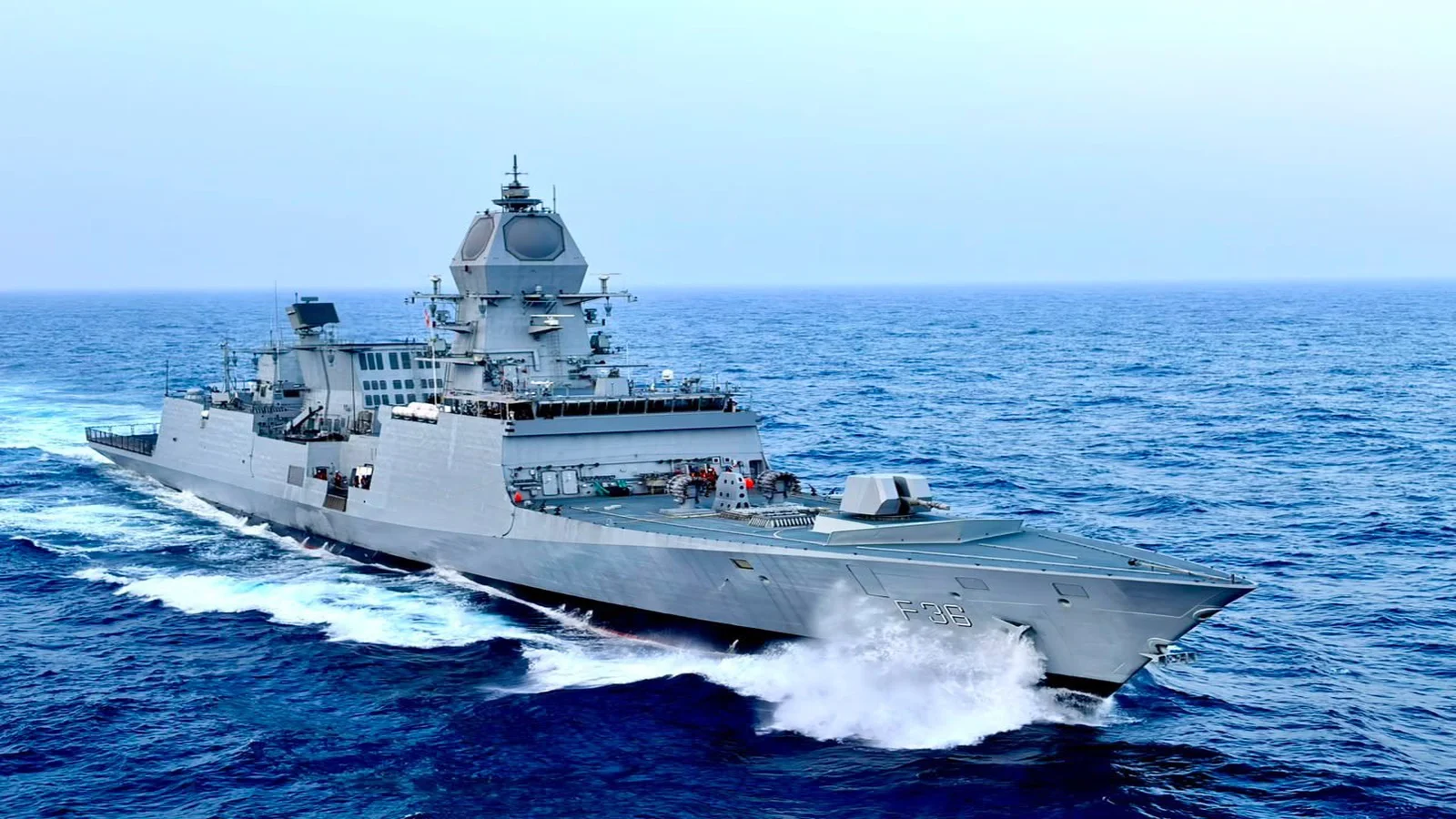
Two ceremonies, eighteen months apart, look almost identical on paper. On 15 January 2025, Prime Minister Narendra Modi commissioned a destroyer, a frigate and a submarine together at Naval Dockyard, Mumbai. On 21 June 2026, he did the same at Garden Reach Shipbuilders and Engineers (GRSE) in Kolkata, commissioning a frigate, a survey vessel and an anti-submarine craft. What changed in between is the real story behind India’s Indian Navy warship induction 2026 target — not the ceremony, but the assembly line that made a second one possible this quickly.
- What the Navy’s 2026 induction figures actually show
- The commissioning timeline, ship by ship
- Why “integrated construction” is the structural change, not the ship count
- What it means for GRSE and Mazagon Dock’s order books
- How India’s pace compares with China’s
- What to watch next
A Decade-Long Frigate Programme Reaches Its Final Stretch
Project 17A was sanctioned as a follow-on to the Shivalik-class frigates, with seven hulls split between two public-sector shipyards — four at Mazagon Dock Shipbuilders Limited (MDL) in Mumbai and three at GRSE in Kolkata. The lead ship, INS Nilgiri, took years longer to reach the water than the programme’s planners had hoped, a familiar pattern in Indian warship construction going back decades. [Verified Fact — Ministry of Defence, Annual Report 2025–26]
What makes the programme worth revisiting now is not that it eventually finished. It is how the last six hulls were delivered once the lead ship’s delays were absorbed. Every Indian Navy warship induction 2026 figure now being cited in Parliament and in the press traces back to this one frigate class behaving very differently in its second half than in its first.
The Commissioning Timeline the Navy Doesn’t Usually Lay Out This Plainly
Between January 2025 and July 2026, the Indian Navy commissioned nine named frontline platforms in public ceremonies, according to the Ministry of Defence’s own Annual Report 2025–26 and subsequent naval reporting. Laid end to end, the sequence reads less like an annual procurement cycle and more like a staggered production schedule running across two cities.
| Date | Platform(s) | Yard |
|---|---|---|
| 15 Jan 2025 | INS Surat (destroyer), INS Nilgiri (frigate), INS Vaghsheer (submarine) | MDL, Mumbai |
| 18 Feb 2025 | INS Nirdeshak (survey vessel) | GRSE / Navy design |
| 18 Jun 2025 | INS Arnala (ASW shallow water craft) | GRSE |
| 18 Jul 2025 | INS Nistar (diving support vessel) | Hindustan Shipyard Ltd |
| 26 Aug 2025 | INS Udaygiri (frigate) and INS Himgiri (frigate) — same day, two yards | MDL and GRSE |
| 6 Oct 2025 | INS Androth (ASW shallow water craft) | GRSE |
| 6 Nov 2025 | INS Ikshak (survey vessel) | GRSE |
| 21 Jun 2026 | INS Dunagiri (frigate), INS Sanshodhak (survey vessel), INS Agray (ASW craft) | GRSE, Kolkata |
| 11 Jul 2026 | INS Mahendragiri (frigate) — final MDL-built Project 17A hull | MDL |
Sourced to the Ministry of Defence Annual Report 2025–26 and Naval News reporting on the 2026 commissionings.
The 26 August 2025 entry is worth pausing on. It was the first time two frontline warships built at two separate Indian public-sector yards were commissioned on the same day — a coordination problem as much as a construction one, since it required MDL and GRSE to converge their delivery schedules instead of simply running faster on their own. [Official Statement — Ministry of Defence]
Separately, the Navy’s own public statements put total 2025 inductions at 14 vessels including one submarine, against a stated target of 19 for calendar 2026 — figures that run on calendar-year accounting, whereas the Ministry’s fiscal-year reporting cycle resets at a different point — this is why the two counts will not match exactly if compared line for line. Readers should treat the “19 in 2026” figure as the Navy’s own calendar-year framing, distinct from the fiscal-year commissioning list above.
Why “Integrated Construction” Matters More Than the Ship Count
The headline number — a record year for commissionings — is the least interesting part of this story. The more durable change is in how long each hull takes from keel-laying to commissioning. According to reporting on the Project 17A build methodology, the first three Nilgiri-class ships needed roughly 76 months from keel-laying to commissioning; the last four needed closer to 60. The Shivalik-class predecessor averaged 108 months for the same span. [Independent Analysis — Tribune India, build-methodology reporting]
That compression did not come from either yard simply working harder. It came from “integrated construction” — pre-outfitting large hull blocks with cabling, piping and machinery before they are joined, instead of assembling a bare hull first and threading systems through it afterward. GRSE and MDL both adopted variants of this method for the Nilgiri class, after decades in which Indian warship construction followed the older sequential model.
The arithmetic is simple once the method is understood. A hull built sequentially waits for compartments to be closed before cabling and piping can be threaded through; a hull built in pre-outfitted blocks does that wiring work in parallel, in open-air block yards, before the blocks are ever joined. Shaving even a third off the keel-to-commissioning span, multiplied across seven hulls and two yards, is what converts a routine procurement into a record Indian Navy warship induction year.
Put plainly: a warship that once resembled a single long handcrafted project now resembles, in its back half, something closer to a staggered production run. That is the actual shift an Indian Navy warship induction 2026 record represents: not more orders placed, but faster conversion of existing orders into commissioned hulls.
An Industrial Test Neither Yard Had Faced Before
Running two public-sector shipyards on the same hull design at an overlapping cadence is itself new ground for India’s warship-building base. MDL remains the only Indian yard building both destroyers and two distinct classes of conventional submarine, while GRSE has spent the same period diversifying into survey vessels and anti-submarine shallow water craft alongside its frigate work. [Verified Fact — Ministry of Defence, Annual Report 2025–26]
For a fuller picture of how GRSE’s balance sheet and execution capacity have evolved through this period, TES has separately examined GRSE’s Navratna status and what it signals about India’s fastest-growing shipyard. The compression documented here is, in effect, the operational evidence behind that financial turnaround.
The strain shows up less in the frigates that have already been delivered than in what comes next. One Project 17A hull remains, and the real test for India’s shipbuilding base is whether this cadence holds for Project 17B — the follow-on frigate programme — or whether the last 18 months were a one-off compression made possible by two yards simultaneously clearing a long-overdue backlog.
What This Means for GRSE and Mazagon Dock’s Order Books
GRSE’s own disclosed order book stood at ₹15,324.13 crore as on 31 March 2026, with ₹653.74 crore in export orders received during the 2025–26 financial year, according to the Ministry of Defence’s Annual Report. [Official Statement — Ministry of Defence, Annual Report 2025–26] That figure is the one to anchor on; press and brokerage estimates for the same order book have varied considerably by date and by which contracts analysts choose to include, which is a caution worth carrying into any investor-facing reading of this story.
Business Standard’s market reporting through 2025 and 2026 has repeatedly linked shipbuilding-stock rallies at GRSE, MDL and Cochin Shipyard directly to Navy order visibility and delivery news of exactly this kind — reporting on order-book visibility across India’s three listed defence shipyards has flagged a combined pipeline running into the lakhs of crores for FY26–27, though that pipeline remains a brokerage projection rather than a confirmed Ministry figure. [Company Claim / Analyst Projection]
For readers tracking Mazagon Dock specifically, TES’s prior analysis on why Mazagon Dock’s stock has sat well below its record despite a pending Project 75I submarine order is the more relevant read — MDL’s four Nilgiri-class deliveries are now complete, and the market’s next cue will likely come from submarine contracting, not frigate commissioning.
Measured Against China, the Record Year Still Trails
Nineteen ships in a calendar year is a genuine record for the Indian Navy. It is also, by any available comparison, well short of China’s shipbuilding throughput. The US Congressional Research Service’s most recent assessment, drawing on Pentagon reporting, projects the People’s Liberation Army Navy’s battle force growing from roughly 234 warships (excluding auxiliaries) toward 395 ships by 2025 and 435 by 2030 — a scale of annual addition that dwarfs India’s record year even before accounting for China’s parallel coast guard and maritime militia fleets. The CRS report’s detailed force-level tables are a useful primary reference for readers who want the underlying numbers rather than secondary summaries. [Official Statement — US Congressional Research Service / Pentagon reporting]
TES has covered this balance-of-fleet question in more depth elsewhere, including an assessment of how India’s 2026 fleet compares with Pakistan’s tonnage and Germany-origin submarine programme. The China comparison is a different order of magnitude, and this piece treats it as a reasoned assessment rather than a settled verdict — PLAN’s own commissioning schedule is not published with the same transparency as India’s, which is itself part of why direct year-on-year comparisons are difficult to make with precision.
What India’s compressed timeline does change is the terms of the comparison. A Navy that converts sanctioned hulls into commissioned ships in five years rather than nine is closing one kind of gap — speed of execution — even where it is not closing the gap in absolute numbers.
What Happens to This Cadence Next
One Project 17A hull remains to be commissioned, completing the class. The more consequential question is whether Project 17B — the next-generation frigate programme expected to follow — inherits the integrated-construction cadence GRSE and MDL have now demonstrated, or whether the 2025–26 compression proves to be a backlog-clearing event rather than a repeatable capability.
If the pace holds, India’s defence-industrial base will have crossed a threshold that matters more than any single year’s induction count: the ability to run two yards concurrently on a shared design without one dragging on the other’s schedule. If it does not hold, the 15 January 2025 and 21 June 2026 ceremonies will be remembered as bookends to an unusually good 18 months, rather than evidence of a structural change in how India builds warships.
What to Watch
The Navy’s calendar-year target is 19, against 14 commissioned in 2025 including a submarine. The Ministry of Defence’s fiscal-year reporting shows nine named platforms commissioned between January 2025 and the report’s cutoff, so the final calendar-year count depends on inductions in the remaining months of 2026 that had not yet occurred at the time of the Annual Report’s compilation.
It is a method of pre-outfitting large hull blocks with piping, cabling and machinery before joining them, rather than building a bare hull first and installing systems afterward. Indian yards adopted variants of this approach for the Nilgiri-class programme, which analysts credit with cutting keel-to-commissioning timelines from roughly 108 months to between 60 and 76 months.
No. US Congressional Research Service assessments, drawing on Pentagon reporting, project China’s navy growing toward 395–435 battle-force ships by 2025–2030, a scale of annual addition well beyond India’s record 2026 figure. India’s compressed delivery timeline narrows the execution-speed gap without closing the numerical one.
- Nine named platforms were commissioned between January 2025 and July 2026, per the Ministry of Defence’s own Annual Report — the clearest primary-source count available.
- Project 17A’s build time fell from a Shivalik-class average of 108 months to as little as 60, driven by “integrated construction” rather than added shipyard capacity alone.
- 26 August 2025 marked the first same-day commissioning of frontline warships built at two separate Indian public-sector yards.
- GRSE’s order book stood at ₹15,324.13 crore as on 31 March 2026 — the figure to anchor on amid widely varying press estimates.
- Even a record Indian year trails China’s projected naval growth by a wide margin; the real story is execution speed, not parity.