Ten Indian defence companies submitted bids this week for a 300-billion-rupee ($3.6 billion) program to manufacture 87 Medium Altitude Long Endurance (MALE) unmanned aerial vehicles for the tri-services. The Ministry of Defence (MoD) requirement targets a domestic production line to offset reliance on Israeli and American imports.
Hindustan Aeronautics Limited (HAL), Larsen & Toubro (L&T), and Tata Advanced Systems are among the primary contenders for the tender. The procurement marks the largest single indigenous drone solicitation in the history of the Indian state.
The move follows a 2022 ban on the import of foreign drones to stimulate the local aerospace sector.
The 87-Unit Mandate Awarded to Indian defence contractors
The Indian Army will receive the majority of the airframes, with the Navy and Air Force taking the remainder. Current operational requirements demand an endurance of at least 24 hours and a service ceiling of 30,000 feet.
The MoD is emphasizing high indigenous content (IC). Bidders must prove at least 60% of the platform, including sensors and data links, is sourced or manufactured within India.
Adani Defence and Aerospace, Solar Industries, and Raphe mPhibr are also in the running.
The government may split the order.
Dividing the contract between two or more vendors would create redundant production lines. This prevents single-point failure in the supply chain during active hostilities.
TAPAS development and Chitradurga Trials
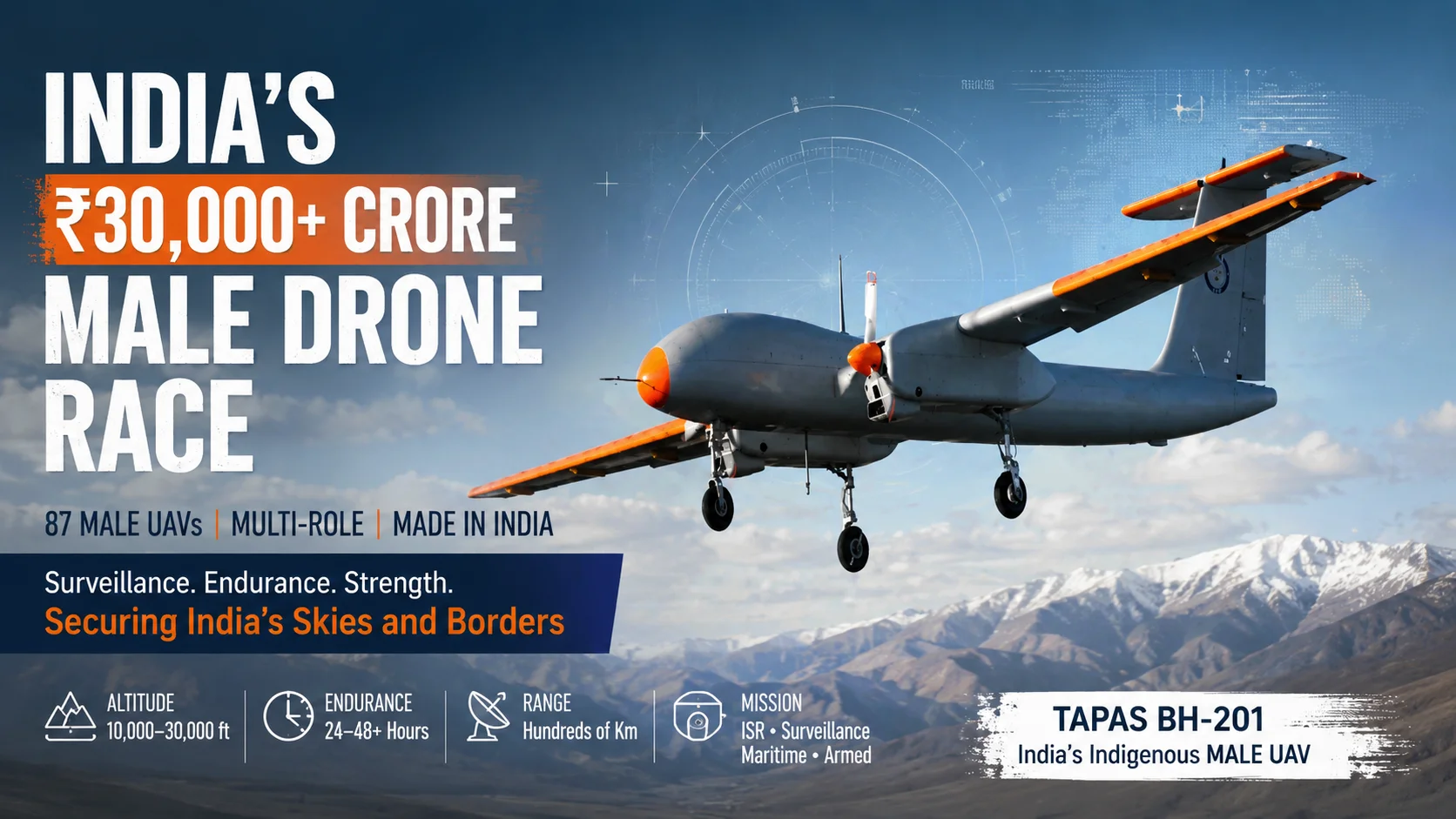
The TAPAS BH-201, developed by the Defence Research and Development Organisation (DRDO), serves as the technological baseline for this program. HAL and Bharat Electronics Limited (BEL) have already been involved in the development of the TAPAS, which has conducted over 200 test flights at the Aeronautical Test Range in Chitradurga.
But the TAPAS has faced weight and altitude bottlenecks.
Early prototypes struggled to reach the 30,000-foot ceiling required by the military for operations in the high-altitude regions of Ladakh and Arunachal Pradesh. The current tender seeks to rectify these deficits through private-sector industrial design.
The platform must carry a 350-kilogram payload.
This includes Synthetic Aperture Radar (SAR), Electronic Intelligence (ELINT), and Communication Intelligence (COMINT) packages.
The 3.99-Billion-Dollar Predator
This domestic push occurs alongside India’s $3.99 billion purchase of 31 MQ-9B SeaGuardian and SkyGuardian drones from General Atomics. That deal, approved by the U.S. State Department in February 2024, provides a high-end capability while the domestic MALE program scales up.
The MQ-9B acquisition includes 15 drones for the Navy and eight each for the Army and Air Force.
The domestic program is intended to fill the numerical gap.
India currently operates approximately 70 Israeli-made Heron and Searcher UAVs. Many of these airframes are nearing the end of their operational life or require extensive mid-life upgrades.
Upgrading the Heron fleet to SATCOM-linked Mark-II standards has cost the exchequer over ₹5,000 crore in recent years.
Frontier Logistics, Maritime Friction, and Indian defence contractors
The LAC with China spans 3,488 kilometers of mountainous terrain. Traditional manned reconnaissance is limited by weather and pilot fatigue.
The MALE platforms allow for persistent “stare” capability over the Depsang Plains and the Pangong Tso region.
And the maritime requirement is equally acute.
The Indian Navy currently monitors the Indian Ocean Region (IOR) using P-8I Poseidon aircraft and leased MQ-9Bs from its base in INS Rajali. Operating a domestic MALE fleet at a lower hourly cost than a P-8I would reduce the wear on the manned Boeing fleet.
The Navy wants drones capable of identifying “dark shipping” and monitoring Chinese research vessels near the Ninety East Ridge.
SWIFT and Stealth Strike Derivatives for defence companies
While the MALE tender focuses on surveillance, the DRDO is concurrently testing the Autonomous Flying Wing Technology Demonstrator (SWIFT). This is a precursor to the Ghatak UCAV, a stealth strike drone.
SWIFT weighs approximately one ton and uses a Russian NPO Saturn 36MT turbofan engine.
The Ghatak program aims to produce a full-scale combat drone with an internal weapons bay.
It is a flying-wing design.
This configuration minimizes the Radar Cross Section (RCS), allowing the drone to penetrate integrated air defense systems (IADS) that currently protect Pakistani and Chinese airspaces.
Corporate Arithmetic Among Key Indian defence companies
L&T has positioned itself by highlighting its work on the Arihant-class nuclear submarines and the K9 Vajra self-propelled howitzers. Their focus is on the structural integration and the ground control stations (GCS).
Tata Advanced Systems leverages its existing joint venture with Lockheed Martin and Boeing. They already manufacture fuselages for the AH-64 Apache in Hyderabad.
HAL remains the incumbent.
It has the largest aerospace infrastructure in South Asia and direct access to the TAPAS intellectual property.
But private firms argue HAL’s overhead costs and production timelines have historically lagged behind military requirements.
Sensor and Subsystem Bottlenecks for MALE unmanned aerial vehicles
The success of the 30,000-crore program depends on the supply of high-definition EO/IR (Electro-Optical/Infrared) pods. Currently, India relies heavily on Israeli firms like Elbit Systems and Rafael for these components.
Bharat Electronics Limited is attempting to indigenize these sensors under the “Atmanirbhar Bharat” initiative.
And then there is the engine issue.
India lacks a domestic small turbofan or high-power piston engine with the required reliability for MALE operations. Most Indian UAVs currently use engines from the Austrian firm BRP-Rotax.
Developing a domestic engine would likely take another decade.
Fiscal Context and Multi-Year Outlook for Defence Sector
The 2024-25 defense budget allocated ₹1.72 lakh crore for capital acquisitions.
The drone program will be funded through this capital head over a multi-year delivery schedule.
Payments will be milestone-based.
The MoD expects the first flight of the production-standard domestic MALE drone within 24 to 36 months of contract signing.
The program is a hedge.
If successful, it ends the era of buying off-the-shelf foreign surveillance assets.
If it fails to meet altitude benchmarks, the military will be forced to increase its dependency on further American or Israeli purchases to maintain parity at the border.
Testing continues at the Chitradurga range.