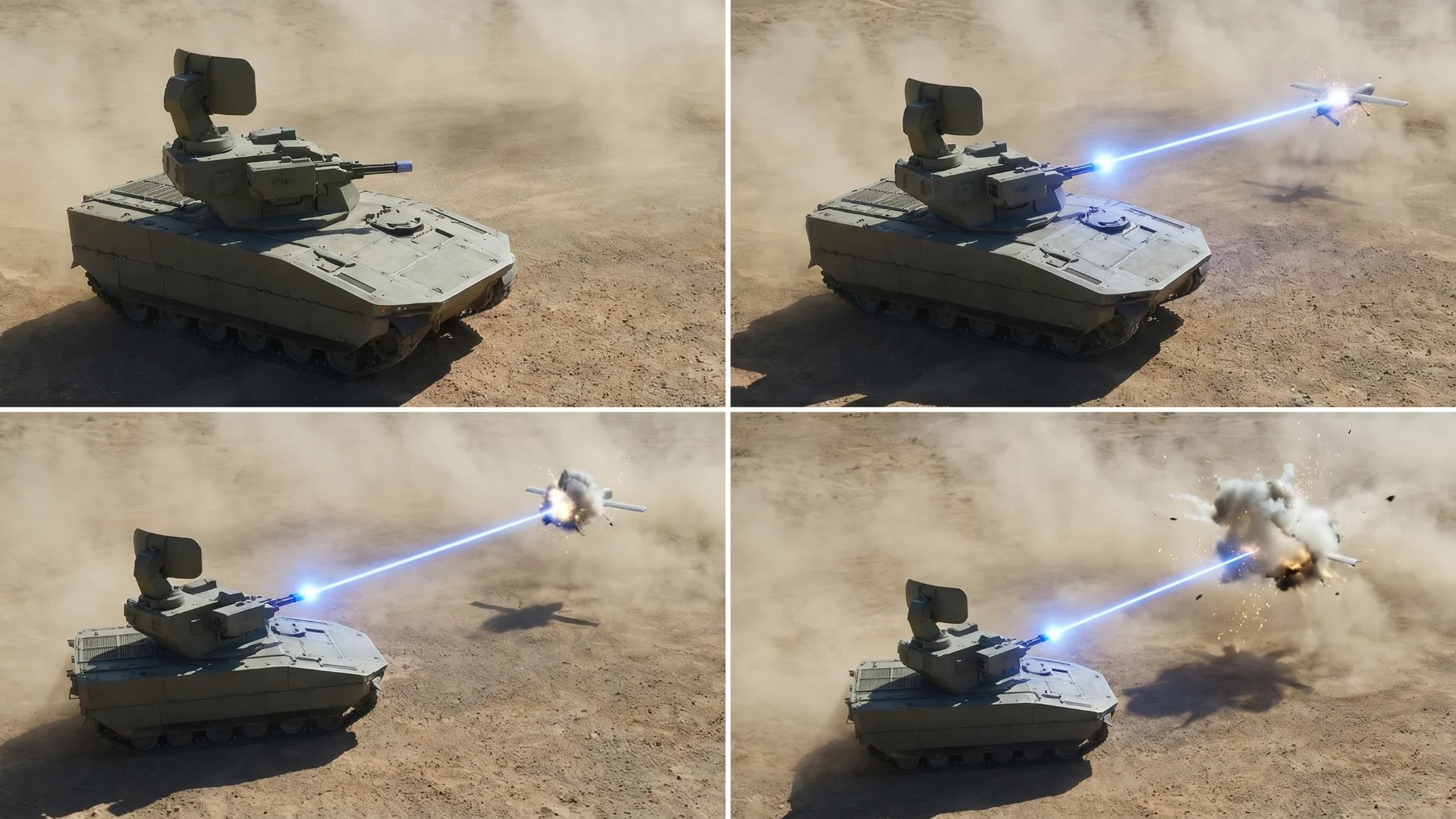
How DRDO’s 100kW DURGA II laser weapon is rewriting the economics of air defense and protecting India’s airspace.
NEW DELHI — The Indian Ministry of Defence is accelerating procurement timelines for directed-energy weapon (DEW) systems following the June 27, 2021, drone strike on the Jammu Air Force Station. Two low-altitude unmanned aerial vehicles (UAVs) breached the facility perimeter at 01:37 and 01:42 local time, highlighting a cost-asymmetry gap in current air defense networks. Existing radar-guided surface-to-air missiles (SAMs) often exceed $100,000 per unit, while the components for the improvised explosive devices used in the Jammu attack are valued under $1,000.
What is DRDO’s 100kW DURGA II laser weapon ?
The Centre for High Energy Systems and Sciences (CHESS), a Hyderabad-based laboratory under the Defence Research and Development Organisation (DRDO), is managing the primary indigenous laser programs. These efforts include the “DURGA II” (Directionally Unrestricted Ray-Gun Array) project. Military officials familiar with the development confirm that current prototypes are targeting a 100-kilowatt power threshold.
A 100kW system is required to neutralize hardened targets or fast-moving loitering munitions at distances exceeding 2 kilometers.
Current Indian air defense relies on the Akash and Israeli-made SPYDER systems. A single Tamir interceptor used in Israel’s Iron Dome costs approximately $40,000 to $50,000. In contrast, the US military estimates the cost per shot of a high-energy laser at roughly $1 to $10, excluding the initial capital expenditure of the hardware. The financial burden of countering swarms—where 20 to 50 low-cost drones attack simultaneously—threatens to deplete traditional missile inventories within hours of sustained engagement.
Logistical constraints complicate the rollout of these systems in India’s diverse geography.
In the Thar Desert, high ambient temperatures and particulate matter in the air cause “thermal blooming.” This phenomenon occurs when the laser beam heats the air it passes through, causing the beam to spread and lose lethality. In the high-altitude regions of Ladakh, lower oxygen density affects the efficiency of liquid-cooling systems required to prevent the laser diodes from melting. A 100kW laser generally requires more than 300kW of raw electrical input, necessitating massive mobile power generation units that must be transported over mountainous terrain.
The Indian Navy is the most likely first adopter for high-output DEWs.
Modern destroyers like the Visakhapatnam-class (Project 15B) possess the requisite electrical bus capacity to integrate 50kW to 100kW weapon systems. Onboard gas turbine generators provide a stable power source that land-based mobile platforms currently lack. Naval deployment also mitigates some dust-related beam scattering, though sea spray and high humidity introduce different atmospheric attenuation variables that diminish beam intensity over long distances.
China has already operationalized the “Silent Hunter,” a fiber optic laser system. Reports from the 2022 World Defense Show indicated that Saudi Arabia used the Silent Hunter to successfully intercept Iranian-designed Shahed-series loitering munitions. The Shahed-136 has a unit cost estimated between $20,000 and $30,000. If an interceptor costs $2 million—the price of a single PAC-3 MSE missile—the defender faces a cost-exchange ratio of 1:100.
India Directed Energy Weapons Program
DRDO conducted trials of a 1-kilowatt laser system against a drone at a range of 250 meters in 2018.
The progress toward 100kW reflects a tenfold increase in complexity regarding beam combination. To reach these power levels, engineers must combine multiple fiber laser modules into a single, coherent beam. Any misalignment at the milliradian level results in the energy dissipating before it reaches the target. This necessitates ultra-fast steering mirrors and adaptive optics to compensate for atmospheric turbulence in real-time.
Private sector participation is growing. Zen Technologies recently introduced the “Zen Bijli,” a counter-unmanned aerial system (C-UAS) utilizing directed energy. The presence of domestic firms in the supply chain for specialized optics and power electronics reduces reliance on components restricted by the Missile Technology Control Regime (MTCR) or other export control frameworks.
Financial markets are tracking these shifts. Shares of Indian defense contractors have seen increased volatility and volume as the government emphasizes “Atmanirbhar Bharat” (Self-Reliant India) in high-tech sectors. The Ministry of Defence’s Technology Development Fund (TDF) is currently subsidizing multiple projects related to pulse power and high-repetition-rate lasers.
Comparison with the UK’s “DragonFire” system, which recently achieved successful trials in Scotland, shows the global benchmarks India is chasing. The UK Ministry of Defence claims DragonFire can hit a coin from a kilometer away. Achieving this level of precision requires sophisticated target acquisition and tracking (TWS) radars that can distinguish between a bird and a carbon-fiber drone frame at high speeds.
The Indian Army’s requirements include a vehicle-mounted system capable of protecting moving columns.
Current Indian prototypes require a stationary platform to maintain the line-of-sight (LOS) dwell time necessary to burn through a drone’s fuselage. Depending on the material—plastic, carbon fiber, or aluminum—the laser must stay on a specific point for 2 to 5 seconds. Movement makes this dwell time difficult to sustain without advanced gyro-stabilization.
Short-range air defense (VSHORAD) remains a priority as the People’s Liberation Army (PLA) deploys swarm-capable units along the Line of Actual Control (LAC). Recent satellite imagery suggests the expansion of Chinese infrastructure capable of supporting electronic warfare and directed energy units in the Tibet Autonomous Region.
India’s KALI (Kilo Ampere Linear Injector) project represents a different branch of DEW research. Unlike lasers, KALI uses relativistic electron beams to produce high-power microwaves (HPM). HPMs do not melt the target but instead fry the integrated circuits and sensors inside the drone, rendering it fly-blind.
Operational integration into the Tri-Services commands will require new doctrines. Laser weapons operate at the speed of light, making them faster than any kinetic projectile. But they are limited by the horizon. They cannot hit targets behind hills or structures. This creates a tactical requirement for a “mixed-battery” approach where lasers handle the visual-range drones and missiles handle the over-the-horizon threats.
The hardware costs for a single high-power DEW system are estimated by industry analysts to be between $15 million and $30 million during the initial low-rate production phase.
Mass production depends on the domestic manufacturing of high-purity crystals and specialized fiber optics. Most high-end laser components are currently sourced from a limited number of suppliers in the US, Germany, and Japan. Establishing a local supply chain for these materials is a prerequisite for a sustainable DEW program.
The Ministry of Defence has not yet announced a formal date for the induction of the 100kW DURGA II. However, the 2024-25 interim budget indicated a continued 13% increase in R&D allocations for the DRDO. Testing continues at the Integrated Test Range (ITR) in Chandipur.
The focus remains on the “dwell time” versus “kill distance” metric.
If a 100kW DURGA II laser can neutralize a drone in 3 seconds at 3 kilometers, it can theoretically clear a swarm of 10 drones in 30 seconds. A traditional missile battery would be exhausted by such a swarm, requiring a 15-to-30-minute reload cycle. This time-on-target advantage is the primary driver for Indian defense investment in the sector.
The physics of the beam is constant. The industrialization of the platform is the variable.