Strategic Analysis · Middle East · India
Pakistan, Saudi Arabia and Turkey signed the Mecca Joint Defence Agreement on 7 August 2026. Behind the NATO-style rhetoric sits a question none of the three governments will directly answer.
At a Glance
- What happened: Turkey, Saudi Arabia and Pakistan signed the Mecca Joint Defence Agreement on 7 August 2026, treating an attack on one signatory as an attack on all three.
- The unresolved question: Whether the pact extends Pakistan’s nuclear deterrent to Saudi Arabia — something no official has confirmed or fully denied.
- The numbers: Pakistan holds an estimated 170 nuclear warheads to India’s 190 (SIPRI, January 2026).
- India’s response: The Ministry of External Affairs says it is “closely following” the development.
- The industrial angle: Turkey ($3B Akinci drone deal) and Pakistan ($4.6B JF-17 deal) are already outpacing India in new Gulf defence-export contracts.
On the night of 6 November 2013, BBC Newsnight’s diplomatic editor Mark Urban went on air with a claim that should have been the biggest nuclear proliferation story of the decade: Saudi Arabia, he reported, had already paid for nuclear weapons that sat ready in Pakistan, waiting only for a phone call. Islamabad called it baseless. Riyadh called it speculation. Nobody produced the weapons, and the story faded into the long list of things everyone in the nonproliferation world quietly assumes but nobody can prove.
Twelve years later, Pakistan, Saudi Arabia and Turkey stood together in Mecca and signed the Mecca Joint Defence Agreement — a pact built on the same unspoken premise that made Urban’s report so explosive in the first place.
What the Mecca Joint Defence Agreement Actually Says
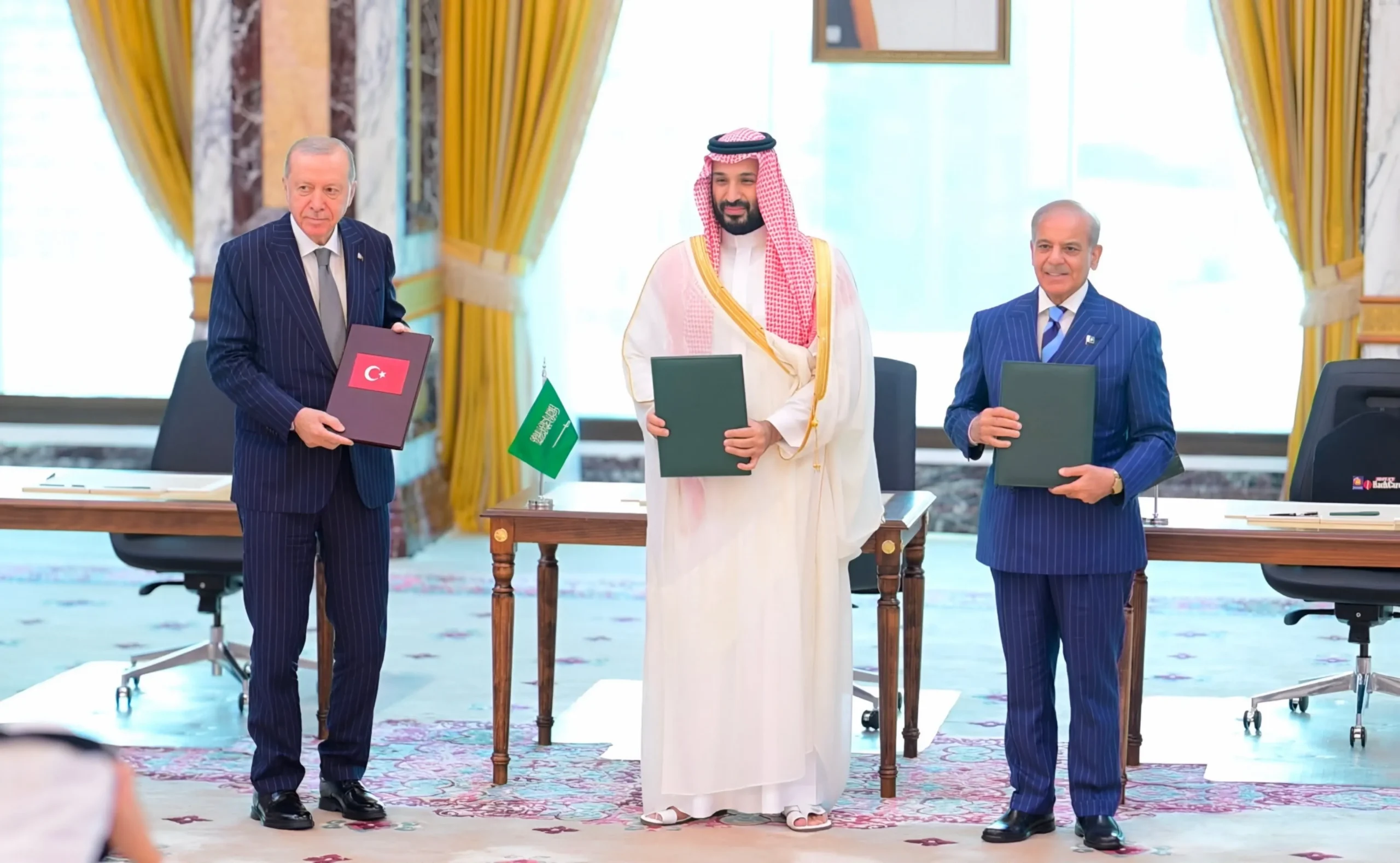
The Mecca Joint Defence Agreement is a trilateral pact signed on 7 August 2026 by Turkey, Saudi Arabia and Pakistan, committing each to treat an armed attack on any one signatory as an attack on all three. No treaty text has been published; the only public language is a joint statement describing “collective deterrence,” and officials from all three countries insist the pact targets no specific country.
The agreement was signed by Turkish President Recep Tayyip Erdoğan, Saudi Crown Prince and Prime Minister Mohammed bin Salman, and Pakistan Prime Minister Shehbaz Sharif, who was accompanied by army chief Field Marshal Asim Munir. The signing came against the backdrop of the ongoing US-Israel war on Iran, repeated Houthi strikes on Saudi territory, and mounting Gulf doubt over Washington’s reliability as a security guarantor, according to Al Jazeera’s reporting from the signing.
Turkish Vice President Cevdet Yılmaz and a Saudi deputy minister both insisted, separately, that the pact targets no specific country. The Atlantic Council’s analysts describe it as an inflection point in the emerging multipolar order across the Middle East and South Asia.
The comparison to NATO’s Article 5 is unavoidable, and also imprecise. Article 5 sits inside a seventy-seven-year-old treaty with a standing command structure, integrated militaries and a defined consultation process before any collective response. Mecca has none of that scaffolding yet — no joint command, no published force commitments, no timeline for building either. What it has is the rhetoric of automatic collective defence without the machinery to make it automatic. That gap is not necessarily a flaw. Strategic ambiguity of this kind lets all three governments project a deterrent effect without accepting the legal exposure of a binding military obligation — a feature, from Riyadh’s and Ankara’s perspective, not an oversight.
The Riyadh Blueprint: A Pact Formalised Twice
The Mecca pact is not a new relationship — it is an old one, formalised twice in eleven months. Pakistan and Saudi Arabia signed a bilateral Strategic Mutual Defence Agreement on 17 September 2025 in Riyadh, a pact analysts say largely codified decades of existing military cooperation. Turkey’s accession in August 2026 converted that bilateral understanding into a trilateral bloc.
Analysts at the Belfer Center, including Rabia Akhtar, argue the 2025 pact largely codified decades of existing military cooperation rather than creating something new. Pakistani troops have deployed in the Kingdom since the 1960s; Pakistan has trained an estimated 8,000 to 10,000 Saudi personnel over the decades and currently stations roughly 1,500 to 2,000 troops there in training and advisory roles.
Turkey’s accession, under negotiation since early this year according to Turkish media reports, converts a bilateral security understanding into something closer to a trilateral bloc — one combining Turkey’s NATO-anchored military, Saudi Arabia’s oil wealth, and Pakistan’s status as the only nuclear-armed state in the Muslim world. Turkey’s own motives are as much about Ankara’s regional positioning as about Riyadh or Islamabad — TES has previously examined why Turkey backs Pakistan strategically, and what that alignment means for India.
The Industrial Teeth Behind the Diplomacy
Set the nuclear speculation aside and the Mecca pact still has hardware behind it. Turkey brings a $3 billion Saudi drone contract, Pakistan brings a $4.6 billion fighter-jet export record, and Saudi Arabia brings a Vision 2030 mandate to localise half its defence spending by 2030 — three industrial bases already courting the same Gulf procurement budgets independently of any treaty.
Turkey’s Baykar signed what it called the largest defence export contract in Turkish history with Saudi Arabia in July 2023 — a deal for Akinci strike drones reported at roughly $3 billion, with Saudi Arabian Military Industries planning to eventually produce up to 70 percent of the aircraft locally. Pakistan’s JF-17 Thunder programme, co-produced with China, delivered its own record when Islamabad signed a $4.6 billion, 40-aircraft deal with Azerbaijan in 2025 — Pakistan’s largest defence export ever. Saudi Arabia has been named among several countries weighing potential procurement of the JF-17, alongside Iraq, Libya and Sudan, though no contract has been confirmed. Riyadh’s own defence-industrial arm, the General Authority for Military Industries, reported local content reaching 24.8 percent of military spending last year, on a Vision 2030 path toward 50 percent localisation by 2030.
| Actor | Metric | Value | Year |
|---|---|---|---|
| Turkey → Saudi Arabia | Akinci strike-drone export deal | ~$3.0 billion | 2023 |
| Pakistan → Azerbaijan | JF-17 Thunder fighters (40 units) | $4.6 billion | 2025 |
| Saudi Arabia | Vision 2030 defence-localisation (current / target) | 24.8% / 50% | 2025 / 2030 |
| India | Nuclear warheads (SIPRI estimate) | ~190 | Jan 2026 |
| Pakistan | Nuclear warheads (SIPRI estimate) | ~170 | Jan 2026 |

None of this is new because of Mecca. But a trilateral security framework gives Ankara and Islamabad a diplomatic umbrella under which to pitch exactly this kind of joint production and technology-transfer cooperation to Riyadh — precisely the “joint production, technology partnerships, procurement and greater military interoperability” that RUSI researchers have flagged as one of the pact’s more concrete near-term outcomes, describing contracts that were already in motion before the pact existed, now with a political rationale attached.
The Question Mecca Didn’t Answer
When Reuters asked a senior Saudi official directly whether the pact obliges Pakistan to extend a nuclear umbrella to the Kingdom, the reply was carefully non-committal: “This is a comprehensive defensive agreement that encompasses all military means.” Pakistan’s declared doctrine says its weapons exist solely to deter India — a position Islamabad has never formally revised.
That single sentence, reported by Reuters after the September 2025 signing, is doing a great deal of work. Not yes. Not no. Yet the ambiguity of “all military means” has been enough to fuel a decade of speculation that Riyadh has, at minimum, purchased insurance it hopes never to redeem.
A Rumour With a Paper Trail
Speculation that Saudi Arabia has secured access to Pakistani nuclear weapons dates to at least 2013, when BBC Newsnight’s Mark Urban reported that warheads built for Riyadh sat ready in Pakistan. Both governments denied it on the record then, and both have denied every version of the claim since — a pattern of allegation and denial stretching back to Saudi Arabia’s covert 1980s missile purchases from China.
Saudi Arabia secretly acquired dozens of CSS-2 ballistic missiles from China in the late 1980s — weapons designed to carry warheads, deployed roughly two decades ago, and never publicly explained. Bruce Riedel of the Brookings Institution wrote in 2008 that Pakistan maintained “an unacknowledged nuclear partnership to provide the kingdom with a nuclear deterrent on short notice if ever needed.” During Nawaz Sharif’s tenure as prime minister, researchers have pointed to a period when Saudi financing appears to have helped keep Pakistan’s nuclear and missile programmes afloat during a domestic financial crisis.
Every one of these claims has been denied on the record. Pakistan’s Foreign Office called the 2013 BBC report “baseless, mischievous and provocative.” The Saudi embassy in London noted, accurately, that the Kingdom remains a signatory to the Nuclear Non-Proliferation Treaty. Independent analysts, including Akhtar at the Belfer Center, argue the 2025 and 2026 pacts do not constitute a nuclear guarantee and that reading one into vague treaty language overstates what has actually changed. Both readings can coexist in the same story — that is precisely what makes the ambiguity durable.
New Delhi’s Calculus
For India, the arithmetic starts with numbers. SIPRI’s Yearbook 2026 put Pakistan’s arsenal at roughly 170 warheads against India’s 190 — a gap the institute says is narrowing as Pakistan develops new delivery systems. India’s Ministry of External Affairs has responded to the Mecca Joint Defence Agreement by saying only that it is “closely following” the development.
SIPRI’s Yearbook 2026, released in June, linked Pakistan’s continued development of new delivery systems and fissile-material stockpiles to the four-day India-Pakistan conflict of May 2025. TES has separately examined the physics and doctrine behind India’s own deterrent in our explainer on the Agni-V MIRV programme, and the conventional side of the equation in our analysis of Pakistan’s prospective J-35 stealth fighter options.
India’s Ministry of External Affairs has so far kept its public response deliberately thin. After the 2025 bilateral pact, spokesperson Randhir Jaiswal said New Delhi would “study the implications.” After the trilateral version this month, the language barely moved: India is “closely following” the development, Jaiswal told reporters on 7 August, “and we shall keep you updated.” The MEA also moved quickly to knock down an AI-generated fake news report — sourced to Turkish outlet Straturka — claiming India had sought a matching defence pact with Israel in response, evidence of how fast misinformation now attaches itself to a story like this.
Not every analyst reads the pact as a setback for India. Michael Kugelman has cautioned against over-reading the agreement, telling the BBC it “does not hinder India in a direct way” and that Saudi Arabia — India’s second-largest trading partner and a major oil supplier — is “not about to engage in hostile retaliatory acts against India.” IISS’s Hasan Alhasan frames the pact chiefly through a Saudi-Israel lens, arguing Riyadh is using it to plug a conventional deterrence gap against a nuclear-armed Israel rather than to reposition against India at all. Against that, Indian commentary has been considerably less sanguine: The Week described the pact as bringing Pakistan’s “nuclear weapons, Turkey’s massive NATO-backed military, and Saudi Arabia’s immense wealth and religious leadership” into a single bloc that “presents a significant strategic challenge to India.”
The Investor Read
No confirmed stock-market repricing has been tied directly to the Mecca signing, and the pact’s immediate effect is diplomatic rather than commercial. The figure worth tracking instead is competitive: Turkey and Pakistan are already winning billion-dollar Gulf defence contracts, and a shared security framework makes it easier for both to pitch Riyadh on joint production — directly in the lane India’s own Gulf defence-export ambitions occupy.
India has spent the past two years building its own parallel track in the Kingdom: a Munitions India Limited memorandum of understanding signed on the sidelines of World Defence Show 2024, and a third round of the India-Saudi Security Working Group held in January 2026. That track now operates in a more crowded field. Turkey has a $3 billion drone contract and a stated local-production offer; Pakistan has a $4.6 billion export record and is already named on Saudi Arabia’s shortlist of countries under consideration for JF-17 talks. A political framework that makes it easier for Ankara and Islamabad to pitch Riyadh on joint production doesn’t show up as a stock-price move — it shows up later, in whose order book grows in the Gulf’s defence-procurement market over the next several years. That is the number for Indian investors and exporters to track, not a one-day repricing.
What Would Actually Have to Change
For now, the Mecca pact is a political signal dressed in legal language. Converting it into an operational military commitment — joint command structures, prepositioned forces, an explicit nuclear-sharing arrangement — would require steps none of the three governments has taken or announced. That gap between rhetoric and machinery may be the entire point.
Qatar’s potential accession, floated by Pakistan’s defence minister as a welcome next step, would expand the bloc’s economic weight further without necessarily resolving the ambiguity at its centre. A published nuclear-sharing clause would trigger a nonproliferation crisis Riyadh does not want and a doctrinal contradiction Islamabad cannot easily explain. A flat denial would strip the pact of the deterrent value that comes from uncertainty. Mecca left the question exactly where Mark Urban left it in 2013 — unanswered, unresolved, and doing more strategic work by staying that way.
What to Watch
Does the Mecca Joint Defence Agreement give Saudi Arabia access to Pakistani nuclear weapons?
No government has confirmed this. The pact’s language is deliberately vague — a senior Saudi official has said only that it is “a comprehensive defensive agreement that encompasses all military means,” while Pakistan’s declared doctrine states its weapons exist solely to deter India. Analysts are split on whether this constitutes an implicit understanding or nothing more than durable speculation.
How has India responded to the Mecca Joint Defence Agreement?
India’s Ministry of External Affairs has kept its response deliberately measured, saying only that it is “closely following” the development — language consistent with its response to the original bilateral Pakistan-Saudi pact in September 2025.
Could Qatar or other countries join the Mecca Joint Defence Agreement?
Pakistan’s government has said Qatar’s accession would be welcome, though no formal steps toward Qatari membership have been announced as of this writing.
Sourcing note: Claims regarding Saudi financing of, or access to, Pakistan’s nuclear programme are longstanding, contested allegations denied on the record by both governments — not verified facts — and are presented as such throughout this piece.