
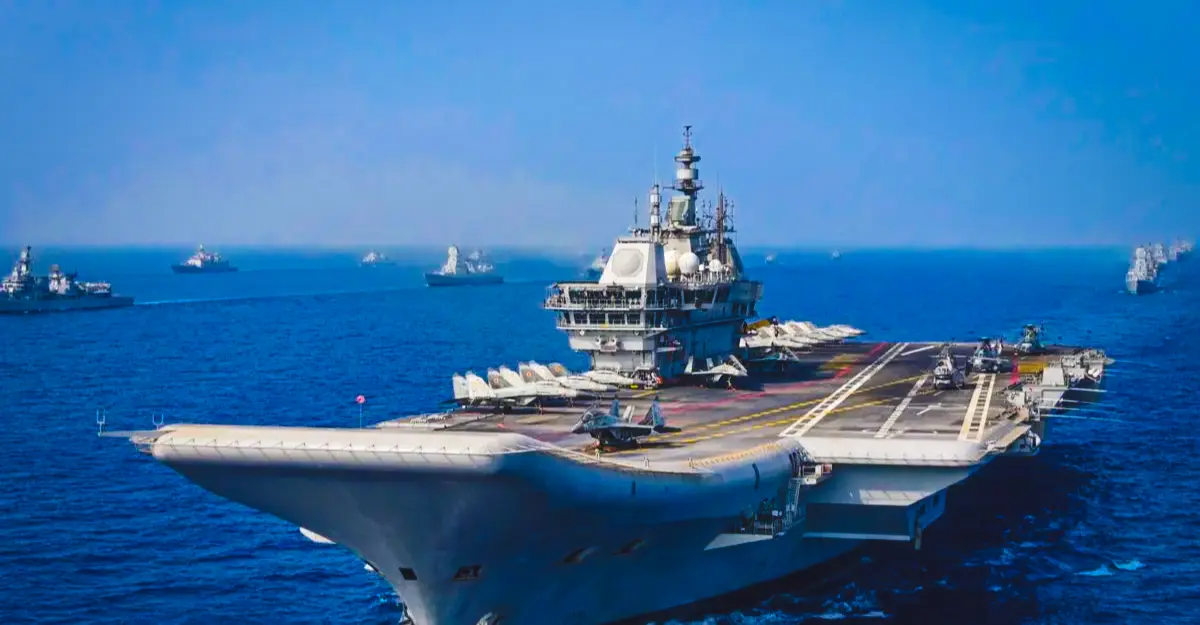
Indian Navy 2026 has been a record year for the fleet — a record 19 warships commissioned, fifth place globally by tonnage — even as its third carrier awaits formal clearance and its German submarine deal remains unsigned.
Indian Navy 2026 is best understood by looking backward first. On 4 December 1971, three Soviet-built missile boats no larger than modern coast guard cutters slipped toward Karachi harbour after dark and fired on the Pakistan Navy at point-blank range. Operation Trident sank a destroyer, a minesweeper and a merchant vessel, and it proved something that outlasted the war: that a conflict decided mostly by tanks and infantry on land could still turn on what happened at sea. India has marked 4 December as Navy Day ever since. For most of the half-century that followed, the lesson didn’t fully stick — the Navy stayed the smallest line item in India’s defence budget, an afterthought to the Himalayan border.
That changed, on paper, in 2026. India commissioned a record run of warships this year, and by the metric that matters most — total fleet tonnage — it now outweighs Pakistan’s navy roughly 5.5 times over and sits fifth in the world, ahead of France, the UK and Italy. Yet India’s existing two-carrier fleet — INS Vikrant and INS Vikramaditya — still isn’t a three-carrier one: formal clearance for a third carrier, IAC-2, is only targeted for late 2026, and the submarine deal meant to close India’s biggest capability gap has been “close to signing” for over a year. All three facts are true simultaneously, and together they are the real Indian Navy 2026 story — more useful than any single headline number.
- 632,000t India’s total naval fleet tonnage — 5th globally, GlobalFirepower 2026
- 115,000t Pakistan’s fleet tonnage — 28th globally, ~5.5× lighter than India’s
- 19 ships India’s record 2026 induction count, up from 14 in 2025
- 6 subs / €8bn Project 75I — the still-unsigned Germany deal
- 26 jets / ₹63,000cr Rafale-M — signed Apr 2025, deliveries 2028–2031
- ₹2.35 lakh cr Value of DAC-approved warship orders (74 vessels) still to be built
Why India Is Suddenly Building a Navy, Not Just an Army
The most contested pillar is strategic: the claim, repeated across Indian commentary, that China has encircled India through dual-use ports in Djibouti, Gwadar and Hambantota — a framing widely known as the “String of Pearls.” That characterisation is disputed even within the analyst community; Hambantota remains a Sri Lankan commercial lease, not a confirmed Chinese naval base, and there is no public evidence Beijing has stationed forces at most of the ports commonly cited. It’s a real and widely used lens for reading China’s Indian Ocean footprint — not a verified fact, and TES treats it as the former. See TES’s related coverage of China’s next-generation fighter programme and India’s counter-strategy for the air-power side of this same rivalry.
The third pillar is harder to argue with. India’s “No First Use” nuclear doctrine depends on a second-strike force that can survive a first strike, and land-based missiles and airfields cannot promise that the way a submarine at sea can. That is the logic behind the SSBN fleet, and it is the part of India’s naval expansion that reads less like choice and more like necessity.
Indian Navy 2026: Inside the Record Induction Cycle
On 3 April 2026, the Navy quietly commissioned INS Aridhaman (S4) — its third nuclear-powered ballistic missile submarine, after INS Arihant (2016) and INS Arighaat (2024) — at the Ship Building Centre in Visakhapatnam. Defence Minister Rajnath Singh marked the moment with a single cryptic social-media post rather than a formal ceremony, consistent with the programme’s usual secrecy. At roughly 7,000 tonnes, Aridhaman is a stretched, more heavily armed variant of its predecessors, carrying K-4 and K-5 missiles with substantially longer range than the original K-15. A fourth boat, expected to be commissioned as INS Arisudan, is in sea trials and not due before 2027.
Surface combatants followed close behind. Three Nilgiri-class (Project 17A) stealth frigates — Taragiri, Dunagiri and Mahendragiri — reached the Navy between April and July, joining Nilgiri, Himgiri and Udaygiri, commissioned the year before. That completes six of the programme’s seven planned frigates, split between Mazagon Dock (four hulls) and Garden Reach Shipbuilders & Engineers (three hulls); the seventh, Vindhyagiri, is still awaiting delivery. In May, GRSE separately launched INS Sanghmitra, the first of its four Next-Generation Offshore Patrol Vessels — part of an 11-ship, ₹9,781-crore programme split with Goa Shipyard Limited.
Hunting in Shallow Water: The ASW-SWC Story
On 26 November 2008, ten gunmen reached Mumbai by sea, exposing a gap in India’s coastal and shallow-water surveillance that a navy built for open ocean — not creeks and harbour approaches — was never designed to close. The response took years to reach the water. It arrived, in part, this year.
INS Anjadip (27 February) and INS Agray (21 June) are Arnala-class craft, built by GRSE with L&T’s Kattupalli yard. INS Malwan (22 July) is a Mahe-class vessel, built separately by Cochin Shipyard. Between the two lines, 16 of these coastal hunters are planned in total — small, fast, water-jet-propelled boats built for the acoustic clutter of Indian harbours, where a blue-water frigate is both the wrong tool and an expensive one to tie down.
The Shipyards Behind the Surge
Mazagon Dock leads on submarines and stealth frigates; GRSE splits output between frigates, corvettes and the new NGOPVs; Cochin Shipyard holds the country’s largest dry docks and is the only yard equipped to build aircraft carriers; Goa Shipyard and Hindustan Shipyard round out the public-sector five, the latter specialising in platforms the others don’t touch — including INS Nipun, a 118-metre, 8,560-tonne Diving Support Vessel delivered in July 2026. That platform belongs to HSL alone, worth noting given how differently HSL and GSL are positioned in the private-versus-public conversation TES has covered elsewhere.
Private industry fills the gaps the PSUs don’t prioritise. Titagarh Rail Systems completed a five-vessel Diving Support Craft programme in 2026; L&T’s Kattupalli yard delivered the first of three new Cadet Training Ships, INS Krishna, in February; Thane-based MSME Suryadipta Projects continued its long-running ammunition-barge deliveries; a separate Thane firm, Shoft Shipyard, holds the Navy’s contract for self-propelled fuel barges.
Follow the Money: What the Indian Navy 2026 Order Books Say
India’s naval build-out is not just a military story; it is one of the more visible re-ratings on Dalal Street this year, and the underlying order-book numbers are public and largely official, not brokerage guesswork. The Defence Acquisition Council has accorded Acceptance of Necessity for 74 additional warships — 65 surface ships and 9 submarines — worth ₹2.35 lakh crore, on top of roughly ₹99,500 crore already under contract across 54 vessels currently being built. Brokerage research (Choice Broking, June 2026) names Mazagon Dock, Cochin Shipyard and GRSE as the primary beneficiaries. GRSE closed its books in May 2026 with an order backlog near ₹15,300 crore, about 2.2 times its FY26 revenue; Mazagon Dock’s stood near ₹20,500 crore. SMIFS research separately described the Navy entering a multi-year “commissioning super-cycle,” projecting roughly one warship added every 40–42 days from 2026 onward.
Cochin Shipyard’s near-term stock story is tied to a decision that hasn’t been made yet: brokerage Ashika noted in April 2026 that CSL’s performance remains contingent on the “timing and clarity” of India’s proposed third carrier, IAC-2. The Navy has already scaled back its ambitions here to speed things along — the earlier 65,000-tonne supercarrier concept has been dropped in favour of a cheaper, faster 45,000-tonne repeat of the Vikrant design, reworked for drone operations, with formal Acceptance of Necessity targeted for late 2026. None of this is investment advice; it is the clearest evidence available that markets already treat India’s naval build-out as a structural story.
Indian Navy 2026 vs the World: Where It Ranks
| Rank | Country | Fleet Tonnage |
|---|---|---|
| 1 | United States | 8.27M tonnes |
| 2 | China | 3.19M tonnes |
| 3 | Russia | 1.43M tonnes |
| 4 | Japan | 798,000 tonnes |
| 5 | India | 632,000 tonnes |
| 6 | France | 487,000 tonnes |
| 7 | South Korea | 428,000 tonnes |
| 8 | United Kingdom | 406,000 tonnes |
| 9 | Italy | 388,000 tonnes |
| 10 | Türkiye | 350,000 tonnes |
| 28 | Pakistan | 115,000 tonnes |
The Pakistan Factor: Sea Denial, Not Blue Water
By tonnage, the gap is stark: roughly 115,000 tonnes against India’s 632,000, a 5.5-times difference. By hull count, one open-source tracker puts Pakistan’s active fleet at around 109 vessels, ranked 21st of 71 navies worldwide — a smaller, more coastal-focused force by design, not by failure.
The one place Pakistan is moving fast is submarines. PNS Hangor — first of eight Chinese-built, AIP-equipped boats (2,800 tonnes, derived from China’s Type 039A/S26 design) — commissioned on 30 April 2026. If the remaining three China-built hulls complete on the reported schedule, Pakistan’s AIP-capable submarine fleet more than doubles within the year, from three ageing Agosta-90Bs to seven — the fastest submarine expansion in the Pakistan Navy’s modern history, even if the final four hulls (built locally at Karachi Shipyard) will take longer. On the surface, Pakistan now operates four Chinese-built Tughril-class (Type 054A/P) frigates at 4,200 tonnes each, plus Turkish MILGEM-derived Babur-class corvettes — real modernisation, deepened by recurring “Sea Guardians” exercises with China’s navy, but scaled for coastal deterrence between Karachi and Gwadar, not for contesting sea lanes further out.
The German Deal: Project 75I Isn’t Signed Yet
Six Type 214-based diesel-electric submarines with fuel-cell AIP — three weeks submerged endurance — built in Mumbai by Mazagon Dock under a Strategic Partnership with Germany’s ThyssenKrupp Marine Systems. The rival Spanish bid, from L&T and Navantia, was eliminated in January 2025 on a technology-transfer requirement only TKMS could meet.
Cost has moved around in reporting rather than settling: cost negotiations concluded in February 2026 near ₹66,000–70,000 crore ($8–9 billion), while some August 2026 coverage cites figures as high as ₹90,000–99,000 crore. TES treats the exact number as unsettled until a contract is signed. As of this writing, the deal awaits Cabinet Committee on Security clearance, with Germany’s ambassador saying a signature is expected “very soon” — a timeline that has already slipped past an earlier March 2026 target. Worth being blunt about what comes after signing: even a late-2026 contract likely means the first submarine doesn’t commission before roughly 2033, with the sixth arriving near 2040, per detailed reporting on the negotiation history. This is the deal that effectively sidelined India’s earlier plan for three additional French Scorpène boats.
The Honest 2030 Number
What’s realistic by 2030: the last Nilgiri-class frigate, the fourth Arihant-class SSBN, most of the 11 Next-Generation Offshore Patrol Vessels and 6 Next-Generation Missile Vessels, the remaining Anti-Submarine Warfare Shallow Water Craft, three new Cadet Training Ships, and some portion of the five 44,000-tonne Fleet Support Ships whose deliveries begin “mid-2027” per the Navy’s contract with Hindustan Shipyard — that last programme alone is the single biggest swing factor in the whole estimate.
What’s ordered or approved but structurally can’t arrive in time: seven Project 17B frigates (AoN cleared, contract unsigned), four 32,000-tonne Landing Platform Docks (AoN only, no keel laid), eight Next-Generation Corvettes (GRSE still the lowest bidder, not yet contracted), a dozen Mine Countermeasure Vessels, the Project 75I submarines just discussed, and the Project 18 destroyer class and Project 77 SSN programme, neither of which has cleared formal approval yet. The pipeline is real. It’s simply back-loaded into the 2031–2037 window far more than into the next four years.
Other Big-Ticket Items on the Table
The Ministry of Defence’s Technology Perspective and Capability Roadmap, unveiled 5 September 2025, commits India to operating at least 10 nuclear-propelled surface ships within 15 years — including a nuclear-powered carrier, INS Vishal, reportedly in the 65,000–75,000-tonne class. Separately, the Navy issued a Request for Information in February 2026 for a Land-Attack Cruise Missile to arm its conventional submarine fleet, a strike capability it currently lacks entirely. And the indigenous Twin-Engine Deck-Based Fighter, meant to eventually replace both the Rafale-M and the ageing MiG-29K, has its first flight targeted for 2032–33 — meaning whatever India buys off the shelf now is a decade-long bridge, not a permanent answer.
The Rafale-M Factor
Deliveries begin in 2028 and are due to complete by 2030–31. A French aircraft and pilot are expected to make the type’s first landing on INS Vikrant before the end of 2026, part of a structured deck-compatibility campaign covering arresting gear, ski-jump launches and approach profiles.
The integration isn’t free of friction: naval-aviation reporting has flagged that the Rafale-M’s non-folding wings require modification to fit elevators on INS Vikrant that were sized for the smaller MiG-29K — a real engineering constraint, not a settled fact about final performance, and worth watching rather than assuming away. For now, the plan is for Rafale-M to become the frontline type aboard Vikrant while INS Vikramaditya continues flying the MiG-29K, whose serviceability troubles were the original reason the Navy went shopping for a replacement.
What to Watch
Not yet, but the Navy is targeting formal Acceptance of Necessity by late 2026, for a scaled-back 45,000-tonne design rather than the earlier 65,000-tonne supercarrier concept. India currently operates two carriers, INS Vikrant and INS Vikramaditya; IAC-2 would be the third.
No, as of this writing. Cost negotiations concluded in February 2026, but the contract still awaits Cabinet Committee on Security approval; even a prompt signature points to a first delivery around 2033.
About 5.5 times heavier by tonnage and roughly fifth versus 21st-to-28th globally depending on the metric used — a gap wide enough that Pakistan’s 2026 submarine expansion, while real, changes the regional balance only at the margins.
The Takeaway
India finally started building the navy its coastline, not just its borders, required.
Fifty-five years after three missile boats no one expected proved that India’s navy could decide a war, the Navy is finally being built like the country believes it. Nineteen warships, a third SSBN, a fifth-place spot on the global tonnage table, a fivefold tonnage edge over Pakistan — that’s the real shape of Indian Navy 2026, and none of it happened by accident, or as fast as the headline numbers suggest, either. The fleet Operation Trident’s veterans would recognise fastest isn’t the third carrier still waiting on clearance, or the submarine deal still waiting on Berlin. It’s the small, unglamorous shallow-water hunters now patrolling the same kind of waters ten gunmen once slipped through undetected.
- GlobalFirepower — Navy Fleet by Tonnage 2026
- Naval News — INS Malvan commissioning, July 2026
- The Print — TKMS cost negotiations, February 2026
- Internationale Politik Quarterly — the German-Indian submarine deal
- Quwa — Hangor-class programme status
- Indian Defence News — Rafale-M deck trials on INS Vikrant
- Business Today — GRSE, Mazagon Dock, Cochin Shipyard order books, June 2026
- Carnegie Endowment — the coming of age of India’s nuclear triad

1 thought on “Indian Navy 2026: Five Times Pakistan’s Tonnage, Third Carrier Still Pending”