
Balaji Chandramohan and Natalie Treloar
The strategic balance of the Indo-Pacific is increasingly being shaped beneath its oceans. Submarines, autonomous underwater vehicles, seabed sensors and long-range precision weapons are becoming central to the ability of regional powers to deter aggression, protect maritime communications and operate across vast distances.
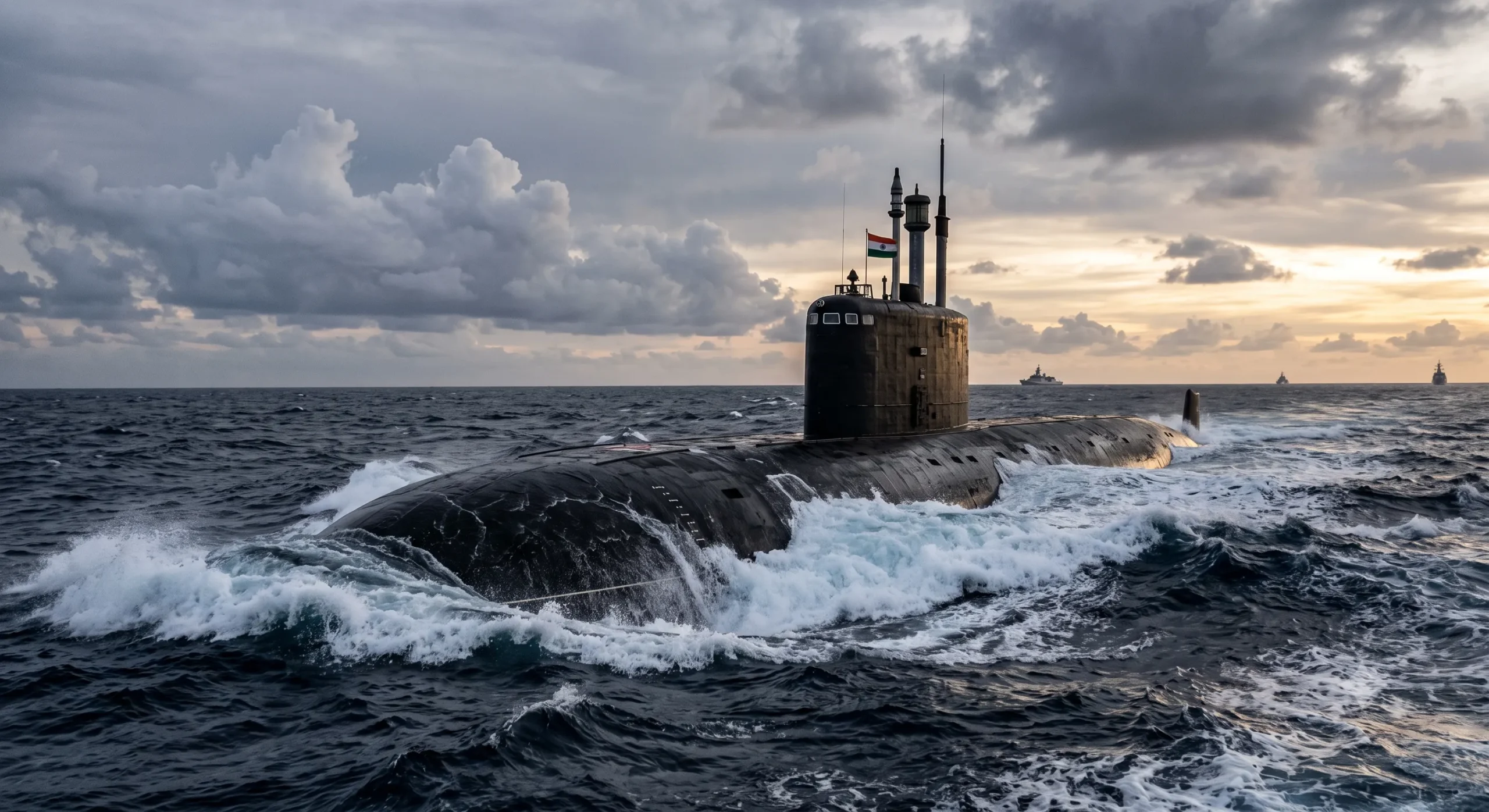
India’s reported plans for its next generation of nuclear-powered attack submarines could mark an important development in this emerging undersea competition. Project-77, previously associated with the designation Project-75 Alpha, is widely reported to have evolved beyond a conventional hunter-killer submarine into a larger, heavily armed platform combining anti-submarine warfare, intelligence collection and long-range conventional strike.
Recent defence reporting claims that Project-77 may incorporate a 24-cell vertical launch system capable of carrying cruise missiles and, eventually, hypersonic weapons. Some reports describe a submarine approaching 10,000 tonnes, effectively creating an “arsenal SSN” able to conduct both sea-denial and land-attack missions. These details have not been officially confirmed, and published accounts differ on displacement and weapons configuration. Nevertheless, the reported concept indicates the direction of Indian naval thinking: a submarine force designed not only to hunt hostile vessels but to impose strategic costs deep within a contested theatre.
Beyond Hunter-Killers: The Strategic Arsenal of Project-77
A traditional nuclear-powered attack submarine, or SSN, is principally designed to locate and destroy enemy submarines and surface ships. It can also escort ballistic-missile submarines, gather intelligence and support special operations.
An arsenal-style Project-77 would retain these missions while adding a significantly larger conventional-strike capacity. A 24-cell vertical launch system could permit the submarine to fire long-range cruise missiles without relying entirely on its torpedo tubes. Future compatibility with hypersonic weapons could further increase its ability to penetrate advanced air and missile defences, although both the platform and prospective weapons remain developmental.
Such a capability would allow India to hold at risk naval bases, logistics facilities, command centres and other high-value military targets from concealed positions at sea. It would also strengthen India’s capacity to disrupt an adversary’s maritime operations through conventional means without immediately escalating to nuclear use, while its nuclear arsenal continued to underpin its overall deterrence posture.
This distinction matters. India’s Arihant-class ballistic-missile submarines protect the survivable sea-based component of its nuclear deterrent. Project-77 would instead provide conventionally armed nuclear-powered attack submarines capable of defending those SSBNs, tracking hostile submarines and delivering precision strikes. The two forces would be mutually reinforcing but doctrinally distinct.
India’s Indo-Pacific strategy
Project-77 reflects India’s transition from a navy focused largely on coastal defence to one capable of sustained operations across the Indian Ocean and into the wider Indo-Pacific.
China’s growing naval reach is a major driver of this shift. Chinese submarines, surveillance vessels and naval task groups are operating with increasing frequency across the Indian Ocean. Beijing has also developed access to a network of ports and logistics facilities extending from the South China Sea towards the Arabian Sea and the African coast.
India therefore requires submarines with the endurance to shadow Chinese forces, protect critical sea lanes and operate far from their home ports. Nuclear propulsion is especially valuable because it provides sustained speed, long endurance and reduced dependence on surfacing or snorkelling.
Project-77 could consequently become one of the principal instruments through which India exercises sea denial across the northern Indian Ocean. It could also patrol approaches to the Strait of Malacca, monitor Chinese naval movements and support Indian operations stretching from the Bay of Bengal to the western Pacific.
The Andaman and Nicobar gateway
The Andaman and Nicobar Islands would be central to this strategy.
Located near the western approaches to the Strait of Malacca, the archipelago overlooks the principal maritime connection between the Indian and Pacific Oceans. India’s Andaman and Nicobar Command is its first and only joint operational command, integrating the Army, Navy, Air Force and Coast Guard in a strategically vital part of the Indian Ocean.
The islands could support maritime patrol aircraft, unmanned systems, surveillance infrastructure and anti-submarine operations monitoring vessels entering or leaving the Indian Ocean. They would not necessarily need to become a permanent foreign submarine base. Their greater value lies in functioning as an Indian-controlled sensor, logistics and intelligence node.
Combined with Project-77, the islands could give India an increasingly powerful undersea presence near one of China’s most important maritime vulnerabilities. They could also become the Quad’s undersea gateway by connecting Indian geographic access with Australian, Japanese and American surveillance, anti-submarine and technological capabilities.
AUKUS and India are not competitors
AUKUS and India’s submarine programme are sometimes treated as competing models of undersea power. This interpretation misunderstands their respective purposes.
AUKUS Pillar I is intended to provide Australia with conventionally armed, nuclear-powered submarines through cooperation with the United Kingdom and the United States. Pillar II is developing advanced capabilities in areas including autonomy, artificial intelligence, electronic warfare and undersea systems. Australia, Britain and the United States announced their first Pillar II signature project in 2026, focused on payloads and enabling systems for uncrewed underwater vehicles.
India is pursuing an indigenous and sovereign SSN capability. It is not an AUKUS member, nor is it likely to accept a submarine arrangement that compromises strategic autonomy.
Yet these approaches are complementary.
AUKUS can strengthen allied submarine numbers, industrial capacity and advanced undersea technology across the southern and eastern Indo-Pacific. India can provide persistent undersea power, geographic access and local intelligence across the northern Indian Ocean. Japan contributes highly capable conventional submarines, maritime patrol aircraft and anti-submarine expertise.
Together, these capabilities create a distributed rather than centralised deterrence architecture.
The Quad’s role
The Quad should not attempt to replicate AUKUS. Nor should it seek shared command over India’s submarines.
Its most valuable contribution would be to connect national capabilities through maritime domain awareness, intelligence exchange, exercises and interoperable surveillance systems. The Quad has already identified maritime domain awareness as an area of practical cooperation, including assistance to regional states through the Indo-Pacific Partnership for Maritime Domain Awareness.
A more developed undersea dimension could involve sharing information on submarine movements, coordinating maritime patrol coverage, developing common standards for autonomous underwater systems and protecting subsea cables.
Sensitive acoustic intelligence would remain subject to national restrictions. Even limited sharing, however, could improve the ability of Quad members to identify unusual submarine activity and reduce the risk of strategic surprise.
Complementary deterrence
The emerging architecture can therefore be understood as three complementary pillars.
India’s Project-77 submarines would provide sovereign sea-denial, intelligence and long-range conventional-strike capabilities across the Indian Ocean. AUKUS would strengthen nuclear-powered submarine capacity and accelerate advanced undersea technologies. The Quad would provide the connective framework through which India, Australia, Japan and the United States share information, build interoperability and develop a more coherent maritime picture.
None of these arrangements requires a single formal alliance or integrated nuclear command.
Their strength lies in distribution. A potential aggressor would have to confront Indian SSNs near the Strait of Malacca and across the Indian Ocean, Australian and American submarines operating from the south and east, Japanese anti-submarine forces in the western Pacific, and a wider network of sensors and autonomous systems.
Project-77 should consequently be viewed as more than an Indian naval acquisition. If its reported arsenal-submarine configuration is realised, it could become an important component of a layered Indo-Pacific deterrence architecture—one in which AUKUS supplies capability, the Quad supplies connectivity, and India supplies geographic weight and sovereign undersea power.


2 thoughts on “Project-77, AUKUS and the Quad: Complementary Pillars of Indo-Pacific Undersea Deterrence”