
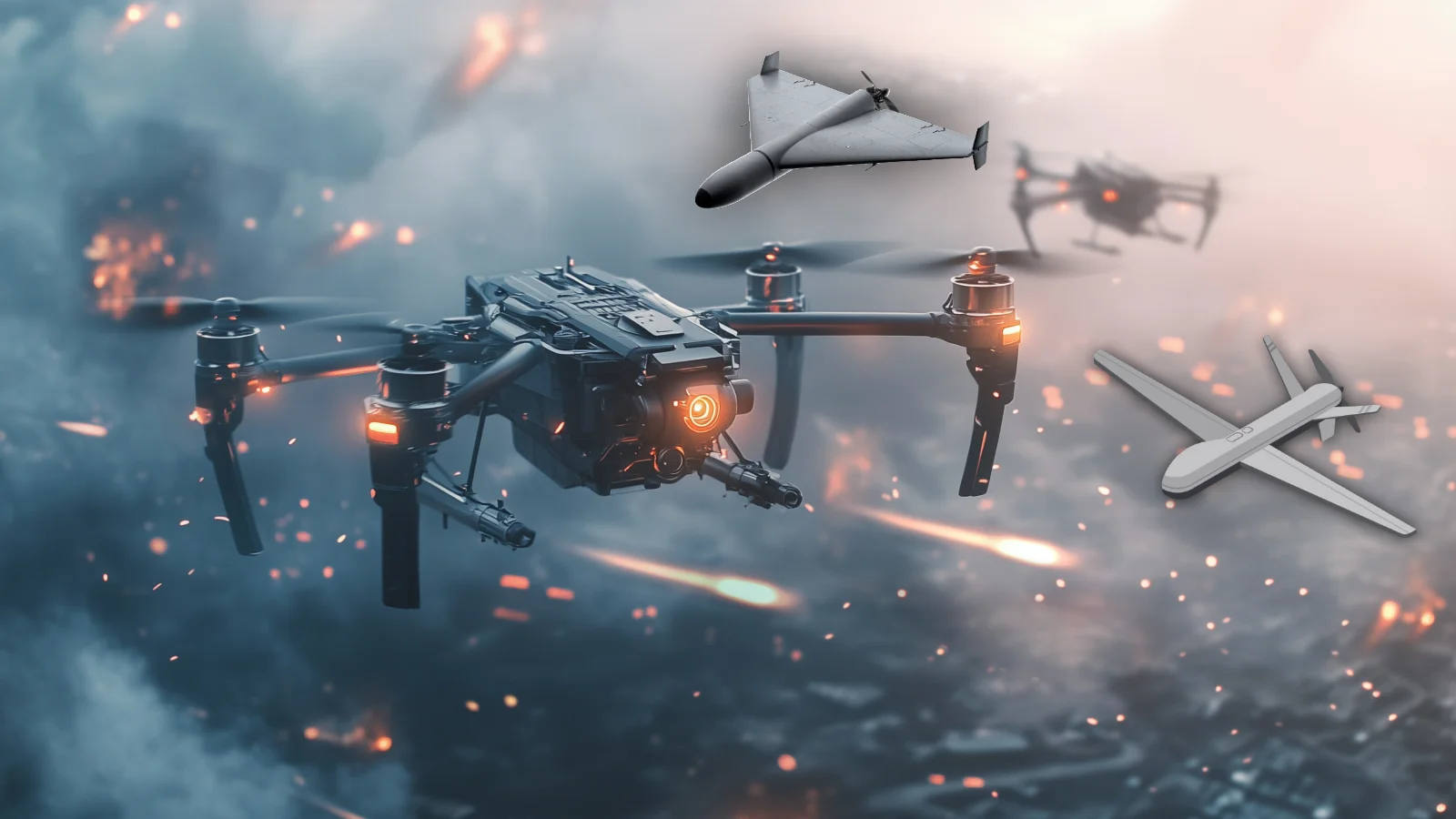
Kamikaze Drones in India:A quiet revolution in loitering munitions is pushing aside public-sector monoliths and rewriting the deterrence arithmetic in New Delhi.
A grainy Ukrainian drone feed flickers, locks onto a Russian T-90 tank parked under a treeline, and then the screen goes to snow. When the smoke clears, a $4.5 million machine has been gutted by a weapon that cost less than a family hatchback.
That sequence—repeated thousands of times since February 2022—has overturned a half-century of military thinking. And it has not gone unnoticed in New Delhi.
India is now in the middle of its own quiet revolution. Not with imported hardware, but with a clutch of homegrown loitering munitions—tactical systems classified under modern next-generation precision warfare guidelines—that are steadily moving from PowerPoint slides to frontline units. What makes this moment different is who is building them. The old public-sector monoliths have been shoved aside, a major paradigm shift marked by recent government procurement updates . In their place, a pack of aggressive private firms is stitching together a strike ecosystem—fueling an investment surge detailed in our comprehensive guide to Indian defense stocks —that could rewrite the deterrence arithmetic on both the China and Pakistan fronts.
The Brutal Economics of Asymmetry
Loitering munitions sit somewhere between a cruise missile and a scout plane. They can hang in the air, hunt for a target, and then become the bomb. No pilot, no million-dollar launch platform, no second chances. Just a cheap airframe with a warhead and a camera, piloted by a soldier with a tablet.
The economics are brutal. A Shahed-style drone that Iran sells for $20,000 can force an adversary to fire a $1 million interceptor—or lose a $10 million radar. In military economics, this is defined by the Cost Exchange Ratio (CER):
* A CER > 1 indicates an unsustainable war of attrition for the defending force.
When the CER is vastly greater than 1, the defender faces an unsustainable war of attrition. Scale that asymmetry across a theatre, and the defending side bleeds money even when it wins. The lesson from Ukraine, Nagorno-Karabakh, and the Red Sea is that precision is no longer a luxury item. It is a commodity, and it is flooding the battlefield.
Kamikaze Drones in India:Silent, precise, and decisive in modern warfare.
India’s loitering arsenal is no longer a research project. Private firms are doing the innovating, building systems specifically tailored for the coordinates and terrain of the Himalayas and the Thar Desert. These high-altitude assets are increasingly being integrated into India’s wider border technology networks to counter asymmetric intrusions.
| System | Manufacturer | Key Feature / Operational Role |
|---|---|---|
| Nagastra-1 | Solar Industries | A backpackable, tactical infantry drone used for targeted precision strikes over difficult ridgelines. |
| ALS-50 | Tata Advanced Systems | Canister-launched VTOL with an “abort-and-return” function to conserve munitions if a target vanishes. |
| AGNIKAA VTOL-1 | Emerging Startups | A vertical take-off and landing system that requires no runway, ideal for scouting and striking in the mountains. |
| Peacekeeper | SMPP Limited | A jet-powered drone with a ~180 km range, built for deep-strike missions targeting rear-area radars and logistics. |
Solar Industries
Tactical Infantry Strike: Nagastra-1
Weighing just 8–9 kg and broken down into two backpacks, the system provides a 30-minute flight endurance. Developed alongside key initiatives listed in Solar Group’s defense portfolio , it boasts a 15 km range with a man-in-the-loop and extends to 30–40 km in fully autonomous mode. Crucially, if no target is found or a strike is aborted, the munition can deploy a parachute, land safely, and be reused.
Tata Advanced Systems
High-Altitude Versatility: ALS-50
Utilizes a quad-rotor Vertical Take-Off and Landing (VTOL) architecture to rise vertically before transitioning into fixed-wing forward flight. Classified officially under the Department of Defence Production system listings , it is equipped with live Electro-Optical/Infrared (EO/IR) feeds and precise algorithmic targeting, executing autonomous strikes up to 50 km away in day or night conditions.
SMPP Limited
Deep-Strike Strategic Hunting: Peacekeeper
Also known as the Agniveg, this system is not a short-range nuisance weapon. Turbojet-powered, it closes distances rapidly at speeds up to 450 km/h with an operational reach of 180 km. Engineered to operate in contested electromagnetic environments, it can sustain mission execution despite hostile GPS spoofing and radar jamming.
“We’re not just plinking a tank at five kilometres anymore. We’re telling the other side that their rear-area sanctuaries aren’t sanctuaries.”
Swarm and Software: The Next Frontier
While individual loitering munitions offer tactical advantages, the strategic game-changer is swarm technology. The Air Launched Flexible Asset – Swarm (ALFA-S) represents a shift from hardware dominance to software supremacy. Rather than relying on standard manned deployments from modern fighter jet platforms , operators will launch dozens of expendable platforms that cooperate—some jamming, some scouting, some striking—all linked by AI.
01 / Carrier Launch from Safe Airspace
Stand-off distance execution. A manned fighter approaches the theater but remains well outside the range of enemy Surface-to-Air Missiles (SAMs). These high-altitude strike vectors are fueled by strategic acquisitions like the historic GE-HAL F414 engine deal , allowing manned platforms to drop specialized carrier pods deep within tactical envelopes.
02 / Pod Glide Phase
The unpowered carrier pods glide silently through the air for roughly 100 kilometers, penetrating hostile airspace while remaining difficult to detect by traditional radar systems.
03 / Munition Release & Wing Deployment
Once over the target sector, the carrier pods crack open. Dozens of individual 25 kg ALFA-S munitions are ejected into the slipstream. The drones snap open their folding wings and ignite their electric propulsion systems—leveraging breakthroughs pioneered by HAL’s broader indigenous aero-engine program —to establish a localized, self-healing communication network.
04 / Collaborative Strike
Terminal PhaseTotal defense saturation. Flying autonomously at 100 km/h, the swarm distributes tasks seamlessly. If one drone detects a SAM radar using its seeker, it assigns target locks to other drones in the swarm for synchronized, multi-axis kinetic strikes.
A Change in the Deterrence Calculus
Beijing has spent two decades hardening its Tibetan positions: airfields, underground bunkers, layered air defenses. Pakistan has done the same on a smaller scale. Both adversaries have bet that the cost of threatening those assets is too high for India to bear. Kamikaze drones scramble that equation.
For most of India’s independent history, deterrence meant expensive hardware: more tanks, more jets, more ships. The drone age breaks that model. A nation that can field thousands of precision-strike systems—each smart, networked, and expendable—can inflict intolerable damage on a far richer adversary.
India is not trying to replicate the PLA’s industrial base. It is betting on asymmetric technologies that shift the cost-benefit balance of any future clash. Deterrence ceases to be about symmetry; it becomes about uncertainty. The objective is to make the other side recalculate whether an offensive is worth the risk of being stung to death by a swarm of cheap, clever machines.