NICE, FRANCE — India France AI collaboration has suddenly emerged as a defining strategic project in the global race for technological sovereignty, after a sudden U.S. decision to restrict foreign access to some of Anthropic’s most advanced artificial intelligence models ignited urgent conversations about dependence, control, and the future of critical national capabilities.
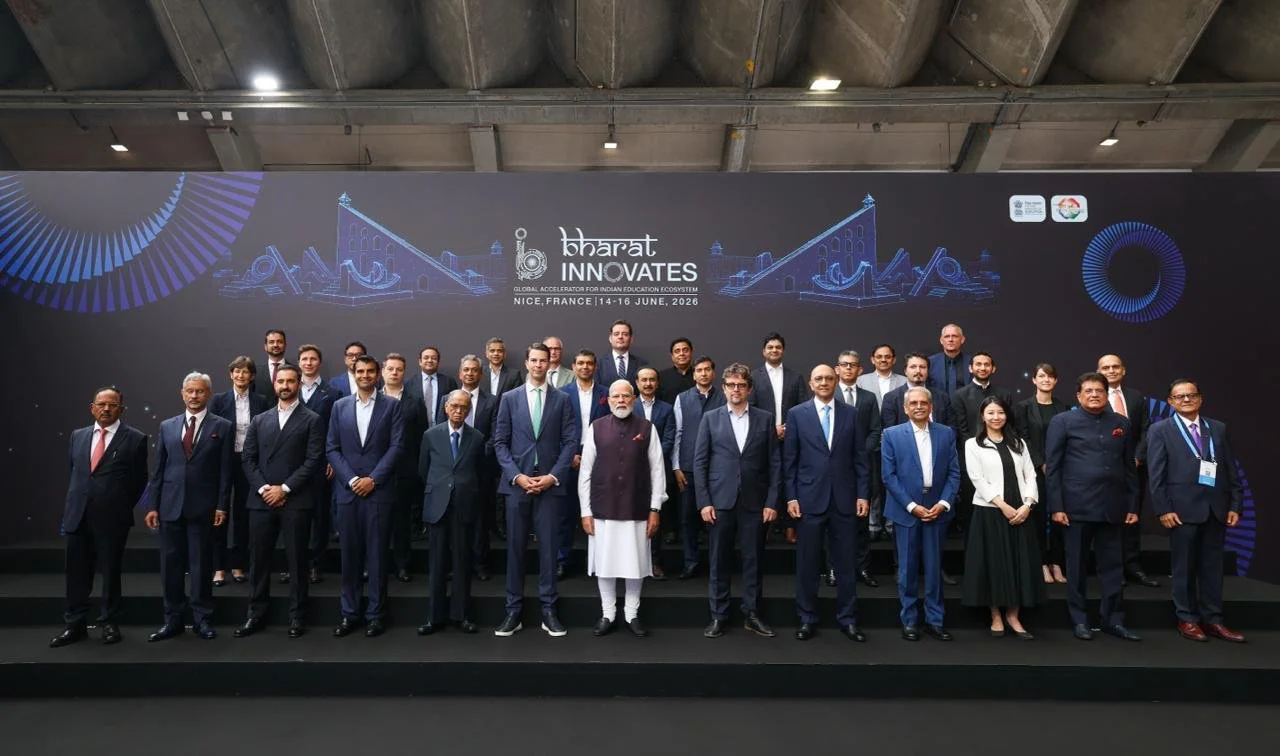
The convergence of American restrictions and deepening France–India cooperation has transformed what might have been a routine diplomatic exchange into a potential inflection point. Speaking during the Bharat Innovates 2026 event in Nice, French President Emmanuel Macron and Prime Minister Narendra Modi highlighted the growing strategic importance of India France AI collaboration, along with cooperation in advanced computing, research, and innovation.
The timing could not be more significant.
Only days earlier, the U.S. Commerce Department directed Anthropic to suspend foreign-national access to its most advanced AI models, citing national security concerns. The move immediately raised questions across the technology sector about access, control, and the future of AI governance.
For India, the decision served as a reminder of a strategic reality that policymakers have increasingly acknowledged: access to frontier AI technologies can be altered overnight by decisions taken in foreign capitals.
India France AI Collaboration and the End of Assumed Access
For much of the past decade, many countries operated under the assumption that access to cutting-edge digital technologies would continue expanding as global markets became more interconnected.
The latest restrictions challenge that assumption.
AI models are increasingly being treated not merely as commercial products but as strategic assets with implications for cybersecurity, military applications, critical infrastructure, and economic competitiveness. As a result, governments are beginning to view advanced AI capabilities through the same lens once reserved for semiconductors, nuclear technology, and aerospace systems.
The shift is particularly relevant for India, which is pursuing ambitious digital transformation goals while seeking to reduce dependence on external technology providers. India France AI collaboration now offers a concrete pathway toward that objective, combining French research leadership with Indian scale and engineering depth.
Why India France AI Collaboration Matters
The debate over AI sovereignty is no longer limited to who develops the best chatbot.
Control over advanced AI systems increasingly influences:
- Cybersecurity capabilities
- Defence technologies
- Industrial competitiveness
- Scientific research
- Critical infrastructure protection
- Economic productivity
According to government estimates and policy assessments, artificial intelligence could contribute trillions of dollars to India’s economy over the coming decade. That potential has elevated AI from a commercial opportunity to a strategic national priority. India France AI collaboration is increasingly seen as a vehicle for accelerating domestic capabilities without falling into full dependency on any single dominant power.
Indian technology leaders have responded to recent developments by arguing that the country must accelerate investment in domestic AI capabilities, foundational models, computing infrastructure, and research ecosystems. The objective is not technological isolation. Rather, it is ensuring that critical national capabilities are not entirely dependent on decisions made outside India’s borders — precisely the logic that is now propelling India France AI collaboration to the centre of strategic planning.
France Offers a Different Vision Through India France AI Collaboration
France has increasingly positioned itself as a leading advocate of technological sovereignty within Europe. Macron has repeatedly argued that countries should avoid becoming overly dependent on either American or Chinese technology ecosystems. That philosophy aligns closely with India’s long-standing strategic autonomy doctrine.
The emerging India France AI collaboration reflects a broader effort by both countries to create a cooperative framework for innovation, research, and technology development that is not dominated by a single global power. Paris views India as one of the few countries capable of becoming a major AI power in its own right, while New Delhi sees France as a trusted partner with advanced research capabilities and growing ambitions in artificial intelligence.
The result is a partnership that extends beyond diplomacy and into the strategic architecture of future technologies, with India France AI collaboration serving as its operational core.
The Rise of a Third AI Ecosystem
The global AI landscape is increasingly shaped by two dominant centres of power: the United States and China. Yet many countries remain uncomfortable with becoming fully dependent on either ecosystem. This creates space for what some analysts describe as a “third path” — a coalition of technologically capable nations seeking greater autonomy while maintaining international cooperation.
India and France could become central pillars of that emerging framework, with India France AI collaboration offering a practical model. India contributes scale, talent, engineering expertise, and one of the world’s largest digital ecosystems. France contributes advanced research institutions, European technology networks, and political support for digital sovereignty initiatives. Together, they offer a potential template for collaborative AI development that balances openness, security, and strategic independence.
Challenges Facing India France AI Collaboration
Building sovereign AI capabilities remains an enormous challenge. Training frontier models requires vast computing resources, access to advanced semiconductors, massive datasets, reliable energy supplies, and sustained investment measured in billions of dollars. The United States and China retain significant advantages across many of these areas.
However, recent events have demonstrated that dependence carries risks of its own. For India, the central question is no longer whether sovereign AI capabilities are desirable. It is whether the country can afford not to develop them — and whether India France AI collaboration can bridge the gap between ambition and reality fast enough to matter.
Strategic Outlook
The controversy surrounding Anthropic’s access restrictions may ultimately be remembered as more than a dispute over one company’s AI models. It may mark the moment when governments around the world recognized that artificial intelligence is becoming a strategic domain comparable to energy, defence, and telecommunications.
For India, the lesson is clear. Partnerships remain essential, but sovereignty matters. As Washington tightens controls and Beijing advances its own AI ambitions, New Delhi is increasingly looking for a path that preserves both technological access and strategic autonomy. France appears ready to help build that path, making India France AI collaboration one of the most closely watched technology alignments of the coming decade.
Whether the partnership can evolve into a genuine alternative in the emerging AI order may become one of the most consequential technology stories of the era.