
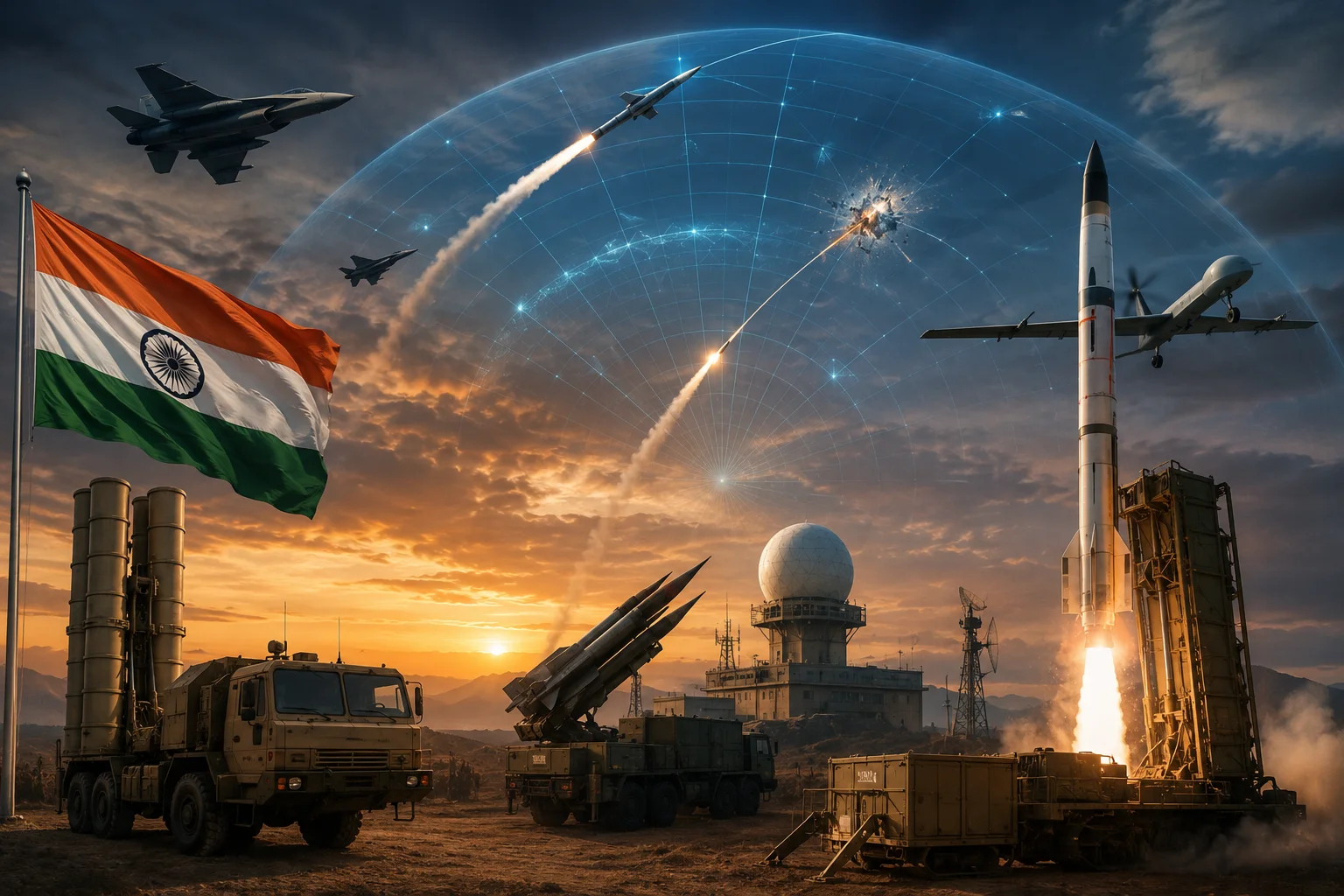
HYDERABAD — Defence Minister Rajnath Singh used the inauguration of the Advanced Weapon System Complex at Hyderabad’s Dr APJ Abdul Kalam Missile Complex this week to make a broader point about India’s future military priorities.
Speaking before scientists and defence officials, Singh described the indigenous Project Kusha air-defence system as a potential “game changer” for India’s security architecture. He also referred to what he called “Mission Sudarshan Chakra,” a vision centered on strengthening India’s air and missile defence capabilities.
The remarks came just days after the Defence Research and Development Organisation (DRDO) announced the successful completion of three major flight tests conducted on June 10 and 11. The trials included demonstrations of India’s multi-layered Ballistic Missile Defence (BMD) capability and the maiden flight of the Naval Anti-Ship Missile-Medium Range (NASM-MR).
Taken together, the speech and the tests offer a glimpse into a shift that has been quietly unfolding for years.
India is no longer focused solely on building missiles that can strike targets deep inside enemy territory. It is increasingly investing in systems designed to stop incoming attacks before they reach Indian airspace.
A Different Kind of Deterrence
Since the late 1990s, India’s strategic posture has largely been associated with offensive deterrence.
The development of the Agni missile family, the rise of BrahMos, and investments in long-range strike capabilities helped establish a credible ability to retaliate against hostile actions. The underlying logic was straightforward: the threat of a powerful response would discourage aggression.
That approach is not disappearing. But it is no longer enough.
Modern battlefields are changing rapidly. Drones, loitering munitions, cruise missiles, precision-guided weapons and ballistic missiles can now be used together in coordinated attacks. A country may possess strong offensive capabilities and still remain vulnerable if it cannot defend its own skies.
This is where recent developments become important.
Mission Sudarshan Chakra and Project Kusha signal a major shift in India’s defence strategy
Most headlines focused on Project Kusha after Rajnath Singh’s remarks in Hyderabad.
The system deserves attention. Developed by DRDO, Kusha is expected to become India’s indigenous long-range air-defence platform, capable of engaging multiple types of aerial threats at ranges reportedly extending up to around 400 kilometres.
But Kusha is only one part of the story.
The more significant development is the gradual emergence of a layered defence architecture.
At the lower end are systems such as Akash and the upcoming Akash-NG, designed to deal with aircraft, drones and tactical threats. Long-range engagement is currently supported by India’s S-400 batteries, with Project Kusha expected to expand indigenous capability in this area.
Above that sits the strategic layer represented by India’s Ballistic Missile Defence programme.
The successful BMD tests announced by DRDO this week suggest that India continues to advance its ability to intercept increasingly sophisticated missile threats.
Viewed separately, each programme serves a specific purpose.
Viewed together, they begin to resemble the framework of a national air-and-missile defence network.
The Real Challenge
Building interceptors is only part of the equation.
The harder task is integration.
Modern air defence depends on a vast web of radars, satellites, sensors, command centres and interceptor batteries sharing information in real time. Threats must be identified, tracked, classified and assigned to the correct defensive layer within seconds.
The effectiveness of any future missile shield will depend less on a single missile and more on how well these systems communicate with one another.
This is likely why the inauguration of the Advanced Weapon System Complex matters.
Facilities such as these are not simply manufacturing sites. They are part of the infrastructure needed to move advanced defence projects from development into operational service.
Why This Matters
India faces a unique security environment.
Both China and Pakistan continue to invest heavily in missile forces, drones and advanced air-power capabilities. At the same time, conflicts around the world are demonstrating how quickly inexpensive drones and precision-guided weapons can overwhelm traditional defences.
Against that backdrop, building a layered defensive architecture is becoming a strategic necessity rather than a luxury.
Many questions remain unanswered. Project Kusha is still under development. The full scope of Mission Sudarshan Chakra remains unclear. And translating successful tests into operational capability is a long process.
Yet the direction is becoming easier to identify.
The events of the past week suggest that India is moving beyond individual missile programmes and toward something larger.
For decades, New Delhi focused on building the spear.
It is now spending just as much effort building the shield.