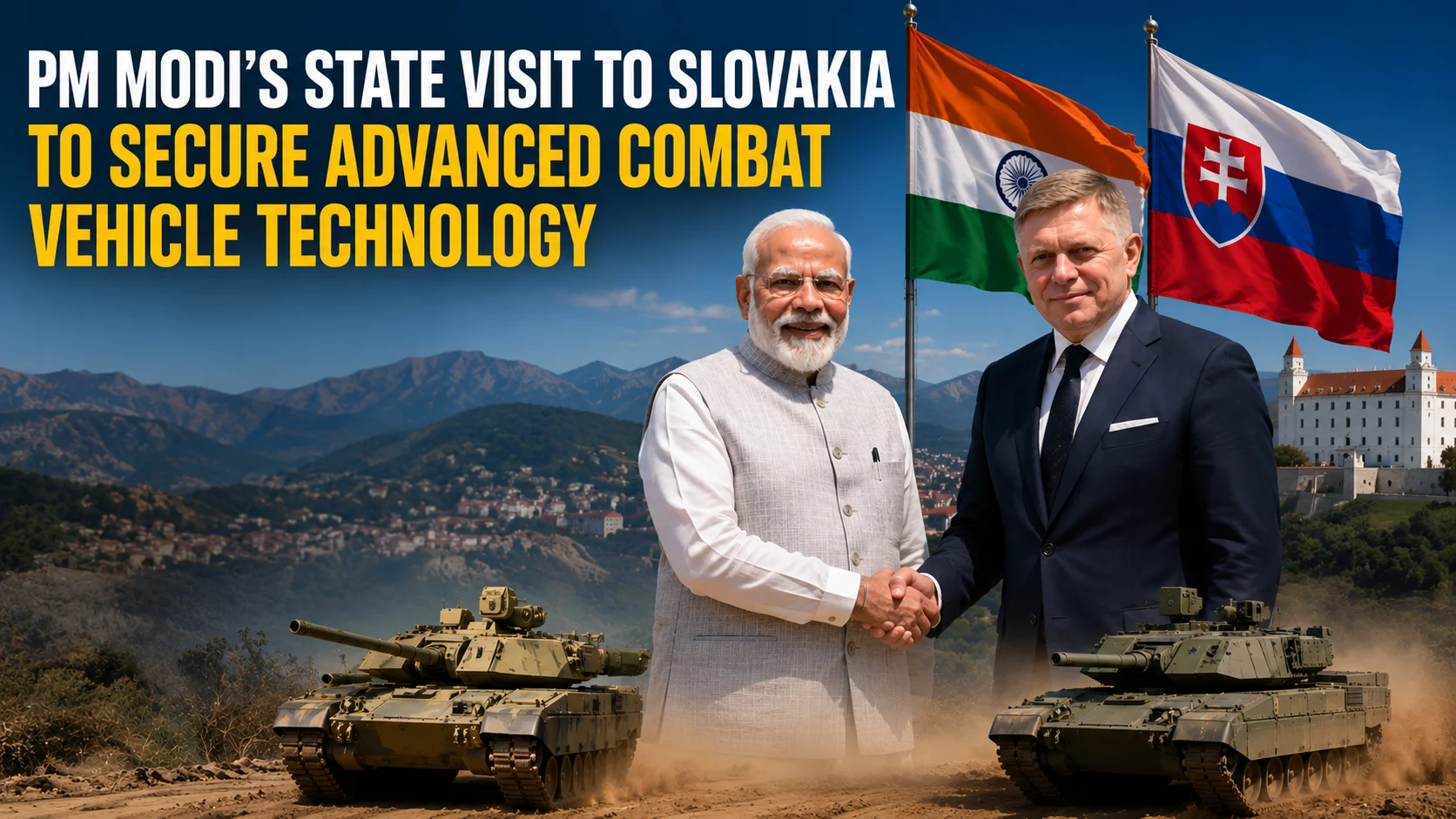
New Delhi/Bratislava: The India FRCV program is reaching a critical inflection point as Prime Minister Narendra Modi begins a state visit to Slovakia on June 14 to secure advanced combat vehicle technology.
The bilateral summit with Slovak Prime Minister Robert Fico follows a two-year delay in India’s indigenous Zorawar light tank program. This delay occurred after the defense ministry demanded armor protection exceeding standard battle specifications. By integrating Slovak turret and active protection systems, New Delhi seeks to fast-track its ₹60,000 crore ($7.2 billion) armored modernization program while preserving tech stack sovereignty away from restrictive Western export controls.
Private Defense Cartels Eye India FRCV program for Tech Stack Sovereignty
Indian private firms Texmaco Defence Systems and JCBL Group’s Airbornics Defence & Space (ADSL) activated a trilateral technology partnership with Slovak contractor Rolus s.r.o.. This consortium targets the local assembly of TURRA 30 remote-controlled weapon stations and active protection systems.
Slovakia-based EVPÚ a.s. designed the TURRA 30, which features independent hunter-killer target acquisition sights and modular ballistic protection rated up to STANAG 4569 Level 4. This modular protection directly addresses the armor deficits that stalled India’s Project Zorawar light tank trials in Ladakh.
Integrating Slovak software drives allows for high-precision sensor fusion and rapid auto-tracking.
The defense ministry seeks to replace its 1,770 Soviet-origin T-72 main battle tanks with modern Future Ready Combat Vehicles (FRCVs) by 2030. Private bidders like Tata Advanced Systems and Larsen & Toubro must meet a 70% indigenous content requirement under the Atmanirbhar Bharat framework to secure the production contracts.
Local Production Sidesteps ITAR and Middle East Backlogs
Sovereign control over vehicle source codes remains the main point of contention for Indian planners.
By securing these local production rights, the India FRCV program avoids the restrictive ITAR compliance burdens often associated with American defense platforms
Traditional Western options fail to meet Indian sovereignty requirements. US-made Stryker combat systems carry strict International Traffic in Arms Regulations (ITAR) that block third-party exports and mandate intrusive end-user monitoring. French platforms demand prohibitive unit costs exceeding $8 million per vehicle.
Israeli active protection systems like the Trophy face production backlog limits due to domestic deployment in Gaza and prior contracts for European Leopard 2A8 fleets.
Slovakia maintains a neutral export position in the European Union and lacks any historical military supply agreements with Pakistan, eliminating technology leak risks. South Korea, conversely, signed formal defense logistics pacts with Islamabad.
Bilateral Trade Explodes as India Targets Global South Markets
Bilateral trade between New Delhi and Bratislava doubled in three years, rising from €800 million in 2023 to €1.6 billion in 2025. Slovak Ambassador Robert Maxian confirmed that the growth stems from a targeted policy focused on automotive supply chains and defense co-development.
The partnership positions India to exploit cheap domestic manufacturing and Slovak European Union certification to export armor platforms at $3 million to $5 million per unit. High-cost Western alternatives sell for up to $12 million.
This export push builds on India’s record-breaking defense export performance in the 2025-26 fiscal year.
Indian defense exports surged 62.66% to hit a record ₹38,424 crore ($4.6 billion) in the fiscal year ending March 2026. Private defense operators generated 45.16% of this total, proving their capacity to absorb and scale European mechanical technology.
Mountain Artillery Testing Speeds Up Under New Avadi Tenders
On May 30, 2026, the state-run Armoured Vehicles Nigam Limited (AVNL) in Avadi issued public Expressions of Interest (EOIs) to design integrated fire detection and chemical-biological-radiological-nuclear (CBRN) systems for the FRCV. Bids close on June 22, 2026, locking in the next phase of domestic subsystem sourcing.
The joint venture also opens future opportunities in heavy mountain artillery.
Slovak manufacturer Konstrukta Defence recently qualified the 155mm SpGH EVA M2 self-propelled howitzer, which fires automated five-round bursts in under a minute over a 41-kilometer range. The system integrates onto a heavy-duty Tatra 6×6 chassis, a platform already widely used within the Indian Army’s logistics division.
The defense ministry expects to issue the formal FRCV request for proposals by late 2026, initiating a three-year prototyping phase before full-scale manufacturing begins in 2030 to counter rising Sino-Pakistani armor concentrations along the borders.
Ultimately, the success of the India FRCV program will serve as a bellwether for India’s broader goal of becoming a net exporter of advanced, software-defined armored platforms by 2030.